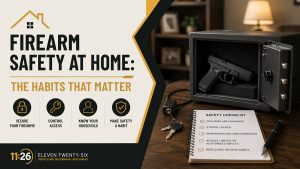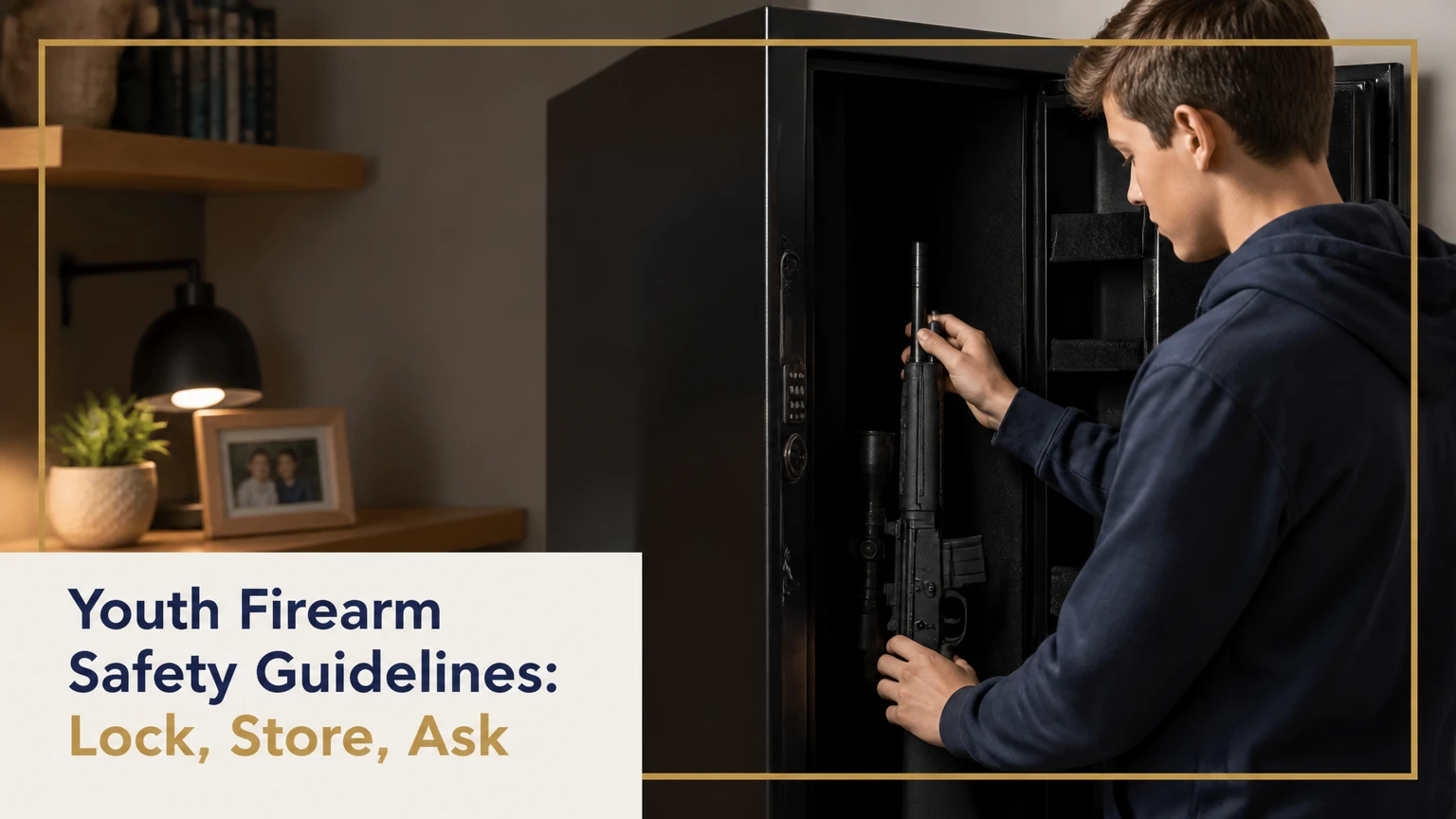
Youth firearm safety guidelines are a prevention system that keeps children and teenagers from unauthorized firearm access, accidental discharge, theft, and crisis-related harm. The safest baseline is to store every firearm unloaded, locked in a secure container, and separate from ammunition, while teaching children never to touch a found firearm and immediately tell an adult.
Key facts at a glance
Locked storage is the physical barrier; child education is the backup response, not a replacement for the barrier.
A hidden firearm is not secured because children can discover concealed locations.
Children who find a firearm should stop, avoid touching it, leave the area, and tell an adult.
Ammunition should be locked separately unless a specific law or emergency plan requires another arrangement.
A storage device must resist the child’s likely behavior, withstand theft attempts, and remain usable by the authorized adult.
Firearm safety rules do not replace professional instruction, the owner’s manual, or applicable state law.
What Do Youth Firearm Safety Guidelines Require?
Youth firearm safety guidelines require three controls: prevent access, reduce handling hazards, and establish an immediate response if a child encounters a firearm. The American Academy of Pediatrics has stated, “The safest home for a child is one without a gun,” and recommends that families who keep firearms use locked, unloaded storage with ammunition locked separately.
The practical model has two layers. Active access prevention uses a locked safe, lockbox, or other secure container. Behavioral conditioning teaches a child not to touch a firearm and to notify a trusted adult. Behavioral training matters because children may encounter a firearm at a friend’s house, in a vehicle, or in another location outside the family’s control.
No safety lesson makes an accessible firearm acceptable. Project ChildSafe and Safe Kids Worldwide both treat secure storage as the primary intervention, while organizations such as the National Rifle Association and National Shooting Sports Foundation provide handling and range rules. Families should use a qualified instructor for any hands-on training.
How Should Firearms Be Stored Around Youth?
Firearms around youth should be unloaded, locked, and inaccessible, with ammunition secured separately and keys, combinations, and biometric overrides controlled by an adult. The container should be anchored when practical, especially for a collection, and the owner should confirm that the lock works under ordinary household conditions.
The strongest household storage plan answers five questions:
- Can a child reach the firearm? The answer must be no, including through climbing, searching, or access to a key.
- Can a child defeat the lock? Test the actual device against likely behaviors, such as guessing a short code or finding a spare key.
- Can a thief remove the container? A light lockbox may need a cable, tether, or fixed installation.
- Can the authorized adult open it reliably? A defensive-access container needs routine testing and a documented backup method.
- Is ammunition separately secured? Separate locking reduces the consequences of a firearm-access failure.
Which storage device fits a household?
No single lock is safest for every household. A trigger lock may block trigger access but cannot provide the same theft resistance or concealment as a steel safe, while a biometric box can provide rapid authorized access but requires batteries, maintenance, and a backup procedure.
| Device | Typical cost | Typical adult access | Child and theft protection |
|---|---|---|---|
| Cable lock | $0-$20 | 15-30 seconds | Basic action or magazine-area block; low theft resistance |
| Trigger lock | $10-$30 | 10-25 seconds | Trigger coverage; limited concealment and pry resistance |
| Keyed steel lockbox | $25-$150 | 5-20 seconds | Better concealment; strength varies by steel gauge and anchor |
| Biometric lockbox | $80-$300 | 1-5 seconds | Rapid access; battery and reader reliability require testing |
| Full-size steel safe | $300-$3,000+ | 10-60 seconds | Highest collection and theft protection; slower installation and access |
These are typical retail ranges, not guarantees. Prices change by capacity, lock type, fire rating, steel thickness, certification, and installation. A cable or trigger lock is better than an unlocked firearm, but it is not a complete theft-control plan for a determined intruder.
What features matter beyond the lock type?
A storage device should have a clearly controlled access method, durable construction, resistance to prying, and an installation plan that prevents removal. Biometric devices should include a keypad or physical override, while digital locks need a battery warning and a tested emergency-opening procedure.
| Feature | Minimum household question | Failure to prevent |
|---|---|---|
| Access credential | Who knows the code or controls the key? | Child guesses, finds, or copies access |
| Construction | Can common hand tools defeat the container? | Theft during a burglary |
| Anchoring | Can one adult carry the box away? | Entire container disappears |
| Capacity | Can every firearm fit without forced stacking? | Door left open or firearm stored elsewhere |
| Battery backup | What happens after low-battery warning? | Authorized adult cannot open it |
| Ammunition compartment | Is ammunition separately locked? | A single access failure enables loading |
How Should an Adult Clear and Handle a Firearm?
Only a responsible, trained adult should clear or handle a firearm when children are present, and the owner’s manual or qualified instructor should control the exact procedure. Keep the muzzle in a safe direction, remove the ammunition source, open the action, and visually confirm the chamber and action are empty without placing a finger into the chamber.
The safe sequence is deliberate rather than fast:
- Keep people outside the potential line of fire and maintain muzzle awareness.
- Engage any applicable safety device while handling, without treating it as proof of safety.
- Remove the magazine or other ammunition source.
- Open the action according to the manufacturer’s instructions and keep it open.
- Visually inspect the chamber, magazine well, and action area.
- Use an appropriate chamber flag or other approved indicator when required by a range or instructor.
- Lock the unloaded firearm before returning it to storage.
Do not insert a finger into a chamber to verify that it is empty. That advice can create a negligent-discharge hazard and is unnecessary when visibility is adequate. If the chamber cannot be clearly inspected, stop and obtain qualified assistance rather than improvising with a finger or an unsuitable tool.
Children should not be used as a second checker. An adult should confirm storage status after cleaning, range use, hunting, dry practice, visitors, or any interruption.
What Should Children Do If They Find a Firearm?
A child who finds a firearm should stop immediately, avoid touching it, leave the area, and tell a trusted adult. Safe Kids Worldwide and pediatric injury-prevention programs use versions of this four-part response because it remains useful even when a child cannot identify the firearm’s condition.
Teach the response with calm repetition:
- Stop: Freeze hands and do not move the object.
- Do not touch: Do not pick it up, open it, pose with it, or show it to friends.
- Leave the area: Move away and keep other children away.
- Tell an adult: Report the location to a parent, teacher, caregiver, or emergency responder.
If a child has touched or moved a firearm, adults should not shame or punish the child before securing the scene. Keep everyone away, avoid handling the firearm unless necessary to prevent immediate danger, and call emergency services if the firearm may be loaded, someone is injured, or the situation cannot be made safe.
How Should Safety Training Change With Age?
Age labels are useful starting points, but maturity, impulse control, developmental disability, peer pressure, and household conditions matter more than a birthday. Every child needs the avoidance response, while hands-on firearm instruction requires qualified supervision and a demonstrated ability to follow directions consistently.
| Developmental group | Primary objective | Appropriate lesson | Adult boundary |
|---|---|---|---|
| Ages 4-7 | Immediate avoidance | Stop, do not touch, leave, tell | No unsupervised access or handling |
| Ages 8-12 | Rule recognition | Identify unsafe behavior and report it | Supervised instruction only; storage remains adult-controlled |
| Ages 13-15 | Judgment and peer safety | Refuse unsafe handling and report concerns | No carrying or access based on peer claims |
| Ages 16-18 | Responsible decision-making | Transport, range conduct, crisis reporting | Follow law, instructor rules, and adult authorization |
Should a child be taught to shoot?
A child should receive hands-on instruction only when a qualified instructor and responsible adult judge the child ready, the setting is controlled, and local law permits it. Familiarity with a firearm does not make unlocked storage safe, and a low-recoil .22-caliber firearm still requires the same muzzle, trigger, and target discipline.
Readiness indicators include following a multi-step direction without reminders, stopping immediately on command, maintaining attention despite peers, and reporting mistakes honestly. A child who treats the lesson as a game, cannot control impulses, or wants to impress friends is not ready.
The four widely taught handling rules are:
- Treat every firearm as loaded.
- Keep the muzzle pointed in a safe direction.
- Keep the trigger finger outside the trigger guard until ready to fire.
- Know the target and what lies beyond it.
These rules govern supervised handling. They never authorize a child to investigate a firearm found at home.
What Should Parents Ask Before a Playdate?
Parents should ask directly whether firearms are present and whether every firearm is locked and inaccessible. The ASK-style conversation, promoted by pediatric injury-prevention organizations, is a routine safety check rather than an accusation.
A usable script is: “Before the kids play, I ask every family this: Are there firearms in the home, and are they stored unloaded and locked where children cannot access them?” If the answer is unclear, ask who controls the keys or code and whether ammunition is secured separately.
Parents may choose an alternative location without debating ownership practices. A caregiver can say, “Thank you for telling me. My child will play at our home today,” or offer a park, school activity, or supervised visit instead.
A host should also ask about firearms brought by visitors. An unsecured firearm should not remain in a purse, backpack, nightstand, vehicle, or coat pocket. The safest response is to ask the owner to remove the ammunition, lock the firearm in a suitable container, and retain the key or code.
How Should Families Handle Vehicles, Travel, and Temporary Storage?
During transport, a firearm should be unloaded, secured in a locked container, and placed where occupants cannot readily access it, subject to the laws of every jurisdiction on the route. A locked container in a vehicle is temporary transport storage, not a substitute for a secured home safe.
Before travel, verify:
- State and local transport rules, including magazine, ammunition, and container requirements.
- Airline or rail rules when applicable.
- Whether the destination permits possession and storage.
- Whether the vehicle’s trunk or cargo area is accessible to youth.
- Whether overnight lodging provides a secure, anchored storage option.
Do not leave a firearm in an unattended vehicle when another option exists. Heat, theft, and unauthorized access create separate risks. If a trip requires a firearm, plan the locked-container location before departure rather than improvising at a rest stop.
What Are the Biggest Household Safety Failures?
The most common failures occur when families rely on secrecy, a single device, or a lesson instead of maintaining a complete system. A professional safety review looks for behavior under stress, not only the ideal storage arrangement.
| Failure mode | Why it happens | Corrective action |
|---|---|---|
| Hidden firearm | Owner wants fast access without equipment | Use a locked container with controlled adult access |
| Key in a drawer | Convenience defeats access control | Keep keys and codes inaccessible to children |
| Ammunition beside firearm | Storage routine is incomplete | Lock ammunition separately |
| Biometric reader fails | Wet fingers, dirt, dead battery | Clean, replace batteries, test backup access |
| Safe left open | Repeated handling or poor capacity | Close and relock after every removal; increase capacity |
| Visitor brings firearm | Host avoids an awkward conversation | Provide a secure container or change the visit location |
A mechanical safety lever is not a storage lock. The lever can be engaged while the firearm remains accessible, and it can malfunction, be disengaged, or be misunderstood by a child.
Hiding is also not a meaningful access-control measure. Children search more effectively than many adults expect, especially when they know an object exists or have seen a storage routine.
What If the Storage Plan Fails?
If a child accesses an unsecured firearm, treat the event as a system failure and secure the firearm before investigating blame. Check for injury, keep children away, contact emergency services for any possible injury or discharge, and preserve relevant information for responders.
After the immediate danger ends, review:
- Where the firearm was located and whether it was loaded.
- Who could access the key, code, override, or container.
- Whether the container was open, defeated, removed, or malfunctioning.
- Whether ammunition was stored separately.
- Which household event interrupted the normal routine.
- What physical change will prevent recurrence.
Replace a defeated lock rather than relying on the same device with a new promise. If theft occurred, report it promptly as required by local law. State storage and reporting requirements differ, so use the state police, attorney general, local law enforcement, or a qualified attorney for jurisdiction-specific guidance.
What if a biometric lockbox will not open?
Keep children away, confirm the battery condition, clean the scanner, try the registered credential correctly, and use the manufacturer’s documented backup method. Never force the box, bypass the lock, or leave the firearm unsecured while troubleshooting.
A responsible owner should test the primary and backup opening methods before an emergency, replace batteries according to the manufacturer’s schedule rather than an arbitrary annual date, and store any override key where children cannot find it. The backup key must remain available to the authorized adult, not taped to the container or hidden in the same drawer.
How Can Families Reduce Access During a Mental-Health Crisis?
During a suicide risk, severe depression, intoxication, domestic conflict, or acute behavioral crisis, increase physical separation from firearms immediately. The owner or a trusted adult should arrange temporary transfer to a lawful storage location, licensed firearms dealer, range, law-enforcement agency where permitted, or trusted person who can legally possess the firearm.
The 988 Suicide & Crisis Lifeline advises calling or texting 988 for urgent mental-health support in the United States. Call 911 when there is immediate danger, an active threat, an injury, or a firearm discharge.
Temporary separation should include ammunition, access credentials, and any other firearms in the home. Do not rely on a distressed person’s promise to avoid the safe, and do not announce the location of relocated firearms to children or unauthorized adults.
Which Storage Approach Should a Household Choose?
The best storage approach is the strongest system the household will use consistently, with a container matched to the required access time and theft risk. A family with young children and no defensive-access requirement may prioritize a heavy safe, while a household requiring rapid authorized access may add a tested quick-access lockbox inside a broader locked-storage plan.
| Household situation | Preferred arrangement | Main trade-off | Review interval |
|---|---|---|---|
| Young children, one firearm | Locked steel lockbox plus separate ammunition container | Moderate cost and capacity | Monthly access test |
| Multiple firearms | Anchored full-size safe with internal organization | Higher cost and slower access | Quarterly inventory |
| Frequent defensive-access concern | Tested quick-access box plus separate ammunition plan | Battery and override dependence | Monthly battery and access test |
| Teenagers with frequent visitors | Anchored safe, controlled credentials, ASK conversations | Less convenience for adults | After every household change |
| Temporary crisis | Lawful off-site transfer of firearms and ammunition | Planning and transfer constraints | Daily confirmation until resolved |
A quick-access box is not automatically superior. It is unsuitable if the owner cannot maintain batteries, protect the code, verify the fingerprint reader, or reliably relock it after use. A full-size safe is not automatically sufficient if it remains open, unanchored, overfilled, or routinely bypassed for convenience.
What Is a Practical Home Safety Audit?
A practical home audit takes 15-30 minutes and checks every firearm, ammunition container, credential, vehicle, and caregiver arrangement. The audit succeeds when an ordinary child cannot reach a firearm or its access method, and every responsible adult can explain the emergency response.
Use this checklist:
- Count every firearm and identify its normal storage location.
- Confirm each firearm is unloaded before storage under the manufacturer’s procedure.
- Lock every firearm in a container that children cannot open.
- Lock ammunition separately.
- Remove keys, spare keys, codes, and override cards from child-accessible areas.
- Anchor portable containers when theft is a realistic concern.
- Close and relock the container after each use.
- Test batteries, biometric readers, keypad access, and backup methods.
- Ask caregivers and playdate hosts about storage.
- Review vehicle and travel arrangements.
- Reassess after a move, separation, new baby, teen access change, visitor, or mental-health crisis.
Frequently Asked Questions
Is a gun safe enough if the firearm is unloaded?
An unloaded firearm still requires locked storage because a child may load it, another person may have left ammunition nearby, or the owner may have misjudged its condition. Unloading reduces discharge risk, but locking prevents access; separating ammunition adds another barrier when the first control fails.
Are free cable locks effective for child safety?
Free cable locks provide a useful basic barrier and are better than unlocked storage, but they do not conceal a firearm or reliably stop theft by a determined intruder. Use the lock exactly as designed, confirm that it prevents the action from operating, and consider a fixed steel container for broader protection.
Should children know where firearms are stored?
Children should know the safety response and understand that firearms are never toys, but they do not need access credentials or a routine that reveals how to defeat the storage system. Adults should answer age-appropriate questions without turning the storage location into a challenge or secret.
What should a parent do if another adult refuses to answer storage questions?
Do not send the child to that home if the answer is evasive or unacceptable. Parents can move the visit to their own home, a supervised public setting, or another caregiver’s home without requiring agreement about firearm ownership.
Does a trigger lock replace a safe?
A trigger lock does not replace a safe when theft resistance, concealment, or collection storage matters. Trigger locks cover the trigger area, while a substantial locked container can restrict access to the firearm, ammunition, and storage credentials together.
Where can families find local firearm-safety resources?
Families can start with Project ChildSafe for storage education and lock-distribution information, Safe Kids Worldwide for child injury-prevention guidance, the American Academy of Pediatrics for pediatric policy, and state or local authorities for current legal requirements. A certified instructor can provide hands-on training appropriate to the child’s maturity.
The Bottom Line
Youth firearm safety guidelines work when physical security and age-appropriate behavior rules operate together. Store every firearm unloaded and locked, secure ammunition separately, control keys and codes, ask about storage before playdates, and teach children to stop, avoid touching, leave, and tell an adult. Review the plan after every change in household, travel, access, or mental-health risk.