The phrase active shooter is enough to make most people look away, and that is exactly why preparation matters: the fear does not help anyone, but a plan does. The Eleven Twenty Six Elite Training Academy offers active shooter response training for workplaces, schools, faith groups, and families. The goal is preparation over fear.
The Mindset Shift
The first shift is mental. An active shooter event is rare, but rare is not the same as impossible, and the cost of being unprepared is catastrophic. Preparation replaces the helpless feeling with a set of options. The training does not dwell on the horror; it builds the response. That is the difference between anxiety and readiness.
The Run, Hide, Fight Framework
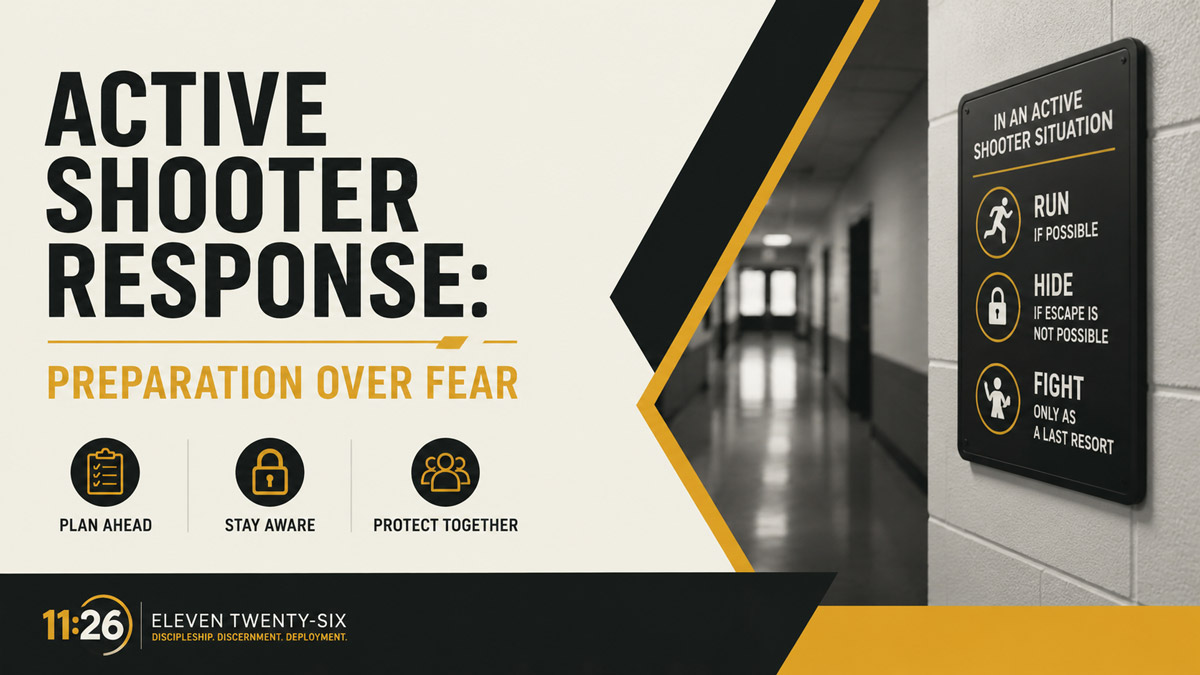
The core of most response training is the run, hide, fight framework. Run means leaving the danger area when that is the option, and it is the best option when it is available. Hide means making it hard to be found when leaving is not possible: locking or barricading, silencing phones, and staying out of sight. Fight is the last resort, the moment when the only option left is to act. The academy’s course covers all three and, importantly, the decision process for choosing between them.
The Building-Specific Plan
General principles only go so far; the plan has to fit the building. The academy’s training is adapted to the audience and the space, which is what makes it practical. A workplace plans around the floor plan, the exits, and the communication channels. A school plans around classrooms, lockdown procedures, and the staff roles. The training asks the group to think through their own building before the event, because the plan that is thought through is the plan that works under stress.
Communication During an Incident
One of the hardest parts of a response is communication. The training covers what to say to 911, what information matters, and how to coordinate with responding law enforcement. The goal is to make the useful information flow without making the situation worse. The academy’s course includes the communication piece because a response is a team activity, even when the team is one person with a phone.
Working With Law Enforcement
When officers arrive, the response does not end; it changes. The training covers what to expect from responders and how to behave when they arrive: hands visible, directions followed, and information given quickly. The transition from the event to the response is where confusion causes casualties, and the training builds the habit of doing the right thing in that moment.
The Group Conversation
For workplaces and organizations, the training is also a planning session. Who decides to evacuate? Who checks the rooms? Who communicates with the staff? The answers become the plan, and the plan becomes the training. The academy’s course is built around these conversations, which is why it fits groups as well as individuals.
The Family Version
Families can train too. The home plan covers the rooms, the exits, and the meeting point, and the conversation gives everyone a role. The training for a family is shorter but just as real, because the principle is the same: preparation replaces fear with options.
The Practice Habit
A plan that is never practiced is a hope. The training gives the group the plan, and the practice habit keeps it real: a quarterly walkthrough, a tabletop conversation, a drill that runs the communication channels. The academy’s course is built to hand the group a plan they can practice, because the practiced plan is the one that works under stress. The training is the start, and the practice is the continuation.
The Preparation Over Fear Promise
The academy’s approach is preparation over fear, and that promise carries through the whole course. The training does not dwell on the worst case; it builds the response. The student leaves with the framework, the plan, and the confidence that comes from having thought the situation through. That is the difference between anxiety and readiness, and it is the difference the course is built to make.
The Takeaway
Preparation is not about living in fear; it is about refusing to be helpless. The academy’s response training builds the mindset, the framework, the building plan, and the communication habits. When the plan is in place, the fear has less room, and the response has more options.
Related Reading
- Your first concealed carry class
- Firearm safety at home
- Why CPR and first aid training belongs on every family’s list
Call about response training to the academy.