A first time firearm buyer guide should help a new owner choose a firearm that matches a defined purpose, complete the purchase legally, budget for training and secure storage, and build safe handling habits before regular use. The best first firearm is the one the buyer can control, operate consistently, store securely, and practice with lawfully.
Key Facts at a Glance
- A firearm purchase involves the firearm, compatible ammunition, secure storage, instruction, eye and hearing protection, maintenance supplies, and recurring range costs.
- Federal law generally requires a licensed dealer to conduct a background check for a dealer transfer, while state law can add permits, waiting periods, training, or registration requirements.
- A larger, heavier handgun is usually easier for a beginner to control than an ultra-light pocket handgun chambered for the same cartridge.
- A firearm should never be selected from caliber or capacity alone; fit, manipulation, reliability, safe storage, and realistic practice matter more.
- Online firearm purchases normally ship to a Federal Firearms Licensee, or FFL, for transfer and the required dealer process rather than directly to the buyer’s home.
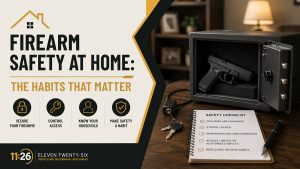
- Secure storage must prevent access by children, unauthorized adults, and prohibited users while allowing the lawful owner to retrieve the firearm according to local requirements.
What Should a New Buyer Decide Before Shopping?
A new buyer should define the firearm’s primary purpose, storage location, practice environment, physical limitations, and total budget before visiting a dealer. Those decisions narrow the appropriate category more effectively than brand lists or online popularity rankings.
Write down one primary mission:
- Target shooting or introductory training
- Hunting a specified game animal
- Clay-target sports
- Home protection
- Lawful concealed carry
- Collection or historical interest
The mission changes the selection criteria. A clay shooter needs a shotgun that fits the shoulder and points naturally. A hunter needs legal game-specific equipment, appropriate ammunition, and field portability. A target shooter may benefit from low ammunition cost and mild recoil. A lawful carrier must evaluate concealment, belt and holster compatibility, training, and local carry law.
A firearm is a poor choice if the owner cannot reach the controls, operate the action, load and unload safely, or maintain a stable grip. Buyers with reduced hand strength, limited mobility, vision concerns, or hearing impairment should ask an instructor to evaluate accessible controls and safe adaptations before purchasing.
What Is a Firearm and How Does It Work?
A firearm uses rapidly expanding propellant gas to propel a projectile through a barrel. Modern fixed ammunition combines a case, primer, propellant, and bullet, although shotgun ammunition uses a shell containing shot or a slug rather than a conventional rifle or pistol cartridge.
The firing sequence varies by design, but a typical repeating firearm feeds ammunition, chambers a round, locks the breech, ignites the primer and propellant, sends the projectile through the barrel, extracts the fired case, and ejects it. A manually operated action requires the shooter to cycle the mechanism, while a semi-automatic action cycles once after each trigger press.
The four cartridge components have different functions:
| Component | Typical material or location | Function | Buyer warning |
|---|---|---|---|
| Case | Brass, steel, or polymer | Holds primer, propellant, and projectile | Must match the chamber specification |
| Primer | Cartridge base | Ignites when struck by the firing mechanism | Never substitute primers or alter ammunition |
| Propellant | Inside the case | Produces expanding gas when ignited | Reloading requires separate training and equipment |
| Bullet or shot | Front of cartridge or shell | Travels toward the target | Projectile type must suit the firearm and purpose |
The barrel marking identifies compatible ammunition, but markings can be misunderstood. “9mm Luger,” “9x19mm,” and “9mm Parabellum” commonly identify the same cartridge, while similar names such as .38 Special and .357 Magnum are not interchangeable simply because the numbers look related. Confirm compatibility in the manufacturer’s manual or with a qualified professional.
Which Firearm Type Fits the Intended Use?
Handguns maximize portability, rifles generally provide a stable shoulder-fired platform, and shotguns support several sporting and hunting applications. No category is universally best because portability, recoil, precision, ammunition cost, and legal restrictions differ by purpose.
| Type | Typical beginner use | Common chamberings | Main strengths | Main limitations |
|---|---|---|---|---|
| Full-size pistol | Range training, home protection | 9mm Luger, .22 LR | 4.5-5 inch barrel, controllable grip, quick magazine changes | Larger for concealment |
| Revolver | Target practice, collection, some lawful carry | .22 LR, .38 Special | Simple visible cylinder, few controls | 5-6 round capacity, demanding trigger |
| Rimfire rifle | Introductory target shooting | .22 LR | Low recoil, typically $0.08-$0.20 training ammunition | Limited suitability for many defensive or hunting roles |
| Centerfire rifle | Hunting, target shooting | .223 Remington, .308 Winchester | Shoulder stability, accuracy, range | Ammunition and optics increase cost |
| Shotgun | Clay sports, hunting | 12 gauge, 20 gauge, .410 bore | Multiple shell types and sporting uses | Recoil, fit, and shell selection require instruction |
A first-time buyer should handle unloaded examples of each relevant category at a dealer or supervised range. The buyer should be able to operate the safety, action, magazine release, cylinder latch, or controls without shifting an unsafe finger position.
How Do Handgun Actions Differ?
Semi-automatic pistols use the fired cartridge’s energy to cycle the slide and prepare the next round, while revolvers rotate a cylinder to bring another chamber in line with the barrel. Semi-automatic pistols usually reload faster and hold more ammunition, but revolvers eliminate some slide and magazine operations.
| Feature | Semi-automatic pistol | Double-action revolver | Single-action revolver |
|---|---|---|---|
| Typical capacity | 10-17 rounds | 5-8 rounds | 5-6 rounds |
| Reload system | Detachable magazine | Speedloader or loose cartridges | Individual loading or specialized system |
| First-shot operation | Trigger plus possible slide manipulation | Trigger press rotates cylinder | Hammer generally cocked first |
| Common beginner issue | Slide manipulation or grip consistency | Long, heavy trigger stroke | More complex handling sequence |
| Practice priority | Grip, loading, unloading, malfunction recognition | Trigger control, reloads | Safe cocking and trigger discipline |
A revolver is not automatically easier for every beginner. Heavy double-action triggers can reduce accuracy, and small revolvers can produce sharp recoil. A full-size semi-automatic pistol often offers a softer shooting experience, but only if the buyer can operate its slide and magazine controls safely.
Is a Shotgun Easier Than a Handgun?
A shotgun is not automatically easier for a new owner. A properly fitted 20-gauge shotgun may be comfortable for some users, while a poorly fitted 12-gauge can produce punishing recoil, poor mounting technique, and reduced practice.
Shotgun gauge is counterintuitive: a lower gauge number generally means a larger bore, so a 12 gauge is larger than a 20 gauge. The .410 is a bore diameter measured in inches rather than a gauge.
Shotgun ammunition has distinct purposes:
| Shell type | Common example | Typical use | Important limitation |
|---|---|---|---|
| Birdshot | 12-gauge No. 7.5 | Clay sports and small birds | Not a universal defensive load |
| Buckshot | 12-gauge 00 buck | Certain defensive and law-enforcement contexts | Pattern must be tested at realistic distances |
| Slug | 12-gauge rifled slug | Larger game and specific field use | Recoil and backstop requirements increase |
| Training shell | 20-gauge target load | Practice and clay shooting | Must still match the chamber length |
Shot does not guarantee a wide, uniform pattern. A shotgun still requires aiming, and pellets can miss, damage property, or create hazards beyond the intended target.
How Should a Buyer Choose Caliber and Ammunition?
A first-time buyer should select ammunition only after identifying the exact chamber marking, then prioritize controllability, availability, cost, and the intended activity. The cartridge name on the firearm and the cartridge name on the ammunition box must correspond exactly.
Common choices include:
- .22 LR: Low recoil and low cost for introductory practice, but it has different reliability and application characteristics from centerfire cartridges.
- 9mm Luger: Broad availability, moderate recoil in service-size pistols, and many factory load options.
- .38 Special: Common in revolvers, with manageable loads available, although small revolvers can still recoil sharply.
- .223 Remington and 5.56 NATO: Similar-looking designations require careful manufacturer guidance because chamber specifications are not identical in every direction.
- 12 gauge and 20 gauge: Shotgun gauges selected according to fit, intended load, recoil tolerance, and legal hunting requirements.
Do not use ammunition merely because it fits physically. Never force a cartridge into a chamber, mix cartridges with similar names, or rely on internet comments when the manual or a qualified gunsmith provides a different answer.
What Is the Lawful Purchase Process?
A dealer firearm purchase generally involves eligibility screening, identity verification, ATF Form 4473, a background check, payment, and compliance with state and local transfer rules. A typical uncomplicated dealer transaction takes approximately 30-60 minutes, but waiting periods, permits, delays, or inventory issues can extend possession by days or longer.
Step 1: Verify Federal and State Eligibility
Federal prohibited-person categories include certain felony convictions or indictments, fugitives, unlawful controlled-substance users, certain mental-health adjudications or commitments, certain immigration statuses, dishonorable military discharges, qualifying domestic-violence convictions, and qualifying protective orders.
The details matter. A medical diagnosis alone is not the same as a disqualifying adjudication or commitment, and state law may impose additional restrictions. Marijuana legalization under state law does not remove possible federal restrictions involving unlawful controlled-substance use.
Before shopping, check:
- The Bureau of Alcohol, Tobacco, Firearms and Explosives, or ATF, eligibility information.
- Your state police, attorney general, or licensing agency.
- The local FFL’s identification and residency requirements.
- Any permit, safety-course, waiting-period, magazine, or transport rules.
Age rules also vary. Federal dealer rules generally set different minimum ages for handguns and long guns, while states may raise those ages or create separate purchase-permit systems.
Step 2: Select an FFL and Confirm Requirements
A Federal Firearms Licensee can be a gun shop, sporting-goods retailer, or transfer dealer. Ask the FFL about transfer fees, identification documents, payment rules, waiting periods, storage during delays, and whether the dealer accepts online shipments.
A current government photo ID with the correct residential address is commonly required for Form 4473. Address exceptions and supplemental documents depend on ATF rules and state policy, so confirm them before arriving.
Step 3: Complete Form 4473 Accurately
ATF Form 4473 records the buyer’s identity, residence, citizenship or immigration information, firearm details, and answers to eligibility questions. Read every question carefully and answer truthfully; a false statement can create serious criminal exposure even if the background check later returns a proceed.
The buyer should inspect the firearm before completing the transfer. Confirm the model, caliber or gauge, serial number, included magazines, warranty documents, and condition match the sales agreement.
Step 4: Understand NICS Outcomes
The dealer or state point of contact submits information to the National Instant Criminal Background Check System, operated by the FBI. The immediate results are generally proceed, delayed, or denied.
| Result | Meaning | Buyer action | Typical timing |
|---|---|---|---|
| Proceed | Check permits the transfer | Complete dealer paperwork and payment | Minutes in some transactions |
| Delayed | More research is required | Ask the FFL about state and store policy | Minutes to several business days |
| Denied | Transfer cannot proceed at that time | Ask about the FBI appeal process | Varies by case |
| State hold | State rule prevents immediate delivery | Complete waiting or permit requirements | State-specific |
Federal law and state law can interact differently when a check remains delayed. The dealer may have discretion under federal rules in some circumstances, but state law, retailer policy, or unresolved compliance questions can prevent transfer. Do not assume that three business days guarantees pickup.
Can You Buy a Firearm Online?
A buyer can often purchase a firearm online, but the firearm normally ships to an FFL in the buyer’s state rather than directly to the buyer’s residence. The receiving dealer conducts the required transfer process, including Form 4473 and the applicable background check.
Confirm these costs before ordering:
- Seller shipping charge
- Receiving FFL transfer fee
- State tax or use tax
- Waiting-period or permit requirements
- Return policy after transfer
- Magazine or feature restrictions
A private-party transaction is not automatically exempt from law. Federal, state, and local rules differ, and a private seller may not know whether the buyer is legally eligible. When the law is unclear, use an FFL or consult a licensed attorney rather than guessing.
What Should the First-Year Budget Include?
A realistic first-year firearm budget is often $500-$1,000 beyond the purchase price when it includes secure storage, instruction, ammunition, range fees, and basic equipment. A buyer who spends the entire budget on the firearm may lack the resources needed to practice and store it responsibly.
| Expense | Typical range | Timing | Why it matters |
|---|---|---|---|
| Entry-level firearm | $300-$700 | Purchase | Quality and fit vary by category |
| Transfer, tax, and fees | $25-$150 | Purchase | State and dealer charges differ |
| Lockbox or locking case | $40-$250 | Before possession | Prevents unauthorized access |
| Basic training course | $100-$300 | First month | Builds safe handling and loading habits |
| Eye and hearing protection | $25-$100 | First range trip | Reduces preventable injury |
| Practice ammunition | $50-$250 | First sessions | Supports skill development |
| Range fees | $20-$40 per visit | Ongoing | Facility access and supervision |
| Cleaning and maintenance supplies | $25-$75 | First month | Supports manufacturer-directed care |
Prices are typical retail ranges, not guarantees. Ammunition prices change with cartridge, region, supply, and package size. A useful planning rule is to reserve at least 20-30% of the total first-year budget for training, storage, and practice rather than accessories.
What Safety Equipment and Storage Does a New Owner Need?
A new owner needs a lockable storage container, eye protection, hearing protection, a manufacturer-compatible cleaning setup, and a written household access plan. Storage must address unauthorized users, children, visitors, theft, humidity, and the owner’s lawful transport obligations.
The National Shooting Sports Foundation’s Project ChildSafe program emphasizes responsible firearm storage, while the Consumer Product Safety Commission has repeatedly warned that unsecured firearms create preventable risks in homes with children. A locking case may be appropriate for a single handgun, while a larger safe may better protect several long guns from theft.
Use these storage controls:
- Keep the firearm unloaded when the intended activity does not require loading.
- Store ammunition separately when appropriate for the household and local law.
- Use a mechanical lock, electronic lock, or safe that unauthorized users cannot defeat.
- Keep keys, combinations, and backup codes inaccessible to children and visitors.
- Anchor heavier safes according to the manufacturer’s instructions.
- Inspect batteries, hinges, cables, and lock function on a regular schedule.
- Establish one clear rule: only trained, legally eligible adults may access the firearm.
The NRA’s basic safety rules include, “Always keep the gun pointed in a safe direction.” That rule applies during handling, unloading, cleaning, and storage preparation.
How Should a Buyer Test Fit Before Purchasing?
A buyer should handle several unloaded models and, when possible, rent them at a supervised range before purchasing. Fit testing should evaluate grip reach, control access, sight alignment, recoil tolerance, loading effort, and the ability to keep the trigger finger outside the trigger guard.
At a dealer, ask to check:
- Whether the grip circumference allows the trigger finger to reach naturally.
- Whether the slide, bolt, pump, or cylinder can be operated without excessive strain.
- Whether the safety and magazine release can be reached without changing grip.
- Whether the sights or optic position can be seen clearly.
- Whether the firearm balances comfortably for several minutes.
- Whether the stock length and comb fit the shoulder and face.
- Whether the unloaded weight is manageable during repeated practice.
A rental session should use an instructor or range officer, especially for a person who has never loaded or fired a firearm. Test at least two models within the same category, using appropriate factory ammunition and stopping if pain, flinching, confusion, or unsafe handling appears.
Should You Buy New or Used?
A new firearm provides clearer warranty support and a known sales history, while a used firearm may reduce the purchase price but requires inspection by a qualified professional. Price alone does not reveal whether a used firearm has been damaged, modified, recalled, or poorly maintained.
| Buying route | Typical price effect | Main advantage | Main risk |
|---|---|---|---|
| New major-brand firearm | Baseline retail price | Warranty and known configuration | Higher initial cost |
| Used common model | 10%-30% below comparable new price | Lower entry cost and accessories may be included | Unknown maintenance history |
| Used surplus firearm | 20%-60% below modern equivalent | Historical interest or low price | Ammunition, parts, and safety concerns |
| Private-party purchase | Variable | Potentially favorable local price | Transfer and condition errors |
Before taking possession of a used firearm, ask an FFL or gunsmith to inspect the chamber, bore, locking surfaces, controls, frame, barrel, and signs of unauthorized modification. Verify that no recall, unsafe conversion, or ammunition restriction applies.
Which First Firearm Choice Fits Each Situation?
The best first firearm choice depends on the activity and the buyer’s ability to practice safely, not on a universal product ranking. A full-size 9mm pistol may fit a range-focused adult, a .22 LR rifle may suit low-recoil instruction, and a properly fitted shotgun may suit a clay shooter or hunter.
For Target Practice
A .22 LR rifle or pistol usually minimizes recoil and ammunition expense, making it useful for learning sight alignment, trigger control, and safe range routines. A centerfire firearm can follow once the buyer has established consistent handling and can afford regular practice.
A .22 LR is not a universal substitute for a defensive or hunting firearm. Its controls, recoil, noise, and ammunition behavior may differ from the platform a buyer eventually intends to use.
For Home Protection
A buyer considering home protection should first address locks, lighting, communication, evacuation, and a household emergency plan. If a firearm remains appropriate, a controllable model that every authorized adult can operate and access safely is more important than maximum capacity.
A full-size handgun may be easier to control than a tiny pistol, while a rifle or shotgun requires a plan for length, storage, backstop, sound, and movement inside the home. Weapon-mounted lights create training and identification requirements. No firearm removes the risk of mistaken identification, missed shots, or projectile travel through walls.
For Hunting
Hunting equipment must match the species, season, terrain, and regulations of the relevant state. A bolt-action rifle may suit certain deer applications, while a shotgun, muzzleloader, or rimfire rifle may be required or preferred for other game.
Check the state wildlife agency’s rules before buying. Confirm legal caliber, magazine limits, ammunition type, hunter education requirements, and transport rules.
For Lawful Concealed Carry
A lawful carrier needs a firearm that can be carried consistently in a rigid holster covering the trigger guard, with a belt and clothing system that keeps the firearm secure. Smaller does not mean easier: short grips, small sights, and light frames can reduce control and make practice uncomfortable.
Carry laws vary by state and may govern permits, locations, notification, vehicle storage, prohibited places, and use-of-force decisions. Complete recognized instruction before carrying, and do not carry until safe handling is automatic under supervised practice.
What Common First-Time Mistakes Should Be Avoided?
The most common first-time mistakes are buying for appearance, choosing an uncomfortable ultra-light firearm, skipping training, underbudgeting ammunition, and storing the firearm casually. Each error reduces practice quality or increases the chance of unsafe access.
Avoid these specific problems:
- Buying before defining the mission: A concealed-carry pistol is not automatically suitable for hunting or clay sports.
- Choosing the smallest handgun: Reduced mass usually increases felt recoil and can make the controls harder to manipulate.
- Ignoring ammunition cost: A firearm that costs $100 less but uses expensive ammunition may cost more over a year.
- Purchasing accessories first: A safe, training, and eye and hearing protection take priority over cosmetic upgrades.
- Using an unprotected trigger: A soft bag, pocket, or purse is not a substitute for a holster designed for the specific firearm.
- Assuming a background check is legal advice: A proceed result does not override a state restriction or make every form of carry lawful.
- Accepting a surprise gift without checking rules: Transfers for another person can create prohibited straw-purchase or unlicensed-transfer issues.
One counterintuitive practitioner rule matters: the firearm that feels impressive in a shop may be the one least likely to receive regular practice. Comfortable control and repeated supervised use generally produce more value than additional features.
What Is the Safest Response to a Firearm Malfunction?
A new owner should keep the firearm pointed in a safe direction, keep the trigger finger outside the trigger guard, and alert the range officer or instructor when a malfunction occurs. Internet clearance techniques can be inappropriate for a particular firearm, ammunition condition, or range environment.
If a firearm produces an unexpected click, weak report, unusual recoil, smoke, or a casing problem:
- Keep the muzzle pointed safely downrange.
- Keep the trigger finger indexed outside the trigger guard.
- Stop manipulating the firearm if the condition is unclear.
- Tell the range officer or instructor exactly what occurred.
- Follow the firearm manual and range procedure.
- Have a qualified professional inspect suspected damaged ammunition or a firearm that behaves abnormally.
Do not look down the barrel, attempt to force a stuck cartridge, strike a firearm, or continue firing after an unusual sound or recoil. A suspected delayed ignition, obstructed bore, damaged cartridge, or squib load requires professional direction because another shot can cause catastrophic damage.
What Should Happen Before the First Live-Fire Session?
Before live fire, a new owner should complete a recognized basic course, read the manufacturer’s manual, learn the range’s commands, and practice safe handling with inert training aids under supervision. The first session should prioritize safety procedures and consistency rather than speed or distance.
A practical first-session checklist includes:
- Confirm the firearm and ammunition are compatible.
- Wear properly fitted eye and hearing protection.
- Learn the facility’s ceasefire and emergency commands.
- Keep the muzzle in the permitted direction.
- Keep the trigger finger outside the trigger guard until instructed.
- Load only when the range officer or instructor permits it.
- Unload and show clear before leaving the firing position.
- Stop immediately when fatigue, pain, panic, or confusion affects control.
Training should continue after the introductory class. Short, regular sessions usually expose fit, recoil, sight, and manipulation problems earlier than a single high-volume visit.
Frequently Asked Questions
What is the easiest firearm for a complete beginner?
The easiest firearm is usually a model with manageable recoil, controls the buyer can operate, and ammunition that supports regular practice. Many beginners start with a .22 LR firearm for instruction, while others choose a full-size 9mm pistol after supervised rental testing. An instructor should confirm the choice.
How long does buying a firearm take?
An uncomplicated dealer purchase may take 30-60 minutes after the buyer selects the firearm and completes the paperwork. A waiting period, purchase permit, delayed background check, store policy, or unavailable inventory can extend the process from several days to longer, depending on state law and the individual transaction.
Do I need a permit to buy a firearm?
Some jurisdictions require a purchase permit, firearm-owner identification card, safety certificate, or registration process, while others do not. Federal law establishes baseline dealer requirements, but the buyer must verify current rules with the state licensing agency and receiving FFL before placing an order.
How much ammunition should a new owner buy?
A new owner should buy a modest quantity of correct factory ammunition for an instructor-led session rather than stockpiling an untested load. A typical first range visit may use 50-150 rounds for a handgun or rimfire firearm, but the instructor and range rules should determine the amount.
Is a gun safe enough if it is unloaded?
An unloaded firearm is safer than a loaded firearm during storage, but unloading alone does not prevent unauthorized access. A locked container or safe remains necessary, and ammunition, keys, combinations, and access codes should be managed according to household risks and local law.
Can a new buyer return a firearm after the transfer?
Return policies vary by seller, dealer, manufacturer, and state. Once a firearm has been transferred, a retailer may treat it as used, and a return may require another dealer transaction. Inspect the firearm and confirm the return policy before completing the transfer.
The Bottom Line
A first time firearm buyer guide should lead to a deliberate decision, not a rushed product purchase. Define the mission, verify federal and state eligibility, compare firearms by fit and controllability, reserve money for training and secure storage, and use an FFL for a compliant transfer when required. The best first firearm is the one the owner can operate safely, practice with regularly, and secure from unauthorized access.