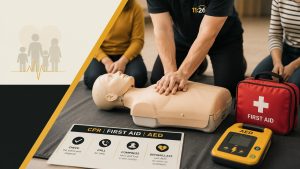
Workplace emergency response procedures are written, practiced instructions for protecting employees, visitors, contractors, property, and operations during fires, medical events, violence, hazardous releases, severe weather, utility failures, and other crises. Effective procedures identify who activates the plan, how people receive warnings, which protective action applies, how everyone is accounted for, and who authorizes re-entry.
Key facts at a glance
OSHA 29 CFR 1910.38 requires covered employers to maintain an emergency action plan when the applicable OSHA standard requires one.
Employers with 10 or fewer employees may communicate an emergency action plan orally under federal OSHA, although a written plan is usually more reliable.
A workplace emergency action plan must address reporting, evacuation, employee accountability, rescue or medical duties, and responsible contacts.
OSHA requires Class A fire extinguishers to be located so employees do not travel more than 75 feet to reach one, where that standard applies.
A fire drill, active-threat exercise, chemical-spill drill, and severe-weather exercise test different decisions and should not be treated as interchangeable.
No employee should investigate, contain, or fight an emergency beyond the training, equipment, authority, and safe conditions defined by the employer.
What Are Workplace Emergency Response Procedures?
Workplace emergency response procedures are hazard-specific actions embedded in an organization’s Emergency Action Plan (EAP). The procedures convert risk assessments, building information, regulatory duties, and emergency-service coordination into decisions employees can execute under stress.
An EAP is broader than a laminated evacuation map. It should explain how a warning starts, who gives instructions, which employees have assigned duties, how visitors and contractors are counted, how emergency services receive information, and what conditions must exist before normal work resumes. A separate business continuity plan addresses longer-term service, technology, supply-chain, and financial disruption.
The procedure must match the hazard. Evacuation is appropriate for many fires, while shelter-in-place may protect people from an outdoor chemical release or tornado. Lockdown can reduce exposure during a violent intruder event, but it is not an appropriate response to every security concern.
How does an emergency response cycle work?
A workplace emergency response cycle has six linked stages: detect, assess, activate, protect, account, and recover. The emergency coordinator or incident commander should define each stage before an incident, because improvised authority creates conflicting instructions.
- Detect: An employee, alarm, sensor, supervisor, or external agency identifies a hazard.
- Assess: The designated authority determines whether to evacuate, shelter, isolate, or lock down.
- Activate: The organization issues a plain-language alert through available channels.
- Protect: Employees take the prescribed action, while trained responders perform limited assigned duties.
- Account: Supervisors, wardens, or team leads report known personnel status without sending people back into danger.
- Recover: Leaders coordinate medical care, investigation, notifications, cleanup, continuity, and controlled re-entry.
The incident commander does not replace fire, police, emergency medical, or environmental authorities. Once public responders arrive, workplace personnel provide building plans, chemical inventories, utility information, access support, and accountability data.
What Must an Emergency Action Plan Include?
A compliant and usable emergency action plan identifies the emergency reporting method, evacuation routes, assembly locations, accountability process, rescue or medical duties, and contact information for responsible personnel. OSHA 1910.38 also requires employers to communicate the plan to employees and review it when the plan or employee duties change.
At minimum, include:
- Emergency reporting: 911 instructions, internal extension, alarm pull stations, radio channel, and digital alert process.
- Alarm meaning: Distinct signals for evacuation, shelter-in-place, lockdown, severe weather, and all-clear.
- Protective actions: Primary and secondary exits, refuge areas, shelter rooms, lockdown locations, and outdoor isolation zones.
- Role assignments: Emergency coordinator, incident commander, floor wardens, first-aid personnel, shutdown operators, reception staff, and alternates.
- Accountability: Department rosters, visitor and contractor logs, assembly-point leads, and a process for reporting last-known locations.
- Medical response: First-aid kits, automated external defibrillators, eyewash stations, emergency showers, and trained responders.
- Hazard information: Safety Data Sheets, chemical storage locations, gas cylinders, energized equipment, and special process risks.
- Accessibility: Assistance arrangements for mobility, hearing, vision, cognitive, language, or temporary medical needs.
- External coordination: Fire department access, police contact, landlord or property manager, utility providers, and environmental agencies.
- Training and revision: Orientation, refresher training, drills, after-action reviews, and update triggers.
The phrase “account for all employees after evacuation” appears in OSHA 1910.38(c)(4). Accountability means reporting known status, not forcing a supervisor to conduct a dangerous search.
Who is responsible during an emergency?
The employer assigns authority, but every role needs a backup and a defined limit. A single coordinator is inadequate for a 24-hour facility, a multi-building campus, or a site where the coordinator may be absent.
| Role | Primary duty | Backup or evidence required |
|---|---|---|
| Incident commander | Selects protective action and coordinates responders | Alternate commander, incident vest, radio |
| Emergency coordinator | Maintains plan, contacts, maps, and training | Current revision log and contact roster |
| Floor warden | Sweeps assigned area when safe and directs movement | Two-way radio and secondary warden |
| Reception or security | Brings visitor log and controls access information | Printed roster available during network failure |
| Department supervisor | Reports employee status at assembly point | Current shift roster and contractor list |
| First-aid responder | Provides trained care until EMS arrives | Certification date and stocked kit |
| Shutdown operator | Performs predefined equipment isolation | Written limits and lockout authority |
How Should Employees Respond to Common Emergencies?
Employees should first recognize the hazard, communicate the emergency, and follow the protective action in the site plan. Employees should not delay evacuation to collect belongings, investigate unknown substances, retrieve records, or wait for a manager’s personal instruction when an alarm or emergency message directs immediate action.
Fire or explosion
For a workplace fire, activate the alarm, call emergency services, leave by a safe exit, close doors behind you if possible, and report to the assembly point. Employees may use an extinguisher only when the fire is small, the correct extinguisher is available, a clear escape path remains, and the employee has been trained.
The common RACE sequence means Rescue or remove people from immediate danger, Alarm, Confine, and Extinguish or Evacuate. Terminology varies by organization, so the written plan should define the sequence rather than assume every employee knows the acronym. PASS means Pull, Aim, Squeeze, Sweep, but PASS training does not make an employee a fire responder.
Use stairs rather than elevators unless the building’s emergency system and fire department specifically direct otherwise. Test routes for smoke, locked doors, construction barriers, stored inventory, and nighttime conditions. At the assembly point, supervisors report missing or trapped people to firefighters and never re-enter to search.
Active threat or violent intruder
During an active threat, employees should run if a safe escape route exists, hide and secure themselves if escape is unsafe, and physically resist only as a last resort when facing imminent harm. The U.S. Department of Homeland Security’s “Run, Hide, Fight” framework is a decision aid, not a guarantee and not a substitute for site-specific police guidance.
If escaping, leave possessions, use available exits, keep hands visible when encountering officers, and avoid moving toward the threat. If hiding, lock or barricade the door, silence devices, turn off lights when appropriate, stay out of sight, and avoid opening the door for unverified voices. If immediate violence is unavoidable, coordinated resistance may create an opportunity to survive or escape.
Call 911 when safe and provide location, description, direction of travel, injuries, and hazards. Management should establish reunification, family communications, trauma support, and media-contact procedures before an incident. A lockdown plan that ignores fire alarms, hazardous conditions, or people outside the building is incomplete.
Chemical spill or hazardous-material release
For an unknown or significant chemical release, move away, isolate the area, warn others, call emergency services or the site response team, and consult the relevant Safety Data Sheet from a safe location. Untrained employees should not identify a vapor by smell, mix neutralizers, enter a contaminated zone, or deploy a spill kit without authorization and suitable PPE.
A trained employee may contain a minor spill only when the substance, quantity, ventilation, PPE, waste container, and escape route are known. The SDS provides hazard, first-aid, handling, storage, and accidental-release information, but the SDS does not replace site training or incident-command decisions.
For skin or eye exposure, use the emergency shower or eyewash immediately and follow the SDS and medical direction. Many facilities use a 15-minute flushing period, but the substance-specific SDS and medical professionals control the response. Report exposure even when symptoms appear minor.
Severe weather, earthquake, and utility failure
For tornadoes or high winds, move to an interior shelter away from windows and follow local alerts. During an earthquake, drop, cover, and hold on, then evacuate only after shaking stops if the building or site plan requires it.
For a power failure, stop hazardous work, secure processes only if trained, use emergency lighting, and wait for instructions. Generators, elevators, compressed gases, process chemicals, and automatic doors create risks that a generic evacuation plan does not address.
| Emergency | Immediate action | Do not do | Accountability point |
|---|---|---|---|
| Fire or smoke | Alarm, evacuate, close doors | Use an elevator or re-enter | Outdoor muster area |
| Chemical release | Move upwind or away, isolate, report | Smell-test or clean unknown material | Safe upwind location |
| Tornado warning | Shelter in interior low-level area | Stand near glass or exterior walls | Department check-in |
| Earthquake | Drop, cover, hold on | Run during active shaking | Designated open area |
| Violent intruder | Run, hide, or resist as last resort | Open a secured door | Police-directed reunification site |
| Medical emergency | Call 911, send someone for AED | Move an injured person unnecessarily | EMS handoff location |
Which Emergency Communication System Is Appropriate?
A layered communication system is safer than reliance on email, a single siren, or one cloud platform. The appropriate design combines audible and visual building alerts with voice, text, radio, printed instructions, and human confirmation, because power, cellular networks, internet access, hearing ability, and employee location can all vary.
| System approach | Typical cost and setup | Strength | Limitation |
|---|---|---|---|
| Manual plan, alarms, radios | $500-$3,000; 1-3 weeks | Works during internet outages | Slow for dispersed workers |
| Hybrid SMS and PA | $2-$10 per user annually; 1-2 weeks | Reaches phones and building occupants | Requires current mobile data |
| Enterprise mass notification | $10,000-$100,000 setup; 2-8 weeks | Multi-site, voice, desktop, SMS, visual alerts | Vendor and network dependency |
| Industrial alarm and sensors | $25,000-$250,000; 2-12 months | Detects gas, heat, pressure, or process conditions | Requires engineering and maintenance |
Typical prices vary by site, contract, integrations, training, and local construction requirements. A notification platform cannot solve an incorrect roster, unclear authority, dead batteries, or employees who have never practiced the alert meanings.
Evacuation, shelter, or lockdown: which action applies?
The hazard determines the protective action. Evacuation moves people away from an internal threat; shelter-in-place keeps people inside and protects them from an external threat; lockdown restricts movement and access during a security threat.
| Protective action | Use when | Required resources | Release authority |
|---|---|---|---|
| Evacuate | Fire, internal explosion, unsafe structure | Exit maps, alarms, muster points | Fire incident commander or public responders |
| Shelter-in-place | Tornado, outdoor toxic plume, civil hazard | Interior rooms, weather or air information | Incident commander or public agency |
| Lockdown | Violent intruder or immediate security threat | Lockable rooms, access control, alerts | Police or designated authority |
| Isolate area | Spill, energized equipment, localized hazard | Barriers, signs, shutdown controls | Trained coordinator or responders |
Protective actions may change. A chemical release can require evacuation from one zone and sheltering in another, while a fire alarm during a lockdown can require people to leave through the safest available route. The plan must explain who issues a changed instruction and how employees verify an all-clear.
How Do You Build and Test Procedures?
Build workplace emergency response procedures from a hazard assessment, site survey, workforce analysis, and response capability review. A small office may complete a first draft in 2-4 weeks, while a chemical plant, hospital, or multi-building campus may need several months for engineering review and responder coordination.
Use this sequence:
- List credible hazards. Review incident history, near misses, chemicals, equipment, weather, occupancy, neighboring facilities, and local crime or flood information.
- Map people and places. Mark exits, refuge areas, shelters, fire equipment, AEDs, eyewashes, shutoffs, assembly areas, visitor access, and areas with poor radio or cellular coverage.
- Define decisions. For each hazard, specify detection, alert, protective action, role authority, accountability, medical response, and all-clear.
- Assign trained roles. Name alternates by shift, language, building, and work pattern; document what each role must not do.
- Create communication layers. Test alarms, PA, SMS, radios, visual signals, printed rosters, and manual call trees.
- Train the workforce. Use orientation, brief refreshers, hands-on equipment training, and hazard-specific exercises.
- Exercise and measure. Conduct announced or unannounced drills where appropriate, then record response times, blocked routes, missed alerts, accountability gaps, and corrective owners.
- Revise and control documents. Date every version and remove obsolete maps, rosters, phone numbers, and role assignments.
A drill should test a decision, not merely produce a fast evacuation. Track alert delivery time, last-person-out time, roster completion time, percentage of personnel accounted for, blocked exits, accessibility barriers, false alarms, and corrective actions closed by their due dates.
Federal OSHA does not impose one universal annual evacuation-drill frequency for every workplace. Fire codes, insurers, licensing agencies, local authorities, and industry standards may require specific intervals, and high-hazard employers commonly exercise more often. The employer should set a documented frequency based on risk and applicable jurisdiction.
What Changes for Small, Industrial, and Remote Workplaces?
Emergency procedures must scale to hazards and work patterns, not simply headcount. A 12-person laboratory may need more technical controls than a 200-person office, while a remote team may need less building detail but stronger communication and welfare-check processes.
| Workplace setting | Priority controls | Typical exercise pattern | Special issue |
|---|---|---|---|
| Office, 1-20 workers | Written map, alarm, 911 process, roster | Semiannual review, annual practical drill | Visitors and accessibility |
| Retail or public venue | Evacuation, crowd direction, shelter, cash controls | Seasonal and shift-based drills | Customers are not on employee rosters |
| Corporate campus, 21-200 workers | Wardens, mass notification, zone accountability | At least annual exercises by hazard | Multiple buildings and contractors |
| Manufacturing or chemical site | Process shutdown, gas detection, PPE, ERT | Quarterly or risk-based exercises | HAZWOPER and permit controls |
| Healthcare facility | Patient movement, utilities, clinical command | Scenario-based, department-specific tests | Patients cannot self-evacuate |
| Remote or hybrid workforce | Regional alerts, manager check-ins, emergency contacts | Annual communication test | Home conditions differ from employer sites |
Remote employees still need a corporate emergency communication policy, but an employer should not pretend it can control every home environment. The policy can provide local emergency numbers, weather-alert sources, manager check-in rules, travel restrictions, welfare escalation, ergonomic fire-safety guidance, and instructions for protecting company information during a regional outage.
What Are the Most Common Failure Modes?
The most common emergency-plan failures are stale information, ambiguous authority, incomplete accountability, and procedures that assume ideal conditions. A plan can satisfy a document review while failing during a night shift, a network outage, a renovation, or an event involving visitors.
Failure 1: Treating the plan as a binder
Problem: Maps, phone numbers, rosters, and wardens become outdated after a move or staffing change.
Fix: Review contacts and routes at least every six months and after renovations, incidents, new equipment, organizational changes, or regulatory changes.
Failure 2: Using one communication channel
Problem: Email misses warehouse workers, field staff, people away from desks, and employees with limited connectivity.
Fix: Pair audible or visual alarms with SMS, voice, PA, radio, desktop alerts, supervisors, and printed fallback instructions.
Failure 3: Sending people to search
Problem: Managers send wardens into smoke, chemical vapor, violence, or structural damage to verify missing people.
Fix: Report last-known locations to responders and restrict searches to trained personnel operating under an approved system.
Failure 4: Ignoring contractors and visitors
Problem: A badge report or employee roster does not reveal who is present in a loading dock, conference room, service area, or leased space.
Fix: Maintain sign-in data, require host responsibility, and give reception or security a printed backup list.
Failure 5: Assuming a drill proves readiness
Problem: A fast evacuation can hide a failed alarm, inaccessible route, untrained night crew, or unresolved accountability gap.
Fix: Use varied scenarios and score the controls that matter, including alert reach, role coverage, route usability, and time to reconcile status.
Failure 6: Confusing response with recovery
Problem: Employees know how to leave but not how to preserve evidence, communicate closure, support injured staff, or restart safely.
Fix: Add post-incident care, investigation, regulator and insurer notifications, hazard correction, business continuity, and controlled re-entry.
What is the practitioner rule that prevents the most harm?
Write procedures for the least ideal credible condition, not the average office day. Test the night shift, a blocked primary exit, a disabled alarm, a missing warden, a contractor-heavy shift, and a cellular outage, because those conditions expose dependencies that a routine daytime drill conceals.
How Much Does Implementation Cost?
A basic workplace emergency plan typically costs $1,500-$5,000 for risk review, maps, procedures, and consultation, with completion in 2-4 weeks. Training sessions commonly cost $1,000-$4,000 per session, while mass notification, sensors, construction, and specialized industrial response equipment can increase the budget substantially.
| Work item | Typical range | Typical duration | Main cost driver |
|---|---|---|---|
| Basic EAP assessment and writing | $1,500-$5,000 | 2-4 weeks | Site count and hazard complexity |
| Employee awareness training | $500-$2,500 per session | 2-6 hours | Workforce size and languages |
| Live drill planning and facilitation | $1,000-$4,000 per session | 1-2 planning weeks | Scenario realism and responders |
| SMS or mass notification | $2-$10 per user annually | 1-2 weeks | Integrations and message channels |
| Industrial detection or shutdown | $25,000-$250,000 | 2-12 months | Engineering and installation |
These are typical planning ranges, not legal prices or universal market rates. Local fire-code work, accessibility modifications, medical equipment, hazardous-material training, and labor disruption can exceed the planning budget.
The Bottom Line
Workplace emergency response procedures work when they connect a known hazard to a clear warning, protective action, assigned authority, accountability method, and recovery decision. A strong plan is written for the actual building, shifts, hazards, visitors, contractors, remote workers, and communication failures rather than copied from a generic template.
Use OSHA 1910.38 as a federal baseline where applicable, then verify state-plan rules, fire code, environmental requirements, licensing obligations, insurance conditions, and local emergency-service expectations. Review the plan after every meaningful operational change, exercise it by scenario, and close corrective actions with named owners and deadlines. Workplace emergency response procedures become dependable through testing, not document length.
Frequently Asked Questions
Does every workplace need a written emergency action plan?
Federal OSHA generally permits employers with 10 or fewer employees to communicate the plan orally, but written procedures remain the safer operational choice. A written plan provides consistent instructions for new workers, visitors, multiple shifts, contractors, inspectors, and emergency responders. State OSHA plans, fire codes, licensing rules, or other OSHA standards may impose additional requirements.
How often should a workplace emergency plan be updated?
Review the plan at least every six months for contacts, routes, equipment, and role assignments, then update it immediately after a relocation, renovation, process change, serious incident, near miss, staffing change, or new hazard. A scheduled review does not replace a change-triggered review. Every revision needs a date, owner, approval, and obsolete-copy control.
Should employees always use fire extinguishers?
Employees should use an extinguisher only for a small incipient fire when trained, the extinguisher matches the fire, smoke and heat are limited, and a clear escape route remains. Employees should evacuate instead when the fire is spreading, the room is filling with smoke, the exit may be cut off, or the material is unknown. Calling 911 and activating the alarm come first.
How are disabled employees included in emergency procedures?
The plan should identify accessible routes, refuge areas, alarm alternatives, evacuation chairs where appropriate, buddy or assistance arrangements selected with the employee, and trained backups across shifts. Employers should protect privacy and avoid assigning untrained coworkers to carry someone. Drills must test whether alarms, doors, shelters, and accountability procedures work for actual accessibility needs.
What should an employee do if an exit is blocked?
Use the nearest safe alternate exit shown on the emergency map and follow the alarm or incident commander’s instructions. Do not push through smoke, chemical vapor, flames, flooding, structural damage, or violence to reach a preferred route. Report the blocked exit from a safe location, then proceed to the designated assembly or shelter area.
What information should employees give emergency responders?
Employees should provide the exact site address, building or floor, hazard type, people at risk, last-known locations, injuries, chemical names or SDS information, utility conditions, and safe access points. Employees should not guess or re-enter to verify details. A prepared responder packet should contain site maps, utility shutoffs, chemical inventories, contacts, and current accountability information.