Firearm safety training is important because it converts general caution into repeatable habits for handling, storing, transporting, and using a firearm. Structured instruction reduces preventable handling errors, improves judgment under supervision, and helps owners identify applicable legal duties, although training cannot replace secure storage, safe ammunition practices, or current legal advice.
Key Facts at a Glance
- Firearm safety training teaches knowledge, practical handling skills, and responsible attitudes before independent use.
- The four universal rules address the loaded condition, muzzle direction, trigger control, and the target’s background.
- A typical basic course lasts 3-4 hours and costs about $50-$150 before ammunition or range fees.
- Concealed-carry courses commonly require 8-16 hours, but legal requirements vary by state or country.
- Dry practice with inert training ammunition should occur only after live ammunition has been removed from the practice area.
- Training is one layer of risk control; locked storage, household communication, maintenance, and judgment remain separate responsibilities.
Why Is Firearm Safety Training Important?
Firearm safety training matters because firearm accidents usually involve a chain of preventable decisions rather than a single mechanical failure. Instruction breaks that chain by teaching a person to verify the firearm’s condition, control the muzzle, keep the trigger finger indexed, identify a safe target area, and stop when uncertainty appears.
A firearm can be mechanically sound and still become dangerous through an unsafe direction, an unexpected person entering the target area, incorrect ammunition, or an assumption that the chamber is empty. Classroom instruction explains those hazards, while supervised handling gives the learner a chance to correct them before independent ownership or carry.
The public-health case also deserves precision. The CDC’s Web-based Injury Statistics Query and Reporting System records unintentional firearm deaths and injuries, but national totals do not prove that one specific class prevents a specific number of incidents. Training is best understood as a risk-reduction layer, not a guaranteed accident-prevention device.
What Risks Does Training Address?
| Risk | Training control | Observable behavior | Remaining control |
|---|---|---|---|
| Unintended discharge | Trigger and loading discipline | Finger remains outside trigger guard | Mechanical condition and maintenance |
| Muzzle injury | Directional control | Muzzle stays in a safe direction | Safe range layout |
| Wrong target | Identification procedure | Shooter confirms target and background | Adequate lighting and backstop |
| Unauthorized access | Storage instruction | Firearm is locked when unattended | Quality safe and access management |
| Legal misuse | Scenario discussion | Student pauses and seeks lawful options | Current local legal advice |
The strongest training programs teach a stop rule: if the shooter cannot identify the firearm’s condition, target, background, or lawful purpose, the shooter does not continue. That decision is more valuable than memorizing terminology.
What Does Firearm Safety Training Teach?
A sound introductory course combines four learning layers: firearm knowledge, safe manipulation, supervised shooting, and responsible decision-making. A student should leave able to make the firearm safe, explain the relevant rules, and recognize when a problem requires an instructor or gunsmith.
What Are the Four Universal Safety Rules?
The four widely taught rules are: treat every firearm as loaded; never point it at anything you are unwilling to destroy; keep the trigger finger outside the trigger guard until ready to fire; and identify the target and what lies beyond it. Jeff Cooper is widely credited with formalizing this four-rule framework, although ranges and national authorities may use different wording or add rules.
The rules overlap deliberately. If one habit fails, another can prevent injury. For example, a premature trigger press is less likely to cause harm when the muzzle remains pointed toward a suitable backstop.
A responsible instructor also explains range-specific rules, including when to load, when to make a firearm safe, how to respond to a ceasefire, and who may touch a firearm during a stoppage.
How Does a Typical Course Progress?
Most beginner programs follow a classroom-to-practice sequence, but the exact order depends on the instructor, firearm, and jurisdiction. A supervised progression reduces cognitive load by separating concepts from manipulation and manipulation from live fire.
- Classroom briefing: The student reviews firearm parts, ammunition identification, safe direction, storage, transport, range commands, and applicable laws.
- Safety demonstration: The instructor shows how to verify a firearm’s condition, handle it safely, and place it in a safe state.
- Dry handling: The student practices with an unloaded firearm or approved inert training aids, with live ammunition excluded from the practice area.
- Supervised live fire: The student fires under direct range supervision while maintaining muzzle, trigger, target, and equipment control.
- Practical assessment: The instructor observes safe handling, response to commands, loading and unloading procedures, and the ability to stop when confused.
- Debrief: The student receives corrections, a practice plan, and guidance about storage, maintenance, and further instruction.
A practical assessment should measure safe behavior first and marksmanship second. Accuracy matters for lawful recreational or defensive use, but a precise shot cannot compensate for unsafe target identification or muzzle control.
Which Firearm Safety Course Fits Your Goal?
The appropriate course depends on the firearm, intended activity, local requirement, and the student’s prior experience. A basic safety class is usually the correct starting point for a new owner, while a concealed-carry or defensive course should follow foundational competence rather than replace it.
| Course type | Typical duration | Typical price | Main content | Best starting user |
|---|---|---|---|---|
| Basic owner safety | 3-4 hours | $50-$150 | Rules, handling, storage, range basics | First-time owner |
| Permit or concealed carry | 8-16 hours | $100-$300 | Carry law, judgment, qualification | Permit applicant |
| Private fundamentals | 1-3 hours | $75-$175 per hour | Individual correction and firearm fit | Anxious or returning shooter |
| Defensive skills | 1-3 days | $250-$1,500+ | Decision-making and supervised performance | Experienced student |
| Competition orientation | 4-8 hours | $100-$250 | Match rules, procedures, safe movement | New competitor |
Prices are typical United States ranges and commonly exclude ammunition, eye and ear protection, targets, range fees, travel, and licensing charges. A course advertised at $75 may cost $150-$250 after those additions, depending on the firearm and ammunition selected.
Basic Safety, Concealed Carry, and Defensive Training
Basic safety training answers, “How do I handle and store this firearm without creating avoidable danger?” Concealed-carry training adds public-carry rules, prohibited locations, interaction with law enforcement, de-escalation, and a qualification requirement where local law imposes one.
Defensive training is a later stage. It may address movement, cover, low-light conditions, communication, and decision-making, but advanced drills can create additional hazards when introduced before safe foundational handling. A student who cannot consistently keep the finger indexed should not begin dynamic holster work.
Home-defense courses also have limits. A class cannot make a person legally authorized to use force, identify an unknown person reliably in darkness, or eliminate the risk of hitting a household member. A home safety plan should include locks, lighting, family communication, emergency calls, and avoidance of unnecessary confrontation.
What Is the Best Training Method?
In-person instruction is the most complete option for a beginner because an instructor can observe muzzle direction, trigger-finger position, grip, loading behavior, and responses to range commands. Online education can explain concepts, but it cannot verify physical handling or provide a live-fire qualification unless paired with an approved practical session.
| Method | Typical time | Typical cost | Strength | Limitation |
|---|---|---|---|---|
| Group class | 3-8 hours | $50-$250 | Standardized instruction | Less individual feedback |
| Private lesson | 1-2 hours | $75-$175 per hour | Personalized pacing | Higher hourly cost |
| Hybrid course | 2-6 online hours plus range | $100-$350 | Flexible theory schedule | Practical skills remain unverified online |
| Online-only course | 1-6 hours | $20-$150 | Convenient information access | No physical competency assessment |
| Club or range orientation | 1-3 hours | $25-$100 | Local procedures and equipment | May not cover law or ownership duties |
Online-only instruction may satisfy an administrative requirement in some jurisdictions, but legal acceptance does not equal practical sufficiency. A person who has never handled a firearm should add supervised, in-person instruction before independent use.
Private lessons are especially useful for students with hearing sensitivity, anxiety, mobility limitations, language barriers, or a long gap since prior training. Request slower pacing, quieter range hours, accessible lanes, or an instructor experienced with the relevant accommodation.
How Should a Beginner Start?
A beginner should take a basic safety course before purchasing a firearm whenever possible, or use a reputable range that supplies suitable equipment under instructor supervision. The first objective is not selecting the most powerful or popular model; it is learning safe handling and identifying equipment that the student can control consistently.
Before the first class, confirm five details:
- Whether the course supplies a firearm, ammunition, eye protection, and hearing protection.
- Whether the instructor permits a new student to observe before participating.
- Whether live ammunition is physically separated during dry practice.
- Whether the range has a posted emergency and ceasefire procedure.
- Whether the course covers storage and local law rather than only marksmanship.
A new owner should avoid buying a firearm solely from appearance, online reviews, or recoil reputation. Fit, controls, manageable recoil, reliable operation, and the ability to store the firearm securely matter more than brand prestige.
An instructor should be willing to stop a drill immediately. That behavior is a quality signal, not an inconvenience.
How Do You Choose a Qualified Instructor?
Choose an instructor who can document current certification, explain the curriculum before payment, state the student-to-instructor ratio, and teach safe storage and local legal boundaries. A professional instructor never guarantees that training alone makes a student ready for every firearm, defensive encounter, or legal situation.
Evaluate the course using these criteria:
- Credential and scope: Verify certification through a recognized training organization or local authority, and confirm that the instructor is qualified for the firearm type taught.
- Safety structure: Ask how live ammunition is controlled during dry practice and what happens during a ceasefire or suspected malfunction.
- Assessment: Look for observable standards such as safe muzzle direction, trigger discipline, correct response to commands, and safe unloading.
- Equipment policy: Confirm whether students may use rental firearms, inert aids, or their own firearm after an inspection.
- Student support: Ask about class size, accessibility, language, weather cancellation, and remediation.
- Legal humility: Prefer instructors who identify the jurisdiction and date of legal material and tell students when to consult a lawyer or official agency.
A large class is not automatically poor, and a high-priced class is not automatically superior. Instructor behavior, supervision, curriculum transparency, and student assessment provide better evidence.
How Often Should Firearm Training Be Repeated?
A practical baseline is a formal refresher every 12-24 months, with shorter supervised practice sessions between courses. The correct interval becomes shorter after a long gap, a firearm change, a move to a new jurisdiction, a serious handling error, or a change in physical or psychological condition.
Skill decay affects judgment and manipulation before it becomes obvious on a paper target. A shooter may remember how to fire while forgetting range commands, storage steps, or the correct response to a stoppage.
| Situation | Suggested review | Reason |
|---|---|---|
| New owner after first class | Within 3-6 months | Reinforce safe habits |
| Regular recreational shooter | Every 12 months | Check handling and equipment |
| Infrequent owner | Every 12-24 months | Reduce skill decay |
| Concealed carrier | At least annually | Review law and carry procedures |
| After a negligent handling event | Immediately | Identify and correct the chain of errors |
| After firearm or jurisdiction change | Before use | Learn different controls or rules |
Practice should stop when fatigue, distraction, anger, medication effects, alcohol, or impaired judgment enters the session. Repetition is useful only when the repeated behavior is safe.
Does Firearm Training Reduce Accidents?
Firearm training can reduce risk by improving knowledge, habits, and recognition of dangerous conditions, but available evidence does not justify claiming a universal percentage reduction from a generic course. Injury outcomes also depend on storage, supervision, household behavior, firearm access, alcohol use, mental health crises, and the surrounding environment.
The CDC distinguishes unintentional firearm injuries from intentional injuries, and its injury surveillance systems show why a single training metric cannot capture the whole safety problem. A class may improve handling while leaving an unsecured firearm accessible to a child, visitor, or person in crisis.
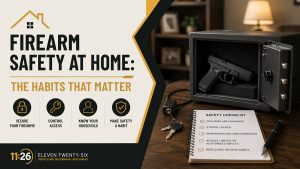
That limitation changes the recommendation. Pair training with locked storage, separate ammunition management where appropriate, child access prevention, and a household emergency plan. Project ChildSafe, a firearm safety program of the National Shooting Sports Foundation, recommends secure storage when firearms are not in use; local law may impose additional requirements.
No responsible instructor should promise zero accidents. The measurable goal is fewer unsafe decisions and faster interruption when a hazard appears.
What Are the Legal Limits of Firearm Training?
Firearm safety training does not create a carry permit, establish lawful self-defense, guarantee immunity from civil liability, or replace current legal advice. Use-of-force rules, prohibited places, transport requirements, storage duties, waiting periods, and permit standards vary by jurisdiction and can change.
A course may discuss concepts such as duty to retreat, defense of habitation, or reasonable force, but those concepts are fact-specific. Students should verify current rules through official government sources, a licensing agency, or a qualified attorney in the relevant jurisdiction.
Training records can document that a person sought instruction, but documentation does not prove that a later act was lawful. A court or investigator may examine the circumstances, conduct, firearm condition, storage, communications, and applicable law rather than treating a certificate as a defense.
What Should Families Teach Children?
Children should learn that a firearm is not a toy, must never be touched without direct permission, and must be reported to a trusted adult if found. Adults remain responsible for locked storage, access control, and checking that visitors cannot reach the firearm.
The National Shooting Sports Foundation’s Project ChildSafe uses the message “Own It? Respect It. Secure It.” That phrase captures the household standard: education supports, but does not replace, physical prevention.
A family plan should specify:
- Which adult controls keys, combinations, or biometric access.
- What children should do if they find a firearm.
- How visiting children are protected from unsecured firearms.
- Where locked firearms and ammunition are kept.
- Which adult handles transport, maintenance, and range preparation.
A child’s apparent maturity is not a storage system. Use physical security every time.
Common Training Mistakes and How Can You Fix Them?
Most beginner errors arise from attention, equipment fit, or unclear procedures rather than deliberate recklessness. Correct the behavior immediately, unload or secure the firearm when needed, and ask the instructor to demonstrate the procedure again.
| Mistake | Likely cause | Immediate correction | Prevention |
|---|---|---|---|
| Finger enters trigger guard early | Poor indexing habit | Move finger high along frame | Rehearse unloaded under supervision |
| Muzzle sweeps a person | Turning with firearm in hand | Stop and make firearm safe | Use a fixed safe direction |
| Flinch at the shot | Excessive noise or anticipation | Pause and reduce pace | Double hearing protection |
| Wrong ammunition | Packaging confusion | Stop before loading | Match cartridge marking exactly |
| Failure to hear command | Hearing protection or distraction | Stop and notify range staff | Review commands before firing |
| Unsafe response to stoppage | No prior instruction | Keep muzzle safe and finger indexed | Request supervised malfunction training |
A flinch is not fixed by simply firing faster. Foam earplugs beneath electronic earmuffs, quieter training periods, reduced session length, and instructor-led pacing can help, provided the student can still hear range commands.
A suspected malfunction requires a safe direction, trigger-finger discipline, and instructor guidance. Do not improvise a repair, force a mechanism, or look down the barrel.
What Should You Do After a Suspected Negligent Discharge?
After a suspected negligent discharge, keep the firearm pointed in a safe direction, place the trigger finger outside the trigger guard, warn others, and notify range staff or emergency services as appropriate. Do not handle evidence unnecessarily, resume firing, or conceal what happened.
If anyone may be injured, call emergency services immediately and provide the location. Follow the range’s incident procedure, preserve relevant information, and obtain medical evaluation even when an injury initially appears minor.
A later review should examine the complete sequence: firearm condition, ammunition, target area, commands, handling decisions, storage, fatigue, and distractions. The goal is prevention, not assigning a convenient explanation.
What Is Firearm Safety Training Not Good For?
Firearm safety training is not a substitute for secure storage, mental-health crisis planning, maintenance by a qualified professional, legal advice, or realistic judgment under stress. A certificate cannot make an unsuitable firearm manageable or transform a short class into advanced defensive competence.
Training is also a poor solution for a person who is currently intoxicated, severely distressed, angry, sleep-deprived, or experiencing impaired judgment. That person should not access or handle a firearm; secure storage and immediate support take priority.
The most important practitioner rule is simple: competence includes refusing a situation. A safe shooter can say, “I am not certain,” unload or secure the firearm when appropriate, and ask for help.
Frequently Asked Questions
Is a firearm safety certificate enough to own a gun?
A firearm safety certificate may satisfy one requirement in a particular jurisdiction, but it does not universally authorize ownership, purchase, possession, or carry. Requirements differ by state and country, and some jurisdictions require permits, background checks, registration, or separate training. Confirm the current rule with the relevant government agency.
Should I take training if I have used firearms before?
Yes, especially after a long gap, a firearm change, a move, or a handling incident. Prior experience may reduce introductory learning time, but it does not prove current competence with different controls, ammunition, storage systems, or local laws. A short assessment with a qualified instructor can identify unsafe habits.
Can I practice firearm safety without firing live ammunition?
You can review rules and practice some handling only with the firearm completely unloaded, live ammunition removed from the practice area, and an instructor-approved procedure. Dry practice still carries risk because a loaded firearm can be mistaken for an unloaded one. Follow the manufacturer’s instructions and use inert aids only when appropriate.
Is a shooting-range orientation the same as a safety course?
Usually not. A range orientation commonly covers facility rules, lane controls, commands, and basic operation, while a safety course may also cover storage, transport, ammunition, legal responsibilities, and household access. Ask for the written curriculum and assessment requirements before assuming the orientation meets a legal mandate.
Does firearm training make concealed carry safe?
Training can improve handling, awareness, judgment, and familiarity with carry equipment, but concealed carry remains a high-responsibility activity. A carrier must follow current local law, use a secure holster compatible with the firearm, prevent unauthorized access, and avoid carrying while impaired. Continued practice is more useful than a one-time certificate.
What should I do if I feel overwhelmed during class?
Tell the instructor immediately and ask to pause, unload, or leave the firing line according to range procedure. Loud noise, anxiety, trauma history, physical limitations, or information overload can affect safe performance. A quieter session, private lesson, accessible equipment, or a later class may be safer than pushing through.
The Bottom Line
Why firearm safety training is important comes down to risk control: instruction gives people repeatable habits for muzzle direction, trigger discipline, target identification, storage, transport, and lawful decision-making. The strongest path is a supervised basic course, secure storage, current jurisdiction-specific information, and periodic refreshers that measure safe behavior rather than merely issuing a certificate.