Concealed carry training is a structured course covering firearm safety, state carry laws, responsible decision-making, and basic shooting proficiency. Most programs combine classroom instruction, supervised handling, live-fire qualification, and an assessment, but required hours, permitted firearms, scoring standards, and online-course acceptance depend on the issuing state.
Key Facts at a Glance
A typical permit course takes 4-16 hours, although some jurisdictions require longer classroom and range components.
Standard fees commonly run $75-$250 before ammunition, range charges, fingerprints, and permit fees.
The live-fire test may use 50-150 rounds at distances such as 3, 5, 7, and 10 yards, but state standards differ.
Permit training establishes minimum legal eligibility and shooting proficiency; it does not create defensive expertise.
Online classroom instruction is accepted in some jurisdictions and rejected or restricted in others.
A state-approved instructor and an accepted certificate matter as much as the class content.
What Happens During Concealed Carry Training?
Concealed carry training usually moves through four connected stages: classroom instruction, supervised firearm handling, live-fire qualification, and a written or verbal assessment. The order can change, and some instructors combine the assessment with classroom work, but students should expect safety rules before any ammunition is handled.
The classroom portion establishes the responsibilities attached to carrying a hidden firearm. The handling portion checks whether students can follow commands, keep the muzzle pointed safely, and manipulate their chosen firearm without putting people at risk. The range portion measures a narrow set of marksmanship skills under supervision.
A permit class is often structured for compliance rather than realism. Students may not practice defensive movement, low-light shooting, vehicle scenarios, or force-on-force judgment unless they enroll in a separate advanced course.
How Long Does the Class Take?
A concealed carry class commonly takes one long day or two shorter sessions, with a typical total of 4-16 instructional hours. The exact duration depends on state law, whether classroom and range work are separate, the instructor’s testing process, and whether the course includes a first-time handgun orientation.
| Course component | Typical duration | Typical requirement or output |
|---|---|---|
| Classroom law and safety | 4-12 hours | Attendance record and legal knowledge |
| Firearm-handling orientation | 1-2 hours | Safe loading, unloading, and clearing under direction |
| Live-fire qualification | 1-2 hours | Target score at prescribed distances |
| Written examination | 20-45 minutes | Passing score set by instructor or state |
| Certificate and paperwork | 15-30 minutes | Training certificate and application instructions |
New York provides an example of a more demanding statutory model: applicants for a concealed handgun license generally complete 16 hours of classroom instruction and 2 hours of live-fire training under New York’s current rules. Requirements can change, so applicants should verify the current state police, attorney general, sheriff, or licensing-agency guidance before paying for a course.
A class can also run longer when several students need individual coaching, firearms malfunction, or paperwork is incomplete. Treat the advertised end time as an estimate rather than a guaranteed departure time.
Which Laws Are Covered?
Concealed carry law instruction commonly covers eligibility, prohibited locations, use of force, transport, storage, disclosure duties, and interactions with law enforcement. Instructors should identify the controlling state statutes and agency guidance instead of relying on generic national rules.
Students may discuss concepts such as deadly force, defense of self or others, defense of an occupied home, duty to retreat, and stand-your-ground provisions. These concepts are jurisdiction-specific. A phrase used in one state may have no legal effect in another, and a permit does not authorize force merely because a person feels threatened.
Common classroom subjects include:
- Minimum age, residency, disqualifying convictions, restraining orders, and prohibited-person rules.
- School grounds, courthouses, government offices, airports, posted private property, and locations with alcohol restrictions.
- Safe storage around children, prohibited transfers, vehicle transport, and leaving a firearm unattended.
- Whether a carrier must disclose possession during a police encounter.
- What to do after a defensive shooting, including calling emergency services, requesting medical aid, preserving evidence, and following counsel’s advice.
The instructor is not a substitute for a criminal-defense attorney. State statutes, administrative rules, local ordinances, and court decisions can produce different answers, especially for reciprocity and prohibited locations.
What Happens on the Range?
The range qualification tests controlled shooting from fixed positions, usually at several short distances, rather than recreating a defensive encounter. Students normally receive a safety briefing, load only on command, fire a prescribed course, unload when directed, and keep the firearm pointed downrange throughout the exercise.
Typical qualification distances include 3, 5, 7, and 10 yards. A course may specify 20-50 rounds, while some programs use more ammunition for practice before the scored portion. Targets often include a B-27 silhouette or a state-approved equivalent, but scoring zones and passing thresholds vary.
| Range variable | Typical permit-course range | Why the variable matters |
|---|---|---|
| Total ammunition | 50-150 rounds | Covers practice, qualification, and occasional reshoots |
| Common distances | 3, 5, 7, 10 yards | Tests basic control at progressively greater distance |
| Target type | B-27 or state-approved silhouette | Determines scoring zones and hit placement |
| Passing threshold | 70%-80% of required score | State or instructor standards control |
| Shooting positions | Standing, sometimes seated or supported | Course design may affect firearm handling |
| Qualification time | 15-45 minutes | Depends on commands, strings, and class size |
A passing score demonstrates performance on that particular course under controlled conditions. It does not prove that a person can safely draw under stress, identify a threat, communicate during a crisis, or make a lawful force decision.
The NRA’s first basic firearm-safety rule is commonly stated as, “Always keep the gun pointed in a safe direction.” That rule explains the range culture: students are expected to stop, keep the muzzle controlled, and ask for help rather than improvise.
Is a Written Exam Required?
A written examination is common, but no universal national exam exists for concealed carry applicants. The test generally checks firearm-safety rules, storage, prohibited locations, use-of-force principles, and basic legal definitions presented during the course.
Questions may use multiple-choice, true-or-false, short-answer, or instructor-led verbal formats. Some instructors allow a retest after reviewing missed material, while others follow a state-defined process. Ask about the passing score before enrollment because a certificate policy can differ from the range qualification policy.
Students should read every question carefully. Legal terms such as “reasonable,” “imminent,” and “necessary” are not interchangeable, and a correct answer depends on the jurisdiction’s wording and case law.
What Should You Bring to Class?
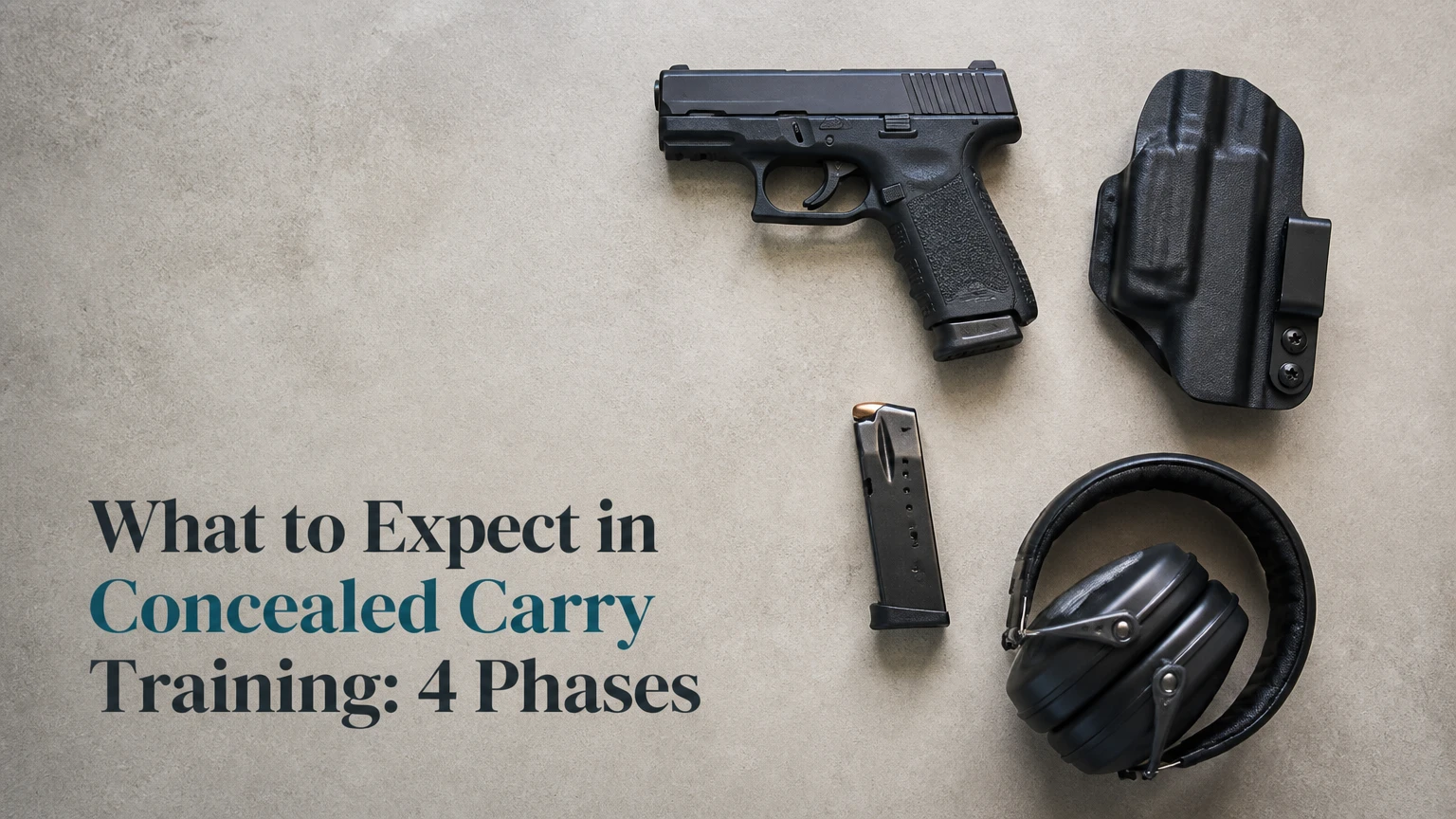
Bring government identification, course-payment confirmation, eye and hearing protection, water, note-taking materials, and only the firearm and ammunition permitted by the instructor. Wear closed-toe shoes, a high-neck shirt, sturdy pants, and clothing that allows safe movement without exposing the firearm during supervised handling.
Confirm the equipment policy before class. Some ranges prohibit personal ammunition, require factory-new ammunition, limit calibers, or require a specific holster. Other facilities supply a firearm and ammunition for an added fee.
Use this preparation checklist:
- Confirm the instructor’s state approval and certificate acceptance.
- Verify the class location, start time, parking, lunch policy, and range rules.
- Ask whether the firearm must arrive unloaded, cased, and separated from ammunition.
- Bring 50-150 rounds only after confirming the approved caliber and ammunition type.
- Bring prescription glasses if needed, plus properly rated eye and ear protection.
- Avoid open-toe footwear, loose scarves, low-cut tops, and clothing that can trap hot brass.
- Do not carry a loaded firearm into a classroom unless the instructor expressly provides a lawful, documented procedure.
A new firearm is a poor choice for the qualification unless the student has already learned its controls under competent supervision. New magazines, stiff springs, unfamiliar safeties, and incorrect ammunition can create avoidable problems.
How Should a Beginner Prepare?
A beginner should take a basic handgun-safety or introductory pistol course before the permit class if they have never loaded, unloaded, or fired a handgun. Ten to twenty minutes of supervised orientation before a qualification can prevent confusion, but it cannot replace foundational instruction.
A first-time student does not need to purchase a firearm before enrolling. Many ranges offer rentals, and using a familiar rental can be safer than bringing an untested personal gun. Ask whether the range permits rental firearms during qualification and whether the instructor requires a particular caliber.
The most useful preparation is supervised familiarity with:
- Identifying the firearm’s controls and status.
- Confirming that the firearm is unloaded when instructed.
- Loading and unloading without rushing.
- Maintaining trigger-finger discipline until the sights are on the designated target.
- Responding to commands such as “cease fire,” “unload,” and “show clear.”
A larger, manageable handgun often produces less perceived recoil than an ultra-compact model. That does not make one model universally suitable. Hand size, grip reach, strength, vision, and the ability to operate the controls should guide selection.
How Much Does Concealed Carry Training Cost?
A standard concealed carry course typically costs $75-$250, while advanced defensive instruction often costs $200-$500 or more per day. The complete first-time budget can exceed the advertised tuition after adding ammunition, range fees, equipment, fingerprints, background checks, and the government permit application.
| Expense | Typical amount | When paid |
|---|---|---|
| Basic permit course | $75-$250 | Registration or class day |
| Ammunition | $25-$75 for 50-150 rounds | Range day |
| Range, lane, or rental fee | $15-$50 | Range session |
| Eye and ear protection | $15-$80 | Before or during class |
| Fingerprints and background check | $20-$100 | Permit application |
| State permit application | $40-$150 or more | Application submission |
| Advanced defensive course | $200-$500 or more per day | Separate skill training |
A realistic budget for a first-time applicant is often $170-$600 before purchasing a firearm, secure storage, a carry method, or additional training. Costs rise when a student needs a rental gun, private coaching, a second qualification attempt, or travel to an approved instructor.
Government processing can take 30-90 days in many jurisdictions, but that is a typical range rather than a promise. The issuing agency controls the timeline, and incomplete fingerprints, missing documents, or background-check questions can delay approval.
Which Training Format Should You Choose?
In-person classroom and range instruction is usually the strongest choice for a first-time carrier because an instructor can correct unsafe handling immediately. Hybrid courses can save travel time, while advanced defensive courses provide capabilities that a basic permit class normally does not assess.
| Format | Typical time | Typical price | Best use | Main limitation |
|---|---|---|---|---|
| In-person permit class | 4-16 hours | $75-$250 | First permit and hands-on coaching | Fixed schedule |
| Hybrid online plus range | 4-12 hours online, 1-2 hours range | $75-$250 | Students with limited weekday time | State acceptance varies |
| Multistate legal seminar | 4-8 hours | $100-$300 | Travelers comparing reciprocity | Does not create universal carry rights |
| Defensive pistol course | 8-24 hours | $200-$500 or more daily | Existing shooters building practical skills | Usually separate from permit approval |
| Force-on-force simulation | 2-8 hours | $100-$400 | Judgment and communication practice | Scenario training is not live-fire qualification |
Online classroom content is not automatically equivalent to a state-approved permit course. Before registering, confirm that the certificate is accepted by the actual issuing agency, that any live-fire requirement is satisfied, and that the instructor’s authorization covers the applicant’s jurisdiction.
A multistate certificate also does not create a national permit. Reciprocity can change, some states recognize only resident permits, and a visiting carrier must follow the destination state’s location, transport, notification, and storage laws.
What Is the Difference Between Permit Training and Defensive Training?
Permit training answers whether an applicant has completed a legally recognized minimum; defensive training develops repeatable skills for safe decisions under pressure. The two objectives overlap in safety and marksmanship, but they should not be treated as interchangeable.
Basic permit instruction may omit:
- Drawing from a concealed holster.
- Shooting from unusual positions.
- Low-light identification.
- Movement, use of cover, and communication.
- Medical response and emergency trauma care.
- Force-on-force scenarios with role players.
- Post-incident decision-making under stress.
Advanced training can be valuable, but it should follow safe fundamentals rather than replace them. Students should ask whether the course uses inert training guns, live ammunition, protective equipment, and documented safety protocols. A course that promises “realistic” drills without clear muzzle-control procedures is a warning sign.
The honest limitation is simple: a permit class is not designed to make someone tactically proficient. It is also not a legal opinion, a guarantee of personal safety, or evidence that carrying a firearm is appropriate for every individual circumstance.
What If You Fail or Have a Malfunction?
If a firearm malfunctions, keep the muzzle pointed downrange, keep the trigger finger indexed, and follow the instructor’s direction rather than turning around or attempting an unfamiliar repair. If a student fails the qualification, the instructor may offer coaching and a reshoot, but retest rules and fees vary.
Common range problems have predictable responses:
| Problem | Safe immediate response | Likely recovery |
|---|---|---|
| Failure to fire | Keep muzzle downrange and wait for direction | Instructor-led clearing procedure |
| Stoppage or jam | Do not rotate, inspect, or walk with the firearm | Instructor handles or supervises correction |
| Low, wide impacts | Stop rushing and request coaching | Grip, sight, and trigger correction |
| Excessive recoil | Inform the instructor before continuing | Rental firearm or adjusted instruction |
| Missed qualification score | Ask for the exact scoring deficit | Review, practice, and permitted reshoot |
| Hearing or eye-protection issue | Stop and notify range staff | Replace or refit protective equipment |
A same-day reshoot may cost an additional $10-$50 for ammunition or range time, but no student should assume that option exists. Ask before class whether the school permits a second attempt, how many attempts are allowed, and whether a failed attempt is recorded.
A practitioner rule matters here: a student who feels confused should raise a hand and stop. Quietly guessing at a malfunction is more dangerous than losing a few minutes of range time.
How Do You Evaluate an Instructor?
Choose an instructor by verifying government acceptance, safety procedures, course scope, and teaching quality rather than relying solely on an NRA, USCCA, or other private certification. A private credential may demonstrate training, but the state agency decides whether the instructor and certificate satisfy the permit requirement.
Before paying, ask these questions:
- Which agency authorizes this instructor and accepts the certificate?
- What current statute or agency page confirms the required hours?
- Is live fire mandatory, and where does qualification occur?
- Are rental firearms and factory ammunition available?
- What happens if a student fails the written test or range test?
- How many students share one instructor and one firing lane?
- Does the course cover storage, transport, schools, government buildings, and vehicle rules?
- Is the class accessible for hearing, vision, mobility, or language needs?
A low student-to-instructor ratio improves individual correction, particularly for beginners. A large class is not automatically unsafe, but the instructor should explain how commands, lane supervision, loaded-firearm movement, and emergency procedures are controlled.
Look for written policies. A vague promise that a certificate is “good everywhere” is inaccurate because permit recognition depends on the issuing and destination states.
What Happens After the Class?
After passing, the student usually receives a completion certificate or qualification record and submits it with the permit application, identification, photographs if required, fingerprints, and fees. The licensing agency, not the instructor, makes the eligibility decision and issues the permit.
Keep copies of the certificate, application, payment receipt, and agency correspondence. Check whether the certificate expires before application, whether renewal requires another class, and whether address or name changes require prompt notification.
After approval, the carrier still needs a lawful storage plan and a method of transport. The permit does not eliminate restrictions on prohibited places, alcohol-related locations, private-property rules, or carrying across state lines.
The first post-class priority should be continued safe practice. Short, supervised sessions focused on accuracy, unloaded handling, and judgment reinforce the class better than immediately attempting complex drills.
Situational Recommendations
Different students need different next steps because the permit class has a narrow purpose. Beginners need fundamentals, travelers need current reciprocity research, and experienced shooters need legal refreshers plus structured defensive practice.
- Absolute beginner: Take an introductory handgun course first, then enroll in the state-approved permit class.
- Busy professional: Use a hybrid format only after confirming online acceptance and scheduling the required range session.
- Frequent traveler: Research each destination state through official government sources; do not rely on a reciprocity map alone.
- Experienced shooter: Select a concise legal-compliance class, then take a separate defensive pistol course with medical and judgment components.
- Older adult or mobility-limited student: Ask about accessible firing positions, grip strength requirements, lighting, hearing support, and instructor accommodations before registering.
The best course is the one that satisfies the correct legal requirement while giving the student enough supervised feedback to handle the firearm safely. A cheaper certificate is a poor value if the issuing agency rejects it or the student leaves unable to operate the firearm confidently.
Frequently Asked Questions
Do You Need to Own a Gun Before Concealed Carry Training?
No, ownership is not always required before class. Many approved ranges provide rental firearms, although policies differ about caliber, ammunition, and qualification use. Contact the instructor before arriving because some courses require students to bring a specific firearm, while others supply a .22 LR or 9mm handgun for supervised training.
Can You Take a Concealed Carry Class With No Shooting Experience?
Yes, some classes accept complete beginners, but a separate introductory handgun course is usually safer and less stressful. Permit classes often move quickly through loading, unloading, grip, sight alignment, and qualification. A beginner should disclose their experience level during registration so the instructor can recommend appropriate preparation.
Can You Use a Different Gun During Qualification Than You Carry?
Often, yes, but the answer depends on the state and instructor. Some qualification records identify only the firearm type or caliber, while other jurisdictions impose specific rules. A rental handgun can help a student qualify, but the student should practice separately with the firearm, holster, and ammunition intended for lawful carry.
Is Concealed Carry Training Difficult?
The legal and range requirements are manageable for many students, but the class can be demanding because it combines unfamiliar terminology, strict safety commands, and timed or scored shooting. Difficulty increases when a student brings an unfamiliar firearm, wears unsuitable clothing, or tries to learn basic manipulation during the qualification.
How Often Should You Practice After the Class?
Practice frequency depends on experience, access, and goals, but a new carrier benefits from regular supervised sessions rather than a single annual visit. Unloaded handling should occur only under a safe, documented procedure, while live-fire practice should reinforce accuracy, recoil control, and safe range behavior without introducing unsupported tactical shortcuts.
Does Concealed Carry Training Guarantee a Permit?
No. Training completion is one eligibility element, not a guarantee of approval. The licensing agency separately evaluates age, residency, criminal history, prohibited-person status, fingerprints, application accuracy, and other state-specific requirements. A certificate can also be rejected if the instructor or course format was not approved.
The Bottom Line
Knowing what to expect in concealed carry training means preparing for a legal class, supervised firearm handling, a live-fire qualification, and an assessment, usually within 4-16 hours. The most important success factors are verifying state acceptance, bringing approved equipment, following range commands, and understanding that minimum permit training is not the same as defensive proficiency.