Youth firearm safety is a prevention framework that combines secure storage, adult supervision, age-appropriate education, safe handling, and rapid response when a child encounters a gun. Its purpose is to prevent unintentional shootings, suicide, theft, and unauthorized access, whether a firearm is kept at home, used in sport, or encountered at another household.
Key Facts at a Glance
Youth firearm safety depends on physical access control and behavior training; neither layer is sufficient alone.
A child who finds an unattended firearm should stop, avoid touching it, leave the area, and tell a trusted adult.
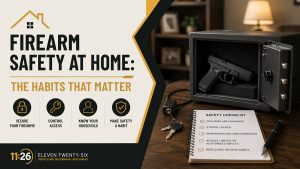
Adults should store every firearm locked, inaccessible to unauthorized users, and according to the manufacturer’s instructions.
A firearm safety switch does not replace a locked container, cable lock, or other access-control device.
Ammunition requires its own access-control decision; storing it separately can add a useful barrier.
Youth shooting requires direct supervision, muzzle control, trigger discipline, action checks, and target verification.
What Is Youth Firearm Safety?
Youth firearm safety means controlling both the firearm and the circumstances in which a young person can encounter or handle it. The framework covers children who never shoot, adolescents learning hunting or marksmanship, parents who own firearms, and families whose children visit homes with guns.
The American Academy of Pediatrics identifies firearms as a major cause of death among U.S. children and adolescents. Its injury-prevention guidance emphasizes that the safest option is removing firearms from a home, while secure storage becomes especially important when a firearm remains present. The Centers for Disease Control and Prevention provides current mortality data by age, intent, and mechanism, so specific rankings and rates should be checked against the latest release rather than treated as permanent.
Youth firearm safety is not the same as teaching a child to operate a gun. For a young child, the safest lesson is refusal and avoidance. For a trained adolescent participating in a supervised activity, safety education includes controlled handling under an instructor’s direct authority.
How Does Youth Firearm Safety Prevent Harm?
Youth firearm safety uses defense in depth: several independent barriers reduce the chance that curiosity, a stolen key, an adult mistake, or a moment of crisis becomes access to a loaded firearm. The strongest plan combines locked storage, restricted access, supervision, clear household rules, and a response routine.
Layer 1: Remove or restrict access
The highest-control option is not keeping firearms in the home. If firearms remain, store them unloaded when appropriate, locked in a secure container, and inaccessible to children, visitors, and unauthorized adults. Store keys, combinations, and biometric access methods so a child cannot use or discover them.
Layer 2: Control ammunition
Ammunition storage is a separate risk decision. A locked ammunition container can create another barrier, but the correct arrangement depends on the firearm, local law, manufacturer instructions, and the household’s emergency plan. Never alter a firearm or storage device in a way that creates a new mechanical hazard.
Layer 3: Train adults and children
Children need a simple response they can remember under stress. Adults need a storage inspection routine and a plan for visitors, playdates, travel, and mental-health emergencies. Education supports physical security; it cannot compensate for an accessible firearm.
Layer 4: Supervise permitted activities
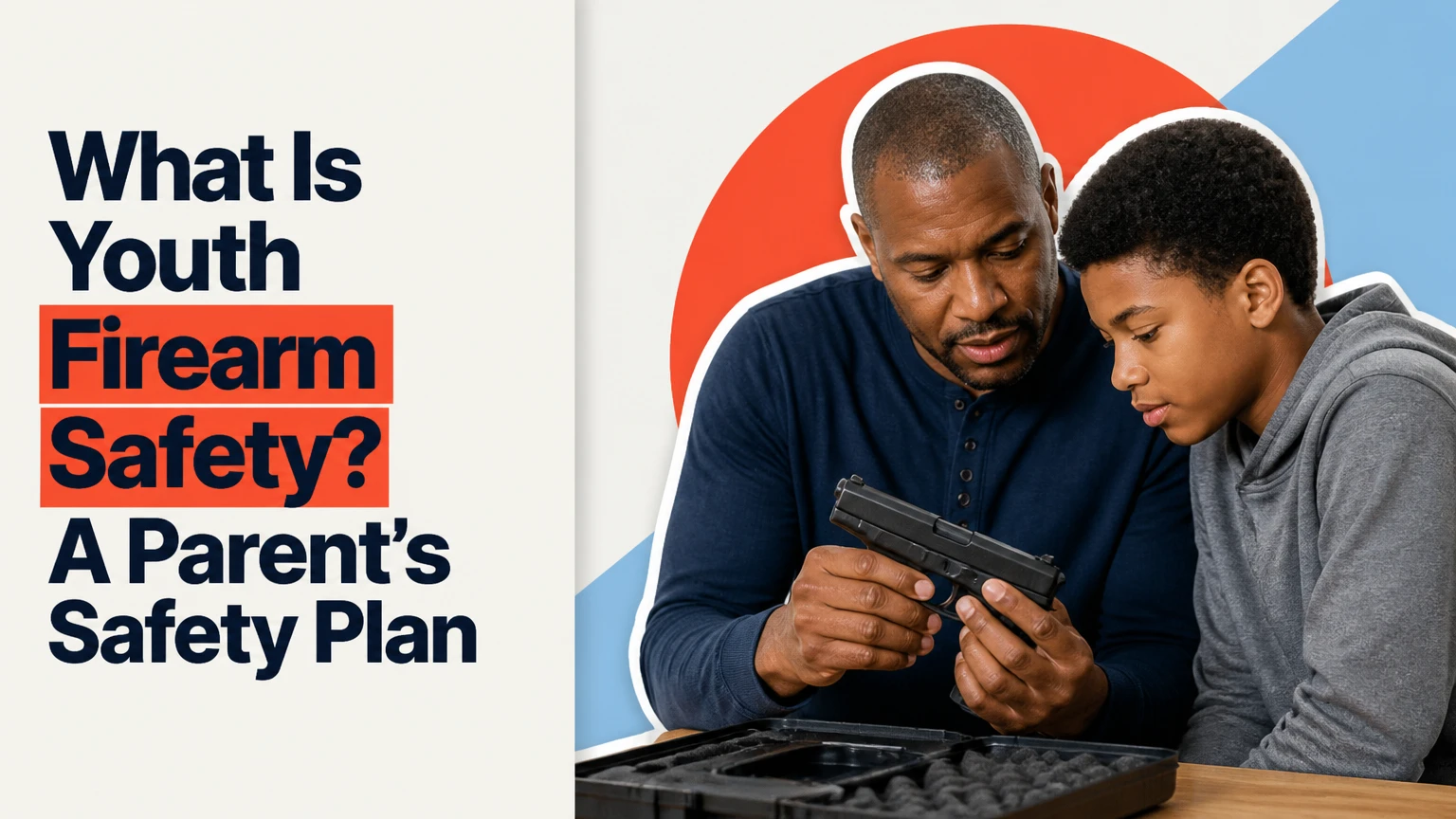
A youth participant should handle a firearm only in a controlled setting with a qualified instructor or responsible adult who can stop the activity immediately. The adult should control loading, unloading, range commands, and access whenever the young person’s skill or attention is uncertain.
What Should a Child Do After Finding a Gun?
A child who finds an unattended firearm should stop, avoid touching it, leave the area, and immediately tell a trusted adult. The child should not test whether the gun is real, move it, unload it, take a photograph, or return to check whether another person has secured it.
Use this four-step sequence:
- Stop. Freeze and keep hands away from the firearm.
- Do not touch. Do not pick up, open, carry, point, or manipulate the gun.
- Leave the area. Walk away and keep other children away without handling the firearm.
- Tell an adult. Report the location to a parent, teacher, range officer, police officer, or another trusted authority.
Programs such as the NRA’s Eddie Eagle GunSafe Program teach a similar “Stop! Don’t Touch. Leave the Area. Tell an Adult.” message. Parents should teach the response without placing a real firearm in a child’s hands. Practice with age-appropriate role-play using a clearly inert training object, then explain that replicas, air guns, and real firearms can be difficult for children to distinguish.
If a firearm appears loaded, is damaged, or is in a public location, adults should keep people away and contact emergency services when there is an immediate danger. Adults should not create additional risk by moving an unfamiliar weapon.
When Can a Teen Handle a Firearm?
A teenager should handle a firearm only in a lawful, structured activity with an appropriate instructor, direct adult supervision, and a firearm suited to the participant. Readiness depends on judgment, impulse control, attention, physical ability, respect for commands, and the ability to stop immediately when told.
A parent should not treat age alone as permission. A mature 16-year-old may still be unsuitable for unsupervised access, while a younger participant in a formal program may safely follow a tightly controlled lesson. State hunting laws, minimum ages, transport rules, and supervision requirements vary, so families should verify requirements with the state wildlife agency.
The National Shooting Sports Foundation’s four primary rules include “Always keep the gun pointed in a safe direction.” A supervised youth activity should also require these operational controls:
- Keep the muzzle pointed toward an approved safe direction.
- Treat every firearm as loaded until an authorized adult verifies its condition.
- Keep the trigger finger straight and outside the trigger guard until the instructor authorizes firing.
- Confirm the target, the area around it, and what lies beyond it.
- Open the action and stop handling when someone moves downrange or when a command is unclear.
- Wear suitable eye and hearing protection and obey range-specific rules.
An instructor should demonstrate each action before the youth performs it. “Safe” does not mean merely having a manual safety engaged. Mechanical safeties can be misunderstood, damaged, or disengaged.
Which Youth Firearm Safety Programs Fit Different Ages?
Accident-prevention lessons fit younger children, while supervised sport and hunter education fit adolescents who demonstrate readiness. Program names, curriculum quality, instructor qualifications, and legal recognition differ by location, so parents should inspect the actual course rather than rely on its label.
| Program type | Typical participant | Typical duration | Main content | Adult-control requirement |
|---|---|---|---|---|
| Refusal and avoidance lesson | Pre-K through elementary school | 1-2 hours | Stop, do not touch, leave, tell | No live-fire handling |
| 4-H Shooting Sports | Often ages 8-18, local rules vary | Multiple sessions | Marksmanship, range commands, responsibility | Certified volunteer supervision |
| USA Clay Target League | Commonly middle and high school | Season-based, often 8-12 weeks | Shotgun sport, team rules, range safety | Coach and range supervision |
| Hunter education | Usually older children and teens | Often 8-16 hours | Laws, conservation, field safety, handling | Certified instructor and adult oversight |
| Scout shooting activity | Age and discipline vary | Single event or multi-session | Range procedure and shooting fundamentals | Qualified range staff |
What should parents check before enrolling?
Parents should confirm the instructor’s certification, the participant-to-instructor ratio, equipment rules, hearing and eye protection, emergency procedures, and whether the course includes live-fire activity. A course that only distributes slogans may not address storage, crisis access, visitors, or the difference between a real firearm and a replica.
Hunter education is not a substitute for home storage. It teaches lawful field conduct and handling in a defined environment, while the home presents different hazards, including unsecured keys, sleeping adults, visitors, and emotional crises.
Which Storage Method Is Safest for Children?
A locked container that prevents unauthorized access is safer than concealment, and the best device depends on the number of firearms, storage location, theft risk, required access speed, and the child’s ability to defeat the lock. No consumer lock should be described as childproof under every circumstance.
| Storage option | Typical price | Access characteristic | Main limitation | Appropriate role |
|---|---|---|---|---|
| Cable lock | $0-$20 | Requires deliberate unlocking | Can be cut and may not prevent theft | Low-cost added barrier |
| Trigger lock | $0-$20 | Blocks trigger access on compatible models | Fit and installation vary; not a full safe | Supplemental lock |
| Biometric lockbox | $100-$300 | Rapid authorized access | Battery, fingerprint, and mounting failures | Quick-access handgun container |
| Steel handgun safe | $80-$400 | Keypad, key, or combination access | Capacity and theft resistance vary | Compact locked storage |
| Heavy gun safe | $500-$2,500 or more | Slower, controlled access | Cost, weight, and installation demands | Multiple firearms and long-term storage |
Cable and trigger locks are not interchangeable with a theft-resistant safe. A trigger lock may prevent a trigger pull, but it does not necessarily stop a person from taking the firearm or handling other controls. Follow the firearm and lock manufacturer’s instructions because an incorrectly installed device can damage equipment or fail to provide the intended barrier.
Biometric boxes can provide fast adult access, but fingerprints can fail because of moisture, injury, age-related changes, or a depleted battery. A responsible owner should test the device regularly and maintain a backup access method that children cannot reach.
A heavy safe needs correct anchoring, a private combination, and enough internal organization to prevent a firearm from remaining outside the locked compartment. A large safe that adults leave open is less protective than a smaller container that is consistently locked.
How Do Storage Options Compare by Household Need?
Storage selection should begin with the child’s access opportunity, not with the product’s marketing category. The key question is whether an unauthorized child can reach the firearm, the ammunition, the key, the code, or the container itself.
| Household situation | Preferred control | Why it fits | Additional check |
|---|---|---|---|
| Infant or toddler at home | Locked safe, unloaded firearm | Removes simple access and handling opportunities | Keep code and key inaccessible |
| Several long guns | Anchored heavy safe | Provides capacity and theft resistance | Verify the door closes and locks |
| One handgun near an adult sleeping area | Properly mounted quick-access safe | Balances controlled adult access with child restriction | Test battery and backup entry |
| Temporary visitor with children | Locked container outside child access | Prevents unfamiliar access during a visit | Ask about firearms in guest homes |
| Teen experiencing a mental-health crisis | Remove firearms from the home | Eliminates immediate household access | Use off-site storage that is lawful and secure |
| Travel or transport | Locked case and legal transport method | Prevents access during transit | Check state and destination rules |
The safest response to a credible suicide risk is to remove firearms from the home, not merely hide them or place a key higher on a shelf. Contact emergency services or a qualified crisis professional when immediate danger exists. Storage decisions during a crisis should follow local law and avoid transferring a firearm to someone who is legally prohibited from possessing it.
What Does Youth Firearm Safety Cost?
Typical costs range from free community-distributed cable locks to more than $2,500 for a large steel safe, while youth classes commonly range from free to $150. Actual prices vary by state, instructor, equipment, program sponsorship, safe size, locking technology, and installation.
| Safety measure | Typical cost | Typical time | Cost driver |
|---|---|---|---|
| Project ChildSafe lock | $0-$20, often free locally | 5-15 minutes to install | Local distribution and compatibility |
| Trigger or cable lock | $0-$20 | 5-15 minutes | Lock type and firearm design |
| Biometric lockbox | $100-$300 | 15-45 minutes to configure | Fingerprint reader, mounting, backup access |
| Heavy gun safe | $500-$2,500+ | 1-4 hours for delivery and setup | Capacity, steel thickness, fire rating, anchoring |
| Refusal lesson | $0-$50 typical | 1-2 hours | Sponsorship and venue |
| Youth shooting or hunter course | $0-$150 typical | 8-16 hours for certification | State rules, range fees, equipment |
Project ChildSafe reports that free firearm safety kits, including cable locks, may be available through participating law-enforcement agencies. Availability is local and should be confirmed before relying on it. A free lock is useful only when it fits the firearm, is installed correctly, and is used consistently.
What Common Safety Mistakes Should Families Fix?
The most frequent failure is treating a child’s knowledge as a substitute for adult-controlled storage. Children may follow a rule during practice and still act impulsively when a friend, crisis, or realistic replica changes the situation.
Mistake 1: Hiding instead of locking
A drawer, closet, nightstand, or high shelf is concealment, not access control. Children can search familiar rooms, observe adult routines, or obtain a key.
Fix: Use a locked container, then confirm that the firearm, ammunition, key, code, and backup entry method are inaccessible.
Mistake 2: Leaving a firearm temporarily accessible
“Only for a minute” creates an access window during phone calls, sleep, bathing, visitors, or household emergencies.
Fix: Establish one rule: when the firearm is not in an adult’s immediate control, it returns to locked storage.
Mistake 3: Relying on a manual safety
A manual safety is a firearm feature, not a child-access solution. It can be disengaged, misunderstood, or mechanically compromised.
Fix: Use safe handling and locked storage regardless of the switch position.
Mistake 4: Ignoring replicas and air guns
Realistic replicas can attract the same curiosity and create confusion during an emergency response. They can also be mistaken for real firearms by police or other adults.
Fix: Store replicas with comparable care, mark them according to applicable law, and teach children never to handle any gun-shaped object.
Mistake 5: Failing to ask about other homes
A parent can secure every firearm at home while a child encounters an unsecured gun at a friend’s house.
Fix: Use the ASK method, commonly associated with Asking Saves Kids: ask directly whether firearms are present and stored locked before a child visits.
Mistake 6: Forgetting access changes
A child’s physical size, reading ability, curiosity, social access, and technology skills change quickly. A storage plan that worked at age six may fail at age twelve.
Fix: Review storage after a move, new firearm purchase, change in custody, household crisis, or child developmental change.
How Should Families Handle Visits, Schools, and Public Places?
Families should ask about firearm storage before playdates and should teach children to leave immediately if they see a gun. Schools, camps, and sports organizations should provide written policies for weapons, emergencies, reporting, and contact with law enforcement.
A non-gun-owning household can use a direct question without accusation: “Are there any firearms in the home, and are they stored locked and inaccessible to children?” If the answer is unclear or the household refuses to discuss storage, choose another location.
A child should not be assigned responsibility for securing another person’s firearm. The child’s role is to avoid, leave, and report. The adult’s role is to control the hazard and contact the appropriate authority.
For travel, adults should use a locked case and verify the laws of the departure state, destination, and any state crossed in transit. Airline, public-transport, campground, and lodging rules can add requirements beyond ordinary home storage.
What Is Youth Firearm Safety During a Mental-Health Crisis?
During a youth mental-health crisis, the safest household action is to remove firearms from the home and restrict access to ammunition until qualified professionals determine that the immediate risk has passed. Locking a firearm in a container may be insufficient if the young person knows the combination or can access the key.
Warning signs requiring urgent attention can include suicidal statements, a stated plan, access to firearms, severe agitation, intoxication, psychosis, or sudden behavioral change. If danger is immediate, call emergency services. In the United States, call or text 988 for the Suicide & Crisis Lifeline, while recognizing that emergency services may be more appropriate when a weapon or imminent attempt is involved.
Off-site storage must comply with local law and should involve a lawful, trusted person or facility. Do not place a firearm with someone who is prohibited from possessing it.
Frequently Asked Questions
Is teaching children about guns enough to keep them safe?
No. Education can improve a child’s response after finding a firearm, but it cannot reliably prevent curiosity, impulsivity, peer pressure, theft, or access during a crisis. The American Academy of Pediatrics recommends removing firearms from homes when possible and using secure storage when firearms remain.
Should ammunition always be stored separately?
Separate locked ammunition storage can add another access barrier, but families should also follow the firearm manufacturer’s instructions and applicable law. The essential requirement is that unauthorized children cannot access a usable firearm, ammunition, keys, combinations, or backup entry systems.
What is the best first lesson for a young child?
The first lesson is simple: stop, do not touch, leave the area, and tell an adult. Parents should use calm repetition and role-play with an inert training object, never a real firearm, and explain that a gun-shaped object may be real even if it looks like a toy.
How often should firearm storage be checked?
Check storage whenever the firearm is put away, and inspect locks, batteries, mounting, keys, and combinations at regular household intervals. A monthly access-control check is a practical rule of thumb, while manufacturer instructions may require more frequent testing for electronic devices.
Are gun safes fireproof?
Some safes carry a tested fire-resistance rating, but “fireproof” is not absolute. Protection depends on the rating, fire duration, installation, seal condition, and safe contents. Fire resistance does not guarantee child resistance, theft resistance, or reliable emergency access.
Can a teenager take a hunter safety course?
A teenager may be eligible for a hunter education course, but eligibility, minimum age, supervision, and licensing rules differ by state. Families should use the state wildlife agency or an approved course provider, then maintain locked home storage regardless of course completion.
The Bottom Line
Youth firearm safety is a layered system, not a single conversation or lock. For children who do not shoot, teach stop, do not touch, leave, and tell; for supervised youth participants, require muzzle control, action checks, trigger discipline, and target verification; for adults, keep firearms and access methods locked and review the plan whenever household circumstances change. Secure storage remains the central protection.