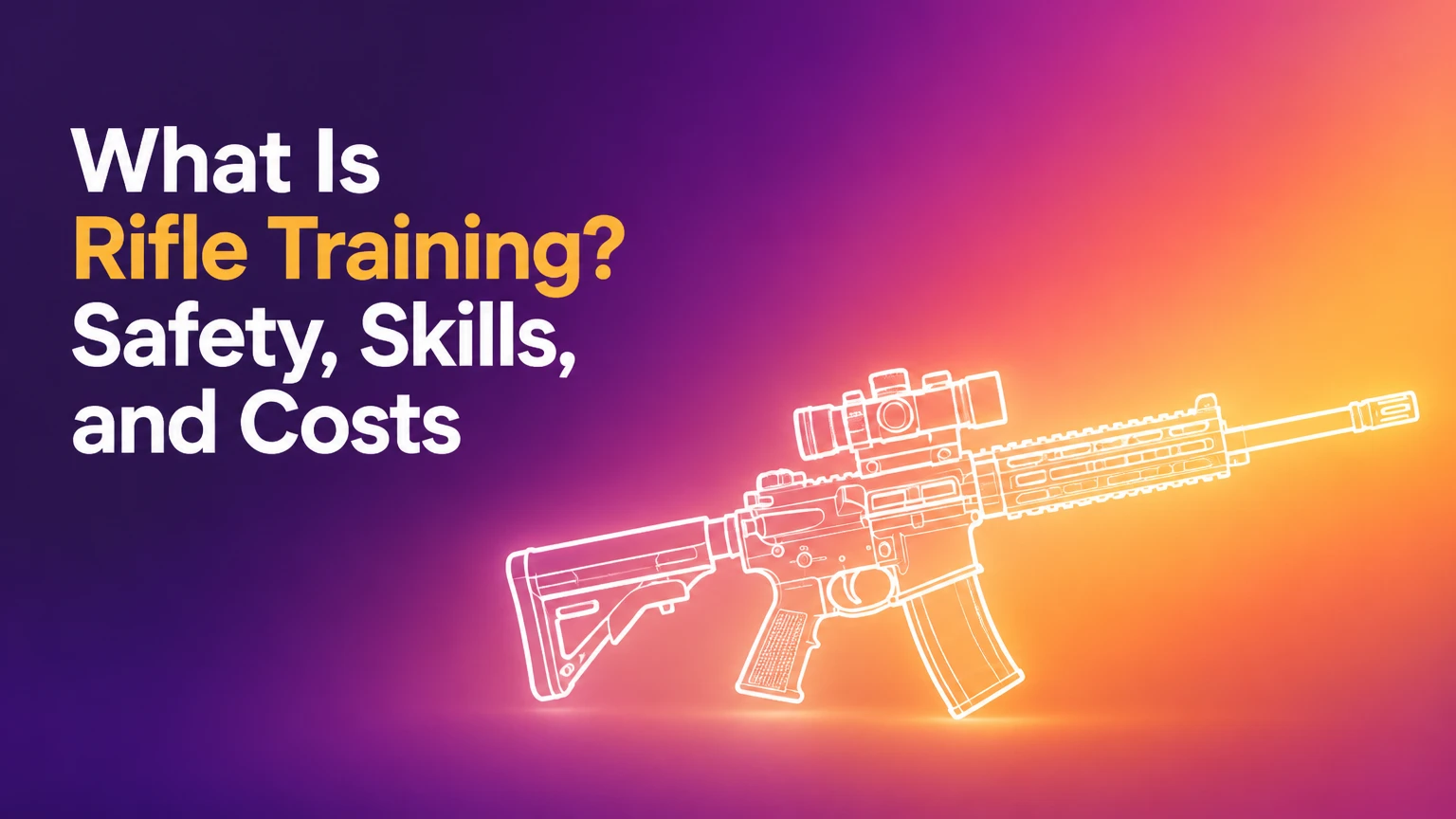
Rifle training is structured instruction that teaches a person to safely handle, operate, maintain, and fire a shoulder-fired rifle. A complete program combines firearm safety, rifle mechanics, marksmanship fundamentals, ammunition knowledge, range procedures, and practice under qualified supervision. The correct course depends on whether the goal is hunting, target shooting, competition, or lawful defensive preparedness.
Key Facts at a Glance
- Rifle training begins with safe handling and supervision before live-fire accuracy work.
- A basic course commonly takes 3-8 hours, while specialized courses may take 1-3 days.
- Typical introductory instruction costs $75-$250 before ammunition, range fees, and equipment.
- Rifle training covers position, sight alignment, trigger control, breathing, recoil management, and follow-through.
- A rifle’s accuracy depends on the shooter, ammunition, optic, mechanical condition, and environmental conditions.
- A certificate proves course completion, not universal competence or legal authorization to use a firearm.
What Does Rifle Training Include?
Rifle training includes safety procedures, mechanical operation, marksmanship, maintenance, ammunition selection, and range judgment. Students learn how to identify the rifle’s controls, verify its condition, use appropriate ammunition, establish a stable position, aim consistently, press the trigger without disturbing the rifle, and respond safely when something does not function as expected.
A responsible course treats safety as a repeated behavior rather than a one-time lecture. The four widely taught rules are to treat every firearm as loaded, keep the muzzle pointed in a safe direction, keep the trigger finger outside the trigger guard until ready to fire, and identify the target and what lies beyond it. Different organizations phrase the rules differently, but the underlying controls are consistent.
Rifle training also teaches the limits of a shooter’s knowledge. A student should know when to stop, ask the instructor, unload under direction, or leave a problem rifle untouched. That judgment matters more than memorizing terminology.
What Skills Are Taught First?
Safety verification and rifle handling come before accuracy drills. In a typical beginner class, the instructor introduces the rifle’s action, safety mechanism, magazine or loading system, sights, stock, barrel, muzzle, chamber, and bolt or charging handle, depending on the design.
The course then connects each control to a safe action. A student may learn how to check whether a rifle is loaded, how to keep the muzzle oriented safely, how to carry it on a range, and how to place it in a rack or case. Exact procedures vary by rifle type and range rules, so an instructor’s method takes priority over generic internet instructions.
How Does Rifle Training Work?
Rifle training works by progressing from low-risk instruction to supervised live fire, while the instructor isolates one variable at a time. The usual sequence is classroom safety, rifle familiarization, unloaded practice, supported shooting, sight adjustment, positional shooting, and evaluation against course-specific standards.
A good curriculum controls pace. Beginners generally benefit from a .22 Long Rifle rimfire rifle or another low-recoil training platform because reduced recoil makes it easier to observe errors without encouraging flinching. A .22 rifle does not reproduce every centerfire experience, but it can teach safe handling and core marksmanship at lower ammunition cost.
Live-fire sessions should use clear range commands, defined firing lines, safe backstops, eye protection, and hearing protection. The instructor watches muzzle direction, loading behavior, trigger-finger discipline, and communication as closely as group size.
Typical Course Sequence
| Stage | Typical time | Main content | Practical checkpoint |
|---|---|---|---|
| Safety classroom | 30-90 minutes | Rules, storage, transport, ammunition, range commands | Student explains safe direction and loading status |
| Rifle orientation | 30-60 minutes | Parts, controls, action type, fit, optic or sights | Student identifies controls without unsafe handling |
| Unloaded practice | 20-45 minutes | Position, sight picture, trigger movement, follow-through | Rifle remains stable during simulated trigger press |
| Supported live fire | 60-120 minutes | Bench or prone support, grouping, basic corrections | Consistent groups appear at a short distance |
| Zero confirmation | 30-90 minutes | Sight or optic adjustment and repeat groups | Point of aim and impact are acceptably aligned |
| Positional practice | 60-150 minutes | Prone, sitting, kneeling, standing, field support | Student maintains safe control in each position |
| Review and assessment | 20-60 minutes | Safety, accuracy, maintenance, next steps | Instructor identifies a safe practice plan |
What Are the Main Types of Rifle Training?
The main types are foundational marksmanship, hunting education, precision or long-range shooting, competition training, and defensive rifle instruction. Each type uses a different standard of success, so a course designed for hunting may not prepare someone for a precision match or a defensive carbine class.
| Training type | Primary goal | Common rifle | Skills emphasized |
|---|---|---|---|
| Beginner fundamentals | Safe operation and basic accuracy | .22 LR bolt-action or semiautomatic | Safety, loading procedures, position, trigger control |
| Hunting marksmanship | Ethical field shots and safe hunting | Centerfire bolt-action or lever-action | Shot placement, field rests, terrain, game laws |
| Precision rifle | Repeatable groups at extended range | Heavy-barrel bolt-action | Ballistics, wind, data logging, stable support |
| Competition shooting | Accuracy under a ruleset and time limit | Rimfire or centerfire match rifle | Stage planning, position changes, scoring, equipment use |
| Defensive rifle | Lawful emergency preparedness | Modern sporting rifle or carbine | Safe storage, identification, recoil control, decision-making |
| Youth or adaptive training | Accessible fundamentals | Low-recoil rifle with fitted support | Supervision, fit, communication, controlled practice |
What Is Long-Range Rifle Training?
Long-range rifle training teaches how distance, bullet trajectory, wind, elevation, ammunition, and rifle setup affect point of impact. The term has no universal distance threshold, although many programs treat 300 yards and beyond as an environment where ballistic calculations and environmental observation become increasingly important.
Students may learn minutes of angle, milliradians, ballistic data, range estimation, wind calls, and the effects of temperature and elevation. The useful lesson is not that a rifle can always hit at a particular distance. The useful lesson is knowing whether the available equipment, conditions, and shooter skill support a responsible shot.
A precision course should include conservative judgment. A small group at 100 yards does not guarantee equivalent performance at 600 yards, because wind uncertainty and shooter position become larger sources of error.
What Are the Four Basic Rifle Shooting Positions?
The four traditional rifle positions are prone, sitting, kneeling, and standing. Prone usually offers the greatest stability, while standing usually demands the most balance and body control, but field supports can change the practical ranking.
| Position | Relative stability | Typical use | Main limitation |
|---|---|---|---|
| Prone | Highest | Bench or open-ground precision | Poor visibility and limited mobility |
| Sitting | Moderate-high | Grass, slopes, and low cover | Hip flexibility and terrain affect fit |
| Kneeling | Moderate | Uneven ground and quick field support | Balance varies with leg and ankle mobility |
| Standing | Lowest | Shorter-distance field shots | Body movement magnifies aiming errors |
| Pack or tripod support | Variable | Hunting or precision field use | Support setup can consume time |
The position should support the rifle through bone structure and stable contact rather than muscular tension alone. A stock that is too long, an optic mounted too high, or a sling adjusted poorly can make a technically correct position uncomfortable and inconsistent.
Why Do Breathing and Trigger Control Matter?
Breathing and trigger control matter because small body movements can shift the sights during the firing cycle. A shooter normally pauses at a comfortable respiratory point, maintains a natural aim, presses the trigger smoothly, and keeps the rifle aligned through recoil and the shot’s release.
The goal is not to hold the breath until uncomfortable. Excessive breath-holding increases tension and can reduce concentration. The instructor should help the student find a repeatable pause rather than prescribe a rigid timing ritual.
What Is Zeroing in Rifle Training?
Zeroing is the process of adjusting a rifle’s sights or optic so the point of aim and point of impact correspond at a selected distance. Common zero distances include 25, 50, and 100 yards, but the appropriate distance depends on the rifle, ammunition, intended use, range, and instructor’s method.
Zeroing is not the same as proving permanent accuracy. A zero can change when the optic moves, ammunition changes, the rifle is damaged, or environmental conditions differ. A responsible shooter confirms the rifle’s zero before hunting, competition, or any activity where a misplaced shot could create harm.
Minute of angle, or MOA, is an angular measurement used to describe group size and sight adjustments. One MOA is approximately 1.05 inches at 100 yards, often rounded to 1 inch for practical discussion. At 200 yards, one MOA is approximately 2.1 inches.
| Distance | Approximate 1 MOA size | Practical interpretation |
|---|---|---|
| 25 yards | 0.26 inches | Useful for initial sight checks |
| 50 yards | 0.52 inches | Common rimfire training distance |
| 100 yards | 1.05 inches | Standard reference distance |
| 200 yards | 2.09 inches | Wind and position become more visible |
| 300 yards | 3.14 inches | Ballistic data becomes more useful |
A beginner should not treat a one-MOA benchmark as a universal pass standard. Rifle capability, ammunition, wind, target size, distance, and course purpose all change what counts as an acceptable result.
How Much Does Rifle Training Cost?
Rifle training typically costs $75-$250 for an introductory class, $200-$500 for a full-day fundamentals course, and $500-$1,500 or more for specialized precision or defensive instruction. The final cost usually adds ammunition, range fees, rifle rental, eye and ear protection, travel, and any required membership.
Prices vary by region, instructor credentials, class size, insurance, facility, and round count. A low tuition price may exclude ammunition and range access, while a higher price may include a loaner rifle, coaching, targets, and equipment support.
| Course format | Typical tuition | Duration | Common additional costs |
|---|---|---|---|
| Safety orientation | $50-$150 | 2-4 hours | $15-$40 range fee, rental if needed |
| Beginner rifle class | $100-$300 | 3-8 hours | $25-$100 ammunition and targets |
| Private instruction | $75-$200 per hour | 1-3 hours | Ammunition, rental, range fee |
| Hunting marksmanship | $150-$400 | 4-8 hours | License education or range charges |
| Precision clinic | $500-$1,500 | 1-3 days | 200-600 rounds, lodging, travel |
| Competition coaching | $150-$500 | Half or full day | Match fee and specialized ammunition |
These figures are typical United States ranges, not fixed national prices. State and local laws may also require a separate hunter education course, firearms safety certificate, permit, or background-check process.
Group Class or Private Instruction: Which Is Better?
Group classes usually provide the lowest cost per student and a structured introduction, while private instruction offers faster correction of individual problems. Beginners with no firearm experience often benefit from a small group if the instructor maintains a low student-to-coach ratio; shooters with a specific recurring error may gain more from private coaching.
| Criterion | Group class | Private lesson | Simulator or dry practice |
|---|---|---|---|
| Typical price | $100-$300 total | $75-$200 per hour | $0-$100 after equipment |
| Student ratio | 4:1 to 12:1 typical | 1:1 | 1:1 |
| Feedback frequency | Every few minutes | Continuous | Software or self-observation |
| Recoil experience | Yes, on a live range | Yes, on a live range | No physical recoil |
| Best use | First course and shared fundamentals | Diagnosis and refinement | Repetition between lessons |
| Main limitation | Less individual time | Higher cost | Cannot validate live-fire behavior |
Simulators can train visual processing and dry practice can reinforce unloaded movement patterns, but neither substitutes for supervised live fire. Recoil, noise, ammunition handling, range communication, and real environmental conditions require an actual range.
How Do You Choose a Rifle Training Course?
Choose a rifle course by matching the curriculum to the intended activity, then verify the instructor, facility, safety procedures, class size, equipment policy, and legal requirements. A course marketed as “advanced” is not automatically appropriate for a first-time shooter or a person who has not demonstrated safe rifle handling.
Use this checklist before booking:
- Define the goal: hunting, target shooting, competition, general safety, or defensive preparedness.
- Check instructor credentials: look for documented teaching experience, current certifications where applicable, insurance, and clear safety policies.
- Ask about class size: confirm the number of students per instructor and the amount of live-fire time.
- Request the equipment list: identify whether the course provides a rifle, ammunition, targets, eye protection, and hearing protection.
- Confirm prerequisites: ask whether previous shooting experience, a license, or a specific rifle platform is required.
- Review the range: verify the backstop, firing-line procedures, weather policy, and emergency plan.
- Confirm the total price: include tuition, ammunition, rental, range fee, targets, and travel.
- Read the learning outcomes: look for measurable skills rather than vague promises of mastery.
The best beginner course spends substantial time on safety and communication. A class that rushes directly to rapid shooting without confirming muzzle and trigger discipline is a poor choice.
What Should a Beginner Bring to Rifle Training?
A beginner should bring government identification if required, weather-appropriate clothing, a brimmed hat, water, eye protection, hearing protection, and only the ammunition specified by the instructor or range. Students should not bring unfamiliar ammunition or modify a rifle immediately before class.
A fitted .22 LR rifle is often a practical starting point because ammunition is widely available and recoil is modest. However, renting the range’s approved rifle can be sensible until the student understands stock fit, sight preferences, and course goals.
Comfort affects performance. A stable closed-toe shoe, clothing that permits kneeling or prone positions, and protection from sun or cold matter during a several-hour class. Electronic hearing protection may make range commands easier to understand, but passive protection remains a useful backup.
What Problems Do New Rifle Shooters Commonly Have?
New rifle shooters most often struggle with flinching, trigger disturbance, inconsistent cheek position, poor eye relief, fatigue, and unsuitable ammunition. Each problem can look like an accuracy failure, but the correction differs, so changing equipment first is often premature.
Flinching and Recoil Anticipation
Flinching occurs when the shooter reacts before the shot, often pushing the rifle, closing the eyes, or tightening the grip. An instructor can reduce the problem with a lower-recoil rifle, shorter practice strings, deliberate pauses, and supervised unloaded or inert-cartridge exercises that comply with the range’s rules.
A heavier rifle or softer-recoiling cartridge may improve comfort, but equipment cannot replace gradual exposure. Pain is a training signal, not a requirement.
Jerking the Trigger
A jerking trigger press moves the rifle as the shot breaks and commonly produces inconsistent groups. The useful correction is a slower, repeatable press while maintaining the sight picture, followed by observation of the rifle’s movement after the shot.
A coin-balance exercise is sometimes used during verified unloaded practice, but home dry fire requires strict compliance with the manufacturer’s instructions and complete ammunition separation. Instructor-led practice is safer for people who are uncertain about unloading procedures.
Poor Stock Fit and Optic Alignment
An inconsistent cheek weld changes the eye’s position behind the sights or optic, which can alter the apparent aiming point. Scope eye relief must also be appropriate for the optic and rifle, because an incorrect distance can produce a restricted sight picture or injury risk under recoil.
The rifle should fit the shooter before accuracy conclusions are drawn. Adjustable stocks, different length-of-pull settings, and properly positioned sights can help left-handed shooters, shorter users, and people with limited shoulder mobility.
Fatigue and Excessive Round Counts
Fatigue reduces concentration and can degrade trigger control, muzzle awareness, and communication. More ammunition does not automatically create better learning, particularly when a student continues firing after the instructor can see a repeated error.
A practical rule is to stop when technique or safety behavior deteriorates, record the lesson’s correction, and resume after rest. The instructor should prioritize quality repetitions over a high round count.
What Rifle Training Does Not Prove
Completing rifle training does not prove that a person can safely use every rifle, make accurate shots in every environment, or understand the laws governing firearm possession and use. A certificate records participation or assessment under specific conditions; it does not replace continued practice, maintenance, judgment, or legal advice.
Training also does not guarantee a particular group size. A rifle may be mechanically accurate while the shooter, ammunition, optic, wind, or support introduces error. Conversely, a tight group at one distance does not establish reliable performance at a longer distance.
Defensive rifle instruction has additional limits. A class cannot predict every real-world event, and no course should encourage unsafe target identification, reckless movement, or unlawful use of force. Storage, access control, de-escalation, and emergency planning belong in the decision alongside marksmanship.
Rifle Training Versus Handgun Training
Rifle training differs from handgun training through greater stock support, longer sight radius, higher potential velocity, greater projectile range, and different storage and handling requirements. Handgun instruction may emphasize one-handed or two-handed grip and concealment, while rifle instruction adds stock fit, sling use, longer sight alignment, and greater attention to backstop distance.
| Attribute | Rifle training | Handgun training |
|---|---|---|
| Primary support | Shoulder stock and both hands | Two-handed grip, sometimes one-handed |
| Typical effective learning distance | 25-100 yards initially | 3-25 yards initially |
| Common beginner platform | .22 LR rifle | .22 LR or 9mm handgun |
| Key fit issue | Length of pull and cheek position | Grip circumference and reach |
| Storage concern | Longer case and greater access footprint | Smaller, easier-to-conceal platform |
| Common goal | Hunting, target, competition, defense | Defensive carry, target, general safety |
Neither discipline automatically transfers to the other. Safe firearm handling principles transfer, but grip, sight alignment, recoil behavior, movement, and legal context require separate instruction.
Is Rifle Training Necessary for Hunting?
Rifle training is strongly recommended for hunting because ethical shot placement depends on safe handling, realistic distance judgment, field positions, and knowledge of the animal and local regulations. Hunter education may also be legally required for a first hunting license, depending on the jurisdiction.
A hunting-focused course should include unloaded rifle handling in terrain, safe muzzle direction, ammunition identification, field rests, shooting from practical positions, and a clear decision to pass on an uncertain shot. Ballistic performance is only one part of the decision.
Hunters should confirm that their rifle, ammunition, optic, and zero match the intended game and local rules. A range group does not replace knowledge of vital anatomy, recovery procedures, land access, season restrictions, and safe transport.
What Is a Realistic Beginner Outcome?
A realistic beginner outcome after one supervised class is safe rifle handling, basic operation under direction, a repeatable supported position, and an understanding of how to practice without reinforcing unsafe habits. Consistent accuracy across distances and positions usually requires multiple sessions rather than one certificate.
| Practice stage | Typical schedule | Reasonable outcome |
|---|---|---|
| First orientation | 1 class, 3-8 hours | Safe handling and basic range communication |
| Early practice | 2-4 sessions over 1-2 months | Repeatable supported groups and stable trigger press |
| Developing skill | 6-12 sessions over 3-6 months | Positional shooting and basic zero confirmation |
| Specialized pathway | 1-3 clinics plus practice | Hunting, precision, or competition-specific skills |
| Maintenance | 1 session every 1-3 months | Retained safety habits and verified equipment familiarity |
These are typical practice ranges, not guarantees. Vision, mobility, prior experience, equipment fit, coaching quality, and access to a safe range all affect progress.
Frequently Asked Questions
Can I learn rifle shooting without owning a rifle?
Yes, many ranges and instructors provide approved rental rifles and may offer ammunition packages. Renting first can prevent an expensive mismatch between the rifle’s stock dimensions, sighting system, recoil level, and the student’s intended activity. Confirm availability, caliber restrictions, cleaning requirements, and rental fees before attending.
Is rifle training suitable for children?
Youth rifle training can be suitable when local law permits it, the child is mature enough to follow instructions, and a qualified instructor provides continuous adult supervision. A low-recoil platform, correctly fitted stock, eye and hearing protection, and short sessions are preferable. A child should never handle a firearm without the responsible adult’s direct control and clear safety plan.
How often should someone practice rifle skills?
A new shooter may benefit from one supervised session every 2-4 weeks, with brief safe practice between sessions when the firearm is completely unloaded and the manufacturer and instructor permit dry fire. Frequent short sessions usually reinforce technique better than occasional high-round-count days, because fatigue and discomfort can conceal mistakes.
Do I need a license to take rifle training?
Course attendance and firearm possession requirements vary by country, state, province, age, and rifle type. Some jurisdictions require hunter education for licensing, while others regulate possession, transport, or particular firearms separately. Contact the range, instructor, and relevant government agency before booking rather than treating a general course as legal advice.
What caliber is best for rifle training?
A .22 LR rifle is often the most forgiving training option because recoil and ammunition cost are relatively low, but the best caliber depends on the goal. Hunting requires a lawful cartridge suitable for the game, while precision training may use a centerfire platform. An instructor can match the rifle to the student’s body size, range, and intended use.
Can dry fire replace live-fire rifle training?
Dry fire can reinforce trigger movement, sight alignment, and position without ammunition cost, but it cannot reproduce recoil, sound, live-range commands, ammunition handling, or bullet impact. Dry practice should occur only after complete unloading and separation from ammunition, with the rifle’s manual and a qualified instructor’s safety guidance controlling the procedure.
The Bottom Line
Rifle training is supervised education in safe firearm handling, rifle operation, marksmanship, maintenance, and judgment. Start with a safety-first fundamentals course, choose instruction that matches the goal, use suitable low-recoil equipment when appropriate, and measure progress through safe behavior and repeatable results rather than round count alone. Understanding what rifle training is helps a beginner choose instruction responsibly.
Title tag: What Is Rifle Training? Safety, Skills, and Costs
Meta description: Compare rifle courses from $75 to $1,500, see the usual 3-8 hour beginner path, and choose instruction for hunting or target shooting.