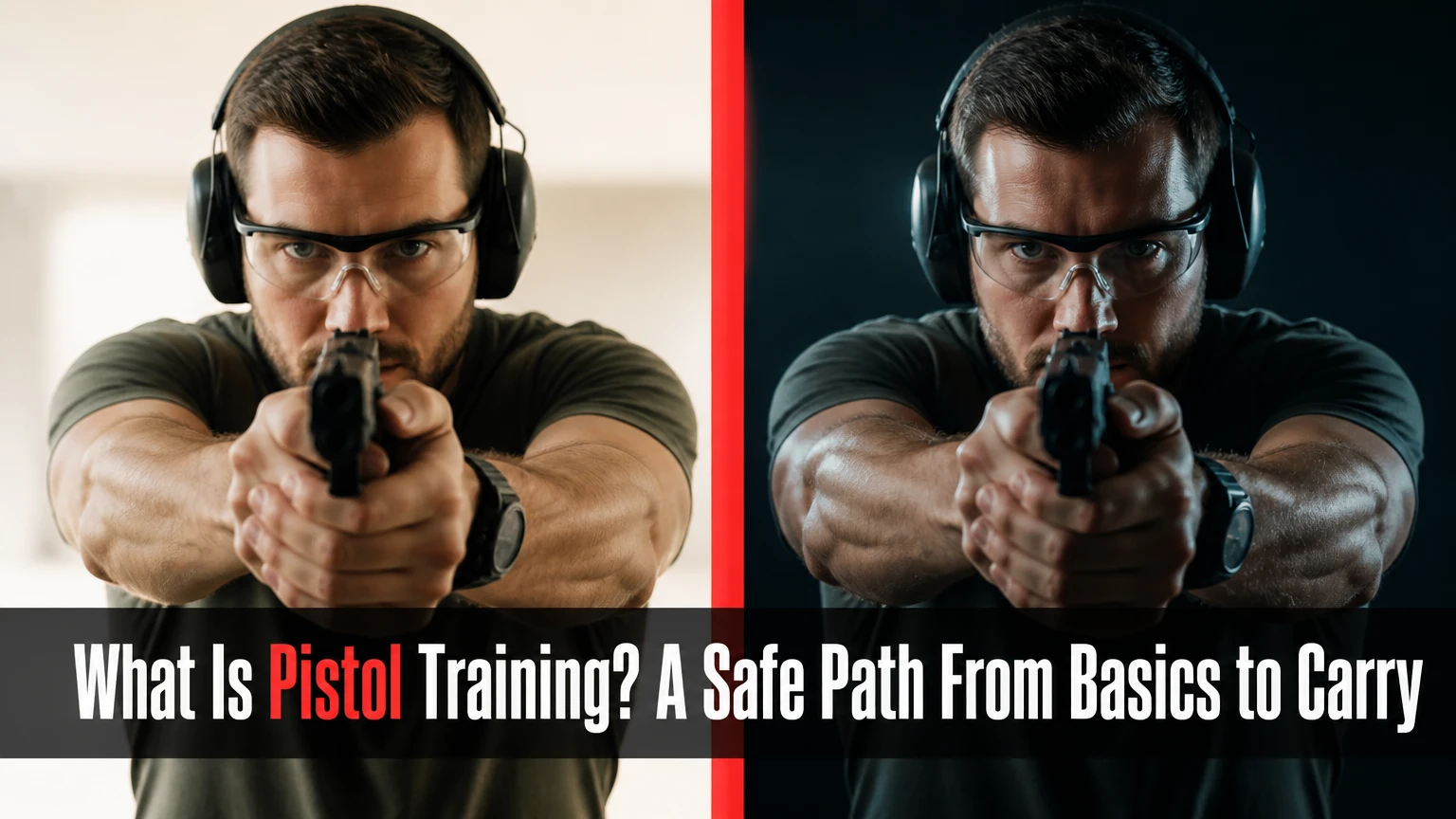
Pistol training is a structured program that teaches safe handgun handling, mechanical operation, marksmanship, judgment, and responsible storage or carry. It combines classroom instruction, supervised practice with an unloaded firearm, and controlled range work, then adds specialized skills such as competition, home defense, or concealed carry when appropriate.
Key facts at a glance
Pistol training develops safety habits before speed or tactical skills.
A complete beginner course commonly takes 2-4 hours and uses approximately 50-100 rounds.
Dry practice can improve grip and trigger consistency, but it cannot reproduce recoil or range conditions.
Defensive and concealed-carry courses require legal instruction in addition to shooting practice.
A qualified instructor should teach the firearm’s manual, range procedures, loading, unloading, and malfunction response.
Local laws determine permit, transport, storage, and defensive-force requirements.
What Does Pistol Training Include?
Pistol training includes the knowledge, physical skills, judgment, and safety behavior required to operate a handgun responsibly. A quality program teaches how the firearm works, how to handle it without endangering others, how to fire controlled shots, and how to make lawful decisions about possession or use.
The central entity is the handgun, which may be a semi-automatic pistol or revolver. A semi-automatic pistol typically uses a detachable magazine and a reciprocating slide, while a revolver stores cartridges in a rotating cylinder. Their controls, loading procedures, sight systems, trigger characteristics, and malfunction procedures differ.
Training is therefore more than target shooting. A student must understand muzzle direction, trigger discipline, ammunition identification, backstop awareness, hearing protection, eye protection, and safe storage. Marksmanship is only one part of competence.
The National Rifle Association’s widely repeated safety wording begins, “Always keep the gun pointed in a safe direction.” The specific wording and number of rules vary among organizations, but the underlying principle is consistent: prevent an unintentional discharge from injuring a person or damaging property.
What Is Pistol Training Designed to Improve?
Pistol training improves four connected abilities:
- Knowledge: firearm parts, controls, ammunition, basic ballistics, range commands, and applicable law.
- Handling: safe loading, unloading, holstering where authorized, storage, and cleaning.
- Marksmanship: grip, stance, sight use, trigger press, recoil management, and follow-through.
- Judgment: identifying a safe target, recognizing when not to shoot, and understanding legal responsibility.
A student can group shots tightly and still lack safe handling habits. Conversely, a safety-conscious owner may need additional coaching to improve accuracy. Instructors should evaluate both dimensions separately.
How Does Pistol Training Work?
Pistol training normally follows a crawl, walk, run progression: understand the task, perform it slowly under supervision, and increase complexity only after safe consistency appears. The progression starts with unloaded handling and simple targets, then introduces live ammunition, distance, time pressure, movement, or multiple targets according to the course objective.
Stage 1: Learn Safety and the Firearm
Students first learn four broadly accepted rules:
- Treat every firearm as if it is loaded.
- Keep the muzzle pointed in a direction where an unintended discharge would cause the least harm.
- Keep the trigger finger outside the trigger guard until the sights are on the intended target and shooting is justified.
- Identify the target, what is around it, and what is beyond it.
An instructor should also cover the owner’s manual, chamber and magazine status, operating controls, ammunition compatibility, and the facility’s cease-fire procedure. Eye and ear protection should be worn on the range. A loaded firearm should never be handled casually, and a student should stop immediately when uncertain.
Stage 2: Practice Unloaded Fundamentals
Dry practice means rehearsing firearm handling without live ammunition. It can develop a repeatable grip, presentation to the target area, sight alignment, trigger movement, and reload motions when an instructor has confirmed the practice area is safe.
A safe dry-practice routine begins by removing all live ammunition from the room, unloading the firearm according to its manual, inspecting the chamber and magazine well, and keeping ammunition in a separate location. A second visual and physical check is prudent. The firearm should point toward a safe backstop or direction throughout the exercise.
Dry practice does not teach recoil control, noise management, range etiquette, or the effects of stress. It complements supervised live-fire training rather than replacing it.
Stage 3: Apply Skills With Live Fire
Live-fire instruction introduces ammunition, recoil, noise, bullet impact, and the need to follow range commands. The instructor normally begins at a short, fixed distance with deliberate shots, then reviews groups and handling before changing one variable at a time.
A useful coaching sequence isolates the cause of an error. The instructor may examine the shooter’s grip, sight movement, trigger press, stance, and visual focus rather than immediately prescribing faster shooting. Slow, repeatable shots often reveal more than hurried repetitions.
Stage 4: Add a Specific Purpose
Advanced pistol training should have a defined purpose. Concealed-carry training may address holster selection, presentation from ordinary clothing, retention, legal decisions, and avoidance. Competitive training may emphasize stage planning, movement within match rules, reload consistency, and time management. Defensive classes may address decision-making and communication, but students should avoid courses that prioritize dramatic scenarios over safe supervision.
What Are the Main Types of Pistol Training?
The main categories are introductory, marksmanship, concealed-carry, defensive, competitive, and instructor-level training. Course names are not standardized, so the syllabus matters more than the title.
| Training type | Typical duration | Typical cost | Typical live ammunition | Primary outcome |
|---|---|---|---|---|
| Introductory handgun | 2-4 hours | $75-$150 | 50-100 rounds | Safe operation and basic accuracy |
| CCW or permit course | 4-16 hours | $100-$250 | 50-200 rounds | Legal education and qualification |
| Defensive pistol | 1-2 days | $250-$600 | 300-600 rounds | Decision-making and applied skills |
| Competitive pistol | 4-8 hours or match-based | $100-$400 | 150-500 rounds | Match procedures and performance |
| Private coaching | 1-hour blocks | $50-$120 per hour | Instructor-dependent | Individual diagnosis and correction |
Introductory and Basic Marksmanship
Basic training is the appropriate starting point for a person with little or no handgun experience. Lessons usually cover firearm safety, loading and unloading, grip, stance, sight alignment, trigger press, recoil, and paper-target evaluation.
A .22 Long Rifle handgun can reduce recoil and ammunition cost for some learners, although the firearm should still resemble the controls and grip style of the handgun they intend to use. A small, lightweight pistol is not automatically easier for a beginner because reduced weight can increase felt recoil.
Concealed-Carry and Permit Training
A concealed-carry course may combine classroom instruction, a written test, live-fire qualification, and state-specific legal information. Requirements differ substantially by jurisdiction. Some states require a permit, some recognize permits from other states, and some impose separate rules for carrying in vehicles, schools, government buildings, or private businesses.
A permit class is a legal and introductory course, not proof of defensive proficiency. Students who plan to carry should seek additional instruction on safe holster use, ordinary clothing, storage, conflict avoidance, and the legal consequences of displaying or firing a handgun.
Defensive Handgun Training
Defensive handgun courses focus on judgment, communication, access, safe movement, and accuracy under realistic but controlled conditions. Legitimate instruction places safety boundaries around any work involving holsters, movement, low light, or unusual positions.
Defensive training is not a license to pursue confrontation. A responsible course should repeatedly address avoidance, emergency communication, medical response, identification, and the fact that a firearm may increase danger when carried or stored carelessly.
Competitive Pistol Training
Competitive pistol training uses formal rules and measurable results. USPSA, IDPA, and Steel Challenge differ in stage design, equipment rules, scoring, and movement requirements. Competition can improve safe gun handling, match preparation, and performance under a timer, but competition habits do not automatically transfer to defensive encounters.
Which Pistol Training Format Fits Your Goal?
The best format depends on experience, purpose, budget, and the amount of individual feedback required. A small group class is usually efficient for basic safety, while private coaching becomes more valuable when a shooter has a persistent accuracy or handling problem.
| Format | Typical class size | Feedback level | Recoil exposure | Best use |
|---|---|---|---|---|
| Group class | 4-12 students | Moderate | Full live-fire | First course and shared fundamentals |
| Private lesson | 1 student | High | Full live-fire | Correcting a specific recurring error |
| Simulator session | 1-4 users | Software-dependent | None | Judgment practice and orientation |
| Dry practice | 1 person | Self-directed | None | Repetition of safe basic movements |
| Competition practice | 4-15 shooters | Peer and coach feedback | Full live-fire | Match skills and timed performance |
Are Simulators as Effective as Live Fire?
Simulators are useful for visual decision-making, range orientation, and some presentation or aiming exercises, but they cannot reproduce real recoil, blast, ammunition handling, or bullet impact. A simulator should supplement, not replace, supervised live-fire practice.
Dry-fire systems can provide useful feedback about movement during a trigger press. Electronic devices may show muzzle motion or shot timing, but the data still depends on correct setup and interpretation. A device cannot identify every safety problem or determine whether a defensive action is lawful.
Group Class or Private Coaching?
A group class usually costs less and exposes students to a standardized curriculum, range commands, and different learning speeds. Its limitation is attention: an instructor cannot diagnose every grip, vision, mobility, or comprehension issue equally.
Private coaching costs more, but one hour can resolve a problem that repeated unsupervised practice reinforces. The best choice for a first-time shooter is often a small introductory class followed by private coaching if progress stalls.
What Should You Bring to a First Pistol Class?
A first class generally requires eye and ear protection, comfortable clothing, closed-toe shoes, water, identification, and any paperwork required by the range. The facility may provide a firearm, ammunition, targets, and a secure storage area, but students should confirm those details before arriving.
| Item | Typical requirement | Why it matters | Selection note |
|---|---|---|---|
| Eye protection | 1 pair, impact-rated | Protects against fragments and ejected cases | Clear lenses suit indoor ranges |
| Hearing protection | 1 set of earmuffs or plugs | Reduces impulse noise exposure | Double protection helps new shooters |
| Ammunition | 50-100 rounds for basics | Supports deliberate supervised practice | Confirm caliber and range rules |
| Targets | 1-3 paper targets | Shows group size and point of impact | Use the instructor’s target choice |
| Firearm | 1 compatible handgun, if allowed | Provides platform-specific practice | Rental availability varies |
| Secure storage | 1 locked container at home | Prevents unauthorized access | Follow local law and manufacturer guidance |
Students should wear a shirt with a modest collar, avoid loose scarves or dangling jewelry, and bring a brimmed cap for indoor ranges if recommended. A person with prescription glasses should ask whether additional protective eyewear fits over them.
How Do You Choose a Qualified Instructor?
Choose an instructor who can explain credentials, course objectives, safety procedures, student limits, and emergency plans before accepting payment. Certification alone is not enough; teaching ability, current knowledge, supervised experience, and a disciplined range culture matter just as much.
Ask these questions before booking:
- What organization or agency issued the instructor’s current certification?
- How many students will share one instructor?
- Is the firearm supplied, rented, or student-owned?
- What happens if a student is uncomfortable or makes a safety error?
- Does the course include classroom, dry practice, and live fire?
- What are the ammunition, caliber, cancellation, and protective-equipment rules?
- Does the instructor explain local storage, transport, permit, and defensive-force laws?
- Is a first-aid kit and emergency-action plan present at the facility?
Red flags include promises of instant proficiency, pressure to buy a particular firearm, unsafe demonstrations, uncontrolled rapid fire, contempt toward beginner questions, or tactical branding without a detailed syllabus. A professional instructor welcomes questions about boundaries.
How Often Should You Practice Pistol Skills?
A beginner benefits from short, regular practice rather than occasional exhausting sessions. A typical plan is one supervised live-fire session every 2-4 weeks, combined with 10-15 minutes of verified safe dry practice once or twice weekly when local law, household conditions, and the firearm manual permit it.
Practice should track a specific objective. Examples include keeping five-shot groups within a defined target area at a fixed distance, operating controls without sweeping another person, or maintaining a consistent trigger press. Speed should be added only after safe, repeatable performance.
An instructor can establish a baseline during the first lesson. Record date, firearm, ammunition, distance, target, group size, and observed handling errors. That record distinguishes genuine improvement from a good or bad session caused by fatigue, ammunition, or unfamiliar equipment.
Why Do Pistol Shooters Miss the Target?
Pistol accuracy problems usually come from inconsistent trigger movement, changing grip pressure, poor visual focus, or an unsuitable setup rather than from a single universal “error chart.” The instructor should diagnose the shooter while observing the firearm and target, because the same group location can have different causes.
Anticipating Recoil
Anticipating recoil often causes the shooter to tighten the hands or push the muzzle before the shot. A qualified instructor can use inert training devices or a carefully supervised ball-and-dummy exercise, following range rules and confirming that all participants understand the procedure.
The correction is not to force the trigger break into a surprise. The correction is a steady press, consistent support-hand pressure, and visual attention to the sights while accepting the firearm’s normal movement.
Changing Grip Pressure
“Milking” the grip means contracting the fingers as the trigger finger moves. That movement can disturb alignment and spread shots. A stable two-hand grip should remain consistent through the press, while the trigger finger moves independently.
Hand size, grip texture, fatigue, and firearm weight influence this error. A smaller handgun may fit poorly even when its dimensions appear convenient for concealed carry.
Looking at the Target Instead of the Sights
Sight focus depends on the task and distance. At slower, precision-oriented distances, a clear front sight or aiming reference helps alignment; at closer distances, target-focused methods may be taught for speed and awareness. No single visual rule fits every distance, optic, or training objective.
Beginners should follow the instructor’s method and change only one visual habit at a time. Shooters using prescription lenses or red-dot optics may need a separate vision assessment.
What Pistol Training Cannot Teach by Itself
Pistol training cannot guarantee accuracy under every stress condition, predict a violent encounter, or replace legal advice from a qualified local professional. A class also cannot make an unsuitable firearm comfortable, remove the need for secure storage, or turn a permit qualification into broad defensive competence.
Ammunition shortages, range restrictions, hearing sensitivity, limited hand strength, poor vision, mobility limitations, and anxiety can change the learning experience. Instructors can often adapt distance, targets, pace, grip method, and equipment, but students should disclose relevant limitations before training begins.
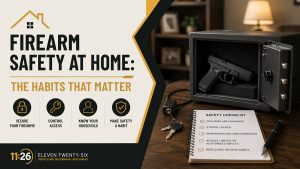
Home-defense planning has additional limits. A firearm may be inaccessible when locked properly, and a readily accessible firearm may create risk for children, visitors, or unauthorized users. The plan should include secure storage, emergency communication, identification, and family procedures rather than relying on shooting skill alone.
Which Training Path Fits Different Shooters?
Different goals require different next steps, and the safest progression begins with basic instruction even when the eventual objective is competition or defensive carry.
- Absolute beginner: Take a 2-4 hour introductory course with a low student-to-instructor ratio. Rent or borrow equipment only through a lawful, supervised range arrangement, and avoid buying a handgun before trying suitable grip sizes.
- New owner: Read the owner’s manual, confirm ammunition compatibility, learn the controls, and schedule a basic live-fire lesson before practicing alone.
- Prospective concealed carrier: Complete the required state course, then take additional instruction on holster safety, storage, clothing, judgment, and avoidance. Do not confuse the permit process with proficiency training.
- Home-defense planner: Begin with safe storage and emergency planning, then seek a course that addresses identification, communication, low-light limitations, and responsible decision-making.
- Competitive shooter: Learn match rules and safe movement through a supervised club or introductory competition. Select equipment after understanding division rules and fit.
- Intermediate shooter with a plateau: Use one private coaching session to identify the limiting factor, then practice a measured correction instead of adding random drills.
Frequently Asked Questions
Is pistol training required to buy a handgun?
Federal and state requirements differ, and some jurisdictions impose training before purchase, possession, or carrying while others do not. Legal requirements can also change by location and firearm type. Regardless of the minimum law, formal instruction is strongly advisable before handling a handgun independently.
Is a pistol the same as a handgun?
A handgun is the broad category of firearms designed for one-handed or two-handed use. A pistol commonly refers to a handgun with a chamber integrated into the barrel and a repeating slide or similar action, while a revolver uses a rotating cylinder. Everyday usage sometimes treats pistol and handgun as synonyms.
How long does it take to become proficient with a pistol?
Basic safe operation may be introduced in one 2-4 hour class, but proficiency requires repeated practice and evaluation over time. The needed duration depends on the learner’s coordination, vision, experience, firearm fit, training frequency, and goal. Safe handling should precede accuracy, speed, or defensive scenarios.
Can I learn pistol training entirely online?
Online videos and simulator programs can explain terminology, equipment, and some visual concepts, but they cannot verify muzzle direction, trigger discipline, recoil management, or safe ammunition handling in person. Online material should prepare a student for instruction, not replace a qualified instructor and supervised range session.
Should beginners start with a small pistol?
Small pistols are easier to carry but often produce more felt recoil, have shorter grips, and offer less control surface. A beginner should prioritize safe handling, comfortable reach to the controls, manageable recoil, and reliable fit over minimum size. Trying several lawful rental options with an instructor is more useful than choosing by appearance.
The Bottom Line
Pistol training is the structured development of safe handgun handling, mechanical knowledge, marksmanship, judgment, and responsible storage or carry practices. A sound progression begins with an instructor-led safety and fundamentals course, adds supervised live fire, measures improvement, and then branches into concealed carry, defensive, recreational, or competitive training.
The best program is not the most dramatic or expensive one. It is the course with a clear syllabus, qualified supervision, appropriate equipment, realistic boundaries, and enough practice to build safe consistency. That is what pistol training should provide.