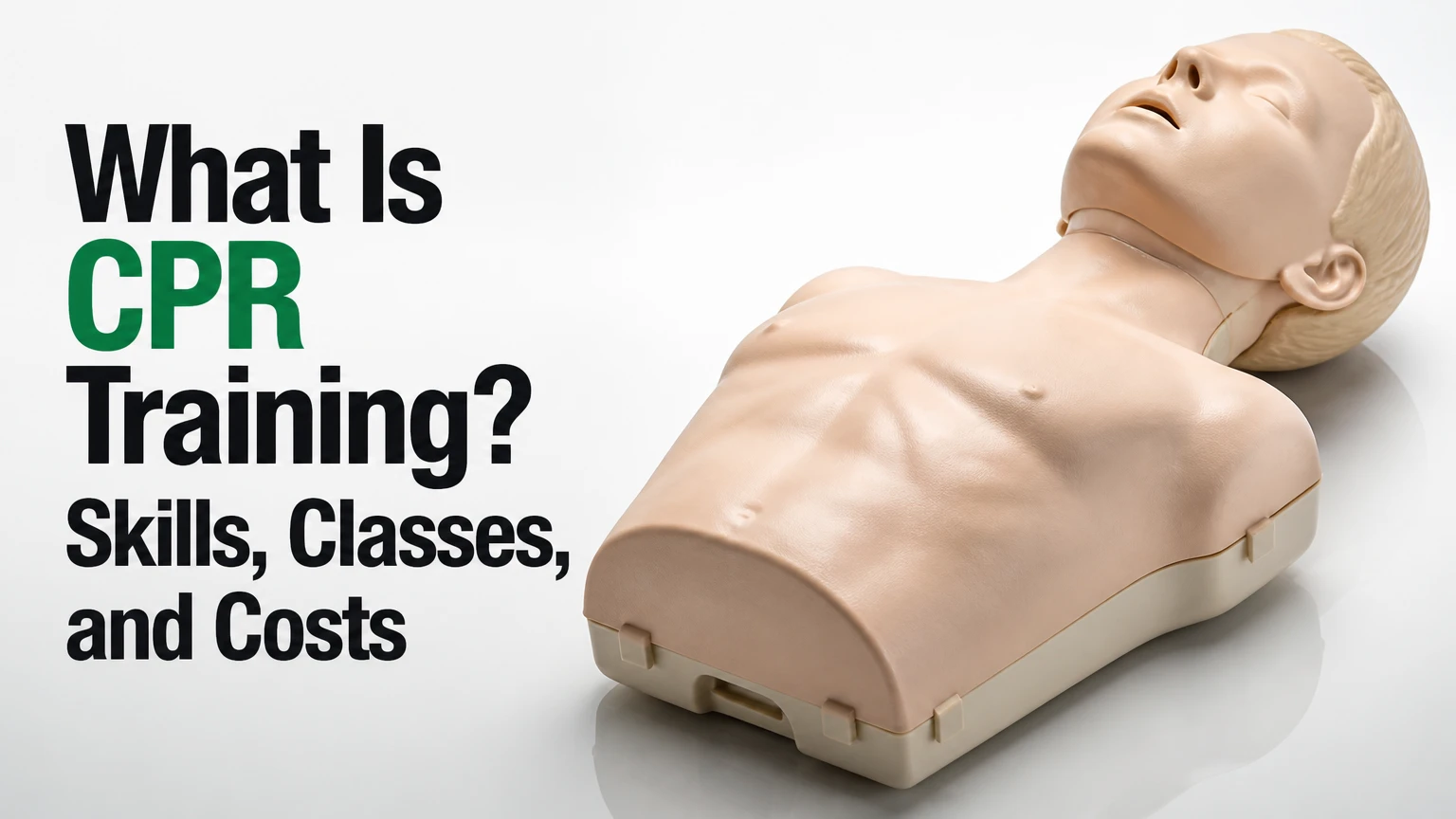
CPR training is instruction that teaches a person to recognize cardiac arrest, start chest compressions, provide appropriate rescue breaths, use an automated external defibrillator (AED), and continue care until emergency medical services arrive. Cardiopulmonary resuscitation does not restart every stopped heart, but it temporarily maintains blood flow and oxygen delivery to the brain and other organs.
Key Facts at a Glance
CPR training teaches recognition, chest compressions, rescue breathing, AED operation, and emergency communication.
Adult compressions are performed at 100-120 per minute, with a depth of about 2-2.4 inches, or 5-6 centimeters.
Standard CPR uses 30 compressions followed by 2 breaths when the rescuer is trained and willing to give breaths.
Hands-only CPR is appropriate for many sudden adult collapses, while children, infants, drowning victims, and opioid overdoses may need breaths.
Most United States CPR certification cards are valid for two years, but an employer or licensing body may set different rules.
An AED analyzes the heart rhythm and gives a shock only when its software identifies a shockable rhythm.
What Does CPR Training Teach?
CPR training teaches a coordinated emergency response rather than chest compressions alone. A typical course covers scene safety, recognition of cardiac arrest, activation of emergency services, high-quality compressions, rescue breaths, AED use, choking response, and age-specific technique.
Cardiac arrest means the heart has stopped pumping blood effectively. The person is usually unresponsive and not breathing normally, although abnormal gasping can occur. The American Heart Association (AHA) describes CPR as a way to maintain circulation until a more definitive treatment, particularly defibrillation, becomes available.
CPR cannot replace emergency medical care, diagnose the cause of collapse, or guarantee survival. Training improves the chance that a bystander will act quickly and correctly, especially when practice mannequins provide feedback about compression rate, depth, recoil, and hand position.
Why Is CPR Performed?
CPR is performed to move oxygenated blood to the brain and heart during cardiac arrest. Permanent brain injury can begin within minutes when circulation stops, although the exact timeline varies with temperature, cause of arrest, prior health, and the speed of professional treatment.
The AHA’s 2025 Guidelines for CPR and Emergency Cardiovascular Care emphasize early recognition, immediate CPR, rapid AED use, and high-quality compressions as linked parts of the adult chain of survival. CPR mainly buys time. An AED and advanced medical treatment address the underlying electrical or medical problem.
How Does CPR Work?
Chest compressions mechanically squeeze the heart and raise pressure inside the chest, producing limited blood flow to vital organs. Releasing pressure completely allows the heart and chest to refill, while rescue breaths add oxygen when ventilation is needed.
The mechanism is simple but physically demanding. Compression quality declines when a rescuer bends the elbows, leans on the chest, pauses too long, or moves away from the correct hand position. AHA instructor materials use the phrase, “Push hard and fast in the center of the chest,” a concise description of the two most important adult compression principles.
Early defibrillation matters because CPR alone may not correct ventricular fibrillation or pulseless ventricular tachycardia. The AED determines whether a shock is advised; rescuers should never touch the person during rhythm analysis or shock delivery.
What Are the Main CPR Numbers?
The principal adult CPR numbers are 100-120 compressions per minute, 5-6 centimeters of depth, a 30:2 compression-to-breath ratio, and pauses shorter than 10 seconds. Child and infant technique uses the same general rate and ratio for one rescuer, but compression depth and hand placement change with body size.
| Person | Compression rate | Compression depth | One-rescuer ratio | Hand position |
|---|---|---|---|---|
| Adult | 100-120/minute | 5-6 cm, 2-2.4 in | 30:2 | Center of chest, lower half of sternum |
| Child | 100-120/minute | About one-third chest depth, roughly 5 cm | 30:2 | One or two hands, depending on size |
| Infant | 100-120/minute | About one-third chest depth, roughly 4 cm | 30:2 | Two fingers or two-thumb encircling technique, according to course guidance |
| Two rescuers, child or infant | 100-120/minute | One-third chest depth | 15:2 | Two-thumb encircling technique often taught for infants |
The phrase “exactly one-third” should not be interpreted as a measurement that rescuers can calculate during an emergency. Training focuses on approximately one-third of the chest’s front-to-back depth, with full recoil and minimal interruption.
What Are the Steps in an Emergency CPR Response?
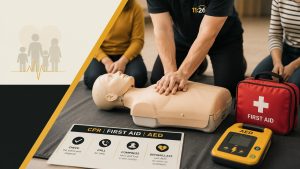
A trained responder should make the scene safe, check responsiveness and breathing, activate EMS, begin compressions, provide breaths when appropriate, and apply an AED as soon as one arrives. The entire sequence should be fast, with no prolonged search for a pulse by an untrained lay rescuer.
Step 1: Check Scene Safety
Confirm that traffic, electricity, fire, water, violence, or hazardous substances do not put the rescuer at unreasonable risk. Move only when necessary to remove an immediate danger, because unnecessary movement can worsen an injury.
Step 2: Check Responsiveness and Breathing
Tap the shoulders and ask loudly, “Are you okay?” Check breathing for no more than 10 seconds. Normal breathing means regular, effortless breathing; occasional gasps, snorts, or irregular sighs are not normal breathing and should be treated as possible cardiac arrest.
Step 3: Call EMS and Get an AED
Call the local emergency number, place the phone on speaker, and send a specific bystander for an AED. Naming the person, such as “You in the blue shirt, call EMS,” is more reliable than giving a general instruction to a crowd.
Step 4: Start Chest Compressions
Place the heel of one hand in the center of the adult’s chest on the lower half of the sternum, place the other hand on top, and keep the arms straight. Compress at 100-120 per minute, reach approximately 5-6 centimeters in an adult, and allow complete recoil after every compression.
Step 5: Add Rescue Breaths When Appropriate
Trained rescuers who are willing to give breaths generally provide two breaths after every 30 compressions. Each breath lasts about one second and should produce visible chest rise, not forceful inflation. A pocket mask or bag-valve mask reduces direct mouth contact when the rescuer has the equipment and training.
Step 6: Apply the AED
Turn on the AED, expose and dry the chest, attach the pads as shown, and follow every voice prompt. Stop compressions only when the AED says to analyze or deliver a shock, then resume CPR immediately when instructed.
Who Should Take CPR Training?
The right course depends on the learner’s role, the age groups they may assist, and whether a licensing authority requires a specific provider. A parent needs different practice from a hospital employee, even though both may learn adult, child, and infant fundamentals.
| Course type | Intended learner | Core skills | Typical time | Typical United States cost |
|---|---|---|---|---|
| Hands-only community session | General public, students, families | Adult compressions, recognition, emergency call | 30-60 minutes | Free-$25 |
| Heartsaver CPR/AED | Teachers, coaches, office staff, fitness workers | Adult, child, infant CPR, AED, often choking | 3-4 hours | $50-$110 |
| Pediatric first aid and CPR | Parents, babysitters, daycare staff | Infant and child CPR, breaths, choking, first aid | 4-8 hours | $70-$150 |
| BLS | Nurses, EMTs, physicians, dentists, medical students | Single- and two-rescuer CPR, ventilation, team response | 3-5 hours | $60-$150 |
| Professional rescuer course | Lifeguards, firefighters, public safety staff | CPR, AED, oxygen or advanced rescue elements, depending on agency | 5-8 hours | $100-$250 |
Heartsaver is a course family associated with the AHA, while the American Red Cross and other recognized organizations offer comparable lay-responder programs under different names. The employer, school, state licensing board, or clinical program determines which card is accepted.
Is BLS the Same as CPR Certification?
BLS is not simply a longer version of basic CPR certification. Basic CPR courses target lay rescuers, while BLS training prepares healthcare professionals to recognize arrest, coordinate teams, use ventilation equipment, assess pulse according to protocol, and respond within a professional scope of practice.
BLS courses commonly include two-rescuer CPR, bag-valve-mask ventilation, team roles, AED use, and relief of foreign-body airway obstruction. BLS does not authorize a person to perform every advanced airway or medication intervention; those skills require separate education and legal authorization.
Which CPR Training Format Is Best?
Blended or in-person CPR training is usually the strongest choice when a learner needs a valid workplace credential or must perform a practical skills test. Online-only courses can teach cognitive information, but many employers and regulators do not accept a certificate without observed, hands-on evaluation.
| Format | Learning time | Hands-on assessment | Typical cost | Best fit |
|---|---|---|---|---|
| In-person classroom | 3-8 hours | Instructor and mannequin | $50-$175 | First certification, childcare, clinical roles |
| Blended learning | 1-3 hours online plus 1-2 hours onsite | Required onsite skills check | $60-$160 | Renewals and employees with limited schedule flexibility |
| Online-only | 1-4 hours | Usually none or remote video | $15-$60 | General knowledge when no credential is required |
| Community practice session | 30-90 minutes | Basic practice, limited testing | Free-$25 | Families, students, public awareness |
Online-only training is not automatically worthless. It can help someone understand the sequence before an in-person class, refresh terminology, or provide basic awareness. Its limitation is the absence of reliable feedback about compression depth, speed, recoil, ventilation, and physical stamina.
How Long Does CPR Certification Last?
Most AHA and American Red Cross CPR or BLS cards are valid for two years from the course date. Employers may require renewal before expiration, and some clinical programs impose shorter internal deadlines or require annual skills review.
A renewal class is not a permanent substitute for practice. A person who rarely performs compressions can lose speed and confidence before the card expires, so brief mannequin practice every several months is a practical retention measure.
How Much Does CPR Training Cost?
CPR training typically costs $50-$150 for a recognized adult, child, and infant course, while hands-only community instruction may be free and online-only programs may cost $15-$60. The final price depends on the provider, course level, certification card, travel, equipment, and whether first aid is included.
| Purchase situation | Typical price | Typical duration | Included credential or item | Main price variable |
|---|---|---|---|---|
| Free public workshop | $0 | 30-60 minutes | Participation only | Community sponsorship |
| Online awareness course | $15-$60 | 1-4 hours | Provider certificate | No practical assessment |
| Workplace CPR/AED | $50-$110 | 3-4 hours | Two-year card | Class size and provider |
| CPR plus first aid | $75-$175 | 5-8 hours | CPR and first-aid card | First-aid modules |
| BLS renewal | $60-$120 | 3-4 hours | Two-year BLS card | Testing and equipment |
| Private group session | $75-$175 per learner | 3-6 hours | Course card if approved | Instructor travel and group size |
A suspiciously cheap online certificate may fail an audit if it lacks an in-person skills evaluation or comes from a provider the employer does not recognize. Confirm acceptance before paying.
What Mistakes Reduce CPR Quality?
The most damaging errors are shallow compressions, leaning on the chest, incorrect hand placement, long pauses, and failure to recognize abnormal gasping. These problems reduce blood flow or delay defibrillation even when the rescuer knows the correct sequence.
Common practitioner rules improve performance:
- Count out loud or follow an audio metronome near 100-120 beats per minute.
- Change compressors about every two minutes when another trained rescuer is available, because fatigue commonly reduces depth.
- Assign one person to compressions, one to ventilation, and one to the AED or phone during a multi-rescuer response.
- Do not stop to search for a pulse repeatedly when a lay rescuer sees an unresponsive person who is not breathing normally.
- Do not press over the xiphoid tip or the ribs. Aim for the center of the chest.
Chest injury can occur during effective CPR, particularly in older adults. A fractured rib is a recognized complication, but fear of injury should not cause a rescuer to avoid life-saving compressions.
What If Rescue Breaths Do Not Make the Chest Rise?
If the chest does not rise, re-open the airway with a head tilt and chin lift, improve the mask seal, and deliver the next breath without prolonged interruption. If the second attempt fails, return immediately to compressions and follow the course protocol for a possible airway obstruction.
Do not spend multiple cycles trying to force air into the lungs. A poor seal, incorrect head position, vomit, blood, or a foreign body can prevent visible chest rise, and forceful ventilation can inflate the stomach instead.
What If the Person Vomits?
If a person vomits during CPR, turn the person briefly onto the side if safe, clear visible material from the mouth, reposition the person, and resume compressions promptly. A rescuer should not perform a blind finger sweep, because it can push an object deeper into the airway.
Does Hands-Only CPR Work for Everyone?
Hands-only CPR is an effective initial response for many sudden adult cardiac arrests witnessed in public, particularly when the rescuer is untrained or unwilling to provide mouth-to-mouth breaths. It is not the complete response for every patient or cause of collapse.
Rescue breaths become more important in children, infants, drowning, respiratory arrest, choking, and many opioid overdose situations because oxygen depletion often precedes cardiac arrest. Follow dispatcher instructions, and use naloxone when an opioid overdose is suspected and the medication is available.
| Scenario | Initial priority | Breaths typically emphasized? | Additional consideration |
|---|---|---|---|
| Sudden adult collapse | Call EMS, compressions, AED | Optional for untrained rescuer | Rapid defibrillation |
| Infant or child arrest | EMS, CPR with ventilation | Yes, when trained | Respiratory causes are common |
| Drowning | Remove from danger, CPR | Yes, when trained | Oxygen failure is central |
| Opioid overdose | EMS, naloxone if available, CPR | Yes, when trained | Repeat naloxone according to label or dispatch |
| Trauma arrest | Scene safety, EMS, CPR | Follow training and dispatch | Severe bleeding may need control |
CPR is also modified by context. During pregnancy, standard CPR remains appropriate, but advanced responders may add manual uterine displacement and other measures. In a suspected spinal injury, rescuers should avoid unnecessary movement while opening the airway as needed.
How Do You Choose a CPR Provider?
Choose a provider accepted by the organization that requires your card, with a practical skills assessment and a course matched to your likely patients. The provider should identify the issuing organization, card validity, instructor credentials, course length, and renewal process before registration.
Use this checklist:
- Confirm whether the employer requires AHA, American Red Cross, American Health & Safety Institute, or another named provider.
- Verify that the course includes AED practice if the job involves a public or workplace AED.
- Select pediatric content if caring for children under age eight or infants.
- Confirm that blended learning includes an in-person skills session.
- Check whether the price includes the certification card, textbook, first aid, and travel.
- Avoid providers that promise instant certification without demonstrating practical skills.
- Ask how make-up testing and expired-card renewals work.
School districts, hospitals, childcare regulators, and occupational safety programs may use different acceptance rules. A course can be medically sound yet administratively unsuitable for a particular job.
CPR Training FAQs
Can a 12-year-old learn CPR?
Yes. Many children around age 12 can understand the emergency sequence and perform useful compressions, although strength and body size affect depth. Youth courses should emphasize calling EMS, finding an AED, hands-only CPR, and safe adult supervision. Certification eligibility varies by provider and does not guarantee physical performance on every adult.
Is CPR training difficult?
CPR training is physically moderate and cognitively straightforward, but maintaining 100-120 compressions per minute for several minutes can be tiring. Most learners complete a basic course in 3-4 hours, including instruction, mannequin practice, AED use, and a practical evaluation. Repetition improves confidence more than memorizing a written checklist.
Do I need CPR training for a workplace?
You may need CPR training if your employer, professional licensing board, childcare regulator, school, or contract requires it. OSHA does not impose one universal CPR card for every job, but workplace risk assessments and industry rules can create a requirement. Ask the employer which provider and renewal interval it accepts.
Can I perform CPR if I am not certified?
Yes. Certification is not generally required to help during a sudden emergency, and an untrained bystander can call EMS and perform hands-only CPR for an unresponsive adult who is not breathing normally. Follow the emergency dispatcher’s instructions, use an AED when available, and stop when professionals take over or the person shows normal breathing.
Is an AED safe for an infant?
An AED can be used on an infant or child when pediatric pads or a pediatric setting is available, according to the device instructions. If pediatric equipment is unavailable, follow dispatcher and AED guidance rather than delaying treatment. Never touch the person during analysis or shock delivery, and ensure the chest is dry.
Where can I take CPR training?
CPR training is available through the AHA, American Red Cross, hospitals, fire departments, community colleges, employers, and approved private instructors. The best location is one that offers the required credential, age-specific practice, AED training, and an observable skills assessment. Search locally, then verify acceptance with the organization requiring certification.
The Bottom Line
CPR training teaches people to recognize cardiac arrest, activate emergency services, perform effective compressions, provide breaths when appropriate, and use an AED. For general awareness, a hands-only session is a fast starting point; for work, childcare, healthcare, or lifeguarding, choose an accepted course with hands-on assessment and age-appropriate practice.
The most important CPR training lesson is immediate action. Call EMS, begin compressions for a person who is unresponsive and not breathing normally, use an AED as soon as it arrives, and continue until trained responders take over.