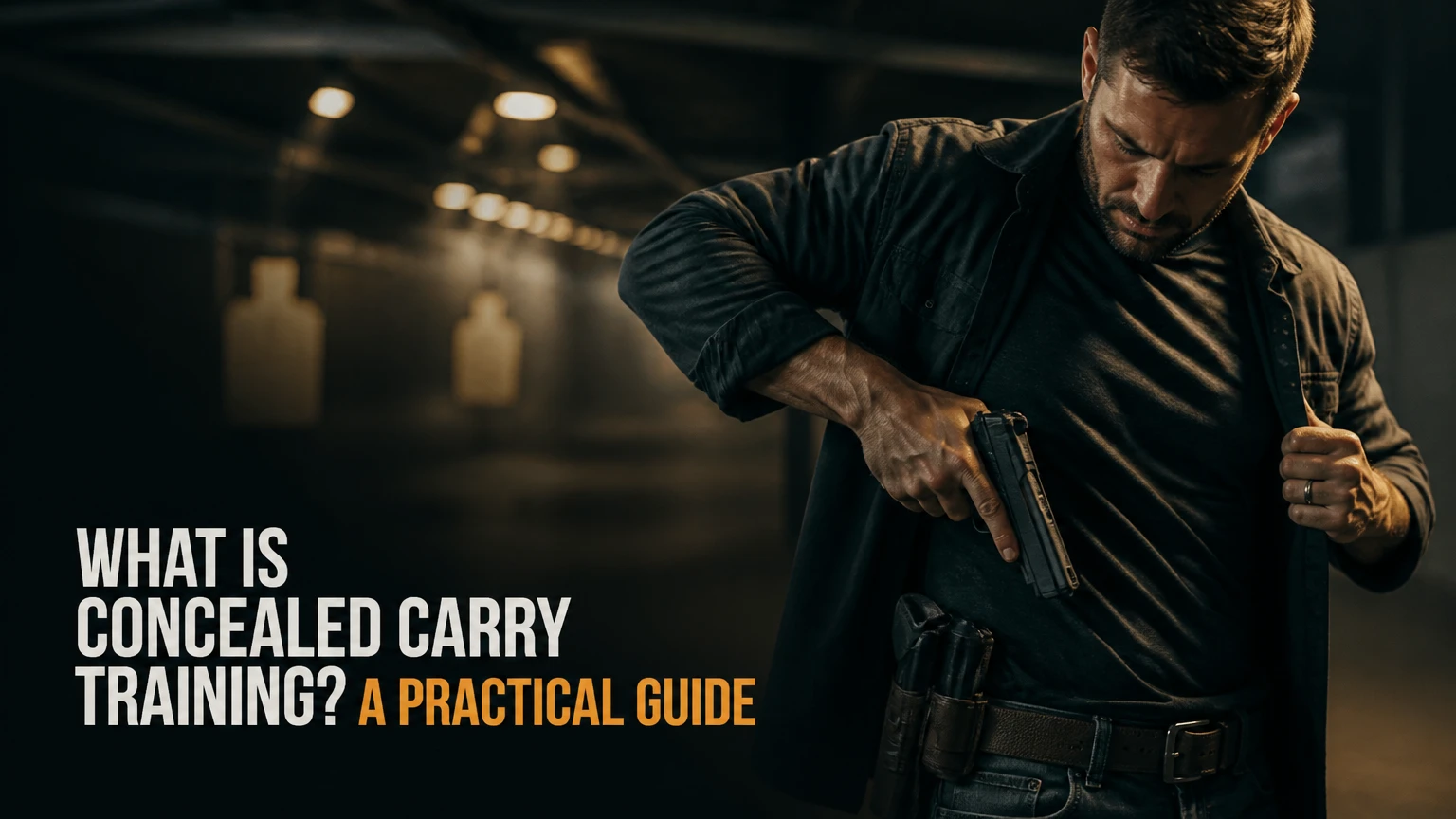
Concealed carry training is structured education and supervised practice for people who carry a hidden handgun in public. It covers firearm safety, state-specific law, handling, marksmanship, judgment, avoidance, and the responsibilities that follow a defensive incident. A permit class may satisfy a legal requirement, but it does not automatically create defensive competence.
Key Facts at a Glance
- Concealed carry training combines legal instruction, safe gun handling, shooting fundamentals, and decision-making.
- Permit requirements differ by state, and some states allow permitless carry while still regulating eligibility and prohibited locations.
- A state qualification usually measures basic safety and accuracy, not complete real-world defensive readiness.
- Online instruction may explain concepts, but many jurisdictions require in-person instruction or live-fire qualification.
- Effective training uses the same firearm, holster, clothing, and environment that the carrier expects to use.
- Ongoing practice should include safety checks, dry practice, live fire, legal review, and first-aid training.
What Does Concealed Carry Training Teach?
Concealed carry training teaches a civilian how to handle, transport, carry, and use a concealed firearm within applicable law. A responsible curriculum begins with preventing negligent discharges, then develops basic shooting ability and judgment. The strongest programs also address avoidance, de-escalation, communication with police, emergency medical care, and the psychological consequences of violence.
The phrase covers two different products. A state-mandated concealed handgun license, or CCW, course is primarily a licensing requirement. A defensive handgun course is a skills-development program intended to improve performance under pressure. Some providers combine both, but the course title alone does not prove that it includes realistic practice.
The four universal safety rules are commonly taught in some form: treat every firearm as loaded, keep the muzzle pointed in a safe direction, keep the trigger finger outside the trigger guard until ready to fire, and identify the target and what lies beyond it. Instructors may phrase the rules differently, so students should follow the range’s posted procedures and commands.
The four core curriculum areas
- Safety and firearm operation: loading, unloading, storage, transport, ammunition identification, mechanical controls, and safe responses to problems.
- Law and responsibility: defensive-force standards, prohibited places, vehicle transport, interactions with law enforcement, reporting duties, and civil consequences.
- Marksmanship: grip, stance, sight alignment, trigger control, recoil management, and accuracy at controlled distances.
- Judgment and prevention: awareness, avoidance, verbal boundary-setting, escape decisions, and knowing when not to introduce a firearm.
The curriculum should match the student’s actual circumstances. A person carrying during a daily public-transit commute faces different decisions from a person carrying occasionally in a rural area, although both need the same safety foundation.
Is Concealed Carry Training Required by Law?
Concealed carry training is required in some jurisdictions, optional in others, and structured differently across the United States. The controlling authority is the law of the state or locality where the person carries, not the marketing language used by a class provider. Permitless carry does not eliminate restrictions on eligibility, prohibited locations, private-property rules, or lawful use of force.
A licensing course may include a classroom block, a written test, a live-fire exercise, or a combination of those elements. Requirements can change through legislation, court decisions, administrative rules, and agency forms. The Bureau of Alcohol, Tobacco, Firearms and Explosives publishes federal firearms information, but it does not replace the issuing state’s rules.
What should the legal portion cover?
A serious legal module should identify:
- The jurisdiction’s definitions of lawful defensive force and deadly force.
- Whether the state has a duty to retreat, a stand-your-ground rule, or location-specific limitations.
- Castle-doctrine protections and their actual boundaries.
- Prohibited locations such as schools, courthouses, secured government buildings, or posted private premises.
- Alcohol and drug restrictions.
- Vehicle storage and transport rules.
- Permit application, renewal, notification, and change-of-address requirements.
- Reciprocity limits when traveling to another state.
- Interaction and notification rules during a police encounter.
- Civil liability, investigation, seizure of the firearm, and possible criminal proceedings after a shooting.
The federal Gun-Free School Zones Act and the Firearm Owners Protection Act are frequently mentioned in travel discussions, but neither creates a universal permission slip to carry across state lines. State reciprocity maps are useful starting points, not legal advice.
How Does the Training Pathway Work?
A safe concealed-carry pathway normally moves from supervised fundamentals to legal education, basic qualification, and continuing development. The sequence matters because students who begin with speed or complex scenarios before mastering muzzle control create unnecessary risk. A four-stage pathway is useful, but the time required depends on experience, state rules, instructor standards, and the student’s ability.
Stage 1: Establish safe fundamentals
Start with a qualified instructor or a recognized introductory firearm-safety course. The first checkpoint is consistent safe behavior: the student can keep the muzzle controlled, follow range commands, identify ammunition correctly, and unload or secure the firearm without prompting.
A beginner may need one private lesson, several supervised range visits, or a multi-session basic pistol course. Typical introductory instruction costs $75-$200, excluding ammunition and range fees. Students should not begin from-the-body-draw practice until the instructor confirms that the firearm, holster, clothing, and handling habits are appropriate.
Stage 2: Complete the state licensing curriculum
The licensing class commonly combines law, safety, storage, responsible ownership, and a qualification exercise. Typical advertised durations range from 4-16 hours, but a state may require a specific curriculum, instructor credential, or live-fire component.
Students should verify three facts before paying: whether the instructor is approved by the issuing authority, whether the certificate remains valid for the application period, and whether the course includes every required component. A certificate from a reputable national organization can still fail to satisfy a particular state’s administrative rules.
Stage 3: Complete supervised live-fire practice
Live fire develops skills that dry practice cannot reproduce, including recoil management, noise exposure, ammunition handling, and confirmation that the firearm functions with the chosen ammunition. Qualification distances, target types, round counts, and passing scores are state-specific. The frequently cited 20-100 rounds and 70%-80% scores are typical examples, not national standards.
A qualification is a threshold test. Passing it may show that the student can safely fire an approved course, but it does not establish reliable performance in darkness, from an awkward position, around other people, or under emotional stress. Responsible instructors explain that limitation directly.
Stage 4: Continue with defensive and judgment training
Post-permit training can address concealment-specific equipment, movement, communication, low-light identification, medical response, and scenario judgment. Force-on-force courses may use protective equipment and marking systems, while simulators can present branching decisions without live ammunition.
Complexity should be earned. A reputable instructor stops an exercise when safety deteriorates, rather than treating fatigue, speed, or realism as automatic evidence of quality.
What Types of Concealed Carry Training Are Available?
The main training formats are licensing courses, private instruction, defensive skills courses, scenario-based programs, dry practice, and simulators. Each format develops different capabilities, so a sensible plan combines them instead of expecting one class to solve every problem.
| Training format | Typical time | Typical direct cost | Main capability | Important limitation |
|---|---|---|---|---|
| State licensing class | 4-16 hours | $75-$250 | Legal overview and basic qualification | Often limited defensive application |
| Private beginner lesson | 1-3 hours | $75-$200 | Safe handling and individualized coaching | Requires follow-up practice |
| Defensive handgun course | 1-3 days | $250-$700 | Holster, concealment, and performance fundamentals | Ammunition and equipment add cost |
| Scenario or force-on-force course | 4-8 hours | $150-$500 | Judgment and communication under pressure | Availability and protective gear vary |
| Simulator session | 1-2 hours | $50-$150 | Decision-making and visual processing | Does not reproduce live recoil |
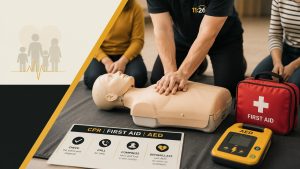
| First-aid or trauma course | 4-8 hours | $75-$250 | Bleeding control and emergency response | Does not teach firearm handling |
What is the difference between a permit class and defensive training?
A permit class proves compliance with a licensing framework, while defensive training seeks to improve safe performance across more realistic conditions. The permit course may use a static paper target and a fixed firing line; a defensive course may add concealment, communication, movement, and decision-making, but only under carefully controlled supervision.
The distinction affects expectations. Someone who completes an 8-hour legal seminar has received useful education, but should not assume that the certificate validates a fast draw, shooting in low light, or a response to an active threat. Those capabilities require separate instruction and repeated evaluation.
How Much Does Concealed Carry Training Cost?
Concealed carry training typically costs $75-$700 in tuition, depending on whether the student chooses a licensing class, private lesson, advanced course, or scenario program. The complete first-year budget can be higher because it may include ammunition, range fees, a safe, a holster, eye and ear protection, application charges, and medical equipment.
| Expense | Typical range | When paid | Cost variable |
|---|---|---|---|
| Licensing course | $75-$250 | Before class | State approval and class length |
| Handgun rental | $15-$40 | Range visit | Range policy and firearm type |
| Practice ammunition | $25-$60 per 100 rounds | Each session | Caliber and local supply |
| Range fee | $15-$35 per visit | Each session | Indoor versus outdoor facility |
| Permit application | $50-$150 | Application or renewal | State and fingerprinting fees |
| Secure storage | $40-$250 | Initial setup | Lockbox, safe, or biometric model |
| Defensive course | $250-$700 | Course registration | Instructor ratio and round count |
These figures are typical planning ranges, not official prices. Students should ask whether tuition includes targets, qualification ammunition, range access, eye and ear protection, and certificate processing. A low advertised price can become expensive when each item is charged separately.
Can Online Training Replace an In-Person Class?
Online concealed-carry training can supplement legal education, but it cannot automatically replace an in-person class, supervised handling, or a live-fire qualification. Whether online instruction satisfies a licensing requirement depends on the issuing jurisdiction and the exact course approval. Students should confirm the rule with the state licensing agency before enrolling.
Online modules are useful for reviewing terminology, reading statutes, taking practice quizzes, and preparing questions for an instructor. They are poor substitutes for observing muzzle direction, correcting grip and trigger habits, checking equipment fit, and confirming safe behavior around a loaded firearm.
A remote course also creates a verification problem. The provider may issue a certificate, but the certificate may not be accepted by the state, particularly if the law requires an approved instructor or in-person demonstration. Treat online study as preparation unless the official authority expressly accepts it.
What Equipment and Instructor Standards Matter?
Training equipment should match the equipment and clothing used for lawful carry, but beginners should not bring a loaded firearm into a class unless the instructor’s written instructions require it. Many facilities require firearms to arrive unloaded and secured, with ammunition stored separately until the range briefing.
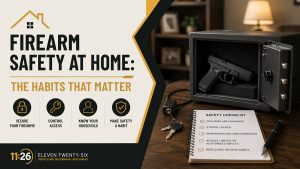
A basic student checklist includes eye protection, hearing protection, several magazines or speedloaders appropriate to the firearm, reliable factory ammunition approved by the instructor, a small notebook, water, and clothing that does not create unsafe access problems. A secure storage container is part of responsible ownership, not an optional accessory.
How should someone evaluate an instructor?
Look for an instructor who can identify the state approval or credential supporting the course, publishes prerequisites, states the round count and equipment rules, limits class size, and explains what the class does not teach. Ask how the instructor handles students with no shooting experience, physical limitations, anxiety, or difficulty meeting the qualification.
Warning signs include guaranteed permit approval, promises of combat readiness after one afternoon, pressure to buy a particular firearm, unsafe loaded-firearm handling in the classroom, and a course that treats tactical intensity as more important than control. Instructor quality matters more than a dramatic course title.
How Often Should a Concealed Carrier Train?
A practical maintenance plan includes brief dry practice several times per week, live-fire practice every 1-3 months, legal review at least annually, and a formal refresher or skills assessment every 6-12 months. The exact schedule should follow local law, instructor guidance, equipment changes, and the carrier’s actual performance.
Dry practice must occur with ammunition removed from the practice area, the firearm confirmed empty, and a safe direction selected. It can reinforce handling and visual focus, but it cannot confirm recoil control, ammunition reliability, or safe live-fire behavior.
Practice should measure safe, repeatable performance rather than chase a single speed record. A carrier who changes firearms, holsters, carry position, or clothing should schedule a supervised transition session because familiar habits may no longer map cleanly to the new setup.
What Problems Do New Concealed Carriers Commonly Encounter?
New concealed carriers often overestimate what a qualification proves, practice with different equipment from their carry setup, neglect medical training, and focus on drawing before establishing safe handling. These errors matter because concealment changes access, clothing interaction, retention, and the consequences of an unsafe movement.
Common problems include:
- One-and-done training: Fix the gap with a staged plan covering law, fundamentals, live fire, judgment, and refreshers.
- Unfamiliar carry equipment: Train only after an instructor checks the holster’s trigger-guard coverage, retention, stability, and compatibility with the firearm.
- Speed before control: Reduce complexity and return to slow, supervised repetitions when muzzle or trigger discipline degrades.
- Legal overconfidence: Recheck official statutes and current agency guidance after moving, traveling, or changing permit status.
- No emergency plan: Take a bleeding-control course and learn how to contact emergency services, preserve evidence, and cooperate appropriately after an incident.
- Ignoring avoidance: Treat distance, leaving, verbal de-escalation, and calling for help as primary protective options.
Flinching and anticipation are coaching issues, not character flaws. An instructor can use unloaded demonstrations, inert training aids, and carefully controlled exercises to identify the problem without turning a partner-loading drill into an unsafe activity.
Which Training Path Fits Different People?
The best training path depends on experience, environment, physical ability, and legal purpose. A first-time owner needs supervised fundamentals before a licensing class; an experienced recreational shooter may need judgment and concealment work; an older adult or person with a disability may need private instruction and equipment adaptation.
| Student situation | First priority | Recommended next step | Typical planning horizon |
|---|---|---|---|
| First-time handgun owner | Safety and operation | Private lesson or beginner pistol course | 2-6 weeks |
| New permit holder | Legal and equipment review | Supervised concealed-carry skills class | 1-3 months |
| Daily urban commuter | Avoidance and judgment | Scenario-based communication course | 1-6 months |
| Budget-conscious student | Legal compliance and fundamentals | Approved class plus structured home practice | 4-8 weeks |
| Older adult or disabled student | Fit and safe manipulation | Private adaptive coaching | Individualized |
| Frequent interstate traveler | Reciprocity and storage law | State-by-state legal review | Before each trip |
Urban commuters should prioritize recognition, escape routes, verbal interaction, and crowded-background judgment rather than assuming a firearm is a solution to every confrontation. Travelers should verify every destination’s current rules, because a permit valid at home may have no effect elsewhere.
What Should You Do After Completing a Class?
After class, confirm that the certificate, application, fingerprints, photographs, and other documents meet the issuing authority’s requirements. Store the certificate and permit information securely, record renewal dates, and obtain written clarification for any legal issue the class did not resolve.
Next, test the complete carry system under supervision. The test should include the actual firearm, holster, belt or support system, ordinary clothing, and approved ammunition. If concealment causes unsafe handling or repeated access problems, change the setup rather than accepting poor performance.
A defensive incident creates legal, medical, and investigative consequences. The carrier may need emergency medical care, witnesses, police communication, legal counsel, and emotional support. Training cannot predict the outcome of an investigation, and no class can guarantee immunity from criminal or civil liability.
Frequently Asked Questions
Is a CCW class the same as concealed carry training?
A CCW class is often the state-required licensing course, while concealed carry training can mean the broader process of developing safe handling, legal knowledge, shooting ability, judgment, and emergency-response skills. Some providers use the terms interchangeably, so students should compare the written curriculum, live-fire requirements, instructor credentials, and course limitations.
Do I need to own a handgun before taking training?
You usually do not need to own a handgun before an introductory course, and many ranges offer supervised rentals. A beginner should first receive instruction on safe operation and fit, then select equipment with professional guidance. The firearm must be compatible with the class rules, approved ammunition, and a safe storage plan.
Does concealed carry training guarantee a permit?
Concealed carry training does not guarantee permit approval. The issuing authority independently reviews eligibility, application documents, fingerprints, background information, fees, and statutory requirements. A course certificate only addresses the education component, and an instructor cannot waive disqualifying conditions or administrative defects.
Can I carry in another state after completing training?
A training certificate does not itself create nationwide carry authority. Another state may recognize a home-state permit, may require its own permit, or may impose different rules for prohibited places, vehicles, notification, and ammunition. Check the destination state’s official source immediately before travel because reciprocity and statutory language can change.
Is concealed carry training useful if my state has permitless carry?
Permitless carry does not remove the need for safety, legal, and judgment education. Training can clarify eligibility, location restrictions, transport rules, defensive-force standards, and safe handling, while also revealing skill gaps that a permitless-carry law does not address. A carrier remains responsible for complying with applicable law.
What is the single most important training goal?
The primary goal is safe, lawful decision-making that prevents unnecessary escalation. Marksmanship matters, but concealed carry training should also teach when to avoid contact, leave, seek help, secure the firearm, and provide emergency assistance. The safest defensive outcome is often one in which the firearm is never displayed.
The Bottom Line
Concealed carry training is more than a certificate or a shooting qualification. It is a continuing process that combines safe firearm handling, state-specific legal knowledge, supervised marksmanship, awareness, avoidance, judgment, and medical preparation. The licensing class establishes a baseline, while responsible practice and periodic instruction address the gaps that a short qualification cannot measure. Before carrying, verify the law in the relevant jurisdiction, select a qualified instructor, use safe equipment, and treat ongoing education as part of ownership. Understanding what is concealed carry training means recognizing both its practical value and its limits.