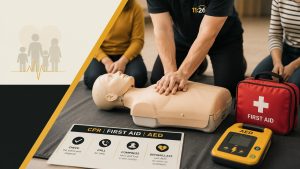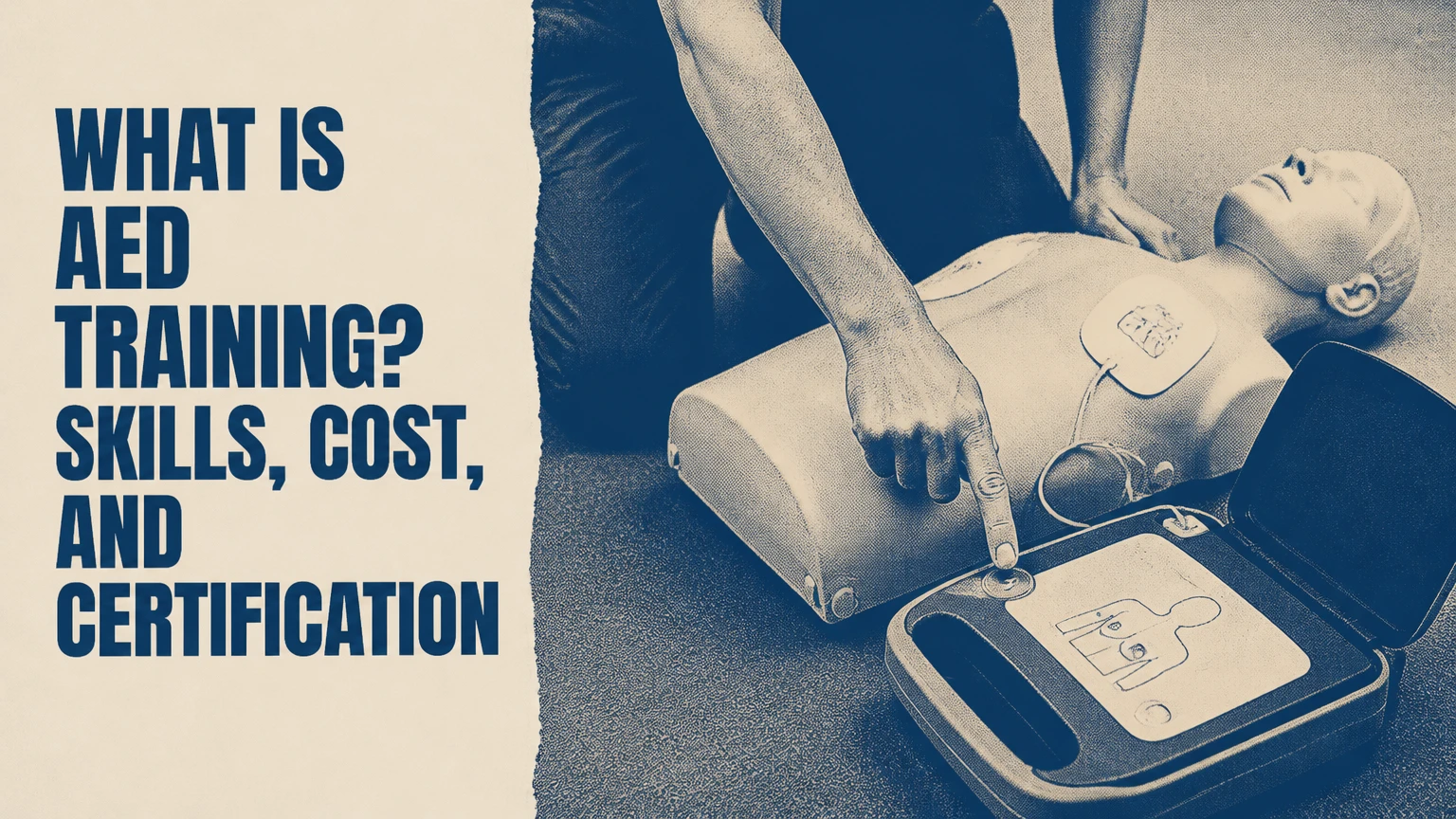
AED training is a practical education program that teaches a person to recognize sudden cardiac arrest, start high-quality CPR, retrieve and operate an automated external defibrillator, and coordinate with emergency medical services. Students practice with a non-shocking AED trainer and a CPR manikin, not a live defibrillator.
Key Facts
An AED analyzes a person’s heart rhythm and delivers a shock only when its software detects a shockable rhythm.
Most public AED courses combine adult CPR, rescue-response decisions, and hands-on device practice.
AED training does not teach manual defibrillation, diagnose heart disease, or replace emergency medical care.
Typical lay-rescuer courses take 2-4 hours and cost approximately $45-$85 in the United States.
Healthcare-provider BLS courses usually include AED use, team CPR, ventilation, and additional assessment skills.
A certificate commonly expires after two years, but employer and licensing requirements can differ.
What Does AED Training Teach?
AED training teaches the sequence of actions needed during sudden cardiac arrest: scene assessment, responsiveness and breathing checks, emergency activation, CPR, AED retrieval, pad application, rhythm analysis, shock safety, and immediate CPR resumption. The course focuses on rapid decisions under stress rather than on diagnosing the victim.
An automated external defibrillator is designed for a person who is unresponsive and not breathing normally. Occasional gasping, called agonal breathing, is not normal breathing and should not delay emergency action. The AED does not shock every cardiac-arrest patient because some rhythms do not respond to defibrillation.
The American Heart Association states, “Anyone can use an AED on an adult or child who may be in cardiac arrest.” The statement describes public-access use, not unrestricted medical practice: a rescuer still follows local emergency-dispatch instructions, device prompts, and applicable Good Samaritan protections.
AED instruction normally includes:
- Recognizing cardiac arrest and activating the emergency response system.
- Performing chest compressions at 100-120 per minute.
- Using an AED trainer on an adult or pediatric manikin.
- Applying electrode pads in the correct positions.
- Keeping everyone clear during analysis and shock delivery.
- Returning to compressions immediately after a shock or a no-shock message.
- Working with a second rescuer while another person calls EMS or retrieves equipment.
How Does AED Training Work?
AED training combines explanation, demonstration, deliberate practice, and scenario testing. Students hear the same voice prompts used by a clinical AED, apply training pads to a manikin, and repeat the sequence until they can perform the safety-critical actions without waiting for instructor prompts.
A training AED cannot deliver an electrical shock. Its appearance, controls, lights, sounds, and spoken instructions resemble a real device, while an instructor remote or programmed scenario controls whether the simulation announces a shockable rhythm, a non-shockable rhythm, poor pad contact, or another fault.
Training electrodes contain sensors or conductive elements that detect placement on the manikin. They are different from clinical adhesive pads and should never be connected to a patient. The instructor may pause the exercise to correct hand position, compression depth, pad placement, or failure to clear the patient.
What Happens During an AED Class?
A typical class begins with a short lesson on cardiac arrest and the chain of survival, followed by a demonstration of CPR and AED operation. Students then complete several scenarios, including one in which the AED advises a shock and another in which it advises no shock.
The practical assessment usually checks whether the learner can:
- Confirm scene safety.
- Check responsiveness and normal breathing.
- Call emergency services or direct another person to call.
- Begin CPR promptly.
- Send a specific bystander for the AED.
- Turn on the device and expose the chest.
- Apply pads as shown by the illustrations.
- Stop touching the patient during analysis.
- Confirm that everyone is clear before a shock.
- Resume compressions without waiting unnecessarily.
The assessment is behavioral as well as technical. A learner who knows the sequence but freezes, touches the patient during analysis, or delays CPR still needs remediation.
Is AED Training the Same as CPR Training?
AED training and CPR training are related but not identical. CPR training teaches compressions, ventilations, and recognition of cardiac arrest, while AED training adds device deployment, electrode placement, rhythm-analysis safety, and shock-response procedures.
Most entry-level providers package both subjects as CPR/AED because an AED cannot replace compressions. CPR maintains limited circulation while another rescuer finds the device, and CPR resumes as soon as the AED completes a shock or announces that no shock is advised.
Which Course Type Fits Your Role?
| Course type | Intended learner | Skills commonly assessed | Typical duration |
|---|---|---|---|
| CPR/AED lay rescuer | Employee, teacher, coach, parent, community member | Adult CPR, AED operation, emergency activation | 2-4 hours |
| CPR/AED with child and infant content | Childcare worker, caregiver, youth coach | Adult, child, and infant response differences | 3-5 hours |
| BLS for healthcare providers | Nurse, physician, EMT, dental or therapy student | Individual and team CPR, AED, ventilation, provider roles | 3-5 hours |
| AED instructor course | Experienced CPR or first-aid instructor | Teaching methods, skills evaluation, remediation, equipment care | Provider-specific |
| Family and Friends CPR/AED | General public without credential needs | Awareness and practice without formal certification | 1-3 hours |
A healthcare student should choose the BLS course named by the school, hospital, or licensing body. A workplace employee usually needs a recognized CPR/AED course with a hands-on evaluation, but the employer’s written policy determines which provider cards it accepts.
How Do You Use an AED During Training?
The standard adult response takes place alongside CPR and emergency activation. The highest-value training behavior is reducing the time between AED arrival and pad placement without stopping compressions before the device instructs rescuers to do so.
Step 1: Check Safety and Responsiveness
Check that the scene is safe, tap the person’s shoulders, and shout to assess responsiveness. Do not enter traffic, fire, electrical hazards, or contaminated areas without appropriate protection.
If the person does not respond, assess breathing for no more than 10 seconds. Occasional gasping is abnormal. A lone rescuer should call emergency services and retrieve an AED according to local protocol, using speakerphone when possible.
Step 2: Start CPR and Send for the AED
Begin chest compressions on a firm surface at 100-120 compressions per minute. For an adult, compress at least 2 inches and avoid exceeding 2.4 inches when possible, allowing the chest to recoil fully after every compression.
Use explicit role assignments. Say, “You call emergency services,” and “You bring the AED,” rather than asking an unspecified crowd for help. Specific commands reduce duplicated tasks and shorten retrieval time.
Step 3: Turn On the AED and Expose the Chest
Turn on the AED by pressing its power button or opening its lid. Remove clothing from the torso and dry the chest if water or sweat is present.
A razor may be needed when dense hair prevents pad adhesion, but shaving should not create a long delay. Remove medication patches with a gloved hand, wipe the area, and never place an electrode directly over a patch.
Step 4: Apply the Pads Correctly
Place one adult pad on the upper-right chest below the collarbone and the other on the lower-left chest below the armpit, following the diagrams supplied with that AED model. Press each pad firmly onto clean, dry skin.
Keep pads away from implanted devices such as pacemakers or implantable cardioverter-defibrillators. If a visible lump identifies the device, place the pad at least 1 inch away rather than directly over it.
For a child younger than approximately 8 years, use pediatric pads or an energy attenuator when available. If adult pads are the only option, follow the AED manufacturer’s instructions. Pads should not touch; front-and-back placement can help when a small chest cannot accommodate side-by-side adult pads.
Step 5: Let the AED Analyze
Connect the pad cable if it is not already attached. When the AED says it is analyzing, loudly announce, “Clear,” and ensure nobody touches the patient, manikin, bed, or connected equipment.
Movement can interfere with rhythm analysis. A rescuer should visually scan the patient and physically confirm that hands are off before the device completes its analysis.
Step 6: Deliver a Shock Only if Advised
If the AED announces “shock advised,” keep everyone clear, confirm that no one is touching the patient, and press the flashing shock button when instructed. A fully automatic AED may deliver the shock without a button press, so rescuers must still remain clear.
An AED cannot restart every stopped heart. The device is designed to treat specific shockable rhythms, commonly ventricular fibrillation or pulseless ventricular tachycardia, and will announce when a shock is not appropriate.
Step 7: Resume CPR Immediately
After the shock, or after a no-shock-advised message, begin chest compressions immediately. Follow the AED’s two-minute cycle and stop only when the device asks for another analysis, the person shows clear signs of life, another trained responder takes over, the scene becomes unsafe, or EMS assumes care.
How Much Does AED Training Cost and How Long Does It Take?
Typical United States lay-rescuer AED training costs $45-$85 and takes 2-4 hours. BLS courses generally cost $65-$110 and take about 3-5 hours, while blended programs divide approximately 1-2 hours of online study from 30-60 minutes of in-person skills practice.
| Training option | Typical learner price | Online portion | In-person skills time |
|---|---|---|---|
| Family and Friends CPR/AED | $20-$50 | 0-2 hours | 1-3 hours |
| Lay-rescuer CPR/AED | $45-$85 | 0-2 hours | 1-3 hours |
| Blended CPR/AED | $50-$100 | 1-2 hours | 30-60 minutes |
| Healthcare BLS | $65-$110 | 0-3 hours | 1-3 hours |
| Instructor course | $150-$400 | 2-8 hours | 4-8 hours |
Prices vary by city, training organization, class size, travel fees, textbook charges, and whether first aid is included. A workplace booking may reduce the per-person price but add a facility or instructor travel charge.
Which AED Training Format Should You Choose?
Choose in-person training when you need correction of compression mechanics, team practice, or a credential with a verified skills assessment. Choose blended learning when you can complete the knowledge component independently but still attend the required in-person demonstration.
| Delivery format | Knowledge assessment | Hands-on evaluation | Typical completion time | Best fit |
|---|---|---|---|---|
| Classroom | Instructor or written test | Yes, during class | 2-5 hours | First-time learners |
| Blended | Online test or module | Yes, scheduled session | 1-3 hours total | Shift workers and employers |
| 100% online | Online quiz | Usually no | 30 minutes-3 hours | General awareness only |
| On-site group class | Instructor-led | Yes, at workplace | 2-5 hours | Teams of 6-20 people |
A 100% online course can teach terminology and decision rules, but it may not satisfy an employer, regulator, school, or licensing body that requires demonstrated physical skills. The correct question is not whether a website calls a course “certification,” but whether the receiving organization accepts that specific card and assessment method.
In the United States, OSHA does not issue a universal AED certificate or make every workplace follow one identical AED-training rule. OSHA requirements vary by workplace hazard, first-aid obligations, state law, and the employer’s emergency-response plan. Verify acceptance before paying for a course.
What Should a Workplace AED Program Include?
A workplace AED program needs more than a machine and a certificate. The program should place the AED where responders can reach it quickly, identify trained responders, connect the site to emergency dispatch, document inspections, and rehearse the response.
A practical implementation checklist includes:
- AED location accessible during all staffed hours.
- Clear signs visible from common travel routes.
- A documented inspection schedule.
- In-date batteries and electrode pads.
- Adult and pediatric supplies when the population warrants them.
- A cabinet alarm or local access process that does not create delay.
- Emergency numbers and building directions beside the device.
- A roster of trained responders across shifts.
- Post-event reporting, debriefing, and equipment replacement.
- Refresher practice between formal certification dates.
The American Heart Association’s chain-of-survival model places early CPR and rapid defibrillation before advanced professional care. That sequence explains why a geographically distant AED can be less valuable than a slightly less sophisticated device that trained responders can reach quickly.
What Are Common AED Mistakes?
The most damaging AED mistakes are delays, unsafe contact during analysis or shock, incorrect pad contact, and failure to resume CPR. Training scenarios should deliberately expose these errors because they are more likely under pressure than simple button confusion.
| Failure mode | Why it causes trouble | Corrective action |
|---|---|---|
| Waiting for the AED before starting CPR | Delays circulation and defibrillation preparation | Start compressions while another person retrieves the device |
| Wet chest or soaked clothing | Weakens pad adhesion and can create an electrical path across the skin | Expose and dry the chest before applying pads |
| Pads placed over an implant | May interfere with pad contact or device placement | Move the pad at least 1 inch from the lump |
| Touching during analysis | Movement can distort the rhythm reading | Announce “clear” and visually check every rescuer |
| Forgetting CPR after a shock | Leaves the heart and brain without compressions | Start compressions immediately after the AED message |
| Asking the crowd for help vaguely | Multiple people may perform the same task | Assign one caller and one AED retriever by role |
An AED “check pads” message usually indicates poor adhesion, a disconnected cable, dried training electrodes, or incorrect manikin placement. In training, press the pads firmly, inspect the connector, replace worn trainer pads, and reset the scenario before repeating the attempt.
Are There Special AED Situations?
AED use remains appropriate in several situations that make inexperienced rescuers hesitate. The rescuer should remove the person from standing water when safe, dry the chest, follow the device prompts, and avoid unnecessary delays.
Pregnancy is not a reason to withhold CPR or AED treatment. A person with an implanted pacemaker or defibrillator can still receive AED treatment, provided the electrode is not placed directly over the implant.
Children require attention to energy settings and pad size, but searching indefinitely for pediatric equipment creates harmful delay. Use pediatric pads or an attenuator when available, follow the manufacturer’s diagrams, and use adult equipment if that is the only immediately available option and local guidance supports it.
AED training is not designed for conscious chest pain, fainting with normal breathing, or a person who has a pulse. Those conditions require emergency assessment, but they do not call for attaching AED pads and following the cardiac-arrest algorithm.
How Long Does an AED Certificate Last?
A CPR/AED or BLS certificate commonly remains valid for two years, although the issuing organization, employer, school, or regulator may specify a different renewal date. Renewal should occur before expiration because an expired card may be rejected even when the learner still remembers the procedure.
Formal renewal is only the minimum interval. Physical skills decay sooner without practice, especially pad placement, compression depth, and coordinated role assignment. A workplace can schedule brief quarterly or semiannual drills using a trainer without requiring employees to repeat the entire certification course each time.
Check four details on the credential:
- The issuing organization and course title.
- The completion and expiration dates.
- Whether hands-on skills were evaluated.
- Whether the employer, school, or licensing body accepts that provider.
How Do You Choose a Credible AED Course?
Choose a course by starting with the receiving organization’s requirement, not by selecting the cheapest digital certificate. Confirm the curriculum, instructor qualifications, skills assessment, adult or pediatric scope, card issuer, expiration period, and replacement-card process.
For a workplace, ask whether the class includes an AED trainer, CPR manikins, scenario practice, and a written record of attendance. For a healthcare role, confirm that the course is the required BLS pathway rather than a general public CPR/AED class.
A credible provider can explain which guidelines it follows, how it evaluates skills, and what happens when a student cannot perform a skill correctly. The provider should also identify whether online work is supplemental or the entire course.
What Does AED Training Not Teach?
AED training does not qualify a lay rescuer to operate a manual defibrillator, interpret an electrocardiogram independently, diagnose the cause of cardiac arrest, administer medications, or provide advanced airway management. Those abilities belong to different clinical education pathways.
AED training also cannot guarantee survival. Defibrillation works best when CPR begins promptly and the shockable rhythm is treated quickly, but outcomes depend on the cause of arrest, response time, underlying health, and professional care.
Frequently Asked Questions
Do I need to be medically trained to use an AED?
No. AEDs are designed to guide trained and untrained bystanders with voice, visual, and sometimes text prompts. A short CPR/AED course improves speed and safety, but a rescuer should follow emergency-dispatch instructions and the device prompts even without a current certificate.
Can an AED shock someone who does not need it?
A properly functioning AED analyzes the heart rhythm before authorizing a shock and will not advise defibrillation for a non-shockable rhythm. Rescuers must still keep everyone clear because touching the patient during analysis can interfere with the assessment, and touching during a shock creates a safety risk.
Do AED pads expire?
Yes. Clinical AED electrode pads have an expiration date because the adhesive and conductive gel degrade. Batteries also have replacement dates or service intervals. A workplace should record both dates during inspections and replace supplies before expiration, following the AED manufacturer’s maintenance instructions.
Is BLS better than CPR/AED training?
BLS is the appropriate choice for healthcare providers or people working in clinical settings because it adds team-based CPR, ventilation, and healthcare-provider algorithms. CPR/AED training is usually sufficient for community responders, employees, parents, teachers, and coaches whose role does not require BLS.
Can I renew AED training completely online?
Sometimes an organization accepts online renewal, but many employers, schools, and healthcare programs require an in-person skills demonstration. Confirm the receiving organization’s policy before enrolling. A fully online class may provide knowledge, but it usually cannot verify compression technique, pad placement, or physical safety behavior.
The Bottom Line
AED training teaches a person to recognize sudden cardiac arrest, start CPR, retrieve and operate an automated external defibrillator, maintain scene safety, and coordinate with EMS. The best course depends on the learner’s role: choose CPR/AED for most community and workplace needs, BLS for healthcare providers, and blended learning only when its in-person skills assessment is accepted.
A certificate alone does not create a reliable emergency-response program. Regular practice, accessible equipment, current pads and batteries, clear role assignments, and rapid AED retrieval determine whether training becomes useful action when cardiac arrest occurs. Knowing what AED training includes helps you choose a course that tests the skills you will actually need.