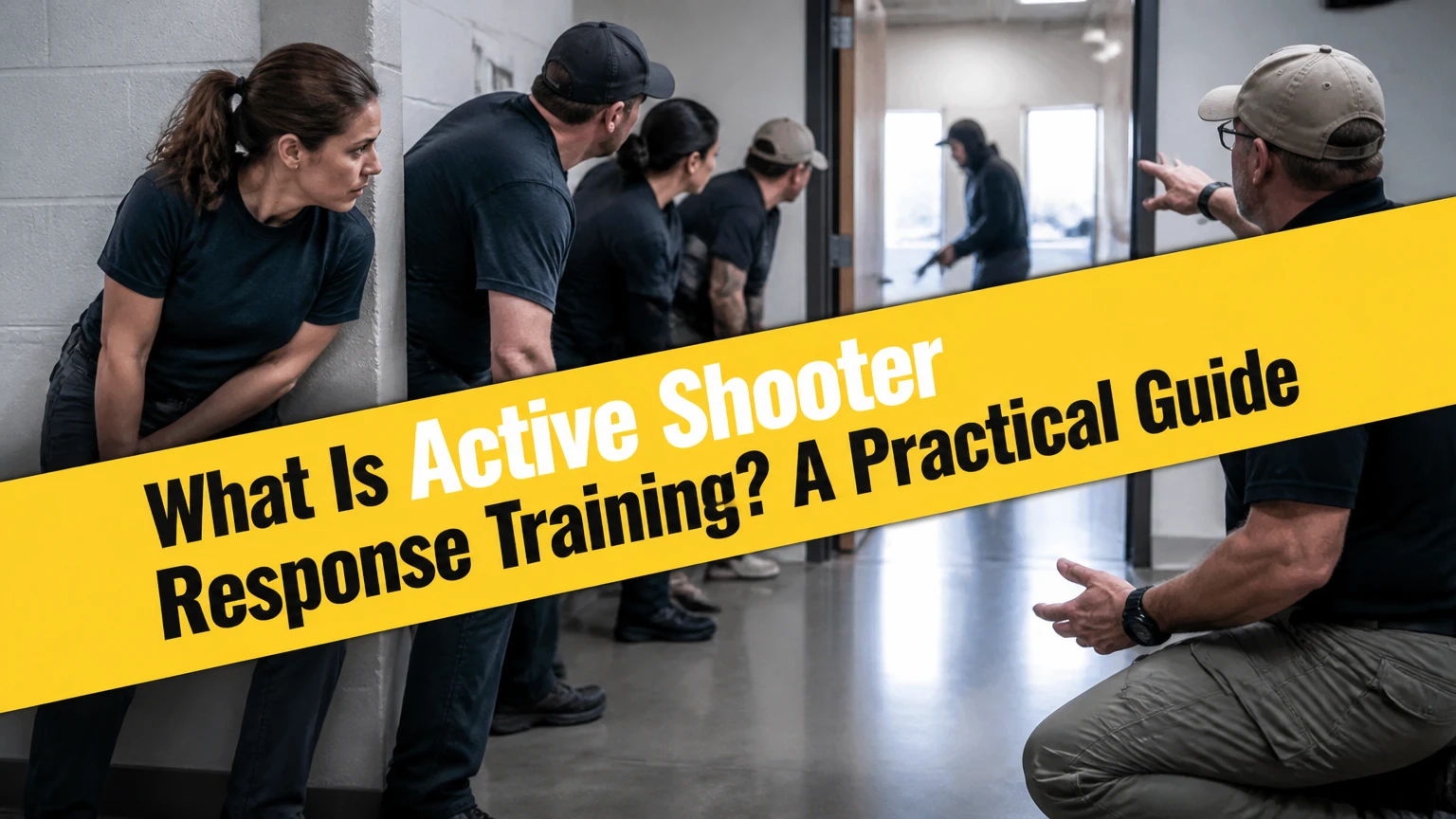
Active shooter response training is structured education and practice that helps people recognize an armed-violence emergency, make fast safety decisions, communicate useful information, and support survival until responders arrive. It combines awareness, evacuation or sheltering procedures, emergency planning, and sometimes bleeding control; it does not guarantee safety or replace professional law-enforcement response.
Key Facts at a Glance
Active shooter response training teaches decisions for evacuation, sheltering, communication, and last-resort self-protection.
The recommended civilian priority is to leave when a reasonably safe route exists, secure a room when escape is unsafe, and resist only during an imminent life-threatening attack.
Typical delivery ranges from 45-90 minutes online to 3-4 hours in person, while custom exercises can require several weeks of planning.
Typical pricing ranges from $15-$50 per online learner, $1,500-$3,500 for a standard on-site session, and $5,000-$15,000 or more for a custom exercise.
Effective programs use multiple exits, accessible procedures, realistic communication, after-action review, and psychological safeguards.
No framework, including Run. Hide. Fight., ALICE, or AVERT, predicts an attacker’s behavior or makes a dangerous situation safe.
What Is Active Shooter Response Training?
Active shooter response training prepares civilians, employees, supervisors, students, healthcare workers, and designated emergency teams for an active shooter or other active-threat event. The training focuses on recognition, decision-making under stress, emergency communication, movement, sheltering, and coordination with police, fire, emergency medical services, and organizational leadership.
The FBI defines an active shooter as “one or more individuals actively engaged in killing or attempting to kill people in a populated area.” The definition describes behavior, not a particular weapon, motive, building type, or victim profile. Some organizations therefore use the broader terms active assailant or active threat in their plans.
The training is different from a fixed evacuation drill. A fire alarm usually points people toward designated exits, whereas an armed attacker can make a familiar route unsafe. Active shooter response training teaches people to reassess conditions, identify alternatives, and communicate changing information.
What outcomes should learners demonstrate?
A competent learner should be able to identify at least two ways out of a routinely occupied area, recognize that unusual gunfire or violence requires immediate judgment, follow the organization’s emergency notification process, and interact safely with arriving officers. Managers should also understand accountability, reunification, continuity, and employee-support responsibilities.
Training should not teach false certainty. A participant cannot know the attacker’s location from a single sound, and a locked door may not withstand forced entry. The useful outcome is a practiced decision process, not a promise that one slogan works in every building.
How Does the Run. Hide. Fight. Framework Work?
Run. Hide. Fight. is a simple civilian decision model: evacuate if a safe path exists, shelter and secure yourself when evacuation is unsafe, and resist as a last resort when facing an imminent threat. The U.S. Department of Homeland Security presents the model as three options rather than a guarantee or a rigid sequence.
Run: evacuate when the route is reasonably safe
Leave immediately when the attacker is not blocking a viable exit and movement does not lead toward the threat. Leave bags and personal items behind, help others when doing so does not trap you, and avoid waiting for a group consensus.
Use routes that provide cover when available. Cover can stop or substantially reduce the danger from bullets, while concealment only blocks visual detection. A concrete structural wall may provide cover; a cubicle partition, curtain, or interior drywall may provide concealment without reliable ballistic protection.
When outside, move away from the building and keep hands empty and visible. Do not stop near entrances, return for belongings, or obstruct people leaving. When police arrive, follow commands, avoid sudden movements, and expect officers to focus first on stopping the threat rather than assisting every injured person.
Hide: secure a room when escape is unsafe
Shelter in a room or area when the attacker is near an exit, the route is uncertain, or leaving would expose you to greater danger. Lock the door if possible, turn off lights, silence devices including vibration alerts, stay out of sight, and remain quiet.
Use available furniture to delay entry, but do not assume a barricade is impenetrable. Move away from the door’s line of sight where the room allows, and avoid creating a tightly packed group that can block escape or emergency care. People with mobility, hearing, vision, or cognitive disabilities need procedures designed before an emergency, not improvised assistance during one.
Call emergency services when safe and provide the building name, address, floor, room, attacker description, direction of travel, weapon information if known, and number of injured people. Do not transmit rumors or repeatedly call if doing so creates noise or risk.
Fight: resist only during an immediate life threat
Physical resistance belongs only in a last-resort situation when a person faces an imminent attack and cannot safely evacuate or shelter. The objective is to disrupt the assault long enough to create an opportunity to escape, not to pursue, disarm, or search for the attacker.
Training may discuss coordinated resistance, improvised objects, and protecting vulnerable people, but instructors should avoid theatrical choreography that implies a reliable technique. Participants should never seek confrontation, handle a weapon after an attacker is incapacitated, or approach police while holding an object that could be mistaken for a weapon.
What Does Effective Training Include?
Effective active shooter response training combines individual behavior with organizational readiness. A 60-minute video cannot reveal whether a building’s emergency messages reach hearing-impaired workers, whether a badge-controlled exit releases during an outage, or whether a hospital can move ventilated patients.
Individual skills
| Skill area | Learner capability | Practical checkpoint |
|---|---|---|
| Recognition | Distinguish suspected gunfire, violence, and credible warnings from routine noise | State an immediate action without waiting for confirmation |
| Evacuation | Identify two alternative exits from a regular work area | Point to routes on a current floor plan |
| Sheltering | Lock, barricade, silence, and remain out of sight | Secure a representative room in under 90 seconds, where feasible |
| Communication | Report address, location, threat direction, and injuries | Deliver a concise emergency call or notification |
| Police contact | Keep hands visible and follow commands | Exit without holding bags, phones, or suspicious objects |
| Recovery | Follow accountability and reunification procedures | Report status through the designated channel |
Organizational capabilities
Leadership training should cover emergency action plans, visitor management, access control, public-address systems, law-enforcement coordination, family reunification, media handling, employee assistance, and business continuity. The plan must assign ownership for each decision because “notify everyone” is not an operational procedure.
A useful after-action review asks four measurable questions: Did people receive the alert within the intended time? Could occupants identify an exit? Did the message contain actionable information? Did any policy, access-control feature, or accessibility barrier create delay? Corrective actions should have an owner and deadline.
What Types of Active Shooter Training Are Available?
Organizations generally choose online awareness training, facilitated tabletop exercises, in-person practical instruction, full-scale simulations, or a blended program. The appropriate format depends on risk, building complexity, workforce turnover, emotional considerations, and the behavior the organization needs to verify.
| Format | Typical duration | Typical cost | Best application |
|---|---|---|---|
| Online awareness module | 45-90 minutes | $15-$50 per learner | New-hire baseline and distributed teams |
| Instructor-led briefing | 1.5-3 hours | $1,500-$3,500 per session | Small businesses and policy rollout |
| Tabletop exercise | 2-4 hours | $2,000-$8,000 per exercise | Leadership, security, HR, and emergency partners |
| Practical walkthrough | 3-4 hours | $2,500-$7,500 per session | Exit, shelter, alert, and accountability testing |
| Full-scale exercise | 4-8 hours plus planning | $5,000-$15,000 or more | Complex campuses, hospitals, and public facilities |
Online courses scale efficiently but cannot validate a door, alarm, route, or radio channel. Tabletop exercises expose planning gaps without placing a large population into a stressful scenario. Full-scale exercises produce more operational evidence, yet they require consent, coordination, medical safeguards, accessibility planning, and careful communication.
Is a tabletop exercise better than a live simulation?
A tabletop exercise is usually the better first step because leaders can test decisions, information flow, and resource gaps without realistic weapons, actors, or surprise. A live simulation becomes useful only after the organization has a written plan, trained facilitators, participant safeguards, and a defined evaluation purpose.
Which Framework Should an Organization Use?
Run. Hide. Fight. is the simplest public-facing model, ALICE adds more non-linear communication and decision options, and AVERT combines active-threat response with bleeding-control instruction. No framework is universally best; the selection should match the audience, facility, local policy, and instructor qualifications.
| Framework | Main emphasis | Typical audience | Main limitation |
|---|---|---|---|
| Run. Hide. Fight. | Simple civilian choices | General workforce and public agencies | Requires local procedures for alerts and accountability |
| ALICE | Alert, Lockdown, Inform, Counter, Evacuate | Schools, offices, and trained organizations | Needs consistent instruction and policy integration |
| AVERT | Threat response plus bleeding control | Workplaces seeking medical response skills | Requires additional equipment, practice, and time |
| Facility-specific EAP | Local routes, roles, and communications | Hospitals, campuses, large sites | Quality depends on the plan and exercise process |
ALICE’s ordering is intentionally non-linear, while Run. Hide. Fight. is easier to remember under stress. AVERT can add value where tourniquet and wound-packing instruction is appropriate, but medical training does not substitute for evacuation, sheltering, or police coordination.
A framework is only as strong as its local translation. A national video cannot determine which stairwell is accessible, whether doors lock from inside, or how a school accounts for children during reunification.
How Much Does Active Shooter Response Training Cost?
Typical active shooter response training costs $15-$50 per online learner, $1,500-$3,500 for a standard instructor-led session, and $5,000-$15,000 or more for a custom full-scale exercise. Prices vary with participant count, travel, scenario design, facility size, law-enforcement participation, medical support, and reporting requirements.
| Cost component | Typical range | Main price driver | Buyer question |
|---|---|---|---|
| Online license | $15-$50 per user | Seat count and reporting | Does completion data integrate with HR systems? |
| Instructor session | $1,500-$3,500 | Group size and travel | Does the instructor inspect the facility? |
| Tabletop exercise | $2,000-$8,000 | Stakeholder and scenario complexity | Is an after-action report included? |
| Custom simulation | $5,000-$15,000+ | Actors, sound, safety, and planning | Who controls realism and participant consent? |
| Bleeding-control add-on | $50-$150 per learner typical | Kit contents and instructor ratio | Are kits provided and maintained afterward? |
These are typical market planning ranges, not mandated prices. A low-cost course may be entirely appropriate for basic awareness, while a high-cost exercise can be wasteful if leadership has not first corrected broken locks, inaccurate floor plans, or unreliable alerts.
How Should an Organization Build a Program?
A practical program begins with a site-specific risk and capability review, then moves from policy to education, exercise, and correction. Most organizations can establish a baseline in 30-60 days, while a complex hospital or campus exercise commonly requires 8-16 weeks of planning.
Step 1: Assess the site and population
Map entrances, exits, stairwells, public areas, controlled doors, rooms without locks, exterior gathering points, and locations where people work alone. Include contractors, visitors, children, patients, night-shift staff, and people who need mobility, sensory, language, or cognitive accommodations.
Step 2: Update the emergency action plan
Define who sends alerts, who contacts 911 or the local emergency number, who communicates with families, how employees report status, and how leaders transfer control to public safety agencies. Confirm that the plan uses the correct local emergency number and does not depend on a single communication channel.
Step 3: Teach the baseline
Provide a short awareness module, then deliver a facility walkthrough. Show two exits, explain shelter options, demonstrate emergency notification methods, and state what arriving officers may do. Use plain language and translated materials where the workforce requires them.
Step 4: Exercise decision-makers
Run a tabletop scenario involving an alert, conflicting reports, blocked access, injured people, visitors, and family inquiries. Record decisions, delays, unavailable resources, and policy conflicts rather than grading employees on theatrical performance.
Step 5: Practice safely and review results
Use announced, no-fault exercises unless a qualified professional has documented a compelling reason for another format. Never use realistic weapons, simulated gunfire, surprise attacks, or locked exits without explicit safeguards, informed consent, accessibility review, and emergency coordination.
What Are the Most Common Training Mistakes?
The most damaging mistakes are unsafe realism, static route memorization, compliance-only delivery, and failure to plan recovery. Each error reduces trust or teaches behavior that fails when the building, attacker, or population differs from the exercise.
- Running an unannounced realistic drill. Participants may experience acute distress, leave the site unsafely, or misinterpret the scenario as real. Announce the exercise, define stop signals, provide opt-out routes, and offer support afterward.
- Teaching one exit as the answer. A blocked corridor invalidates a single-route plan. Require occupants to identify alternatives and managers to verify that maps match current construction.
- Ignoring people who cannot quickly evacuate. A plan that assumes every person can use stairs or hear an alarm excludes patients, wheelchair users, visitors, and some employees. Assign assistance procedures without making one person solely responsible for another’s survival.
- Using training as a compliance checkbox. Completion percentages do not prove that alerts work or that doors secure. Pair learning records with route checks, tabletop findings, and corrective-action deadlines.
- Leaving medical response out. Severe bleeding can become fatal quickly. Consider separate bleeding-control instruction, trauma kits, and coordination with emergency medical services, while making clear that first aid never requires someone to enter an active danger area.
- Neglecting psychological recovery. Provide employee assistance, supervisor guidance, family communication, reunification procedures, and a process for reporting concerns after an exercise or actual event.
How Should Different Facilities Adapt the Program?
Facility-specific design matters because evacuation, sheltering, communication, and accountability constraints differ sharply between a retail store, hospital, office tower, and school. A generic video can establish vocabulary, but local procedures determine whether people can act on it.
| Setting | Primary constraint | Training priority | Useful exercise |
|---|---|---|---|
| Retail store | Public visitors and multiple entrances | Staff-directed evacuation and back-of-house exits | Customer-flow tabletop |
| Office tower | Vertical movement and access control | Stairwell routes, floor communication, visitor records | Multi-floor tabletop |
| Hospital | Non-ambulatory and dependent patients | Unit security, patient movement, clinical continuity | Department-based exercise |
| K-12 school | Children, guardians, and reunification | Age-appropriate instructions and parent messaging | Announced staff tabletop |
| College campus | Open buildings and dispersed population | Mass notification and varied building procedures | Campus communication exercise |
Hospitals need clinical command coordination, protected patient areas, alternate care locations, and procedures for ventilated or sedated patients. Schools need age-appropriate language, substitute-teacher guidance, accessible lockdown procedures, and reunification controls that prevent unauthorized release.
Retail employers should train employees to direct customers toward safe exits without delaying their own escape. High-rise offices should verify stairwell access, floor-warden communications, and procedures for people who cannot use stairs.
What Are the Limits of This Training?
Active shooter response training cannot predict an attacker, eliminate violence risk, guarantee survival, or replace prevention and security controls. Training also cannot correct a building with no functioning notification system, defective locks, inaccurate maps, or leadership that has not assigned emergency roles.
Prevention belongs in the same safety system. Organizations should maintain workplace-violence reporting channels, threat-assessment procedures appropriate to their jurisdiction, visitor controls, lighting, access management, employee support, and coordination with local public safety agencies. The U.S. Occupational Safety and Health Administration treats workplace violence as a broader hazard category than active shooter incidents alone.
Avoid programs that promise a universal tactical solution or pressure participants into physical contact. Responsible instruction is trauma-informed, legally reviewed where necessary, accessible, culturally appropriate, and transparent about uncertainty.
Frequently Asked Questions
Is active shooter response training required by law?
Requirements vary by country, state, industry, collective-bargaining agreement, and facility type. Some jurisdictions require emergency action plans, workplace-violence prevention, school safety planning, or healthcare security measures without prescribing one active shooter curriculum. Check the applicable regulator, insurer, local authority, and employment rules before treating a commercial certificate as compliance.
How often should employees repeat the training?
Provide baseline instruction during onboarding, review policies at least annually, and repeat practical exercises when the building, workforce, access system, or emergency plan changes. High-turnover sites may use online training quarterly or at onboarding, followed by an annual facilitated walkthrough. A fixed calendar is less important than correcting known gaps promptly.
Is online active shooter training enough?
Online training is enough for introductory awareness when an organization also provides site-specific routes, shelter procedures, emergency contacts, and accessible instructions. Online learning cannot verify physical doors, alarms, stairwells, or radio coverage, so it is insufficient as the sole preparation for complex workplaces or high-risk facilities.
Should employees be taught to fight an attacker?
Employees should understand that last-resort resistance may be an option only during an imminent threat when evacuation and sheltering are unavailable. Instruction should emphasize escape and concealment first, avoid combat promises, and never encourage people to search for, pursue, or confront a suspected attacker.
What should someone do when police arrive?
Keep hands empty and visible, follow commands immediately, avoid pointing, sudden movements, or shouting, and continue moving away from danger when directed. Officers may pass injured people initially because their first task is to stop the threat. Share information only when it is safe and concise.
How can an organization measure whether training worked?
Measure alert delivery time, exit and shelter-route knowledge, emergency-call quality, door and alarm performance, accountability completion, accessibility barriers, and corrective actions closed by their deadlines. Satisfaction surveys are useful for identifying distress or confusion, but completion rates alone do not demonstrate operational readiness.
The Bottom Line
Active shooter response training is a preparedness program that turns general safety policy into practiced decisions for evacuation, sheltering, communication, and last-resort survival. The strongest program combines Run. Hide. Fight. or a comparable framework with a site-specific emergency action plan, accessible procedures, safe exercises, bleeding-control capability where appropriate, and a documented after-action process.
The correct starting point is not the most dramatic simulation. It is an accurate facility assessment, clear emergency communication, multiple route options, trained decision-makers, and support for people affected by the subject. When those elements work together, what is active shooter response training has a precise answer: structured preparation for making safer decisions during an active threat, within the limits of what training can realistically control.