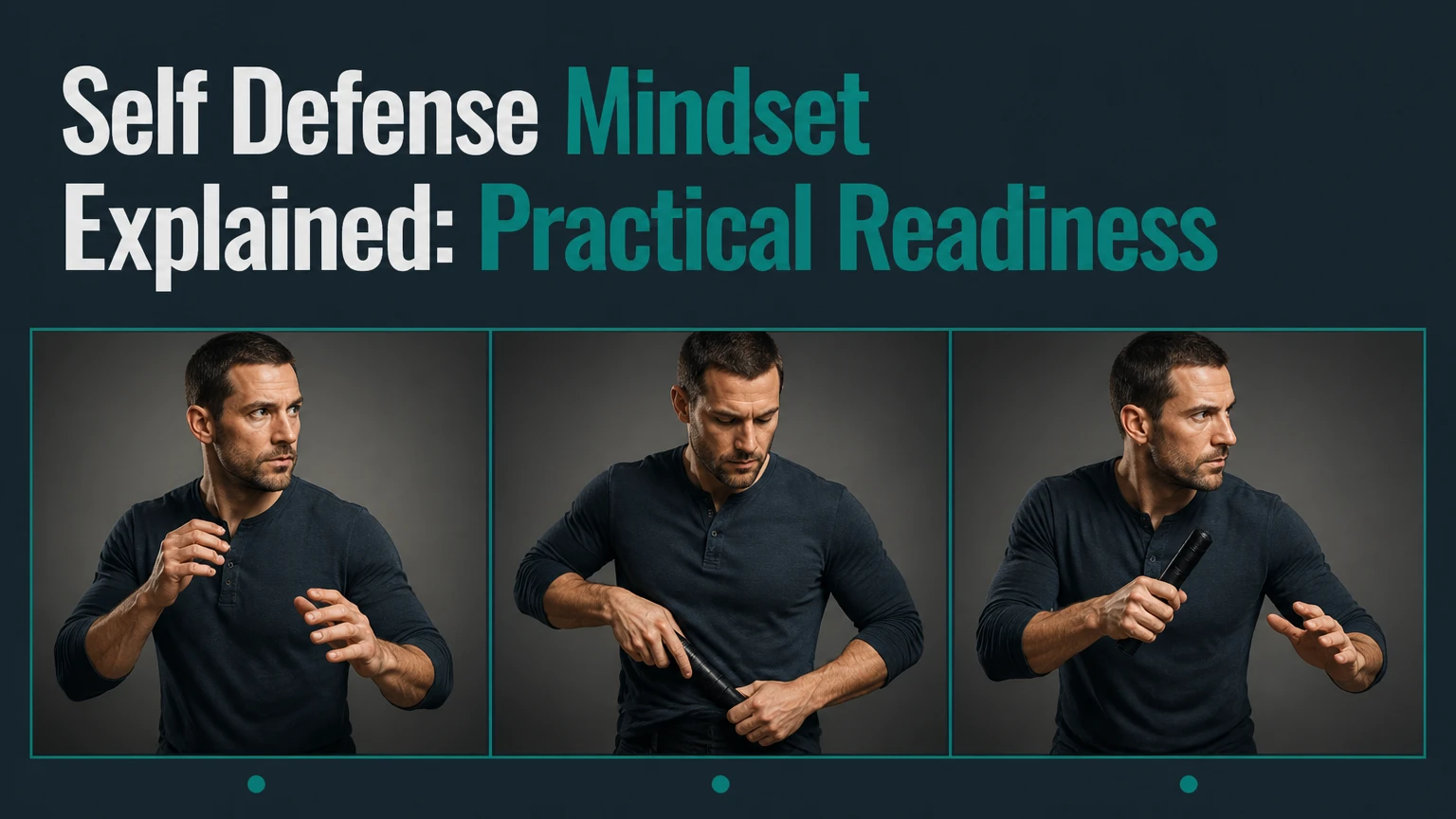
A self-defense mindset is a calm, deliberate approach to personal safety that helps a person notice risk, set boundaries, avoid unnecessary conflict, and act decisively to escape danger. Self-defense mindset training combines situational awareness, mental rehearsal, communication, environmental planning, and lawful physical skills rather than treating fighting ability as the primary objective.
Key Facts at a Glance
A self-defense mindset prioritizes avoidance, escape, communication, and emergency assistance before physical force.
Situational awareness means noticing changes in people, places, timing, and access without assuming every anomaly is dangerous.
The Cooper Color Code is a teaching model for attention and readiness, not a validated system for predicting criminal behavior.
The 21-foot concept illustrates reaction-time problems; it is not a universal distance at which a person becomes automatically dangerous.
Stress can narrow attention and impair speech, memory, and fine motor control, making simple rehearsed actions more reliable.
Effective training should include legal boundaries, realistic decision-making, de-escalation, and safe scenario practice.
What Is a Self-Defense Mindset?
A self-defense mindset is the mental habit of recognizing risk early, preserving options, and choosing proportionate action before a situation becomes a physical confrontation. The mindset is proactive rather than fearful: a prepared person accepts that unwanted events can occur, then makes practical plans without treating strangers as automatic threats.
Self-defense mindset explained plainly means moving from passive hope to active responsibility. That does not mean searching for danger, carrying a weapon, or adopting hostility. It means keeping enough attention available to notice an unusual approach, identifying an exit, saying no clearly, and leaving when a situation violates your safety threshold.
The strongest mindset is compatible with ordinary life. A commuter can listen to music at a low volume while retaining environmental awareness. A restaurant guest can choose a seat with a visible route to an exit without staring at every customer. A student can set a drink and transportation plan before alcohol affects judgment.
Personal safety also includes prevention after an incident. Calling emergency services, obtaining medical care, preserving evidence, contacting a trusted person, and accessing trauma-informed support are part of the safety sequence.
What a self-defense mindset is not
A self-defense mindset is not paranoia, a promise to defeat an attacker, or permission to escalate a disagreement. It is also not a guarantee of survival. No awareness system identifies every threat, and no martial art removes the advantages created by surprise, multiple attackers, weapons, confined spaces, or unequal physical strength.
The Federal Bureau of Investigation’s crime reporting system distinguishes reported offenses from the much larger universe of events that never reach law enforcement. That limitation matters: personal safety advice should not imply that a specific posture or visual cue reliably identifies a criminal.
A useful practitioner rule is simple: notice behavior, not appearance. Unwanted following, blocking, forced proximity, repeated boundary testing, and attempts to isolate someone provide more actionable information than age, clothing, race, gender, or disability.
How Does the Mindset Work Under Stress?
The self-defense mindset works by converting vague fear into a short decision sequence: notice a change, create distance, communicate a boundary, move toward safety, and request help. Rehearsal reduces the number of decisions required when adrenaline disrupts attention, speech, memory, and fine motor coordination.
The brain’s threat response is not a clean switch between rational thought and panic. The amygdala and other threat-processing systems can initiate rapid physiological changes while the prefrontal cortex continues trying to interpret what is happening. The result may be fight, flight, freeze, fawn, confusion, delayed recognition, or several responses in sequence.
The National Institute of Mental Health describes fear as a response that can prepare the body to confront or escape danger. That response is protective, but it can also produce tunnel vision, shaking, dry mouth, and difficulty recalling a rehearsed technique.
Why do people freeze?
People freeze because surprise, uncertainty, social conditioning, and physiological arousal can temporarily interrupt action selection. Freezing is an involuntary protective response, not evidence of cowardice or consent, and criticizing yourself afterward can make future responses less accessible.
Mental rehearsal helps when it stays specific and realistic. Rehearse saying, “Stop. Give me space,” moving toward a public area, unlocking a phone, and calling a named contact. Do not rehearse cinematic victories that depend on perfect timing or precise fine-motor movements.
A practical reset uses one slow exhale longer than the inhale, followed by a visible action such as stepping behind a barrier or moving toward other people. Box breathing can help some people regulate arousal, but counting four seconds in every situation is not mandatory; escape and communication take priority.
What Are the Four Readiness Conditions?
The Cooper Color Code describes four attention conditions: White, Yellow, Orange, and Red. The model is useful as a simple teaching device because it gives people language for changing attention, but it does not measure danger, predict offenders, or establish legal permission to use force.
| Condition | Attention state | Civilian example | Appropriate response |
|---|---|---|---|
| White | Distracted or unaware | Texting while crossing a parking lot | Restore attention before entering riskier space |
| Yellow | Relaxed alertness | Noticing people, lighting, exits, and route | Continue routine while retaining options |
| Orange | Specific concern | A person mirrors your route and closes distance | Change direction, create space, contact help |
| Red | Immediate threat | Someone grabs, corners, or attacks | Escape, call for help, and use lawful force if necessary |
Condition Yellow should be a sustainable baseline, not a permanent state of alarm. Condition Orange requires a specific observation and a specific plan. Condition Red describes immediate action, but the action can be running, locking a door, shouting for help, or using physical force when legally justified.
How should the OODA Loop guide decisions?
The OODA Loop, developed by United States Air Force officer John Boyd, means Observe, Orient, Decide, and Act. For civilians, the loop is a compact way to update a plan as facts change, rather than waiting for certainty before moving.
| OODA phase | Personal safety question | Example |
|---|---|---|
| Observe | What changed? | A stranger has followed through two turns |
| Orient | What does the environment offer? | A staffed store is 40 metres ahead |
| Decide | What reduces exposure now? | Enter the store and call a contact |
| Act | What is the next visible behavior? | Walk inside, tell staff, and request help |
The OODA Loop is continuous. If the person stops following, the plan may return to normal. If the person enters the store, the observation changes and the next action changes with it.
What is the 21-foot rule?
The 21-foot rule is a training illustration associated with reaction distance, not a universal safety boundary or legal standard. A person can cover a short distance quickly, but speed varies with terrain, footwear, obstacles, starting posture, awareness, and the other person’s intent.
The original Tueller concept concerned a specific law-enforcement training problem involving a potentially armed person and reaction time. Treating 21 feet as a magic number creates false confidence. The safer lesson is to preserve a reaction gap, avoid being cornered, keep hands available, and move before a threat reaches contact range.
| Factor | Typical effect on reaction | Practical adjustment |
|---|---|---|
| Person already facing you | Less orientation time | Keep more distance |
| Narrow hallway | Fewer escape angles | Move toward an open room |
| Wet pavement | Slower movement | Avoid sudden physical exchanges |
| Backpack or shopping bags | Occupied hands | Set items down or change route |
| Multiple people | More observation demands | Seek staff, security, or a crowd |
How Can You Build Situational Awareness?
Situational awareness improves through repeated, low-stress observation exercises rather than constant scanning for criminals. A person can practice by identifying two exits, noticing lighting and staff locations, tracking whether a route remains open, and checking whether attention is being absorbed by a phone.
Use a simple three-layer scan:
- Environment: exits, barriers, lighting, cameras, staff, traffic, and areas where movement could be blocked.
- People: unusual proximity, repeated approaches, concealed hands, agitation, intoxication, or refusal to respect distance.
- Self: fatigue, impairment, distraction, injury, emotional distress, and the ability to call or travel safely.
Avoid rules that encourage staring or profiling. Brief eye contact can communicate awareness, but prolonged confrontation can escalate some encounters. The objective is information and options, not dominance.
What environmental details matter most?
The most useful details are those that change your ability to leave or summon assistance. An exit behind a locked gate is not an available exit; a crowded area without staff may provide witnesses but little intervention; a well-lit route can still be unsafe if it funnels someone into a dead end.
| Setting | Risk-relevant details | Better preparation |
|---|---|---|
| Parking garage | Blind corners, elevators, low staffing | Park near active routes and have keys ready |
| Public transit | Platform gaps, carriage exits, staff points | Sit near the operator or exit when practical |
| Restaurant | Restrooms, isolated seating, blocked doors | Choose a seat with a clear route out |
| Hotel | Room number visibility, corridor access | Verify the door latch and avoid opening blindly |
| Online-to-offline meeting | Identity uncertainty, isolation | Meet publicly and share live location |
How Do Verbal Boundaries and De-escalation Work?
Verbal de-escalation works by making the desired behavior clear, reducing audience confusion, and creating time to leave. Use a calm, audible voice and short phrases such as “Stop,” “Do not touch me,” “Back up,” or “I am leaving now,” then move toward safety instead of debating the person.
A boundary is different from a threat. “Do not come closer” describes a limit; “I will hurt you” may intensify the encounter and create legal complications. Avoid insults, challenges, unnecessary explanations, and attempts to prove courage.
A loud command can also recruit witnesses. Point toward a specific person and say, “You in the blue jacket, call emergency services,” because a general request for help often produces diffusion of responsibility.
Which actions reduce escalation?
| Situation | Useful phrase | Movement priority |
|---|---|---|
| Unwanted approach | “Stop there. Give me space.” | Step toward an exit or staff |
| Persistent sales or solicitation | “No. I am not interested.” | Keep walking without debate |
| Touching or grabbing | “Do not touch me.” | Break contact and create distance |
| Argument in public | “I am not fighting. I am leaving.” | Place barriers between people |
| Door or room concern | “Stay outside. I am calling for help.” | Lock the door and contact assistance |
De-escalation is not a duty to remain polite or continue engaging. Leaving early is often the best result. If leaving increases danger, prioritize barriers, witnesses, emergency communication, and a safe opportunity to move.
What Should You Do During an Immediate Threat?
During an immediate threat, prioritize escape, distance, barriers, attention from others, and emergency services. If physical force becomes unavoidable, use only the amount reasonably necessary under the law where you are, stop when the threat ends, and leave if a safe route opens.
A practical sequence is:
- Recognize: identify the immediate behavior, such as blocking, grabbing, or an attempted assault.
- Communicate: use a loud, direct command if speaking does not increase danger.
- Move: angle toward an exit, public area, vehicle, locked room, or substantial barrier.
- Call: contact emergency services as soon as it is safe; give location and behavior.
- Escape: do not pursue, search for the person, or return to recover property.
- Recover: seek medical care, document injuries, preserve messages or video, and contact support.
The law differs by jurisdiction. Self-defense doctrines can involve imminence, necessity, proportionality, retreat duties, defense of others, and reasonable belief. A local attorney, police victim-services unit, or qualified instructor can explain the rules for your location; internet summaries cannot replace legal advice.
What is the right “will to survive”?
The right survival commitment is a decision to keep seeking safety despite fear, confusion, or social discomfort. It does not require a “lethal mindset,” hatred, or a desire to injure someone, and it should never be taught as permission to attack preemptively.
A person may need to act forcefully to break contact, but the objective remains escape. This distinction protects judgment: aggressive fantasies can make people misread ambiguous behavior, while a survival plan keeps attention on exits, witnesses, and lawful necessity.
Which Training Approach Fits Different Goals?
No single self-defense system is best for everyone. Traditional martial arts often provide consistent practice and physical skill, reality-based classes emphasize scenario decisions, and de-escalation courses focus on prevention; the best choice depends on training quality, accessibility, pressure testing, and the student’s goals.
| Training format | Typical time and cost | Main benefit | Main limitation |
|---|---|---|---|
| Book or seminar | 2-6 hours, $20-$100 | Vocabulary and planning | No coached physical feedback |
| Awareness course | 1-2 days, $150-$400 | Observation and avoidance | Limited stress exposure |
| Scenario training | 8-16 hours, $300-$600 | Decision-making under pressure | Quality and safety vary widely |
| Martial arts class | $100-$200 monthly, 6-24 months | Fitness and repeated skill practice | Sport rules may not cover escape |
| One-to-one coaching | $60-$150 per hour, 4-12 sessions | Customized instruction | Higher cost and instructor dependence |
These are typical United States price ranges, not universal prices. Rural areas, major cities, specialist instructors, insurance, equipment, and class size can change the total.
Traditional martial arts versus reality-based training
Traditional martial arts can develop balance, conditioning, discipline, and competence against resisting partners, especially in systems with regular sparring or grappling. Reality-based training can add verbal cues, escape decisions, improvised barriers, and scenario awareness, but some programs use unsafe theatrics or make unsupported claims about street effectiveness.
| Criterion | Traditional martial arts | Reality-based training | De-escalation course |
|---|---|---|---|
| Typical practice length | 60-90 minutes weekly | 2-8 hour intensives | 2-8 hours total |
| Live resistance | Moderate to high in sparring schools | Variable, often scenario-based | Usually none |
| Fitness development | High | Moderate | Low |
| Verbal skills | Low to moderate | Moderate to high | High |
| Fine-motor dependence | Varies by system | Usually reduced | Not applicable |
| Main transfer risk | Sport habits | Instructor overconfidence | No physical option |
Choose a program that explains uncertainty, teaches consent and safety, uses protective equipment, and lets students scale intensity. A class that promises guaranteed outcomes or encourages students to test techniques on unwilling people is a poor choice.
How Much Practice Is Enough?
A practical beginner plan takes about 30 days to establish habits, while reliable physical competence usually requires several months of coached practice. The most important factor is consistency: ten minutes of weekly rehearsal plus regular classes is more useful than one dramatic seminar followed by no maintenance.
| Goal | Minimum practical routine | Typical timeframe | Typical cost |
|---|---|---|---|
| Exit awareness | Identify exits in five new locations weekly | 2 weeks | $0 |
| Boundary communication | Rehearse four phrases twice weekly | 2-4 weeks | $0 |
| Emergency readiness | Update contacts and location sharing monthly | 1 hour monthly | $0-$20 |
| Scenario judgment | Attend a supervised course | 1-2 days | $150-$600 |
| Physical fundamentals | Attend class 1-2 times weekly | 3-12 months | $100-$400 monthly |
Tools such as a phone, flashlight, whistle, or legally permitted pepper spray can support a plan, but each tool requires access practice, maintenance, and legal review. A tool buried in a bag, blocked by clothing, or unfamiliar under stress does not provide dependable protection.
What Common Mindset Errors Cause Failure?
The most common failures are normalcy bias, politeness pressure, tool overconfidence, fixation on winning, and rehearsing techniques without decisions. Each error delays movement until the situation becomes harder to manage.
| Failure mode | What it sounds like | Corrective action |
|---|---|---|
| Normalcy bias | “This is probably nothing.” | Name the observable behavior and move early |
| Politeness pressure | “I do not want to seem rude.” | Use a short refusal and leave |
| Tool overconfidence | “Pepper spray makes me safe.” | Carry lawfully and practice access |
| Victory fixation | “I need to beat this person.” | Reframe success as reaching safety |
| Freeze shame | “I failed because I froze.” | Practice one breath, phrase, and movement |
| Overtraining | “More intensity always helps.” | Add recovery and supervised progression |
A counterintuitive practitioner insight is that early movement often looks socially awkward. Crossing a street, entering a shop, ending a conversation, or calling a friend before certainty feels justified can prevent a later crisis.
Another insight is that attention has a budget. Exhaustion, alcohol, headphones, navigation, and emotional conflict consume the same limited capacity needed for threat interpretation, so reducing distraction may outperform adding another technique.
A third insight is that scenario training should test decisions before contact. If a course only begins after an attack has started, it may build physical reactions while neglecting the more valuable choices involving distance, boundaries, and departure.
How Should Different People Apply the Mindset?
Self-defense planning should match a person’s routine, body, disability, culture, trauma history, and legal environment. A plan that requires sprinting, loud speech, strong grip, or visual detection is incomplete when those abilities are unavailable.
Commuters and night workers
Keep the phone accessible without using it continuously, choose staffed routes, and identify transport alternatives before leaving work. Share an expected arrival time, avoid isolated shortcuts, and treat a repeated route change or forced proximity as a reason to enter a business or contact transit staff.
Students and social settings
Arrange a buddy check-in, control transportation, and decide what happens if someone becomes impaired. Never rely on an unattended drink, an unfamiliar driver, or a social group’s pressure to determine whether a boundary is valid. A clear “Do not touch me” is sufficient.
People with smaller stature or mobility limitations
Replace the idea of a fair fight with access planning. Wheelchairs, canes, service animals, seated positions, fatigue, and medication can change distance and exit options, so practice using accessible routes, alarms, doors, counters, and trusted assistance.
People experiencing domestic or stalking threats
Avoid confronting a stalker to test a theory. Contact a domestic violence or stalking service, review device and account security, preserve messages, vary routines when safe, and create a confidential emergency plan. Local advocates can address housing, transportation, protective orders, and documentation without requiring immediate police contact.
What Should You Do After an Incident?
After an incident, move to safety, contact emergency services when appropriate, obtain medical evaluation, and document facts while they remain clear. Trauma can affect memory, sleep, concentration, and emotional regulation, so delayed distress does not mean the event was minor or fabricated.
Write down the time, location, sequence of observable behavior, witnesses, injuries, property damage, messages, and any words spoken. Save original digital files rather than editing them. Avoid posting identifying details publicly before understanding legal and privacy consequences.
A medical professional can assess injuries that are not immediately visible. A victim-services organization or licensed mental-health professional can help with acute stress, fear conditioning, and recovery. Surviving an assault does not create an obligation to train, confront the person, forgive them, or explain your response.
Frequently Asked Questions
Is self-defense mindset training useful without martial arts?
Yes. Awareness, boundary setting, emergency planning, and escape decisions require no martial arts background. Physical training becomes useful when it includes safe coaching, realistic resistance, and movement under pressure. Martial arts can improve fitness and confidence, but they are one part of a broader safety plan.
Should I carry pepper spray for personal safety?
Pepper spray may be useful for some adults, but legality, access, wind, confined spaces, bystanders, and user exposure affect its value. Check local rules, choose a reputable product, keep it accessible, and learn its operation from lawful instruction. Never treat possession as a substitute for awareness or escape.
Can awareness prevent every assault?
No. Awareness can improve detection and create earlier opportunities to leave, but it cannot guarantee prevention. Surprise, coercion, impairment, domestic violence, weapons, multiple people, and inaccessible environments can defeat even careful planning. The goal is risk reduction and better options, not perfect prediction.
Is the Cooper Color Code scientifically proven?
The Cooper Color Code is a widely used instructional framework, not a scientifically validated scale for measuring danger or identifying offenders. Its value is practical language for changing attention from distracted to alert. Users should combine it with behavior-based observation and avoid treating its labels as legal or tactical rules.
How can I stop feeling guilty for setting boundaries?
Boundary guilt usually comes from social conditioning, not from evidence that the boundary is wrong. Practice brief phrases in low-stakes situations, avoid overexplaining, and leave when someone ignores the first clear limit. A person’s disappointment does not outweigh your right to control contact and movement.
What is the first self-defense habit to practice?
The first habit is to pause phone use when entering a transition point such as a parking lot, stairwell, platform, or unfamiliar street. Identify an exit, keep one hand available, notice who is nearby, and decide where you would go if the environment changed. This takes seconds and costs nothing.
The Bottom Line
Self-defense mindset explained in practical terms means staying observant without becoming paranoid, setting boundaries without seeking conflict, and rehearsing escape decisions before stress narrows your choices. The most dependable sequence is awareness, distance, communication, movement, assistance, and lawful action only when necessary.
Start with a 30-day plan: practice four boundary phrases, identify exits in daily locations, update emergency contacts, take a reputable awareness or scenario course, and choose physical training that matches your ability and routine. The objective is not to win a confrontation. It is to recognize risk earlier and return safely.