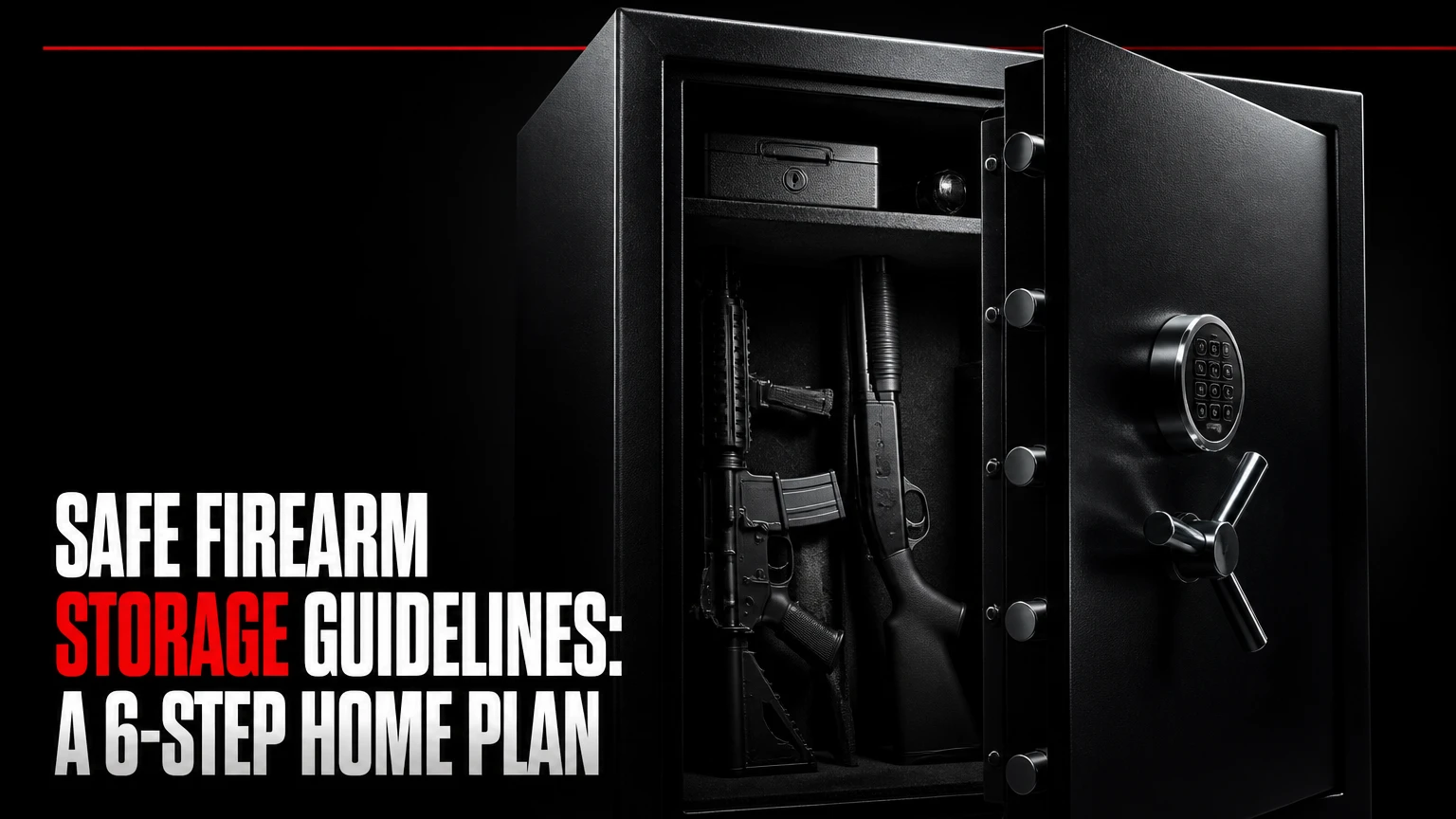
Safe firearm storage guidelines require every firearm to be unloaded, secured against unauthorized access, and protected from theft, with ammunition locked separately when practical and legally appropriate. The reliable method combines safe handling, a firearm lock, a locked enclosure, anchoring, controlled keys or codes, and regular access testing.
Key Facts
A locked enclosure protects against access and theft; a trigger or cable lock alone usually does not.
Verify the chamber is empty every time a firearm enters storage, even if someone else previously unloaded it.
Anchor a safe to structural framing or concrete because an unanchored safe can be carried away.
A firearm lock must not be used in a way that leaves a loaded chamber or creates unsafe pressure on ammunition.
Electronic and biometric locks require a tested mechanical or administrative backup plan.
Storage laws vary by jurisdiction, firearm type, household situation, and location, so official state and local sources control.
What Safe Firearm Storage Means
Safe firearm storage means placing a firearm in a locked device that prevents unauthorized handling, access, and use. The strongest household arrangement adds multiple barriers: the firearm is unloaded, a compatible locking device prevents operation, a hardened enclosure resists removal, and ammunition is secured under separate control.
The goal is not concealment. A pistol hidden in a drawer, closet, vehicle console, or mattress remains accessible to a child, visitor, distressed household member, or thief who discovers it. The CDC identifies secure storage as one prevention measure for firearm injuries, suicide, and unauthorized access, while Johns Hopkins’ Center for Gun Violence Solutions describes locked and unloaded storage as a practical risk-reduction approach.
The National Rifle Association’s first basic safety rule is, “Always keep the gun pointed in a safe direction.” That rule applies during unloading, cleaning, lock installation, and placement in the safe. Storage hardware cannot compensate for unsafe handling while the firearm is being secured.
How Do You Return a Firearm to Storage?
Return a firearm to storage through the same six-step sequence every time: control the muzzle, remove the ammunition source, clear and inspect the chamber, apply a compatible lock, secure the firearm in an anchored enclosure, and lock ammunition separately. The routine usually takes 2-5 minutes when performed deliberately.
Before You Start
| Requirement | Typical specification | Why it matters |
|---|---|---|
| Work area | 6 feet of clear space | Reduces interruptions and muzzle hazards |
| Storage device | 1 compatible lock plus 1 enclosure | Creates layered protection |
| Inspection time | 30-60 seconds | Allows visual and tactile verification |
| Cost | $10-$75 for a lock, $60-$400 for a lockbox | Covers basic to quick-access setups |
| Prerequisite | Firearm-specific manual or qualified instruction | Prevents incorrect unloading procedures |
Step 1: Control the Muzzle and Trigger
Point the muzzle in a safe direction, keep the trigger finger outside the trigger guard, and remove distractions such as phones, children, and pets. A safe direction is one that limits injury and property damage if an unintentional discharge occurs; the floor, a purpose-built clearing container, or an appropriate engineered backstop may be suitable depending on the setting.
Checkpoint: The muzzle remains controlled and the trigger finger stays indexed throughout the process.
Common mistake: Handling the firearm while searching for keys or opening the safe. Prepare the storage area first, then handle the firearm.
Step 2: Remove the Ammunition Source
Remove the magazine from a semiautomatic firearm, open the action on a rifle or shotgun, or unload the cylinder or tubular magazine according to the firearm manual. Removing a magazine does not prove that the chamber is empty because a round may already be chambered.
Checkpoint: The detachable magazine, loose cartridges, and shells are outside the firearm.
Common mistake: Treating a removed magazine as an unloaded firearm. The chamber still requires a separate inspection.
Step 3: Open, Clear, and Verify the Chamber
Open the action and inspect the chamber, breech face, magazine well, and feed path. Use both visual and tactile checks when the design permits, but never place a finger into an unknown firearm’s chamber or manipulate unfamiliar controls without competent instruction.
For a firearm that cannot be safely cleared or whose condition is uncertain, stop handling it and contact a qualified firearms instructor, gunsmith, range safety officer, or law-enforcement agency that provides safe assistance.
Checkpoint: The action is open, the chamber is visibly empty, and the firearm’s status is confirmed rather than assumed.
Common mistake: Looking only from an angle that cannot reveal the chamber. Use adequate light and follow the manufacturer’s unloading sequence.
Step 4: Apply a Compatible Firearm Lock
Install a cable lock, trigger lock, chamber lock, or manufacturer-approved locking device only after the firearm is unloaded and the action is in the position required by that device. A lock must not obstruct safe unloading, damage the firearm, or allow the action to close over ammunition.
Cable locks may pass through an opening that prevents the action from closing. Trigger locks block access to the trigger, but some designs do not prevent manipulation of the action or removal of the firearm. Always follow the lock manufacturer’s instructions.
Checkpoint: The lock is fully engaged, cannot be removed without its key or combination, and does not contact the trigger in a way that could activate it.
Common mistake: Using a trigger lock as the only theft barrier. Most trigger and cable locks are access barriers, not burglary-resistant containers.
Step 5: Lock the Firearm Inside an Anchored Enclosure
Place the locked firearm in a hardened lockbox, cabinet, or safe and close the locking mechanism completely. Anchor the enclosure to concrete or structural framing using the manufacturer’s approved hardware; thin drywall, a closet shelf, or a lightweight piece of furniture is not a reliable anchor.
Checkpoint: Pull gently on the door, confirm the latch is engaged, and verify that the enclosure cannot be lifted or moved with ordinary effort.
Common mistake: Buying a heavy safe but leaving it portable. Weight slows removal, yet anchoring determines whether a thief can simply take the container.
Step 6: Lock Ammunition Under Separate Control
Store ammunition in a locked container separate from the firearm when that arrangement is practical and consistent with local law, household needs, and the firearm manufacturer’s instructions. A locked ammunition box inside or beside a locked safe can provide separate access control without requiring ammunition to be scattered around the home.
Checkpoint: Ammunition is dry, contained, inaccessible to unauthorized people, and not loose on a shelf or in an unlocked drawer.
Common mistake: Storing cartridges where humidity, heat, solvents, or corrosive chemicals can degrade them. Use original packaging or a suitable closed container and inspect periodically.
Which Storage Device Fits the Risk?
The best storage device depends on the access time required, number of firearms, theft exposure, fire risk, and household access profile. A quick-access handgun box suits a bedside defensive role, while a bolted full-size safe better protects several firearms from theft and unauthorized handling.
| Device | Typical price | Typical access | Capacity | Primary limitation |
|---|---|---|---|---|
| Cable or trigger lock | $10-$75 | 10-30 seconds | 1 firearm | Little theft or fire protection |
| Portable steel lockbox | $30-$150 | 5-20 seconds | 1-2 handguns | Requires anchoring or a secure tether |
| Quick-access handgun box | $60-$400 | 1-5 seconds | 1-2 handguns | Limited long-gun capacity and fire protection |
| Steel cabinet | $150-$350 | 5-15 seconds | 4-12 long guns | Thin steel can be pried |
| Residential gun safe | $600-$3,000+ | 5-30 seconds | 8-40 firearms | Heavy, expensive, and not automatically fireproof |
What Does Each Lock Protect Against?
| Lock type | Blocks operation | Resists theft | Best use | Important limitation |
|---|---|---|---|---|
| Trigger lock | Usually | No | Preventing casual trigger access | Must fit without touching the trigger |
| Cable lock | Often | No | Temporary or supplemental storage | Cable can be cut with tools |
| Chamber lock | Yes | No | Demonstrating an open, blocked action | Compatibility varies by firearm |
| Mechanical push-button lockbox | Enclosure access | Moderate | No-battery bedside access | Code management remains necessary |
| Electronic keypad box | Enclosure access | Moderate | Rapid authorized access | Batteries and electronics can fail |
| Biometric box | Enclosure access | Moderate | Repeated access by enrolled users | Fingerprint recognition is not infallible |
A lockbox provides perimeter security that a trigger lock cannot. The distinction matters because an intruder can often remove a trigger-locked firearm and attack the lock later, whereas a properly anchored steel enclosure makes removal and forced access more difficult.
Should Firearms and Ammunition Be Stored Separately?
Firearms should generally be stored unloaded, and ammunition should be locked away from unauthorized users, with separate storage preferred when it does not undermine safe emergency planning. Federal law does not create one universal household-storage method for every owner, but state and local laws may impose specific requirements.
For a household with children, visitors, or a person experiencing suicidal thoughts, the safest response may require temporarily moving firearms outside the home, using a storage provider, or transferring them lawfully to a trusted person. The National Suicide Prevention Lifeline is now reached by calling or texting 988 in the United States and its territories.
Loaded storage creates a faster access option but also increases the consequence of unauthorized access. If a household chooses a loaded defensive firearm, the firearm should remain inside a purpose-built quick-access enclosure, and every authorized adult should receive professional training on access, handling, and emergency decisions.
Ammunition should remain in a cool, dry location away from open flames, solvents, children, and unauthorized users. Do not generalize that a sealed gun safe automatically becomes an explosive device during a fire. Smokeless powder, black powder, primers, and reloading components have distinct storage rules; follow the product manufacturer, local fire code, and National Fire Protection Association guidance.
How Should You Choose a Safe’s Construction?
Safe construction should be judged by steel thickness, door and hinge design, lock quality, anchoring method, capacity, and independently documented fire performance. Steel gauge is counterintuitive: a lower gauge number indicates thicker sheet steel, so 10-gauge is thicker than 14-gauge.
| Feature | Practical target | Verification method | Limitation |
|---|---|---|---|
| Body steel | 12-10 gauge for a residential safe | Manufacturer specification | Gauge alone does not prove burglary resistance |
| Door | Reinforced steel with multiple locking bolts | Product diagram and inspection | Decorative thickness may conceal a thin body |
| Anchor holes | Factory-designed floor or wall holes | Installation manual | Concrete and framing require different hardware |
| Lock | UL-listed or reputable mechanical/electronic assembly | Certification and service information | Certification scope may cover only the lock |
| Fire rating | Independent test, often 30-90 minutes | Test standard and certificate | Fire ratings differ in temperature and method |
| Interior humidity | Approximately 40-50% relative humidity | Digital hygrometer | Location and seasonal climate change readings |
A fire label alone does not guarantee that every firearm, optic, document, or ammunition component remains undamaged. Ask what internal temperature the test permits, how long the rating lasts, and whether the rating applies to the complete safe or only a fire-resistant liner.
Place a large safe on a stable, load-bearing surface and avoid flood-prone rooms. A ground-floor concrete installation reduces tipping and moving problems, but professional installation may be needed for heavy safes, rental properties, or upper floors.
Which Setup Fits Each Household?
Different users need different access and security balances. No single enclosure is ideal for a bedside handgun, a collection of long guns, and a firearm temporarily left in a vehicle.
Home-defense user
Choose a purpose-built quick-access handgun enclosure anchored to structural framing or a substantial bed or nightstand assembly. Mechanical push-button systems avoid battery dependence, while electronic and biometric systems can provide rapid entry if the owner tests them under realistic conditions.
The limitation is capacity. A compact box may protect one handgun but cannot safely accommodate a growing collection, documents, or long guns.
Collector, hunter, or sports shooter
Choose a full-size steel safe with a documented lock, sufficient interior capacity, and factory anchoring points. Leave usable space rather than filling every slot because crowded interiors increase contact damage, slow inspection, and make humidity control harder.
A tall safe protects long guns from casual access, but a steel cabinet with a simple key lock may be inadequate where burglary resistance is a priority.
Household with children or frequent visitors
Use a locked enclosure for every firearm, keep keys and codes inaccessible, and teach children a simple response: do not touch, leave the area, and tell an adult. Do not rely on secrecy, verbal warnings, or a high shelf.
Review access after babysitters, contractors, guests, and relatives arrive. A visitor’s child may know nothing about the alleged hiding place and still discover a firearm during ordinary play.
Person traveling with a firearm
Before entering a courthouse, school, airport, government building, or other restricted location, check the applicable law and facility policy. A portable lockbox with a security cable is a temporary layer, not a substitute for removing the firearm from the vehicle when unattended storage is prohibited or unsafe.
What Are the Legal Storage Requirements?
Legal firearm-storage requirements depend on the state, municipality, firearm category, presence of minors, and place where the firearm is stored. California, Massachusetts, New York, and several other jurisdictions have specific child-access or locked-storage rules, while local requirements can add transport and vehicle restrictions.
Check these sources in order:
- The official state police, attorney general, or legislative website.
- The relevant municipal code for local storage requirements.
- The firearm manufacturer’s instructions.
- The safe and lock manufacturer’s installation requirements.
- An attorney or qualified local firearms instructor for unusual circumstances.
Do not assume a federal rule, a retailer’s product description, or advice from another state answers the question. Document the safe’s model, installation instructions, keys, combinations, and maintenance schedule, but do not write the access code beside the safe.
How Can You Secure a Firearm in a Vehicle?
Vehicle storage should be temporary, locked, concealed from view, and anchored whenever the firearm must remain in the vehicle. A glovebox, center console, or trunk without a hardened lockbox is not a reliable firearm-storage system because thieves can break into those compartments quickly.
Before leaving the vehicle:
- Unload the firearm according to its manual.
- Lock the firearm inside a rigid, dedicated container.
- Attach the container’s security cable to a fixed structural part of the vehicle, where the product instructions permit.
- Keep the container out of sight.
- Park in a secure, lawful location and remove the firearm when the trip ends.
- Check state transport, school-zone, parking-facility, and employer rules.
A cable tether slows opportunistic theft but can be defeated with tools. Do not leave a firearm in a vehicle overnight unless the law and circumstances require it and no safer lawful alternative exists.
How Do You Prevent Rust Inside a Safe?
Prevent rust by controlling humidity, avoiding wet or fabric-wrapped storage, applying the firearm manufacturer’s approved protectant, and inspecting metal surfaces at least monthly in humid climates. A digital hygrometer gives a useful measurement, while renewable silica gel or a correctly installed low-temperature dehumidifier can reduce moisture.
| Condition | Typical action | Inspection interval | Warning sign |
|---|---|---|---|
| Relative humidity 40-50% | Maintain current controls | Monthly | None if metal remains clean |
| Relative humidity 51-60% | Add or renew desiccant | Every 2-4 weeks | Dull finish or condensation |
| Relative humidity above 60% | Improve room and safe control | Weekly until corrected | Orange specks or surface film |
| Wet firearm after use | Dry and inspect before storage | Same day | Water in recesses or under grips |
| Fabric soft case in closed safe | Remove or replace with breathable support | Immediately | Trapped odor or moisture |
Do not store a damp firearm in a soft case inside a sealed safe. Fabric can hold moisture against metal and delay detection. Follow the firearm manual for lubrication because excess oil can migrate into ammunition, optics, wood, or polymer components.
What Happens When Access Technology Fails?
Electronic and biometric storage devices require a backup plan that is secure, legal, and tested before an emergency. Batteries may die, fingerprints may fail after injury or moisture exposure, buttons may stick, and a backup key may be misplaced.
Test the lock monthly with the firearm removed. Replace batteries on a schedule rather than waiting for a low-power warning, enroll more than one authorized finger when the manufacturer permits it, and keep the override key in a controlled location that is not beside the enclosure.
A backup key should remain inaccessible to unauthorized users but available to the authorized owner. If the safe fails while locked, do not drill, pry, or force the container while a firearm may be inside. Contact the manufacturer or a qualified safe technician, and follow local procedures if the firearm cannot be confirmed safe.
Common Storage Mistakes and Their Fixes
| Mistake | Immediate risk | Corrective action | Prevention |
|---|---|---|---|
| Hidden loaded handgun | Child or unauthorized access | Unload and lock immediately | Use a dedicated quick-access box |
| Safe not anchored | Entire safe theft | Install approved anchors | Inspect anchor points annually |
| Key near the safe | Lock bypass by discovery | Move key to controlled storage | Use a code-management policy |
| Battery ignored | Emergency lockout | Replace and test batteries | Schedule monthly checks |
| Chamber not verified | Unintentional discharge | Stop and obtain qualified help | Repeat the same clearing sequence |
| Firearm stored wet | Corrosion and malfunction | Dry, inspect, and follow manual | Use humidity monitoring |
An expert rule of thumb is to design for the least responsible authorized user, not the most careful owner. If a teenager, guest, or tired adult can access the firearm without a deliberate authentication step, the storage system has a foreseeable failure path.
A second rule is to test access under realistic conditions. Opening a box in daylight with clean, dry fingers does not prove reliable access at night, during stress, or after a battery has weakened.
A third rule is to protect the safe from relocation. A strong lock on a portable box may provide less practical security than a modest enclosure that is correctly anchored to the building.
FAQ
Is hiding a firearm ever considered safe storage?
Hiding a firearm is not a dependable storage method because concealment does not create a physical access barrier. Children, visitors, burglars, and distressed household members may discover locations that an owner considers secret. Safe storage requires a locked device, controlled access, and an unloaded condition unless a lawful, trained, purpose-specific plan requires otherwise.
Can I store a firearm in a soft case?
A soft case can protect a firearm from scratches during transport, but it is not a substitute for a locked enclosure. Fabric can trap moisture inside a safe, particularly when the firearm or case enters storage damp. Dry the firearm, follow its maintenance instructions, and place the secured firearm in a locked container.
Is a biometric safe safer than a keypad safe?
A biometric safe is not automatically safer than a keypad safe. Fingerprint readers can fail because of dirt, moisture, abrasions, or enrollment problems, while keypads depend on batteries and code security. Choose the system that authorized users can open reliably, then test it monthly and maintain a secure backup method.
How often should a firearm safe be inspected?
Inspect a firearm safe monthly for lock operation, battery condition, anchor stability, humidity, corrosion, and unauthorized access to keys or codes. Perform a more detailed annual review after moving furniture, changing household members, replacing a lock, or adding firearms. Record inspections without recording the access code beside the safe.
What should I do if someone in my home is suicidal?
If someone may act on suicidal thoughts, create immediate distance from firearms by removing them from the home through a lawful transfer or secure storage provider, and call emergency services when danger is immediate. In the United States, call or text 988 for the Suicide and Crisis Lifeline. Do not rely on a hidden key or verbal promise.
Does a gun safe protect against a house fire?
A gun safe may delay heat and flame damage, but protection depends on its tested rating, installation, fire duration, internal temperature, and contents. Review the independent test documentation rather than relying on the word fireproof. Ammunition and reloading components have separate manufacturer and fire-code requirements.
The Bottom Line
Effective safe firearm storage guidelines produce three outcomes: unauthorized people cannot access the firearm, thieves cannot easily remove the storage system, and authorized users can operate the system reliably. Unload and verify the firearm, apply a compatible lock, secure it inside an anchored enclosure, control keys and codes, lock ammunition appropriately, and inspect the setup monthly. This layered approach is safer than hiding a firearm or relying on a single inexpensive lock.