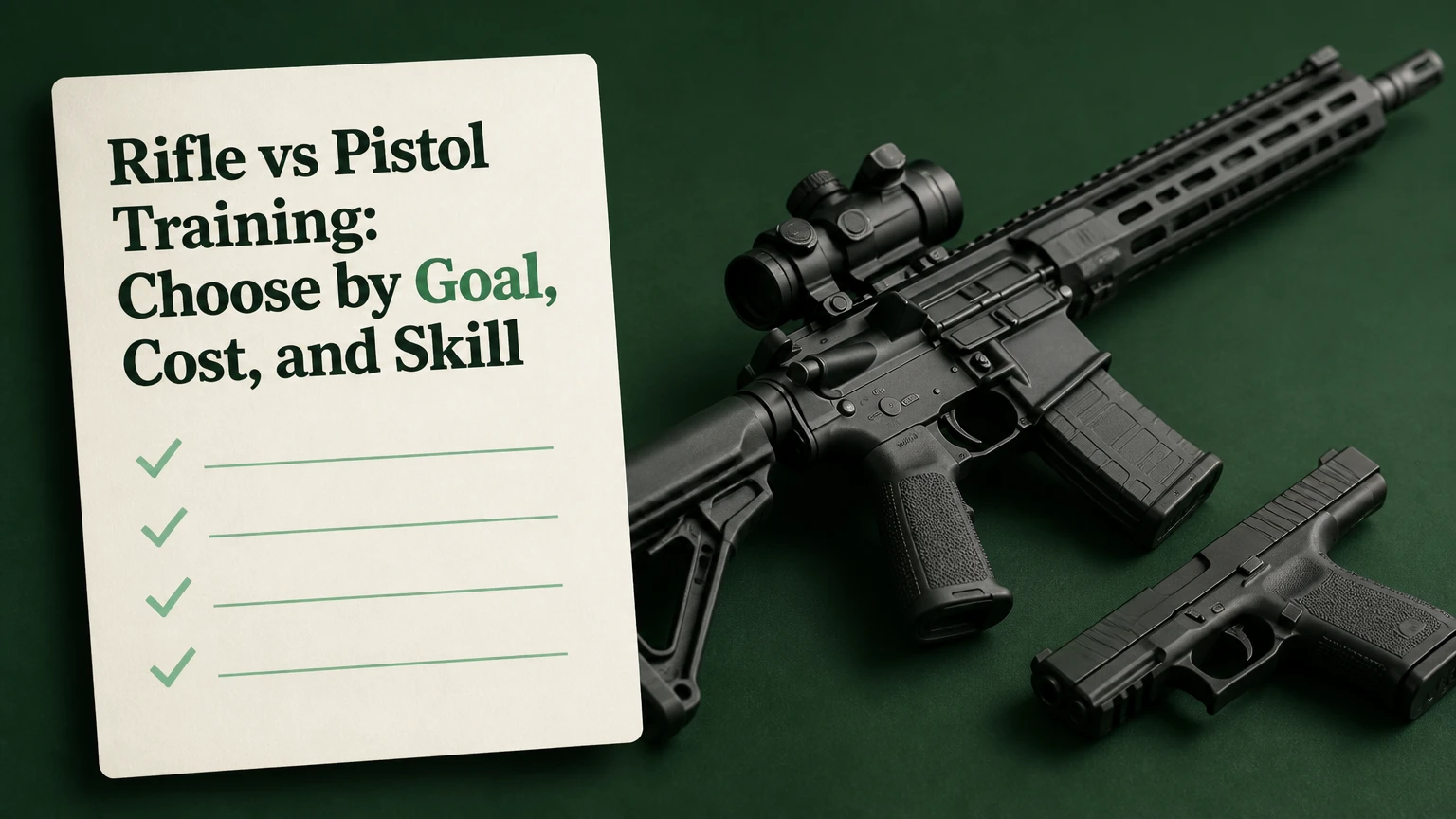
Rifle vs pistol training is not a contest with one universal winner. Rifle training usually produces faster early accuracy because the shoulder stock, longer sight radius, and supported position add stability, while pistol training demands more grip, trigger, and presentation control; the better starting point depends on whether the goal is sport, hunting, home protection, or concealed carry.
Key Facts at a Glance
A rifle offers more body contact and mechanical stability than a pistol, but it requires more space, storage planning, and range access.
A pistol is harder to shoot precisely at first because small grip and trigger errors create larger point-of-impact changes.
Dry practice develops handling and presentation skills, but live ammunition is required to validate recoil control and accuracy.
Typical introductory courses cost about $150-$400 before ammunition, range fees, equipment, and travel.
A safe curriculum begins with universal firearm rules, supervised handling, basic marksmanship, and only then adds speed or movement.
Rifle and pistol skills overlap in sight use, trigger control, safe loading, and accountability for every shot, but platform-specific manipulation does not transfer completely.
What Are Rifle and Pistol Training?
Rifle training teaches safe and accurate operation of a shoulder-fired firearm, while pistol training teaches safe and accurate operation of a handgun held without a shoulder stock. Both disciplines include firearm safety, loading and unloading procedures, aiming, trigger control, recoil management, maintenance, and responsible storage.
The mechanical difference changes the learning problem. A rifle commonly uses a shoulder contact point, cheek contact, two-handed control, and a longer sighting system. A pistol relies mainly on the shooter’s two-handed grip, wrist alignment, visual sight confirmation, and trigger isolation. A revolver and a semiautomatic pistol also require different loading, unloading, and malfunction procedures.
The four-contact-point description often used for rifles is a useful teaching model, not a universal rule. A standing rifle position may have fewer stable contacts than a supported prone position, and an unconventional position may change the body interface entirely. Similarly, pistol shooting is not literally limited to one contact point because both hands can contribute substantially to grip and recoil control.
The National Rifle Association’s familiar safety instruction, “Always keep the gun pointed in a safe direction,” applies equally to both platforms. A competent instructor should also teach treating every firearm as loaded, keeping the trigger finger outside the trigger guard until ready to fire, and identifying the target and what lies beyond it.
How Does Rifle vs Pistol Training Differ?
Rifle training generally rewards skeletal support, body position, stock placement, and sight stability, whereas pistol training exposes errors in grip pressure, wrist alignment, trigger movement, and visual focus. The difference is most obvious during unsupported shooting, rapid follow-up shots, and work at distances where a short sight radius magnifies movement.
| Training attribute | Rifle | Pistol |
|---|---|---|
| Primary support | Shoulder stock, support hand, torso | Two-hand grip, wrists, forearms |
| Typical sight radius | 12-20 inches with iron sights | 5-8 inches with iron sights |
| Common beginner distance | 25-100 yards | 3-10 yards |
| Early accuracy experience | Larger groups become manageable sooner | Small errors produce wider groups |
| Common optic | Red dot, prism, or variable scope | Iron sights or compact red dot |
| Typical platform weight | 5-10 pounds unloaded | 1.3-3 pounds unloaded |
| Main recoil issue | Stock placement and muzzle movement | Grip consistency and anticipation |
| Range requirement | Often outdoor, 50-300 yards | Often indoor, 7-25 yards |
Rifle stability does not make rifle training automatically easy. A rifle with a magnified optic introduces eye relief, parallax, ballistic drop, wind, and mechanical offset. A lightweight hunting rifle can also produce uncomfortable recoil, while a .22 rimfire rifle may be exceptionally manageable.
Pistol training is more portable but less forgiving. The shooter must align a small sighting system while maintaining enough grip consistency for the sights to return predictably after recoil. A red-dot pistol changes the visual task, but it does not remove the need for a repeatable grip or safe draw stroke.
Which Training Type Fits Your Goal?
The best training type is determined by the activity that must be performed safely and repeatedly, not by a general claim that one firearm is superior. Concealed carry points toward pistol fundamentals, precision competition points toward rifle position and wind skills, and hunting requires a platform selected for the quarry, terrain, and local regulations.
| Goal | Primary platform | Core skills | Typical practice setting |
|---|---|---|---|
| Concealed carry | Pistol | Safe handling, presentation, accuracy, retention, legal judgment | Indoor range and supervised class |
| Home protection | Pistol or carbine | Safe storage, identification, communication, accountability | Safety class and structured range |
| Small-game hunting | Rimfire rifle | Position, ammunition selection, field identification | Outdoor range and lawful hunting area |
| Big-game hunting | Centerfire rifle | Zero confirmation, supported positions, field judgment | Outdoor range and hunting course |
| Precision competition | Bolt-action rifle | Wind, external ballistics, positional stability | 100-1,000-yard range |
| Action competition | Pistol, rifle, or both | Accuracy under time, movement, equipment procedures | USPSA, IDPA, IPSC, or 3-Gun club |
| Recreational marksmanship | Either platform | Fundamentals, consistency, safe range conduct | Certified range with an instructor |
The overview’s statement that precision training is exclusive to rifles is too narrow. Rifles dominate long-range precision disciplines, but pistol bullseye, steel challenge, and action shooting also demand precision. Conversely, rifle training includes close-range handling, carbine marksmanship, hunting, and recreational plinking, not only long-range shooting.
Home protection deserves particular caution. A rifle or carbine may offer greater stability and capacity than a handgun, but it can also be more difficult to maneuver, store, and control in a confined home. A handgun is easier to keep secured in some households, yet its lower mechanical stability can increase the training burden. A certified instructor and a documented safety plan matter more than a platform slogan.
How Should a Beginner Progress?
A beginner should complete a safety-oriented introductory lesson, practice unloaded handling under supervision, confirm basic accuracy at short distance, and build consistency before adding speed or complex scenarios. A practical initial cycle is 6-12 weeks, with one coached range session every one or two weeks and short, deliberate practice between sessions.
Phase 1: Safety and Equipment Orientation
Start with the owner’s manual, local laws, range rules, eye and ear protection, and a locked storage plan. The student should identify the firearm’s controls without ammunition present, learn the range’s cease-fire procedure, and demonstrate safe muzzle and trigger discipline.
A beginner should not start with a holster draw, movement drill, low-light exercise, or force-on-force scenario. Those activities require instructor oversight, appropriate equipment, and a training environment designed for them.
Phase 2: Basic Marksmanship
Use a stable, uncomplicated setup. For a pistol, begin at a short distance that allows the student to diagnose technique without chasing the target. For a rifle, a .22 LR platform or low-recoil centerfire rifle can reduce fatigue while the student learns stock placement, cheek position, sight use, and trigger control.
The first checkpoint is repeatability, not a dramatic group size. The shooter should be able to maintain the same grip or stock position, keep the trigger finger correctly placed, and explain why a shot landed outside the intended area.
Phase 3: Supervised Live-Fire Practice
Begin with single shots and deliberate pauses. Increase the number of shots only when the shooter can maintain safe handling, a stable position, and a predictable sight picture. Typical introductory sessions use approximately 50-150 rounds, although the appropriate quantity depends on the firearm, ammunition, instructor, and student fatigue.
A zero is not a universal number. Defensive pistol users may confirm at 7-15 yards, while a general-purpose rifle may be confirmed at 50 or 100 yards. The correct distance depends on the optic, ammunition, intended use, range, and manufacturer guidance.
Phase 4: Platform-Specific Skills
Pistol students may later learn safe holster presentation, magazine changes, and malfunction recognition. Rifle students may learn sling adjustment, supported positions, optic confirmation, and the relationship between the sight line and bore line.
These skills should be introduced individually. Combining speed, movement, multiple targets, and unusual positions before basic control is reliable increases risk without proving competence.
What Distances and Standards Apply?
Typical pistol practice occurs at 3-25 yards, while general rifle practice commonly occurs at 25-300 yards; precision rifle work can extend beyond 1,000 yards when the range, equipment, ammunition, and environmental conditions support it. Distance alone does not establish skill because target size, time limit, position, and scoring system also matter.
| Use case | Pistol distance | Rifle distance | Example benchmark |
|---|---|---|---|
| First supervised session | 3-7 yards | 25-50 yards | Safe operation and consistent hits |
| General practice | 7-15 yards | 50-100 yards | Repeatable group with deliberate fire |
| Defensive-sport practice | 5-25 yards | 25-100 yards | Scored accuracy within a time limit |
| Hunting confirmation | Not usually applicable | 100 yards, sometimes 50 | Group verified with hunting ammunition |
| Precision practice | Not usually applicable | 300-1,000+ yards | Data confirmed for distance and conditions |
A 1-2 MOA rifle group at 100 yards represents roughly 1-2 inches under suitable conditions. That is a useful technical reference, not a universal beginner requirement. A pistol group inside six inches at 10 yards may be a reasonable early practice goal for some shooters, but scoring standards vary by course and discipline.
The most useful standard is a documented baseline. Record distance, ammunition, position, group size, time, and any safety or handling errors. A smaller group achieved slowly from a supported position does not automatically indicate better defensive or competition performance.
Which Skills Transfer Between Platforms?
Sight discipline, trigger control, follow-through, ammunition awareness, safe loading, and responsible target identification transfer from rifle to pistol and pistol to rifle. Stock weld, holster presentation, rifle optic offset, pistol grip pressure, and platform-specific reload procedures require separate practice.
| Transfer category | Transfers well | Requires separate training |
|---|---|---|
| Safety | Muzzle direction, trigger discipline, target identification | Platform-specific unloading sequence |
| Marksmanship | Visual focus, trigger press, follow-through | Stock weld versus pistol grip |
| Recoil control | Anticipation awareness, recovery observation | Rifle shoulder placement versus pistol wrist control |
| Equipment | Magazine awareness, ammunition inspection | Pistol holster versus rifle sling |
| Accuracy | Group measurement and shot diagnosis | Ballistic drop, offset, and sight radius |
| Movement | Footwork and awareness under supervision | Rifle presentation versus pistol draw |
A counterintuitive practitioner rule is that pistol competence does not automatically qualify someone to run a rifle quickly. The controls, balance, sling, optic height, and muzzle-management concerns differ enough to require a dedicated orientation.
The reverse is also true. A rifle shooter who can produce small groups from a supported position may struggle with a pistol because the handgun removes much of the mechanical support. Cross-training helps only when each platform receives focused repetitions.
What Does Training Cost?
Typical introductory firearm courses cost $150-$400, excluding ammunition and equipment, while advanced one-day courses commonly cost $250-$800. The final budget depends on ammunition caliber, range fees, travel, instructor credentials, required gear, and whether the student owns or rents the firearm.
| Expense | Pistol typical range | Rifle typical range | Main cost variable |
|---|---|---|---|
| Introductory course | $150-$300 | $200-$400 | Course length and instructor |
| Advanced day course | $250-$600 | $300-$800 | Specialty and range access |
| Ammunition per class | 100-300 rounds | 80-250 rounds | Drill design and caliber |
| Ammunition estimate | $30-$150 | $40-$250 | 9mm versus .223 Remington or larger |
| Eye and ear protection | $25-$150 | $25-$150 | Passive versus electronic hearing protection |
| Rental fee | $15-$40 | $20-$60 | Range and firearm type |
| Secure storage | $30-$300 | $50-$500 | Lockbox, cable, or full-size safe |
These are typical planning ranges, not fixed prices. Local market conditions can change them substantially, and ammunition prices fluctuate. A beginner should reserve money for instruction and safe storage before purchasing accessories.
Dry practice can reduce ammunition use, but it cannot replicate recoil, noise, blast, ammunition feeding, or the behavioral pressure of a supervised live-fire session. Any dry practice area must be cleared of ammunition, pointed toward a safe backstop, and operated according to the firearm manufacturer’s instructions.
How Should Practice Be Divided?
A reasonable beginner plan allocates about 60-80% of practice to safe handling and fundamental consistency, with the remainder devoted to supervised live-fire confirmation and carefully selected platform skills. The exact ratio changes when the student is preparing for a match, hunting season, licensing course, or concealed-carry qualification.
| Practice type | Typical duration | Pistol emphasis | Rifle emphasis |
|---|---|---|---|
| Safety review | 5-10 minutes | Direction, trigger, controls | Direction, safety, bolt or charging handle |
| Dry practice | 5-15 minutes | Grip and presentation, unloaded | Mount, stock position, sight picture |
| Live fire | 30-60 minutes | Recoil and group confirmation | Position, zero, optic use |
| Maintenance | 10-20 minutes | Inspection and cleaning | Inspection, bore and optic care |
| Review log | 5 minutes | Group, distance, errors | Group, position, conditions |
Dry practice is most useful when the action is simple, slow, and measurable. A shooter can record whether the sights moved during a deliberate trigger press, but a training device or laser does not prove safe gun handling or live-fire proficiency.
Force-on-force training is an advanced option, not a beginner substitute. Simunition, airsoft, and other marking systems require protective equipment, trained role players, strict ammunition separation, and a professional safety brief.
Which Should You Choose?
The right choice follows the user’s actual need, available range, physical ability, storage arrangement, and local law. A beginner who wants broad recreational marksmanship may start with a low-recoil rifle, while a concealed-carry applicant needs pistol-specific training even if a rifle is easier to shoot accurately.
Choose Pistol Training for Concealed Carry
Pistol training is the direct choice for concealed carry because the student must learn handgun handling, secure storage, presentation from lawful carry equipment, and judgment under the applicable jurisdiction’s rules. Training should begin with a qualified instructor before any draw practice occurs.
A pistol is not automatically the easiest defensive platform. Its portability creates a demanding accuracy and handling problem, and carrying a firearm creates continuing responsibilities for retention, storage, maintenance, and legal compliance.
Choose Rifle Training for Hunting and Precision
Rifle training fits hunting and precision goals because the platform supports stable positions and allows instruction in trajectory, zero confirmation, wind, ammunition selection, and field identification. Hunting training must also include local regulations, ethical shot selection, wildlife identification, and recovery planning.
A precision rifle course is a poor substitute for general defensive training. Its supported positions and long-distance data do not teach every close-range handling or decision-making skill.
Combine Both for Competitive Shooting
Competitors should choose the discipline first. USPSA, IDPA, and IPSC emphasize pistol handling and scored accuracy under time, while PRS emphasizes positional rifle shooting and environmental effects; 3-Gun combines rifle, pistol, and shotgun skills.
Competition improves measurement and pressure management, but match performance is not the same as defensive preparation. Rules, targets, range layouts, and known stage procedures create a specialized environment.
Start With a Low-Recoil Platform as a Complete Novice
A complete novice can often learn basic sight use and trigger control comfortably with a .22 LR rifle under supervision. That starting point is useful when noise, recoil, strength, or anxiety would otherwise interfere with safe learning.
The .22 LR platform does not reproduce every centerfire rifle or pistol characteristic. The student should transition deliberately after demonstrating safe handling and should receive instruction on the new firearm’s controls and ammunition.
What Mistakes Cause Poor Results?
Most early accuracy problems arise from inconsistent contact, anticipation, poor visual focus, fatigue, or an unsuitable distance, not from a mysterious defect in the firearm. The correct fix begins with observing a repeatable pattern, changing one variable, and confirming the result with an instructor.
| Symptom | More likely cause | Safe diagnostic response |
|---|---|---|
| Pistol shots spread widely | Grip or trigger inconsistency | Slow down and use a closer target |
| Pistol shots drift low | Anticipation or visual interruption | Return to deliberate single shots |
| Rifle groups shift between strings | Position or stock contact changes | Rebuild the same position each string |
| Close rifle impacts hit low | Sight-to-bore offset | Learn the optic’s confirmed offset |
| Groups enlarge late in session | Fatigue, noise, or heat | Pause, hydrate, and stop when control declines |
| Hits miss despite good groups | Sight or zero issue | Check equipment and confirm zero |
Pistol Troubleshooting
A “milking” grip occurs when the firing hand tightens unevenly as the trigger moves, disturbing the sights. Right-handed shooters may see a low-left pattern, but target patterns are diagnostic clues rather than proof of one specific error.
Use a qualified instructor, slow deliberate presses, and a distance where the shooter can see sight movement. A support-hand-heavy grip is often taught, but fixed percentages such as “70% support hand” should be treated as coaching language, not a universal measurement.
Target focus and front-sight focus are not interchangeable instructions. Iron-sight training commonly requires a clear front sight, while a red-dot technique may use target-focused vision after the shooter can safely present and locate the dot.
Rifle Troubleshooting
Mechanical offset describes the vertical and sometimes horizontal separation between the optic’s line of sight and the bore. A 2.5-inch sight height is common on some modern carbines, but the actual value varies with the optic, mount, stock, and firearm.
Do not memorize a universal “aim higher” correction. Confirm the rifle’s offset and trajectory at the distances used, because ammunition, zero distance, and angle can change the result. Natural point of aim also requires more than closing the eyes: the shooter should build a safe position, relax unnecessary muscle tension, and adjust the body rather than forcing the firearm onto target.
What Does the Overview Miss?
A complete comparison must include storage, hearing protection, physical fit, instructor quality, local law, ammunition availability, and range design. These factors can determine whether a theoretically suitable platform is practical for a particular household.
Rifle storage often needs a longer safe or separate locking arrangement, while pistol storage may require a quick-access lockbox that prevents unauthorized access. Both firearms must be secured from children, visitors, and prohibited users, and local transport rules may impose additional requirements.
Physical fit matters. A small-framed shooter may manage a properly fitted .22 LR rifle well but struggle with a heavy centerfire rifle, while a pistol with an oversized grip can prevent consistent trigger access. Rental programs can help compare fit before purchase, provided the range offers competent supervision.
Range availability changes the learning curve. A pistol student may find a 7- or 10-yard indoor lane nearby, whereas a rifle student may need an outdoor facility with 50- or 100-yard access. Travel time affects practice frequency more than many equipment upgrades do.
The largest limitation of fixed timelines is individual variation. Claims that pistol competency takes three to six months and rifle competency takes two to four months are plausible planning estimates for regular practice, not validated universal milestones. Skill should be demonstrated through safe, repeatable performance rather than a calendar date.
How Can You Select an Instructor?
Select an instructor who explains safety before technique, verifies credentials and insurance where applicable, adapts equipment to the student, and uses measurable exercises instead of beginning with speed. A reputable course states prerequisites, ammunition requirements, refund policies, range conditions, and the exact skills covered.
Ask these questions before booking:
- What instructor credentials and recent teaching experience apply?
- Is the class designed for first-time owners or experienced shooters?
- What firearm types and calibers are permitted?
- How many students share one instructor?
- What happens if a student becomes unsafe or overwhelmed?
- Are legal, storage, transport, and maintenance topics included?
- Does the course provide a written progression or performance standard?
Avoid courses that promise instant mastery, treat tactical language as a substitute for safety, or pressure students to buy equipment. A good instructor can explain why a drill exists and when a student is not ready to perform it.
The Bottom Line
Rifle vs pistol training should be selected by purpose, not by a blanket claim that one platform is stronger or easier. Choose pistol training for concealed carry and handgun-specific responsibilities, rifle training for hunting, precision, and many recreational applications, and a structured combination for competition or broad competence.
Start with safety, fit, storage, and an instructor. Then build accuracy at manageable distances, record results, and add platform-specific skills only after handling remains reliable. The best firearm is the one the student can operate safely, store responsibly, access legally, and practice consistently.
Frequently Asked Questions
Is Rifle Training Safer Than Pistol Training?
Neither rifle training nor pistol training is inherently safe without disciplined handling, a suitable range, and qualified supervision. A rifle’s stock may improve stability, but its longer form factor and greater projectile range create different backstop and storage concerns. A pistol is compact, yet its concealability and handling complexity demand careful training.
Can Pistol Skills Transfer to a Rifle?
Pistol skills transfer to a rifle in areas such as muzzle awareness, trigger discipline, sight use, target identification, and follow-through. Rifle-specific skills still require dedicated instruction because stock placement, sling use, optic height, controls, and balance differ. Transfer is helpful, but it is not a qualification.
Is Dry Fire Enough to Become Proficient?
Dry fire is not enough to establish complete proficiency because it cannot reproduce recoil, noise, ammunition feeding, blast, or live-range decision-making. Dry practice can reinforce safe presentation, sight movement, and trigger control when the firearm is unloaded and the practice area is controlled. Live fire must confirm the result.
How Often Should a Beginner Practice?
A beginner should typically practice briefly once or twice weekly and attend a coached live-fire session every one or two weeks during the first 6-12 weeks. Five to fifteen focused minutes can be more productive than a long session performed while fatigued. Stop when safety or technique deteriorates.
Should Someone Learn Rifle or Pistol First?
A person should learn the platform connected to the immediate lawful purpose. Concealed carry requires pistol-first instruction, while hunting or precision goals justify rifle-first instruction. A complete novice seeking a comfortable introduction may begin with a supervised .22 LR rifle, then take separate pistol training before handling a handgun independently.