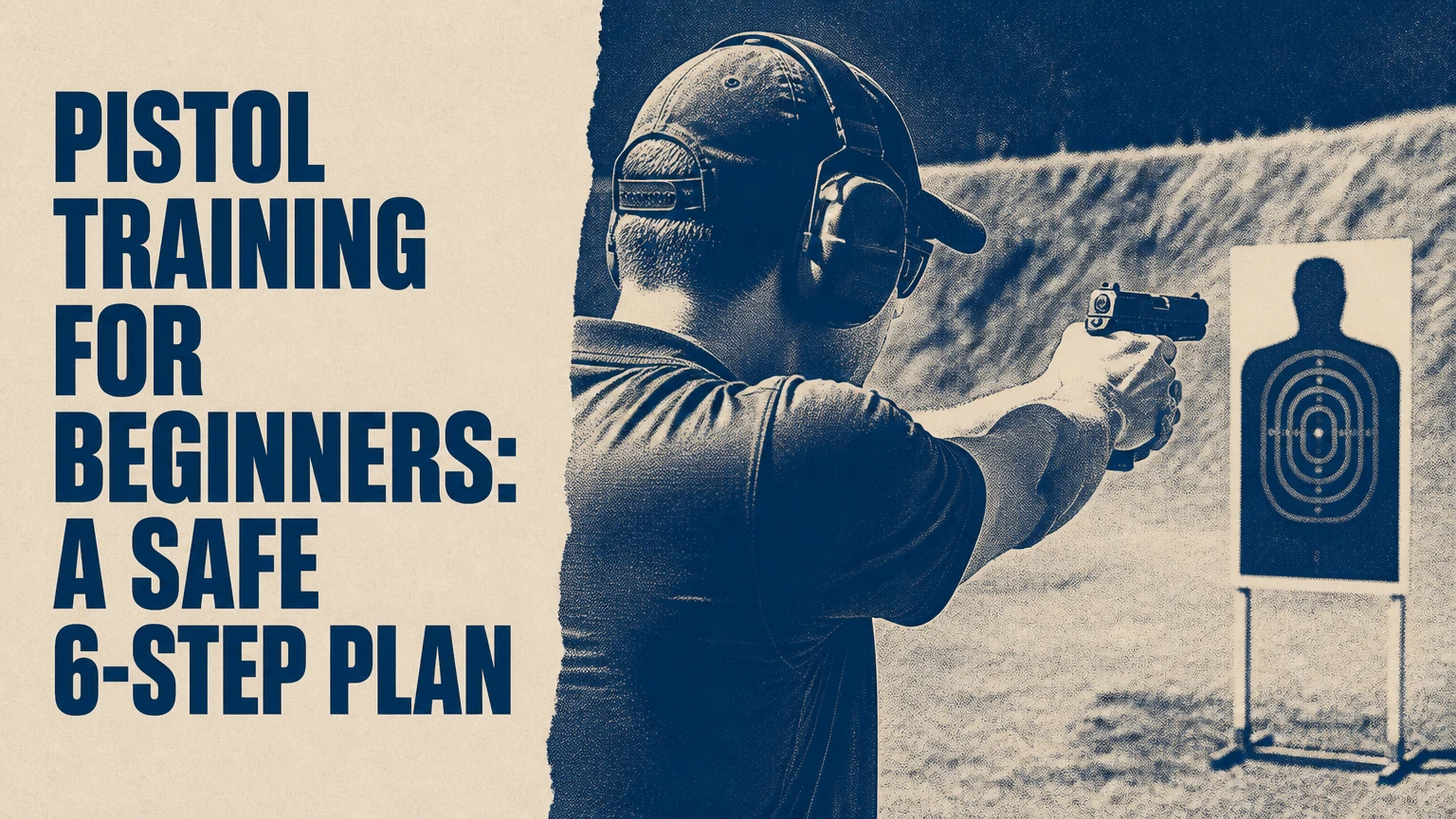
Pistol training for beginners is a supervised, progressive process for learning firearm safety, handling, aiming, firing, storage, and basic maintenance. The safest path starts with a qualified instructor and an unloaded pistol, then adds dry practice and controlled live fire while the learner develops consistent habits rather than chasing speed or distance.
Key Facts at a Glance
A first-time shooter should begin with a qualified instructor, a manufacturer-approved firearm manual, and a range that provides direct supervision.
The four safety rules apply before, during, and after every handling session, including dry-fire practice.
A typical introductory handgun class lasts 2-4 hours and costs about $75-$175, excluding ammunition and range fees.
.22 LR usually produces less recoil and noise than 9mm, while 9mm offers broader defensive-handgun and ammunition availability.
Beginners normally start at 3-5 yards, where an instructor can diagnose grip, trigger, and sight errors without making distance the main challenge.
Safe progress means consistent procedures, controlled hits on an appropriate target, and reliable response to range commands, not a particular round count.
What Does Pistol Training for Beginners Include?
Pistol training for beginners combines classroom instruction, supervised handling, dry-fire mechanics, live-fire practice, and post-session care. A complete course teaches the pistol’s controls, ammunition identification, loading and unloading procedures, sight alignment, trigger control, recoil management, range commands, storage, and the legal limits of carrying or using a firearm.
The exact sequence varies by instructor and pistol model. A striker-fired 9mm, a .22 LR rimfire pistol, a double-action revolver, and a double-action/single-action semi-automatic pistol do not have identical controls or trigger characteristics. The learner must follow the specific owner’s manual rather than memorize a universal manipulation sequence.
Good instruction also manages the human factors that cause many beginner errors: startle response, uncertainty about the controls, excessive grip tension, visual distraction, and premature attempts to shoot quickly. Colonel Jeff Cooper’s well-known maxim, “The safety is between your ears,” captures the point: mechanical safeties do not replace deliberate handling decisions.
What should a beginner be able to do afterward?
A beginner who completes an entry-level course should be able to identify the pistol and ammunition, keep the muzzle in a safe direction, keep the trigger finger indexed outside the trigger guard, follow range commands, load and unload under supervision, and explain safe storage procedures.
A beginner should not assume that one class creates defensive proficiency. A basic class introduces safe operation; it does not substitute for continued practice, legal education, judgment training, medical preparation, or scenario-based instruction.
What Safety Rules Come First?
The four foundational firearm-safety rules are: treat every firearm as loaded, never point the muzzle at anything you are unwilling to destroy, keep the trigger finger outside the trigger guard until the sights are on the intended target and the decision to fire is made, and identify the target and what lies beyond it.
These rules are overlapping safeguards. If one habit fails, the others should prevent an injury. The rules apply at home, in a gun shop, at a classroom table, on a firing line, and during cleaning.
How should a beginner prepare a pistol safely?
Use the owner’s manual and an instructor’s demonstration for the exact pistol. In general, keep the muzzle in a safe direction, remove the source of ammunition, lock the action open when the design permits, and visually and physically verify the chamber and magazine well are empty. Do not rely on a loaded-chamber indicator alone.
Dry-fire preparation requires a separate control system. Remove all ammunition, magazines, and loaded firearms from the room; choose a safe backstop; inspect the pistol and magazine; tell other people not to interrupt; and stop immediately if anyone enters the practice area. Recheck the pistol before returning it to storage or handling ammunition.
At a range, a firearm that is not being fired should remain pointed downrange or secured as the facility requires. When a range officer announces a ceasefire, stop handling the firearm, remove the finger from the trigger, and follow the facility’s procedure exactly.
How Does a Beginner Learn the Shooting Fundamentals?
A beginner learns pistol fundamentals in a fixed order: safety, stance, grip, sight alignment, sight picture, trigger press, recoil recovery, and follow-through. The order matters because a stable grip cannot compensate for a finger placed on the trigger too early, and a perfect sight picture cannot compensate for unsafe muzzle control.
Step 1: Establish a balanced stance
Stand with the feet approximately shoulder-width apart, knees relaxed, and weight distributed so the body can remain stable without locking the joints. A modern two-handed stance may use a squared or slightly offset torso; comfort, balance, and repeatability matter more than copying a dramatic posture.
Lean only enough to remain balanced against recoil. Excessive forward lean can create fatigue and tension, while leaning backward makes recoil recovery less consistent. The success checkpoint is a stable upper body that returns naturally to the target after each supervised shot.
Step 2: Build a high, two-handed grip
Place the dominant hand high on the grip without interfering with the slide or other moving parts. The support hand fills the exposed grip surface, and both thumbs follow the pistol’s design and the instructor’s guidance without touching controls unintentionally.
Grip pressure should hold the pistol securely while leaving the trigger finger independent. A beginner often squeezes harder with the dominant hand during the trigger press, which can move the sights. The success checkpoint is a repeatable grip that does not change between shots.
Step 3: Align the sights and confirm the picture
Sight alignment describes the relationship between the front and rear sights. Sight picture adds the relationship between that aligned sight system and the target. With conventional iron sights, many pistols use a front sight centered in the rear notch with the top edges level, but the owner’s manual or instructor should confirm the model’s intended reference.
Focus on the front sight while keeping the rear sight and target sufficiently visible to maintain alignment. Red-dot optics use a different visual process, yet the safety and trigger principles remain unchanged. The success checkpoint is a sight picture that appears consistently before the trigger press.
Step 4: Press the trigger without disturbing the sights
Place the trigger finger where the pistol’s manufacturer and instructor recommend, usually the center portion of the pad for a conventional trigger. Press smoothly to the rear while keeping the sights aligned and the rest of the hand from tightening abruptly.
Do not attempt to predict the exact instant of discharge. That anticipation commonly produces a flinch or a sideways steering movement. The success checkpoint is a clean press that allows the pistol to fire without a visible dip or sideways jerk.
Step 5: Manage recoil and recover the sights
After the shot, allow the pistol to move within the grip rather than trying to freeze it. Maintain the two-handed grip, keep the finger disciplined, and let the sights return to the target before another deliberate shot.
Recoil management is a repeatability problem, not a contest in physical strength. A smaller shooter may need a different pistol size, grip circumference, or caliber than a larger shooter. The success checkpoint is a controlled return of the sights without changing the grip.
Step 6: Follow through and stop deliberately
Keep the pistol oriented safely after the shot and follow the instructor’s direction about trigger release and reset. Trigger reset can be useful for understanding the pistol’s operation, but beginners should not chase a reset click at the expense of safe trigger-finger placement or sight control.
A competent first session ends with a safe unload, inspection, and storage procedure. The final checkpoint is the ability to stop shooting immediately when instructed and handle the unloaded pistol without confusion.
Which Caliber and Pistol Size Fit a Beginner?
A .22 LR pistol usually minimizes recoil, blast, and ammunition cost, while a 9mm Luger pistol offers a practical balance of availability, capacity, and recoil for many adult learners. Neither caliber is automatically correct for every beginner, and the best choice depends on hand strength, hearing protection, intended use, pistol fit, and instructor availability.
The AI Overview’s claim that 9mm is appropriate for 95% of beginners is not a reliable evidence-based statistic. A better rule is to rent or borrow several lawful, instructor-approved options and choose the model the learner can operate safely and comfortably.
| Option | Typical recoil and cost | Useful beginner setting | Main limitation |
|---|---|---|---|
| .22 LR pistol | Low recoil; $0.08-$0.20 per round | First 50-100 supervised rounds | Rimfire ammunition can be less reliable and differs from many defensive pistols |
| 9mm Luger | Moderate recoil; $0.25-$0.45 per round | General skills and later defensive training | More blast and recoil than .22 LR |
| .380 Auto | Low-to-moderate recoil; $0.35-$0.60 per round | Smaller hands or compact-pistol evaluation | Small pistols can feel sharp and difficult to control |
| .38 Special revolver | Moderate recoil; $0.35-$0.70 per round | Learners who prefer revolver controls | Heavy double-action trigger and slower reload process |
| .45 ACP | Higher recoil; $0.45-$0.80 per round | Experienced shooters with a specific reason | Greater cost, recoil, and blast for early practice |
What size pistol should a beginner use?
A mid-sized pistol often gives a new shooter more controllable recoil and a fuller grip than an ultra-compact model. Compact pistols may be easier to carry but can be harder to hold, operate, and shoot accurately because their short grips and lighter frames transmit more movement.
A rental counter is useful when paired with an instructor. Test whether the learner can reach the trigger without shifting the grip, lock the slide safely, insert and remove a magazine, see the sights clearly, and maintain control for a supervised session. A pistol that is comfortable unloaded may become tiring after 50 rounds.
Which Handgun Action Is Easier to Learn?
For many beginners, a standard striker-fired or double-action/single-action semi-automatic pistol offers a manageable learning path, but each platform introduces different control demands. A revolver is not automatically simpler, because its long trigger press can challenge accuracy and its reload process requires separate instruction.
| Action type | Trigger characteristic | Typical capacity | Beginner advantage | Beginner limitation |
|---|---|---|---|---|
| Striker-fired semi-automatic | Consistent medium-weight press | 10-17 rounds | Same basic press for each shot | Short trigger requires disciplined handling |
| DA/SA semi-automatic | Long first press, shorter later presses | 10-17 rounds | Heavy first press can add margin | Two trigger modes require deliberate practice |
| Double-action revolver | Long press for every shot | 5-6 rounds | No semi-automatic cycling to learn | Long press and reloads can be demanding |
| Single-action semi-automatic | Short, light press after manual setup | 7-10 rounds | Precise trigger potential | Manual safety and loading condition add tasks |
A qualified instructor should teach the specific action rather than switching platforms repeatedly during the first lesson. Platform consistency reduces cognitive load and makes errors easier to diagnose.
How Can Beginners Use Dry Fire Safely?
Dry fire is practice with no ammunition present, and it can reinforce grip, presentation, sight alignment, and trigger movement at little cost. Dry fire is appropriate only after the pistol has been verified unloaded, all ammunition has been removed from the practice area, and the manufacturer’s manual confirms that the procedure is safe for that firearm.
Dry fire does not reproduce recoil, blast, range pressure, target movement, or the consequences of poor muzzle direction. It is therefore a supplement, not 80% of complete pistol training. A cautious home session can last 5-10 minutes and use 10-20 deliberate repetitions, stopping when concentration declines.
Do not use snap caps or dummy rounds unless the instructor or manufacturer has explained their purpose and the practice area remains controlled. Never mix inert and live ammunition during unsupervised practice.
What Should Happen During a First Range Session?
A first range session should begin with a safety briefing, hearing and eye protection, a review of range commands, and a supervised inspection of the unloaded pistol. The instructor should then introduce a small number of rounds at close distance, evaluate the learner’s response, and adjust pace before adding ammunition or distance.
| Session phase | Typical duration | Typical ammunition | Instructor checkpoint |
|---|---|---|---|
| Safety and equipment briefing | 20-30 minutes | 0 rounds | Learner repeats the four rules |
| Unloaded handling practice | 15-25 minutes | 0 rounds | Safe grip, muzzle, and trigger position |
| First live-fire strings | 20-35 minutes | 20-40 rounds | Learner responds correctly to commands |
| Fundamentals practice | 25-40 minutes | 30-60 rounds | Grouping and trigger control remain stable |
| Unload, inspection, and debrief | 10-15 minutes | 0 rounds | Pistol is safely cleared and stored |
Start at 3-5 yards when the range and instructor permit. Move the target farther away only when the learner can maintain safe procedures and consistent hits on the intended scoring area. Distance is a diagnostic variable, not proof of competence.
What equipment does a beginner need?
A beginner needs eye protection, properly rated hearing protection, a pistol matched to the lesson, compatible ammunition, targets, and secure transport or storage. The range may supply the firearm, target, and basic protection, but the learner should confirm policies before arrival.
Use ammunition listed as compatible in the firearm’s manual. Do not bring reloads, unfamiliar ammunition, or ammunition prohibited by the range. Many indoor ranges charge $15-$35 for lane time, $15-$30 for rental, and $15-$30 for basic protection or target materials.
How Much Does Beginner Training Cost?
A typical introductory pistol class costs $75-$175 for 2-4 hours, while private coaching commonly costs $75-$150 per hour before ammunition and range fees. A complete first visit often totals $150-$350, depending on rental charges, ammunition quantity, location, and whether the class includes equipment.
| Training option | Typical duration | Typical instruction cost | Common added costs | Best use |
|---|---|---|---|---|
| Introductory handgun class | 2-4 hours | $75-$175 | $40-$120 for range and ammunition | Absolute beginner |
| Private coaching | 1-2 hours | $75-$150 per hour | $25-$100 for range and ammunition | Specific handling or accuracy issue |
| CCW or permit course | 4-16 hours | $100-$300 | State fees, qualification ammunition | Legal carry requirements |
| Small-group fundamentals | 3-6 hours | $100-$250 | $40-$120 for range and ammunition | Guided practice with peer support |
| Four-week practice plan | 4 sessions | $300-$700 total | 150-250 rounds, targets, travel | Building repeatable habits |
Prices are typical United States ranges, not universal fees. State permit requirements, classroom hours, live-fire qualifications, and renewal rules vary, so the relevant state agency should be checked before booking a CCW class.
How Should Beginners Measure Progress?
Beginners should measure progress through safety consistency, command response, group size, and repeatability rather than speed. A practical early benchmark is keeping deliberate groups within a 4-inch circle at 5 yards with a standard-sized pistol, provided the instructor confirms that the target and scoring method fit the lesson.
A 3-inch, five-shot group at 5 yards can be a useful aspirational benchmark, but it is not a universal safety standard or a reason to rush a learner. Group size changes with pistol fit, ammunition, target design, vision, and the shooter’s physical condition.
Track four data points after each session:
- Pistol and ammunition used.
- Distance and number of deliberate shots.
- Group size and location on the target.
- The specific error the instructor identified.
A useful 4-week beginner progression looks like this:
| Week | Practice focus | Typical live rounds | Advancement condition |
|---|---|---|---|
| 1 | Safety, grip, sights, trigger press | 40-60 | Safe handling remains consistent |
| 2 | Slow deliberate groups at 3-5 yards | 50-75 | Groups remain centered without major flinch |
| 3 | Controlled follow-up shots and reload procedure | 50-75 | Commands and procedures remain automatic |
| 4 | Mixed fundamentals under instructor direction | 60-90 | Learner can diagnose one likely error |
These figures are typical coaching ranges, not mandatory prescriptions. Fatigue, pain, noise sensitivity, or declining attention are valid reasons to end a session early.
How Do You Select a Qualified Instructor?
Choose an instructor who verifies credentials, teaches safety before marksmanship, uses a written curriculum, and provides direct supervision for first-time shooters. Ask whether the class includes an unloaded handling segment, what pistol models are available, the instructor-to-student ratio, and which costs are excluded.
Check whether the instructor’s certification is recognized by the range, state authority, or established training organization. A certificate alone does not prove teaching quality. Observe whether the instructor corrects unsafe behavior immediately and explains why a technique matters.
Avoid a class that promises defensive mastery in one afternoon, emphasizes speed before control, or treats every learner as physically identical. A strong instructor can adapt for vision, hearing, hand strength, mobility, anxiety, and prior experience without lowering safety standards.
Why Do Beginner Shots Miss Low or Left?
Right-handed beginners often shoot low or left because of recoil anticipation, excessive dominant-hand tension, or an inconsistent trigger press; left-handed shooters may see the opposite pattern. The target location is a clue, not a diagnosis, because stance, sights, ammunition, and pistol fit can produce similar results.
Flinching and recoil anticipation
A flinch occurs when the shooter braces for noise or recoil before the pistol fires. The muzzle may dip, the grip may tighten, or the trigger press may accelerate.
Use less intimidating equipment, reduce the round count, slow the cadence, and ask the instructor to supervise any ball-and-dummy exercise. That drill requires safe inert-round control and should not be improvised by mixing ammunition casually. A laser trainer or simulator can also isolate trigger movement without adding recoil.
Milking the grip
Milking means tightening the whole hand as the trigger finger moves. The resulting movement may pull shots toward the dominant-hand side.
Have the instructor observe the pistol during slow presses. Focus on consistent support-hand contact and independent trigger-finger movement, then confirm improvement with a small group rather than firing faster.
Looking over the sights
New shooters often lower the pistol or shift visual attention immediately after firing to inspect the target. That movement can disturb the second shot and create an inaccurate impression of the original sight picture.
Use a target that is easy to see and allow enough time between shots. The instructor should correct visual behavior without demanding an exaggerated front-sight focus that prevents awareness of safe surroundings.
What Legal and Practical Issues Should Beginners Know?
Firearm ownership, transport, storage, concealed carry, training requirements, and use-of-force law vary by jurisdiction. A basic pistol class teaches operation, not individualized legal advice, so a learner should consult the relevant state agency and a qualified firearms attorney for legal questions.
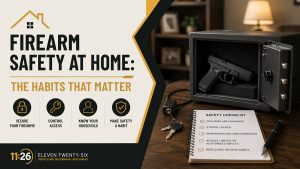
Store the pistol according to local law and household risk. A locked container or quick-access safe should prevent unauthorized access, especially where children, visitors, or prohibited persons may be present. Keep ammunition secured as well, following the firearm and safe manufacturer’s instructions.
A concealed-carry course adds legal and decision-making content, but a permit does not make carrying automatically appropriate. Carrying requires reliable equipment, ongoing practice, awareness of location restrictions, and a clear understanding that avoiding danger is preferable to escalating a confrontation.
Which Training Path Fits Your Goal?
The best training path depends on the learner’s goal, access to equipment, physical needs, and local legal requirements. An absolute novice should start with an introductory class, a prospective permit holder should add state-specific legal instruction, and a shooter with a persistent technical problem should choose private coaching.
Absolute novice
Book a two- to four-hour introductory class with loaner equipment and direct supervision. Start with a .22 LR or manageable 9mm option selected with the instructor, then schedule a second practice session within one or two weeks.
Self-defense learner
Complete basic safety and handling instruction before a CCW course. Add legal education, secure storage, de-escalation, emergency medical awareness, and supervised presentation from a lawful storage or carry method only after an instructor confirms safe fundamentals.
Budget-conscious learner
Use one private lesson to establish safe procedures, then practice short dry-fire sessions under strict ammunition-control rules. Budget approximately $150-$300 for the first range visit and reserve funds for eye and hearing protection rather than spending the entire budget on a pistol.
Learner with small hands, limited strength, or sensory concerns
Prioritize control access, grip circumference, slide or cylinder operation, recoil tolerance, and clear sight visibility. Ask the instructor about accessible lanes, reduced-noise scheduling, prescription-compatible eye protection, and alternative pistols before paying for a class.
The Bottom Line
Pistol training for beginners should move from safety and unloaded handling to supervised live fire, with measurable progress in control, accuracy, and decision-making. Begin with a qualified instructor, use a pistol that fits the learner, practice in short sessions, and treat legal education and secure storage as part of competence rather than optional extras.
Frequently Asked Questions
Can I learn pistol shooting without owning a handgun?
Yes, many ranges and instructors provide rental pistols, eye protection, hearing protection, and targets. A first-time learner can compare a .22 LR pistol, a mid-sized 9mm, and other instructor-approved options before purchasing. Rental policies differ, and some facilities require a second adult or prohibit solo rentals, so confirm requirements first.
Is a 9mm pistol too powerful for a beginner?
A 9mm pistol is not automatically too powerful, but recoil depends on the pistol’s weight, grip design, ammunition, and the shooter’s strength and experience. A full-size or mid-sized 9mm may feel easier to control than a lightweight .380 Auto. An instructor should evaluate comfort and control rather than rely on caliber labels alone.
How often should a new shooter practice?
A new shooter can benefit from one supervised live-fire session every one to two weeks, supplemented by 5-10 minutes of safe dry fire once or twice weekly. Short, attentive practice generally produces better habits than a long session that causes fatigue, flinching, or loss of concentration.
Should beginners start with a pistol or a revolver?
Many beginners can learn either platform, but the choice depends on the learner’s hand strength, intended use, and access to instruction. Revolvers avoid semi-automatic cycling but often have a long double-action trigger and slower reloads. A striker-fired pistol has a consistent trigger but requires strict trigger-finger discipline.
Can I practice drawing a pistol at home?
Only after receiving qualified instruction and confirming that the practice method is lawful, the firearm is unloaded, all ammunition is outside the room, and the manufacturer’s guidance permits the activity. Beginners should first master safe handling and presentation with an instructor. Home practice is never appropriate with live ammunition present.
When should a beginner take a concealed-carry class?
Take a concealed-carry class after learning basic firearm safety and handling, not as a substitute for those fundamentals. The course should cover the applicable state law, lawful storage and transport, use-of-force standards, qualification requirements, and decision-making. Continued supervised practice remains necessary after the permit or certificate.