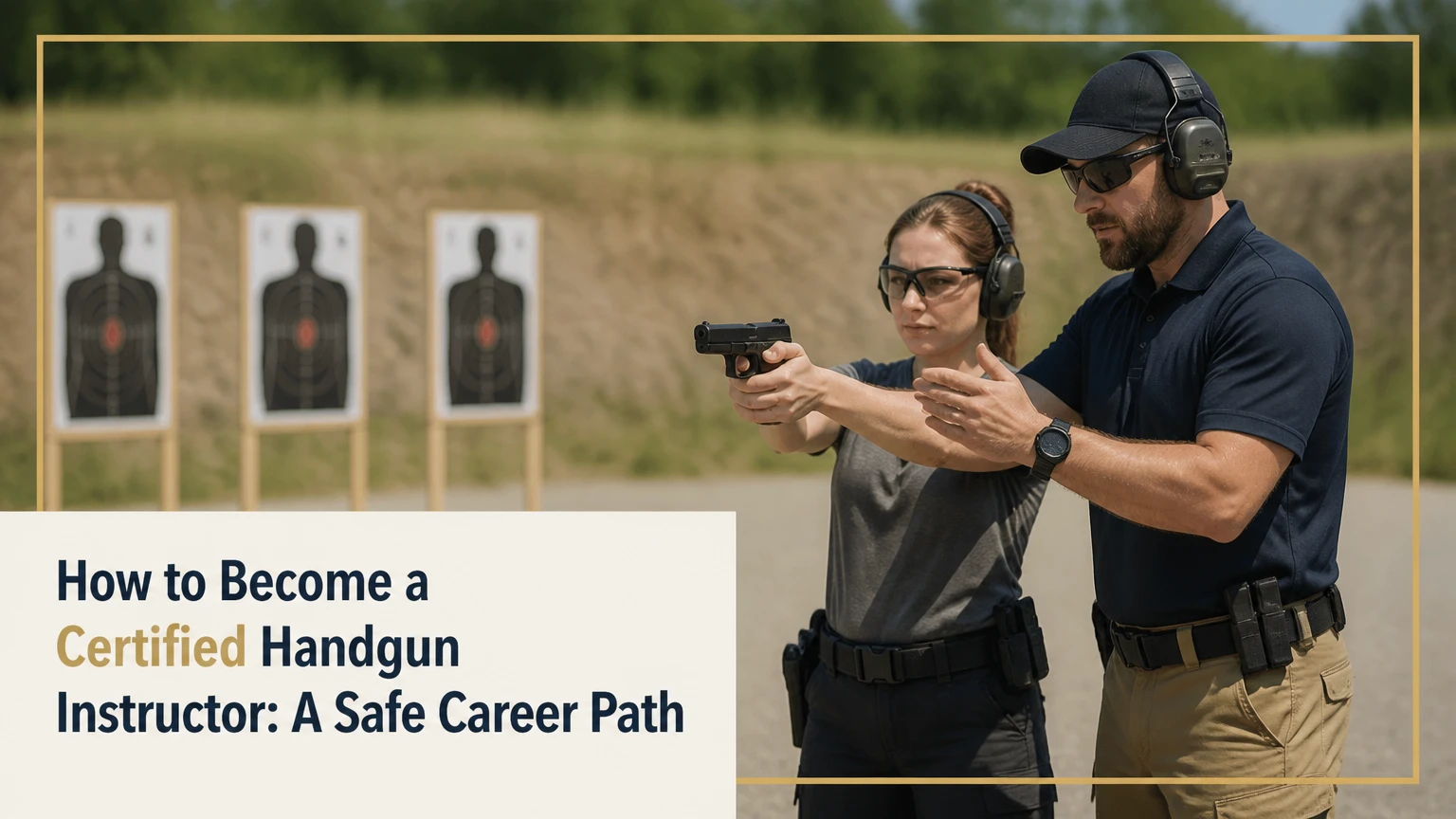
To become a certified handgun instructor, complete an approved instructor-development course, pass its safety, teaching, written, and practical evaluations, then satisfy any state authorization requirements for the classes you plan to teach. The decisive factor is controlled instruction, not advanced shooting speed or tactical equipment.
Key Facts at a Glance
A national instructor certificate does not automatically authorize permit or concealed-carry instruction in every state.
Most civilian candidates first need a basic handgun or pistol course and must pass a legal-eligibility screening.
Instructor courses commonly combine classroom work, role-play teaching, range management, and live-fire qualification.
Typical civilian training costs range from about $200 to $600 before ammunition, range fees, insurance, and state charges.
A new instructor should obtain written permission from the range and appropriate liability coverage before accepting paying students.
NRA, USCCA, state POST, military, and agency credentials are different pathways with different scopes of authority.
What Does a Certified Handgun Instructor Do?
A certified handgun instructor teaches an approved curriculum while controlling safety, equipment, student conduct, and assessment. The instructor must explain handgun operation, safe storage, loading and unloading, basic marksmanship, applicable law, and emergency procedures without exceeding the credential’s authorized scope.
A certificate documents completion of a provider’s instructor course. It does not prove that the holder can teach every handgun discipline, certify security personnel, approve carry permits, or provide legal advice. Those authorities come from state agencies, employers, statutes, or separate approvals.
The National Rifle Association uses a Training Counselor system for instructor development. USCCA uses its own instructor-training and curriculum structure. State law-enforcement agencies and POST boards may impose independent requirements for law-enforcement qualification or private-security instruction.
The practical job has two separate standards. The first is firearms competence: safe operation and consistent performance. The second is instructional competence: recognizing errors, correcting them without humiliating students, and keeping a group safe under changing conditions.
How Does the Certification Process Work?
The standard process has seven stages: choose the teaching scope, verify eligibility, complete prerequisite training, pass screening, attend instructor development, pass final assessments, and obtain state or employer approval. The exact sequence varies by provider and jurisdiction.
Step 1: Choose the Instructor Scope
Choose the population and course type before paying for certification. A basic-pistol instructor, concealed-carry instructor, private-security firearms instructor, and law-enforcement firearms instructor may require different credentials.
| Intended work | Typical credential route | Students served | Additional authority often required |
|---|---|---|---|
| Basic civilian handgun lessons | NRA or comparable civilian provider | New and recreational shooters | Range permission and business insurance |
| Concealed-carry education | USCCA, NRA, or state-approved provider | Permit applicants and armed citizens | State course or instructor approval |
| Armed-security qualification | State security regulator or employer | Licensed security officers | Agency, POST, or regulator approval |
| Police firearms qualification | State POST or department program | Sworn officers and recruits | Agency employment or sponsorship |
| Military small-arms instruction | Military occupational or service school | Service members | Military assignment and command approval |
A common planning error is purchasing a general instructor credential before checking whether the state accepts it for the intended permit course. Contact the state police, department of public safety, attorney general, or licensing agency first, and request the current instructor-approval requirements in writing.
Step 2: Verify Legal and Professional Eligibility
Verify age, firearm possession eligibility, residency or employment requirements, and background-screening rules before enrolling. Many civilian programs require candidates to be adults, commonly at least 21, while some state or provider requirements differ.
Potential barriers include felony convictions, qualifying domestic-violence convictions, unlawful controlled-substance use, certain restraining orders, and other federal or state prohibitions. A military discharge issue may matter under federal law, but the precise consequence depends on the discharge and governing rule.
Do not rely on an instructor-course advertisement as a legal determination. The Bureau of Alcohol, Tobacco, Firearms and Explosives, state licensing agencies, and qualified attorneys are better sources for eligibility questions. A provider may admit a student whose credential later cannot satisfy a state requirement.
Step 3: Complete the Student-Level Prerequisite
Complete the provider’s basic handgun course before the instructor course when required. The prerequisite establishes the terminology, safety procedures, equipment handling, and shooting standard that the instructor candidate must later teach.
Typical prerequisites include a basic pistol or handgun course, safe gun-handling experience, and familiarity with the exact platform used during assessment. Some providers permit equivalent training, while others require their own student curriculum. Read the current course description rather than assuming prior range experience qualifies.
A useful readiness test is whether you can demonstrate each skill slowly while explaining its purpose. An experienced shooter who relies on automatic habits may struggle when asked to narrate every safety decision for a first-time student.
Step 4: Prepare for Screening and Qualification
Prepare for a screening process that may include a written test, safe-handling demonstration, dummy-round exercise, and live-fire qualification. The course provider sets the exact target, distance, firearm, ammunition, score, and number of attempts.
| Assessment area | Typical requirement | Preparation target | Failure consequence |
|---|---|---|---|
| Safe handling | Muzzle and trigger control | Zero safety violations during dry practice | Immediate removal or remediation |
| Loading and unloading | Controlled manipulation | Complete every command without prompting | Repeat demonstration |
| Written knowledge | Safety and curriculum questions | Review the provider manual and state rules | Retest or course failure |
| Live fire | Accuracy at several distances | Consistent groups at 7-15 yards | Qualification remediation |
| Teaching demonstration | Clear lesson delivery | Five-minute explanation with feedback | Counselor evaluation or reassignment |
Do not practice for an unofficial score that may not match the current course. Confirm the standard with the Training Counselor or provider. The NRA, for example, publishes instructor-course information through its official Firearm Training division, while state programs may publish separate qualification tables.
Use the same safety habits with unloaded training guns and dummy ammunition that you would use with live firearms. The NRA’s fundamental safety rule is, “Always keep the gun pointed in a safe direction,” and the organization also instructs users to keep the finger outside the trigger guard until ready to shoot.
Step 5: Attend Instructor-Development Training
Attend the classroom and practical instructor-development sessions, which commonly last one to several days depending on the credential. Training usually covers adult learning, lesson sequencing, demonstrations, questioning, student correction, range commands, and the provider’s required materials.
The counselor evaluates whether the candidate can teach a repeatable process. A tight group does not compensate for unsafe demonstrations, unclear instructions, poor observation, or failure to stop a hazardous action.
Role-play is often more difficult than the shooting test. One candidate may act as a nervous beginner, another may misunderstand a command, and another may create a safety problem. The candidate acting as instructor must identify the issue, give a direct correction, and restore the class to a safe condition.
Step 6: Pass the Final Evaluations
Pass every required written, teaching, handling, and live-fire evaluation before treating the certificate as active. A passing score, where specified, belongs to the provider or state program, so published figures such as 80% or 85% should never be assumed universal.
Final evaluations may test:
- Safe firearm presentation, loading, unloading, and clearing
- Correct use of the approved lesson plan
- Accurate safety explanations
- Range commands and emergency response
- Student observation and corrective feedback
- Written knowledge of course content
- Live-fire accuracy and procedural compliance
Ask for the result, remediation policy, and credential-activation procedure before leaving the course. Some programs allow a candidate to repeat a section within a stated period, while others require a new registration.
Step 7: Activate the Credential and Obtain State Approval
Register or activate the credential according to the provider’s procedure, then apply separately for any state, employer, or permit-course approval. Keep copies of the certificate, instructor number, course completion records, background documents, insurance certificate, and range agreement.
State approval can involve an application, fingerprinting, background checks, proof of experience, a state examination, curriculum review, classroom inspection, or a specific renewal cycle. Requirements change, and neighboring states can use entirely different systems.
A national credential supports credibility and curriculum access. State authorization determines whether your course can satisfy a state-specific legal requirement. Those are related but separate functions.
Which Handgun Instructor Certification Fits Your Goal?
The best route depends on the students you intend to teach and the authority your work requires. Civilian credentials are usually the most accessible entry point, while POST, military, and security pathways often depend on employment, agency sponsorship, or prior service.
| Credential pathway | Entry profile | Typical training emphasis | Typical direct cost |
|---|---|---|---|
| NRA civilian instructor | Civilian with prerequisite skills | Basic pistol safety, operation, teaching method | $200-$400, provider dependent |
| USCCA instructor | Civilian or professional instructor candidate | Concealed carry, home defense, curriculum delivery | Often several hundred dollars, current fee varies |
| State concealed-carry instructor | Applicant meeting state rules | State law, approved curriculum, qualification | State fee often $25-$200, plus course cost |
| State POST firearms instructor | Sworn officer or eligible agency member | Duty weapons, qualification, documentation | Agency-sponsored to $1,500 typical |
| Military small-arms instructor | Service member or qualified veteran | Service weapon systems and military standards | Often employer or military funded |
NRA Versus USCCA
NRA and USCCA are both civilian training routes, but they emphasize different operating models. NRA instructor development is commonly associated with structured firearm-safety and basic-pistol curricula, while USCCA’s instructor pathway is centered heavily on concealed carry, home defense, and business-ready course materials.
| Decision factor | NRA pathway | USCCA pathway |
|---|---|---|
| Primary civilian focus | Basic pistol and broader shooting education | Concealed carry and home defense |
| Curriculum format | Provider-defined NRA course materials | USCCA course materials and student resources |
| State acceptance | Explicitly named in some state programs | Accepted in some states, not universally |
| Business support | Credential and course framework | Often includes marketing or digital tools |
| Cost pattern | Course, materials, and activation fees | Course package or membership-linked fees |
| Best initial use | Range, club, and foundational instruction | Carry-oriented private instruction |
Neither organization automatically outranks the other. Choose the credential named by your state when state recognition controls the purchase. Choose based on curriculum fit, counselor quality, renewal terms, student materials, and insurance compatibility when no state-specific rule controls.
How Much Does It Cost and How Long Does It Take?
A civilian handgun instructor pathway commonly costs $400-$1,200 in total and takes several weeks to several months when prerequisite training, scheduling, state approval, and business setup are included. The course fee is only one part of the budget.
| Expense | Typical range | When paid | What changes the amount |
|---|---|---|---|
| Student prerequisite | $100-$250 | Before instructor course | Provider and location |
| Instructor course | $200-$600 | Registration | Organization and course length |
| Ammunition | $40-$120 | Course day | Caliber and round count |
| Range or target fees | $25-$150 | Course day | Facility and lane time |
| Credential activation | $35-$100 | After passing | Provider and renewal structure |
| State approval | $25-$250 | Application | Fingerprints, license, and jurisdiction |
| Liability insurance | $300-$1,500 annually | Before teaching | Coverage, revenue, and activities |
Typical live-fire requirements may fall near 100-200 rounds, but the official course notice controls. Budget extra ammunition only if the range and counselor permit it. A candidate should never substitute a different caliber, holster, target, or firearm without prior approval.
A two-day instructor course may represent 16 or more classroom and range hours. The full pathway takes longer when the candidate needs a prerequisite class, waits for a counselor’s schedule, or faces a state application process.
What Should a New Instructor Set Up Before Teaching?
A new instructor should establish legal scope, insurance, range permission, student records, emergency procedures, and a written cancellation policy before accepting payment. Certification alone does not create a safe or compliant firearms-training business.
Set up the following:
- Written range agreement: Confirm permitted firearms, ammunition, class size, hours, commands, targets, and emergency contacts.
- Professional liability coverage: Verify that instruction, live-fire activities, negligent-entrustment claims, and employees or assistants are covered.
- Student documentation: Use enrollment, safety acknowledgment, medical or emergency contact information where lawful, attendance, assessment, and completion records.
- Equipment controls: Provide eye and ear protection, suitable targets, first-aid supplies, communication equipment, dummy-training tools, and a documented ammunition policy.
- Business compliance: Check local registration, taxes, zoning, payment records, advertising rules, and any required instructor license.
- Scope statement: Tell students whether the class provides general education, a state permit course, security qualification, or no legal certification.
A certificate does not replace insurance. Insurance also does not excuse unsafe conduct, misleading advertising, or instruction outside the credential’s scope.
What Makes an Instructor Candidate Pass?
A candidate passes by demonstrating safe, observable teaching behavior under pressure. Shooting performance matters, but counselors usually pay close attention to muzzle direction, trigger-finger discipline, command clarity, student monitoring, and immediate correction of unsafe actions.
Three practitioner rules improve performance:
- Slow down during demonstrations. Candidates often fail by moving faster than beginners can observe, especially during loading, unloading, or administrative handling.
- Correct behavior before explaining theory. Stop an unsafe action first, then give the reason and the replacement behavior.
- Teach the approved sequence exactly. Adding personal tactics or unscripted claims can create legal, curriculum, and insurance problems.
Avoid custom gear displays, competitive language, and technical jargon during entry-level instruction. A beginner needs a short command, a visible demonstration, a controlled repetition, and specific feedback.
An effective correction sounds like: “Stop. Keep the muzzle downrange and your finger indexed. We will reset and repeat that step.” The instructor then confirms the student can perform the corrected action before moving on.
What Are the Common Failure Modes?
Most preventable failures involve scope confusion, safety habits, documentation, or business assumptions rather than a lack of shooting ability. Each problem has a practical recovery path.
| Failure mode | Why it happens | Recovery action | Prevention |
|---|---|---|---|
| Failing the live-fire test | Candidate practices a different standard | Request the exact qualification and remediation terms | Confirm distance, target, score, and round count |
| Unsafe dry handling | Candidate treats an unloaded gun casually | Stop practice and rebuild the handling sequence | Use a cleared training area and dummy tools |
| State rejection | Credential is not on the approved list | Apply through the named state process | Verify acceptance before enrollment |
| Range refuses the class | Insurance or operating rules are missing | Obtain written facility requirements | Secure permission before advertising |
| Student injury or complaint | Screening and supervision are inadequate | Report according to policy and contact insurer | Use records, ratios, and emergency procedures |
| Overbroad advertising | Instructor promises legal or tactical outcomes | Correct the advertisement and narrow the claim | Publish exact course scope and limits |
If you fail a qualification, ask whether the provider offers remediation, which components must be repeated, the deadline, and whether additional fees apply. Do not assume a 30-day or 90-day remedy exists; those periods are program-specific.
Can You Become an Instructor Without Law-Enforcement Experience?
Yes, civilians can become certified handgun instructors through civilian programs, but law-enforcement or military credentials usually require a separate employment-based pathway. Civilian certification does not authorize a person to teach police qualification, military tactics, or armed-guard requalification without the required approval.
A civilian candidate can build credibility through supervised range work, assistant teaching, first-aid training, and documented continuing education. Prior experience as a range safety officer can help with line control, but it does not replace an instructor credential.
A law-enforcement candidate should consult the department training unit and state POST board. Agency firearms instructors may need service-specific qualification, instructor development, lesson-plan approval, and recurring qualification documentation.
How Do You Choose a Reputable Course?
Choose a course only after verifying the provider, instructor counselor, curriculum, state recognition, prerequisites, assessment, renewal, and insurance implications. A low advertised price is not a reliable indicator of value if the certificate cannot support the intended work.
Use this verification checklist:
- Confirm the provider’s official instructor page and current course date.
- Identify the person authorized to conduct the instructor training.
- Ask for the exact prerequisite and live-fire standard.
- Request the written state-approval rule for your intended permit course.
- Confirm whether the credential expires, requires renewal, or requires continuing education.
- Calculate course, ammunition, range, activation, travel, insurance, and state fees.
- Ask whether student materials and lesson plans are included.
- Confirm the facility permits the planned class size and activities.
- Check whether personal instruction, defensive tactics, and security qualification are covered by insurance.
The quality of the counselor often affects the learning experience more than the logo on the certificate. A counselor who explains evaluation criteria, controls the range carefully, and gives precise feedback provides greater practical value than a rushed course with attractive marketing.
What Are the Best Variations for Different Goals?
The correct path changes with the student population, legal purpose, and employment setting. A part-time civilian instructor should minimize unnecessary specialization, while a security or agency instructor must prioritize regulator approval and documented qualification standards.
Part-Time Civilian Instruction
Start with a recognized basic-pistol instructor route, range access, insurance, and a narrow class offering. Add concealed-carry or defensive curriculum only after confirming state requirements and developing a reliable student-safety process.
Concealed-Carry Permit Instruction
Select the curriculum recognized by the state where students will apply. Add state-law education from authoritative sources, maintain current approval, and avoid presenting general defensive concepts as individualized legal advice.
Security or Executive-Protection Work
Contact the state security regulator and prospective employers before selecting a civilian credential. Armed-guard instruction often requires a state-approved firearms instructor, specific weapon qualification, agency records, and renewal training.
Range Employment
Ask the range whether it values NRA, USCCA, state, or internal credentials. Range employment can provide supervised teaching opportunities, but the facility’s rules remain controlling.
Frequently Asked Questions
How old must you be to become a handgun instructor?
Many civilian instructor programs set a minimum age of 21, but age requirements differ by provider and state. Eligibility also depends on lawful firearm possession, background screening, and any state license requirements. Confirm the current rule with the provider and licensing agency before paying for training.
Do handgun instructors need a college degree?
Most civilian handgun instructor programs do not require a college degree. They typically evaluate firearm safety, prerequisite training, teaching performance, written knowledge, and live-fire ability. A degree in education, criminal justice, or communications may help with teaching or employment, but it generally does not replace the required instructor credential.
Can an NRA certificate teach concealed carry in every state?
No. An NRA instructor certificate may satisfy a state requirement in some jurisdictions, but state acceptance is not nationwide. A state may require a specific course, instructor number, qualification, background check, curriculum, or agency approval. Verify the current statute or licensing rule for the state where students seek permits.
Do I need a Federal Firearms License to teach handgun classes?
Not automatically. A firearms instructor may not need a Federal Firearms License merely to provide instruction, but activities involving firearm sales, brokering, manufacturing, gunsmithing, or regulated transfers can create separate federal obligations. Obtain legal advice for any business model that handles student firearms beyond supervised instruction.
How often must a handgun instructor renew certification?
Renewal periods range from no routine provider renewal to annual or multi-year renewal, depending on the credential and state. State instructor approvals can require continuing education, refreshed qualification, fingerprints, fees, or updated curriculum. Record the expiration date and verify renewal requirements several months in advance.
What should you do after earning the certificate?
After earning the certificate, activate it, obtain state approval where required, secure range permission and insurance, create student records, and teach within the approved curriculum. Begin with a controlled class size and supervised or co-taught sessions when possible. Expand into specialized instruction only after meeting its separate legal and insurance requirements.
The Bottom Line
To become a certified handgun instructor, select a defined teaching scope, verify eligibility, complete the required student course, pass safety and shooting assessments, demonstrate effective instruction, activate the credential, and obtain state or employer approval. The strongest candidates prioritize safe supervision and accurate communication over speed, equipment, or tactical presentation.
The exact keyword, how to become a certified handgun instructor, describes a process rather than a single universal license. Compare the current NRA, USCCA, state, POST, military, and security requirements against your intended students before enrolling, then build the legal, insurance, range, and recordkeeping foundation that allows the credential to function responsibly.