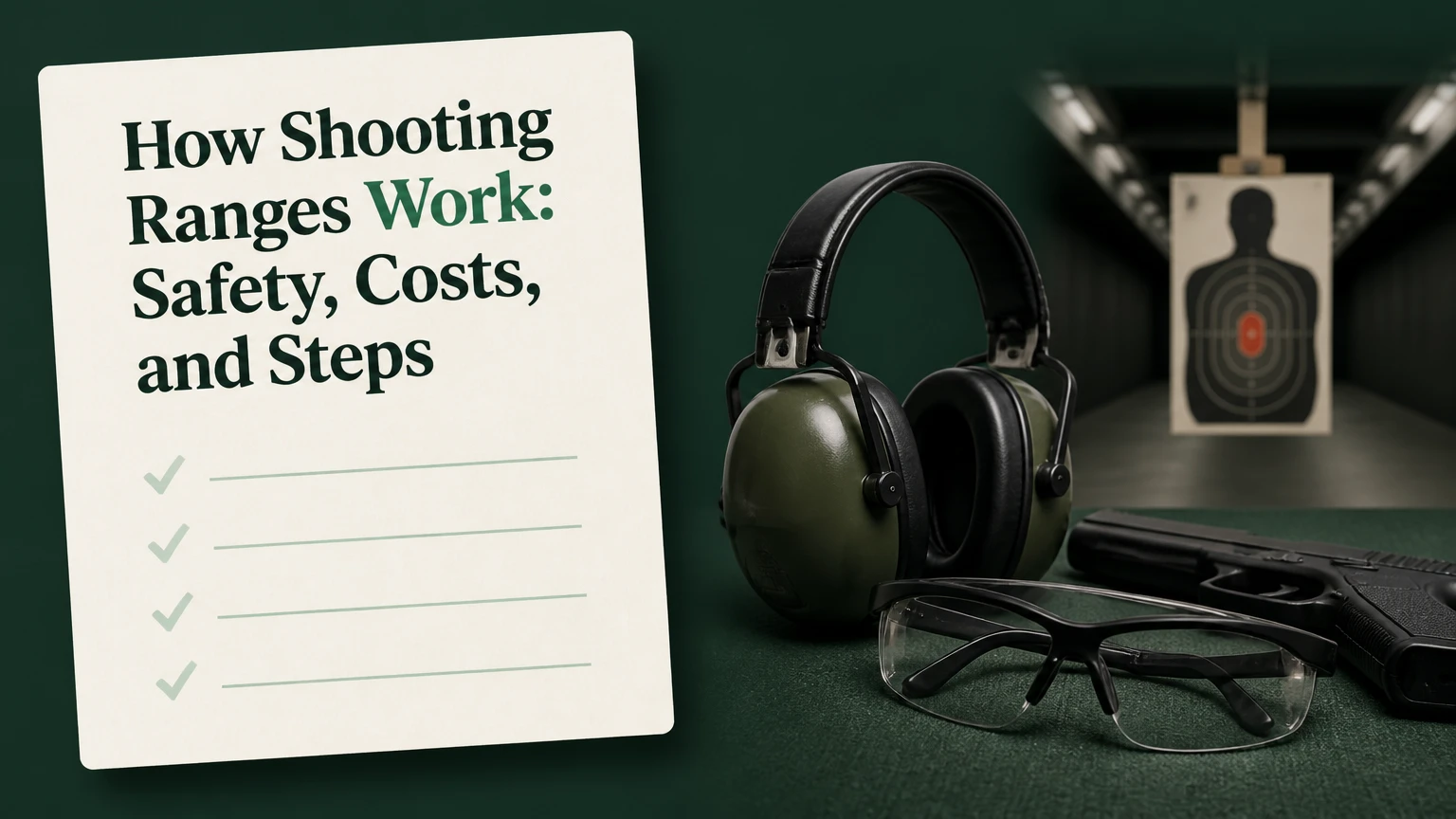
Shooting ranges are controlled facilities that direct firearms, archery equipment, or shotgun projectiles toward designated targets while containing impacts, managing noise and airborne contaminants, and supervising shooter behavior. Indoor ranges use engineered walls, bullet traps, ventilation, and target carriers; outdoor ranges rely mainly on distance, earth berms, rules, and controlled downrange access.
Key Facts at a Glance
A bullet trap stops or captures projectiles behind the target and prevents unsafe penetration or ricochet.
Indoor ranges normally move air from the shooter toward the bullet trap, not from the target back toward the shooter.
A commercial range visit commonly takes 1-2 hours, including check-in, briefing, shooting, and cleanup.
Typical indoor lane fees range from $15-$30 per hour before ammunition, targets, rentals, and instruction.
Outdoor ranges require a complete ceasefire before anyone goes downrange to change targets.
Range rules determine permitted ammunition, firearms, holsters, firing positions, target distances, and ceasefire procedures.
What Is a Shooting Range?
A shooting range is a purpose-built location where people practice aiming and firing under controlled conditions. The facility may accommodate handguns, rifles, shotguns, air rifles, archery equipment, clay targets, or organized tactical exercises, but each activity uses a different containment and supervision model.
A range is more than a room with targets. Its design must account for projectile energy, penetration, ricochet paths, noise, ventilation, fire risk, emergency access, and the movement of people behind the firing line. A small indoor pistol lane and a 1,000-yard rifle range therefore operate very differently.
The range operator controls the environment through physical construction and administrative rules. Physical controls include ballistic walls, overhead baffles, side partitions, earthen berms, steel plates, rubber media, target carriers, and exhaust systems. Administrative controls include safety briefings, lane assignments, ammunition checks, range commands, inspections, and emergency procedures.
A shooting range is not automatically a firearms-training course. A lane can provide a controlled place to fire, but safe gun handling, marksmanship, defensive tactics, and legal instruction may require a qualified instructor and a separate course.
How Do Shooting Ranges Work?
Shooting ranges work by controlling three linked hazards: projectile movement, contaminated air, and human behavior. The target system gives the shooter a defined direction, the backstop absorbs the projectile, the ventilation system carries combustion byproducts away from the firing line, and range staff stop activity when people or equipment enter a hazardous area.
The operating sequence is straightforward:
- The shooter checks in and receives the facility’s rules.
- Staff verify identification, eligibility, firearm condition, and ammunition compatibility.
- A range safety officer gives a briefing or confirms that the shooter understands the commands.
- The shooter enters an assigned lane and keeps the firearm pointed downrange.
- The shooter fires only while the range is hot and only at an approved target.
- Staff call a ceasefire when people must move forward or an unsafe condition occurs.
- The shooter unloads, clears, packs, and exits according to the facility’s procedure.
Every range adds local rules to this framework. One facility may allow rapid fire but prohibit drawing from a holster. Another may permit rifles only with frangible ammunition. The posted rules, not a generic internet description, control the session.
How Does a Bullet Trap Stop a Projectile?
A bullet trap stops a projectile by absorbing its energy, redirecting it into a controlled collection area, or using a mass of soil to halt penetration. The correct design depends on projectile speed, bullet construction, firing angle, maintenance schedule, and the range’s permitted calibers.
Common systems include:
| Backstop system | Typical location | Operating method | Main limitation |
|---|---|---|---|
| Earthen berm | Outdoor rifle and pistol ranges | Soil absorbs projectile energy across a deep, maintained mass | Rocks, erosion, and poor geometry can increase ricochet risk |
| Granular rubber | Indoor pistol ranges | Rubber fragments capture bullets and reduce hard-surface rebounds | Heat, embedded fragments, and ammunition restrictions require monitoring |
| Angled steel trap | Indoor and outdoor ranges | Hardened plates redirect bullets into a hopper or capture area | Incorrect ammunition or excessive impact wear can damage the system |
| Steel slat trap | High-volume indoor facilities | Angled slats break or redirect projectiles into a collection zone | Requires inspection for deformation and accumulated fragments |
A backstop is not simply a thick wall. Designers also control the ceiling and side angles because a bullet can leave the intended path after striking a target frame, fixture, or hard surface. Indoor lanes commonly include overhead baffles and side shields to limit lateral and upward travel.
The range must also remove spent bullets and fragments. Lead and copper recovery is a maintenance and occupational-safety issue, so operators inspect traps, clean firing points, and dispose of recovered material under applicable environmental and waste rules.
Why Do Indoor Ranges Need Ventilation?
Indoor shooting ranges need ventilation because firing ammunition produces airborne contaminants, including lead-containing particles, carbon monoxide, nitrogen oxides, and residual combustion products. A properly designed system replaces and exhausts air so contaminants move away from the shooter’s breathing zone and do not migrate into occupied parts of the building.
Range ventilation is directional. Supply air generally enters behind or above the firing line and travels toward the target area, where exhaust points remove it. The National Institute for Occupational Safety and Health, or NIOSH, has published guidance on controlling lead exposure at indoor firing ranges, including airflow and housekeeping measures.
The often-repeated figure of 75 feet per minute should not be treated as a universal OSHA rule for every range. Actual design values depend on lane geometry, exhaust placement, air changes, pressure relationships, local code, and professional testing. A facility should validate performance with measurements rather than rely on a single airflow number.
HEPA filtration may capture fine particles in an exhaust or recirculation system, but filtration does not replace correct airflow. Carbon monoxide requires a different control strategy from particulate lead, and many ranges exhaust air outdoors rather than recirculate it. Shooters should follow posted hygiene instructions, avoid eating in the firing area, and wash their hands after shooting.
How Is Range Noise Controlled?
Shooting ranges control noise with distance, acoustic absorption, partitions, structural mass, and mandatory hearing protection. Indoor walls and ceilings limit sound transmission to neighboring spaces, while acoustic materials reduce some reflected energy inside the lane.
Sound control does not make gunfire harmless. Earplugs and earmuffs reduce exposure, but they do not eliminate the impulse noise produced by a firearm. Double hearing protection is sensible for indoor sessions, especially when high-powered firearms or muzzle brakes are present.
The firing booth also separates shooters physically. Ballistic dividers reduce the chance that a neighboring shooter’s firearm or muzzle crosses into another lane, while transparent panels may let staff observe activity without entering the firing area.
What Happens During a Shooting Range Visit?
A first visit usually follows a check-in, equipment, briefing, lane, shooting, and exit sequence. The process commonly takes 60-120 minutes, although a private lesson, firearm rental, large group, or busy weekend can extend the visit.
Before You Arrive
Bring government-issued identification if the facility requires it, closed-toe shoes, comfortable clothing, and any permitted firearm and ammunition. Call ahead to confirm age limits, rental policy, caliber restrictions, reservations, transportation rules, and whether the range permits outside ammunition.
Do not assume that every range rents firearms or ammunition. Some facilities require a local safety orientation, prohibit solo rentals for first-time visitors, or require an experienced companion when a person rents without bringing a personally owned firearm.
Check-In and Safety Briefing
At check-in, the operator may record identification, collect a waiver, assign a lane, explain payment, and ask whether the shooter needs instruction or equipment. A waiver does not replace the operator’s duty to maintain a safe facility, and signing one does not authorize a visitor to ignore range commands.
The briefing normally covers the four universal handling rules: treat every firearm as loaded, keep the muzzle pointed in a safe direction, keep the trigger finger outside the trigger guard until ready to fire, and identify the target and what lies beyond it. The exact wording varies by instructor and jurisdiction.
Equipment and Ammunition Inspection
Staff may inspect the firearm, ammunition, magazines, targets, and eye and ear protection before the shooter enters the lane. Steel-core, armor-piercing, tracer, incendiary, aluminum-cased, or unapproved steel-jacketed ammunition may be prohibited because it can damage traps, ignite materials, or create unsafe fragments.
Ammunition restrictions are facility-specific. A cartridge’s caliber alone does not establish compatibility, because bullet construction, velocity, pressure, and jacket material also affect the trap and the firearm.
Lane Operation and Target Retrieval
Indoor ranges commonly use a motorized carrier that moves a paper or cardboard target to a selected distance. Typical commercial lanes offer 5-25 yards, with a digital control or wall switch controlling the carrier. Outdoor ranges may provide fixed target frames at 25, 50, 100, 200, or 300 yards, with longer facilities extending to 600-1,000 yards.
The shooter places the firearm on the bench or uses an approved shooting position, loads only when permitted, and fires toward the target with the muzzle inside the designated lane. Range safety officers monitor behavior, inspect unusual conditions, answer questions, and enforce ceasefires.
Ceasefire and Exit
During an indoor ceasefire, shooters unload firearms, open the actions, place firearms on the bench pointed downrange, and step behind the firing line. Nobody handles a firearm until the range officer declares the range hot again.
Outdoor ranges use a more visible downrange procedure. All shooters stop firing, unload and make firearms safe, step away from the line, and wait for the range officer or designated supervisor to confirm that people may proceed. After targets are changed, everyone returns behind the line before shooting resumes.
At the end of the session, remove the magazine, unload the chamber, open the action, and follow the range’s instructions for casing the firearm. Do not retrieve dropped items beyond the firing line during a hot range. Ask staff for help.
What Types of Shooting Ranges Exist?
The main range types are indoor, outdoor, tactical, and clay-target facilities. Their differences come from projectile energy, target movement, shooting distance, and whether people need to move through the shooting area.
| Range type | Typical distance or layout | Common equipment | Best-fit activity |
|---|---|---|---|
| Indoor lane range | 5-25 yards | Motorized carrier, booth dividers, enclosed trap | Handgun practice and beginner sessions |
| Outdoor target range | 25-1,000 yards | Earthen berm, fixed frames, firing line | Rifle zeroing and distance practice |
| Tactical bay | 10-50 yards, three-sided bay | Berms, barriers, steel or paper targets | Supervised movement and action drills |
| Clay-target field | 16-60 yards of shot travel, field-dependent | Trap house, skeet stations, clay throwers | Shotgun disciplines and moving targets |
Indoor Shooting Ranges
Indoor facilities offer predictable weather, electric lighting, short target-retrieval times, and close staff supervision. Concrete or masonry construction, ballistic partitions, overhead baffles, and engineered traps contain projectiles within a relatively compact building.
Indoor ranges commonly restrict rifle cartridges, muzzle energy, rate of fire, binary or explosive targets, and ammunition materials. A range advertised as allowing 5.56 NATO or .308 Winchester may still impose limits based on the specific trap, barrel length, bullet type, or lane rules.
Indoor ranges are not ideal for every goal. They cannot reproduce wind calls, mirage, long-distance trajectory, field positions, or the movement and communication demands of a multi-stage outdoor match.
Outdoor Shooting Ranges
Outdoor ranges use open air, separation distances, target frames, and large earth berms to create safe projectile containment. Many offer rifle distances from 50 to 300 yards, while specialized facilities may reach 600 or 1,000 yards.
Outdoor shooting gives users more room for long guns and often provides a better setting for zeroing optics or studying wind. The trade-off is exposure to rain, heat, cold, glare, mud, insects, and changing visibility.
Downrange access takes longer outdoors because the complete firing line must go cold. A target change can take 10-20 minutes at a busy range, depending on the number of shooters and the distance to the frames.
Tactical and Clay-Target Facilities
Tactical bays use berms and controlled layouts for movement, barricades, multiple targets, and supervised drills. They are not automatically safer because a shooter moves more; participants generally need formal instruction and must meet the facility’s standards before using holsters or dynamic stages.
Clay-target facilities use mechanical throwers to launch clay discs for trap, skeet, or sporting clays. The hazard pattern differs from a paper-target range because targets move through the air and shot pellets spread across a wider area, so field layout and target angles determine the safe zone.
How Do Indoor and Outdoor Ranges Compare?
Indoor ranges are usually better for convenient handgun practice and first visits, while outdoor ranges are better for long-distance rifles, weather-dependent field skills, and larger shooting areas. The right choice depends on firearm type, training objective, permitted ammunition, travel distance, and tolerance for downrange delays.
| Decision factor | Indoor range | Outdoor range | Practical consequence |
|---|---|---|---|
| Typical target distance | 5-25 yards | 25-1,000 yards | Choose indoor for close handgun work, outdoor for trajectory practice |
| Weather exposure | Climate-controlled | Rain, wind, heat, and cold | Outdoor conditions affect comfort and bullet flight |
| Target changes | Motorized, 10-60 seconds | Manual, often 10-20 minutes | Indoor sessions produce more uninterrupted repetitions |
| Common firearms | Handguns, .22 LR, selected rifles | Handguns, rifles, shotguns | Confirm caliber and projectile restrictions first |
| Supervision | Staff often nearby | Range officer may oversee many benches | Ask for help before handling an unfamiliar firearm |
| Sound environment | Reflected indoor impulse noise | More open acoustic environment | Double hearing protection is especially useful indoors |
A practical rule is to select the facility based on the skill you need to practice, not the firearm you happen to own. A long-range rifle cannot create a 300-yard training problem inside a 25-yard lane.
How Much Does a Shooting Range Visit Cost?
A typical first commercial visit costs about $50-$150 per person before private instruction, depending on whether the shooter owns a firearm and how much ammunition is used. Lane rental, ammunition, firearm rental, targets, protection, and membership fees are usually separate line items.
| Expense | Typical cost | Typical quantity or duration | Cost driver |
|---|---|---|---|
| Indoor lane rental | $15-$30 | 1 hour per lane | Location, peak time, person or lane billing |
| Firearm rental | $10-$25 | 1 firearm per session | Model, caliber, and rental policy |
| Handgun ammunition | $15-$40+ | 50 rounds | Caliber, market price, and range markup |
| Paper targets | $1-$3 | 1-3 targets | Standard, silhouette, or reactive design |
| Eye and ear protection | $2-$5 | 1 session | Rental versus personal equipment |
| Private instruction | $50-$150+ | 1 hour | Instructor, region, and course scope |
| Annual membership | $300-$600+ | 12 months | Lane discounts, guest rules, and reservations |
A visitor who rents a .22 LR firearm may spend less on ammunition than someone firing 9mm, .45 ACP, .223 Remington, or .308 Winchester. Ammunition cost also changes with round count, so a 50-round introductory session and a 200-round practice session are not comparable.
Memberships become financially useful only after comparing the break-even point. For example, a $400 membership that saves $20 per visit requires 20 qualifying visits before the lane discounts exceed the membership price, excluding ammunition and other benefits.
What Should a Beginner Bring?
A beginner should bring identification, payment, closed-toe shoes, comfortable clothing, and a willingness to receive instruction. The facility can often supply the firearm, ammunition, target, and hearing and eye protection, but the visitor should confirm those details before arriving.
Use this preparation checklist:
- Call the range and ask about age, identification, rental, ammunition, and outside-firearm rules.
- Wear eye protection that fits securely and hearing protection that seals properly.
- Avoid loose scarves, dangling jewelry, open-toe shoes, and clothing that interferes with a stable stance.
- Tell the range officer immediately that you are new.
- Start with a low-recoil firearm under direct instruction rather than choosing equipment for appearance.
- Load only when the range officer or posted procedure permits it.
A .22 Long Rifle firearm often produces less recoil than a centerfire handgun, which can make early instruction more manageable. Low recoil does not remove the need for strict muzzle and trigger discipline, and some .22 firearms can be less reliable when dirty or poorly maintained.
What Happens When a Firearm Malfunctions?
When a firearm malfunctions, keep the muzzle pointed downrange, remove the trigger finger, and notify the range safety officer if the problem is not immediately familiar and safe to resolve. Do not turn around, carry a loaded malfunctioning firearm to the counter, or attempt an improvised repair at the firing line.
| Problem | Safe immediate response | Do not do this |
|---|---|---|
| Failure to fire | Keep pointed downrange and wait for staff direction | Immediately open the action if a delayed ignition is possible |
| Failure to feed or extract | Keep muzzle downrange and signal the RSO | Swing the firearm toward a neighboring lane |
| Stuck target carrier | Make firearm safe on the bench and call staff | Step past the firing line |
| Quiet pop or weak report | Stop shooting and alert staff immediately | Fire another round through the barrel |
| Dropped magazine or item | Leave it until the range is safe or ask for help | Reach beyond the line during live fire |
A squib load is especially dangerous because a projectile may remain lodged in the barrel after an unusually quiet discharge. Firing another cartridge can rupture the barrel and injure the shooter or bystanders, so the firearm should remain pointed downrange until qualified staff inspect it.
The range safety officer has authority to stop a shooter, suspend a lane, or clear the entire facility. Treat that intervention as part of the operating system, not as an optional suggestion.
What Are the Most Common Range Mistakes?
The most common range mistakes involve muzzle direction, premature handling, unsuitable ammunition, and failure to communicate. Most are prevented by slowing down and asking the range safety officer before taking an unfamiliar action.
- Uncasing a firearm in the lobby: Keep a personally owned firearm cased until staff direct you to the lane or inspection area.
- Handling during a ceasefire: Unload and open the action, then step behind the line; do not touch the firearm again until the range is hot.
- Reaching for dropped equipment: Ask staff for assistance when an item falls downrange.
- Using unapproved ammunition: Check bullet construction and cartridge approval, not merely caliber.
- Turning with a firearm: Keep the muzzle inside the lane and pointed toward the backstop when speaking to another person.
- Ignoring a strange report: Stop immediately after a pop, weak recoil, or unusual sound.
A counterintuitive operational truth is that a range’s busiest period can be less productive than a quiet session. Waiting for ceasefires, sharing target controls, and responding to lane stoppages can reduce actual practice time even when the paid hour remains unchanged.
What Are Safer Alternatives or Complements?
Dry practice, professional instruction, airgun training, archery, and electronic simulators can complement live-fire range time, but each alternative develops different skills. Dry practice removes ammunition and projectile risk; it does not reproduce recoil, muzzle blast, live-fire ballistics, or the consequences of poor handling in the same way.
| Option | Projectile or firing condition | Typical setting | Skill it supports |
|---|---|---|---|
| Dry practice | No ammunition, verified empty firearm | Home or classroom | Manipulation and sight alignment |
| Airgun range | Low-energy pellet or BB | Indoor or backyard facility | Basic aiming and trigger control |
| Archery range | Arrows with dedicated backstop | Indoor or outdoor field | Repeated shot process and target alignment |
| Electronic simulator | Projected or digital shot feedback | Classroom or training studio | Decision-making and visual feedback |
| Live-fire range | Real ammunition and ballistic impact | Indoor or outdoor range | Recoil management and marksmanship |
Dry practice must follow a written safety procedure and local law, including removing all ammunition from the practice area and verifying the firearm’s condition. A qualified instructor can determine whether dry practice is appropriate for a particular firearm and student.
How Should You Choose a Range?
Choose a shooting range by matching its containment system, permitted equipment, supervision, distance, and instruction to your goal. A beginner usually benefits from a staffed indoor lane and an introductory lesson, while a precision rifle shooter needs verified outdoor distance and suitable target infrastructure.
Ask these questions before booking:
- What firearms and ammunition does the facility permit?
- Is the price per lane, per shooter, or per hour?
- Are firearm rental and ammunition purchases mandatory?
- Does the range require an appointment or safety orientation?
- Can a new shooter receive one-on-one instruction?
- What happens during a ceasefire or equipment failure?
- What distances, shooting positions, and target types are available?
- Does the facility offer accessible benches, vision support, or hearing-protection accommodations?
A range that allows a particular caliber may still be unsuitable for a particular training goal. For example, a 25-yard indoor lane can confirm basic function and close-range accuracy, but it cannot validate a rifle’s 500-yard trajectory or wind performance.
FAQ
Can You Go to a Shooting Range Without Owning a Gun?
Many commercial ranges rent firearms, but policies differ by age, identification, supervision, and group composition. Some facilities restrict solo rentals for first-time visitors because an employee cannot assume the visitor’s familiarity or intent. Call ahead, ask about rental models, and confirm whether rental ammunition must be purchased on site.
How Long Do You Usually Stay at a Shooting Range?
Most ordinary visits last 1-2 hours, with approximately 45-60 minutes spent on the lane. Check-in, waivers, safety instruction, equipment fitting, target changes, firearm cleaning, and payment can add 15-45 minutes, especially during peak periods or when a private lesson is included.
Is a Shooting Range Safe for Someone Who Has Never Fired a Gun?
A properly operated range can accommodate a first-time shooter when the visitor receives direct instruction and follows every command. Beginners should disclose their experience, start with a qualified instructor, use approved eye and hearing protection, and avoid handling a firearm without explicit permission.
Why Do Shooting Ranges Prohibit Certain Ammunition?
Ranges prohibit ammunition that can damage bullet traps, penetrate barriers, create excessive sparks, or produce unsafe fragments. Steel-core, armor-piercing, tracer, incendiary, and some steel-jacketed cartridges are common examples, but the exact policy depends on the trap design and the facility’s insurance and fire controls.
Can You Bring Your Own Targets to a Shooting Range?
Some ranges permit only facility-approved paper targets because target size, mounting method, and placement affect containment. Reactive steel, glass, exploding targets, homemade targets, and hard objects are commonly prohibited unless the range specifically supplies and authorizes them.
Do Shooting Ranges Teach Self-Defense?
Some shooting ranges host qualified instructors who teach firearms safety, marksmanship, or defensive courses, but ordinary lane rental does not equal self-defense training. Defensive instruction may require scenario work, legal education, movement drills, and supervised decision-making that a standard target lane cannot provide.
The Bottom Line
Shooting ranges work by combining projectile containment, directional ventilation, acoustic controls, target systems, and enforced human procedures. Indoor facilities prioritize convenience and close-range practice, while outdoor facilities provide distance, wind, and larger backstops. Before visiting, verify the rules for firearms, ammunition, rentals, identification, instruction, and ceasefires. Understanding how shooting ranges work makes the first session more predictable, but the range officer’s commands always take priority.