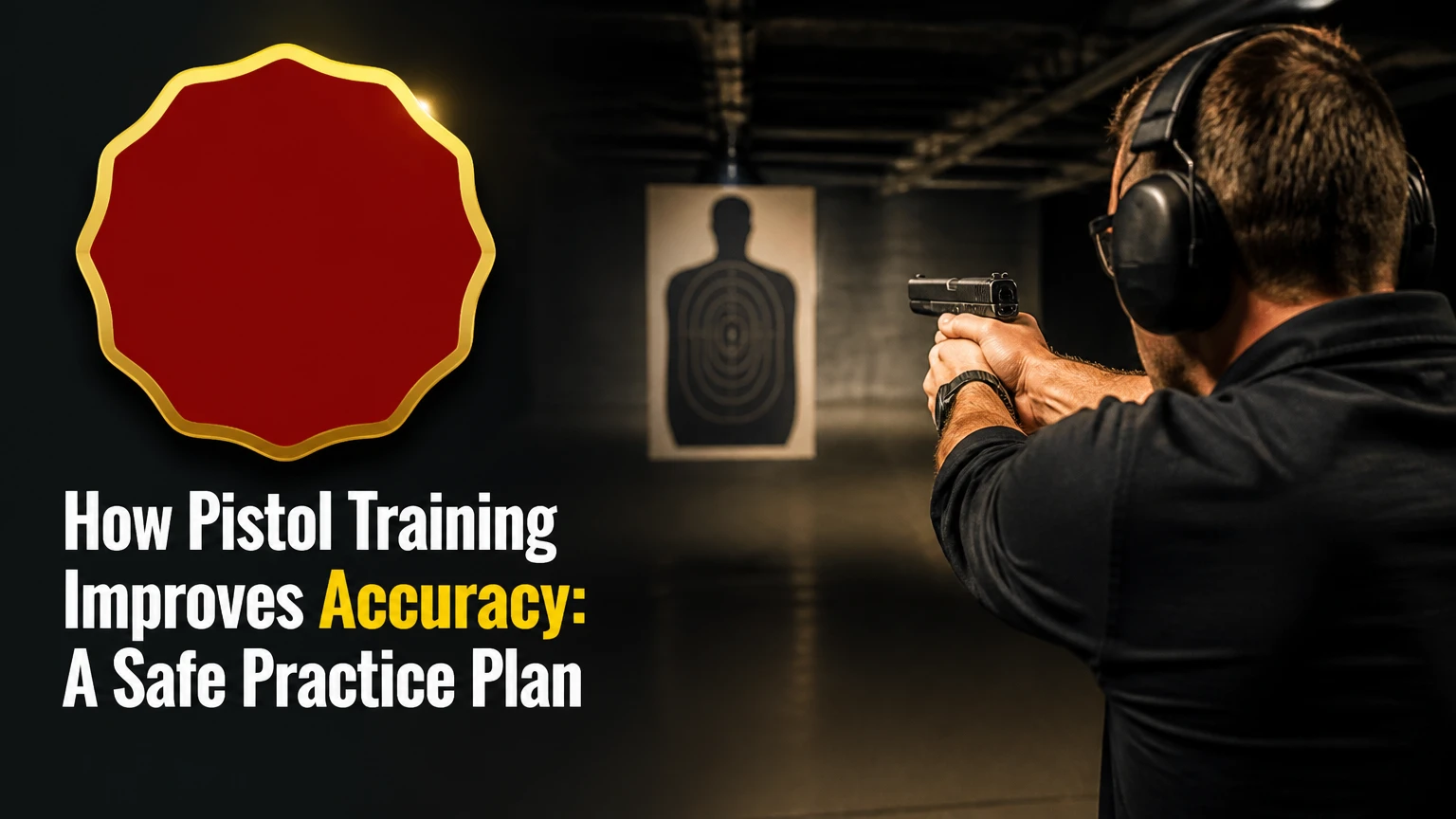
Pistol training improves accuracy by making sight alignment, grip pressure, trigger movement, and follow-through more repeatable. Structured practice also reduces avoidable anticipation and flinching, while coaching and measured live-fire sessions reveal whether errors come from the shooter, pistol fit, ammunition, eyesight, or equipment rather than from one assumed technique.
Key Facts at a Glance
Pistol accuracy depends on muzzle alignment at the instant the projectile leaves the barrel.
A smooth trigger press matters because finger movement can disturb the aligned sights before ignition.
Dry practice develops visual and trigger-control habits, but only live fire reveals recoil management and ammunition effects.
A correction chart can suggest a pattern, but it cannot diagnose every shooter, pistol, sight system, or handedness combination.
Typical beginners benefit more from short, supervised sessions with measurable groups than from high-volume, unsupervised shooting.
Consistent group size is a better early progress measure than speed, distance, or a single bullseye hit.
What Does Pistol Accuracy Actually Mean?
Pistol accuracy has two related meanings: mechanical accuracy and practical shooting accuracy. Mechanical accuracy describes what the pistol and ammunition can produce under controlled conditions, while practical accuracy describes the shooter’s ability to repeat an aligned, stable shot under a particular set of conditions.
A five-shot group measures consistency, or precision, but its center measures point of impact relative to the intended point of aim. A tight group several inches away from the aim point indicates a sighting or zeroing issue; a wide group indicates inconsistent inputs, ammunition variation, equipment fit, or some combination.
Training mainly improves the human portion of the system. It cannot make a damaged barrel precise, correct an unsuitable front sight, or compensate indefinitely for poor vision. The first useful question is therefore whether the shots are tightly grouped, correctly centered, or both.
How Does Training Change the Shot?
Pistol training changes accuracy by reducing variation before, during, and immediately after the trigger break. The shooter learns to build the same grip, confirm the same sight relationship, press the trigger without disturbing the pistol, and maintain visual attention through the shot cycle.
The firing sequence is extremely short, so movement immediately before ignition has a disproportionate effect. A small angular disturbance at the muzzle creates a larger displacement at the target as distance increases. Training cannot eliminate recoil after the projectile has left the barrel, but it can reduce movement that occurs before ignition.
Which variables does practice control?
| Variable | Typical error | Training response | Observable measure |
|---|---|---|---|
| Grip pressure | Pistol shifts between shots | Repeatable two-hand grip under supervision | Group shift or vertical spread |
| Trigger movement | Sights move during the press | Slow unloaded practice and deliberate live-fire presses | Sight disturbance or lateral spread |
| Visual focus | Shooter looks at target too early | Confirm front sight or reticle relationship | Consistency of group center |
| Recoil anticipation | Muzzle dips before ignition | Gradual exposure and supervised diagnostic drills | Movement on inert chamber |
| Body balance | Weight shifts during firing | Stable stance and natural breathing | Vertical group dispersion |
| Equipment fit | Reach or grip angle changes input | Test appropriate pistol and grip sizes | Comparison across pistols |
“Muscle memory” is a convenient phrase, but it can mislead. Practice builds learned motor patterns that remain dependent on attention, equipment, fatigue, stress, and context. Repeating an incorrect movement can make that movement more automatic, which is why feedback quality matters more than repetition count alone.
Which Pistol Fundamentals Have the Greatest Effect?
Grip, visual alignment, trigger control, and follow-through usually have the greatest effect on early pistol accuracy. Stance supports those fundamentals, but a strong stance cannot rescue a trigger press that moves the sights away from the target.
The sequence below provides a useful diagnostic order:
- Establish a balanced, comfortable standing position.
- Build a consistent grip with the dominant hand high on the backstrap when the pistol design permits it.
- Confirm the pistol’s sight picture according to its sight system.
- Press the trigger without changing the aligned relationship.
- Keep the pistol stable long enough to observe the shot and reset.
How should grip and stance be practiced?
A high grip can reduce the leverage of muzzle rise, but the highest physically possible grip is not automatically correct. The grip must allow reliable operation, avoid contact with moving parts, and fit the shooter’s hand without forcing excessive tension.
Support-hand involvement often improves consistency because the support hand supplies substantial lateral and front-to-back stabilization. The commonly repeated 60% to 70% support-hand figure is a coaching guideline, not a universal specification. Hand size, grip texture, pistol design, and discomfort can change the useful balance.
A stable stance places the shooter’s weight in a position that can tolerate recoil without rocking backward. Isosceles and Weaver-derived positions can both work. The correct choice is the position the shooter can reproduce comfortably while keeping the sights stable.
Breathing should remain natural. A brief pause at a comfortable point in the respiratory cycle can reduce movement, but forcing a long breath hold can create tension, visual discomfort, or rushed trigger work.
Why Does Trigger Control Improve Accuracy?
Trigger control improves accuracy because the trigger finger can move the pistol before the projectile exits if the press is abrupt, lateral, or accompanied by tightening elsewhere in the hand. A controlled press allows the sights to remain acceptably aligned through ignition.
The trigger finger should contact the trigger where the pistol’s design allows a straight, repeatable press. Finger placement varies with hand size and trigger geometry, so the pad is a starting point rather than an anatomical law. The important test is whether the sights remain stable as the trigger moves.
Follow-through does not steer a projectile after it has left the barrel. Its value is diagnostic: maintaining visual focus and grip after the break helps the shooter observe the sight movement, identify a premature correction, and prepare a consistent reset.
What should a good trigger press feel like?
A good trigger press feels continuous rather than jerky, and the shooter can describe where the sights were at the moment of release. The shooter should avoid slapping, snatching, or deliberately forcing a surprise break, because those actions can conceal whether the pistol moved during the press.
The National Rifle Association’s firearms safety rules include the direct instruction, “Always keep the gun pointed in a safe direction.” That rule applies during every dry-practice and live-fire exercise, including trigger-control work.
Does Dry Fire Improve Pistol Accuracy?
Dry fire can improve pistol accuracy by allowing the shooter to rehearse grip, sight confirmation, trigger movement, and follow-through without recoil or ammunition cost. Dry fire cannot reproduce live recoil, muzzle blast, ammunition behavior, or the psychological response to a fired shot.
Dry practice must begin with a safe administrative procedure. Remove all ammunition from the room or practice area, unload the pistol according to its manufacturer’s instructions, inspect the chamber and magazine well visually and physically where appropriate, and point only toward a safe backstop. Follow the pistol manual, and use a qualified instructor if any step is uncertain.
Typical practice doses are 5-15 minutes, two to five times per week, with 20-50 attentive repetitions rather than 100 rushed repetitions. Stop when attention declines. A laser cartridge or electronic trainer can provide movement feedback, but the device does not replace live-fire confirmation.
| Practice method | Typical dose | Main feedback | Limitation | Typical cost |
|---|---|---|---|---|
| Unloaded dry press | 20-50 repetitions | Sight movement during trigger press | No recoil or blast | $0 |
| Laser cartridge | 10-20 minutes | Aim point and movement trace | Device fit and battery dependence | $40-$150 |
| Electronic trainer | 10-20 minutes | Trigger or movement metrics | Product-specific scoring | $100-$250+ |
| Live-fire group | 30-60 rounds | Recoil, impact, and group size | Ammunition cost and range limits | $25-$100+ |
| Instructor session | 60-120 minutes | External diagnosis and correction | Instructor quality varies | $70-$150+ per hour |
How Should Live Fire Be Used?
Live fire should confirm the habits developed in dry practice, not replace them with high-volume repetition. A useful session changes one variable at a time, records group size and location, and ends before fatigue causes the shooter to rehearse deteriorating technique.
Typical beginner sessions use 30-60 rounds, while experienced practice may use 50-200 rounds depending on the objective, range rules, ammunition availability, and fatigue. A smaller number of deliberate shots can produce more useful information than a large number of unmeasured rounds.
Use the same pistol configuration, ammunition type, distance, target size, and shooting position when comparing sessions. Changing several variables at once makes improvement impossible to attribute.
What is a controlled accuracy session?
A controlled session can follow this sequence:
- Confirm the pistol, ammunition, target distance, and range procedure.
- Fire a small baseline group from a stable position.
- Record group width, group height, and group center.
- Change one input, such as grip consistency or trigger pace.
- Fire another group with the same ammunition and distance.
- Compare results and write down the next practice priority.
A qualified range instructor should supervise beginners and any diagnostic drill involving inert cartridges. Never improvise a loading exercise with another person, and never mix live and inert ammunition outside a controlled range procedure with clear accountability.
Which Training Type Fits Each Goal?
No single training mode improves every component of accuracy. Dry fire is efficient for movement rehearsal, live fire is necessary for recoil exposure, coaching reduces diagnostic delay, and formal competition training adds time pressure and scoring consequences.
| Training type | Best use | Typical session | Typical timeframe | Main limitation |
|---|---|---|---|---|
| Dry practice | Trigger and sight movement | 5-15 minutes | 1-3 weeks for noticeable consistency | No recoil feedback |
| Coached range lesson | Technique diagnosis | 1-2 hours | Often immediate correction of one error | $70-$150+ per hour |
| Solo live fire | Recoil and group measurement | 30-60 rounds | 4-8 weeks with regular practice | Errors can be reinforced |
| Precision class | Group size and position | 2-4 hours | 3-6 sessions for stable habits | Slower pace, higher instruction cost |
| Competition class | Time, scoring, transitions | 100-300 rounds | Several months of structured work | Speed can hide accuracy loss |
A professional instructor is usually the most efficient choice when the shooter cannot identify why groups are spreading. Credentials, range safety, teaching experience, and the ability to explain observable cause and effect matter more than an impressive résumé.
How Long Does Accuracy Improvement Take?
Many shooters notice a baseline change after two to four weeks of consistent practice, but stable improvement commonly requires four to eight weeks and several measured live-fire sessions. The timeframe depends on starting skill, practice frequency, pistol fit, eyesight, ammunition, and whether feedback identifies the actual error.
| Starting situation | Practice pattern | Reasonable early target | Typical timeframe |
|---|---|---|---|
| New shooter with instructor | Weekly lesson plus short dry practice | Consistent 5-7 yard groups | 2-4 weeks |
| Experienced shooter with trigger issue | 3 dry sessions plus one range session weekly | Reduced lateral spread | 3-6 weeks |
| Recoil-sensitive shooter | Short supervised live sessions | Less pre-ignition movement | 4-8 weeks |
| Precision-focused shooter | Weekly measured groups at 15-25 yards | Smaller group diameter | 6-12 weeks |
| Equipment-related problem | Pistol or sight evaluation first | Reliable point of impact | 1-3 sessions after correction |
A claimed improvement is meaningful only when the testing conditions remain comparable. One unusually good group is evidence of possibility, not proof of a new baseline.
Do Pistol Sights, Fit, and Ammunition Matter?
Pistol training cannot fully overcome poor fit, unsuitable sights, vision limitations, or ammunition that performs differently from the load used during practice. Equipment variables should be checked after basic safety and technique, because changing hardware too early can obscure a correctable movement problem.
Grip circumference affects trigger reach and the ability to apply consistent pressure. Sight height, notch width, contrast, and the shooter’s visual acuity affect how quickly the sight picture can be confirmed. Red-dot sights introduce a different presentation and visual-confirmation process rather than eliminating fundamentals.
Ammunition can change point of impact and group size. Compare ammunition only after confirming the pistol is functioning correctly and the shooter is using the same distance and position.
| Variable | What to compare | Useful control | Common confounder |
|---|---|---|---|
| Grip size | Reach, comfort, contact area | Same pistol with alternate panels | Hand fatigue |
| Sight system | Notch, front-sight contrast, optic | Same target and lighting | Vision correction |
| Ammunition | Bullet weight and manufacturer | Same batch when possible | Different point of impact |
| Distance | 5, 10, 15, 25 yards | One distance per test | Group expansion with range |
| Target | Bullseye, grid, repair center | Identical target design | Aim-point ambiguity |
Why Do Shots Group Low or to One Side?
Low or lateral groups often indicate a repeatable disturbance, but target-direction charts are not universal diagnostic tools. Handedness, trigger geometry, grip pressure, sight offset, stance, and target distance can change the apparent pattern, so the shooter should test one hypothesis rather than accept a chart as a verdict.
For a right-handed shooter, a low-left group may coincide with anticipation or a trigger disturbance, but it can also result from an offset sight picture or an inconsistent grip. A left-handed shooter may show a different pattern. The target identifies where the projectile landed, not which body movement caused it.
Which troubleshooting method is most reliable?
Use a supervised, low-round diagnostic process:
- Fire a slow, carefully observed group from a stable position.
- Ask an instructor to watch the sights and hands, not only the target.
- Compare a dry press with a live shot.
- Check pistol fit, sight alignment, and ammunition before changing technique.
- Repeat the test after one correction.
- Record whether group size, group center, or both changed.
The ball-and-dummy drill can expose anticipation when conducted by a qualified instructor under range rules. The shooter should not know the sequence, and inert cartridges must be controlled before and after the exercise. A sudden muzzle dip on an inert cycle is evidence of anticipation, not proof that every low shot has the same cause.
How Should Beginners Structure Practice?
Beginners should prioritize safe handling, a qualified introductory lesson, and simple accuracy measurement before adding speed or complex movement. A staged plan prevents the common mistake of practicing fast repetitions before the shooter can maintain safe control and consistent groups.
Week 1: Safety and baseline
Complete an instructor-led orientation, learn the pistol’s controls and loading procedure, and fire a modest number of supervised shots at a close, clearly visible target. Record group size without judging a single shot.
Week 2: Dry-practice mechanics
After the pistol is confirmed unloaded and ammunition is absent from the practice area, perform 20-30 deliberate trigger presses per session. Watch for sight movement and stop when attention or hand comfort declines.
Week 3: Live-fire confirmation
Use the same pistol, ammunition, distance, and target style as the baseline. Fire several small groups with pauses between them, then compare group center and spread rather than chasing individual impacts.
Week 4: Targeted correction
Choose one priority, such as grip consistency, visual focus, or trigger movement. Use a short dry session and a supervised live session to test that single change.
| User situation | Priority | Avoid initially | Useful measure |
|---|---|---|---|
| First-time owner | Safety and repeatable handling | High-volume unsupervised practice | Group size at one distance |
| Recreational target shooter | Precision and consistency | Changing ammunition every session | Mean group diameter |
| Older shooter or vision-limited shooter | Sight visibility and comfort | Forcing an unsuitable sight picture | Confirmed sight relationship |
| Competitive learner | Accuracy before pace | Chasing a timer too early | Group size at fixed time |
| Carry-license student | Legal, safe qualification skills | Treating a qualification as full training | Qualification score and instructor feedback |
What Are the Most Common Training Mistakes?
The most common training mistakes are practicing without a measurable goal, accepting a correction chart without testing it, and adding volume after technique has degraded. Each mistake slows learning because the shooter cannot distinguish a true improvement from random variation.
- Changing several variables at once: Keep distance, ammunition, target, and pistol constant while testing one technique.
- Using speed to conceal uncertainty: Slow the press until the sights remain stable, then increase pace gradually.
- Ignoring fatigue: End a session when grip strength, vision, or concentration deteriorates.
- Treating dry fire as complete training: Confirm every meaningful change with supervised live fire.
- Blaming the trigger first: Check pistol fit, sights, ammunition, and vision before modifying technique.
- Chasing one stray shot: Evaluate a group or repeated pattern, not an isolated impact.
A counterintuitive practitioner rule is that fewer rounds can produce better learning. Ten observed, recorded shots can reveal more than 100 rounds fired after fatigue has altered the grip and trigger press.
How Can Accuracy Progress Be Measured?
Accuracy progress should be measured with repeated group data collected under controlled conditions. Record date, pistol, ammunition, distance, target, shooting position, group diameter, group center, and any relevant condition such as fatigue or a sight change.
A simple record might show a reduction from 8 inches to 5 inches at 10 yards across four comparable sessions. That trend is more useful than a single centered shot, because group diameter captures consistency while group center identifies sighting or aiming changes.
Use a ruler or target grid and define in advance whether the measurement is edge-to-edge or center-to-center. Keep the method consistent. For defensive or qualification contexts, follow the applicable instructor, range, and legal requirements rather than adopting an internet-defined accuracy threshold.
Should You Choose Dry Fire, Coaching, or More Ammunition?
Choose dry practice for inexpensive repetition, coaching for diagnosis, and live fire for recoil and confirmation. Most shooters receive better results from a small combination of all three than from selecting only the least expensive or highest-volume option.
Dry practice is not a substitute for a safe range environment. Coaching is not a substitute for personal repetition. High-volume ammunition use is not a substitute for measurement.
What is the most efficient combination?
A typical budget-conscious plan uses two 10-minute unloaded practice sessions and one supervised or carefully controlled live-fire session each week. A shooter who remains stuck after three comparable sessions should spend money on diagnosis before buying more ammunition.
| Budget level | Weekly plan | Monthly quantity | Typical monthly cost |
|---|---|---|---|
| Minimal | 2 dry sessions, 1 short range visit | 100-150 rounds | $35-$100 |
| Moderate | 3 dry sessions, 1 coached range visit | 150-250 rounds | $150-$350 |
| Instruction-led | 2 dry sessions, 2 lessons | 100-200 rounds | $250-$500+ |
| Precision-focused | 3 dry sessions, 2 measured range visits | 200-400 rounds | $200-$600+ |
Prices vary by location, caliber, range fees, ammunition brand, and instructor. Treat these as typical planning ranges, not guaranteed quotations.
What Are the Limits of Pistol Training?
Pistol training improves controllable human performance, but it cannot remove all dispersion or guarantee accuracy in every environment. Lighting, distance, weather, unfamiliar equipment, visual correction, hand injury, hearing protection, stress, and ammunition differences can all change results.
Training also cannot certify a person for every firearm-related responsibility. Safe storage, transport, local law, range rules, and professional instruction remain separate obligations. Accuracy practice should take place only where lawful and appropriate, with a safe backstop and suitable supervision.
The strongest limitation is transfer. A shooter may perform well from a stable range position yet need additional qualified instruction for any different context, equipment configuration, or formal course requirement. Accuracy in one setting does not automatically transfer to another.
Frequently Asked Questions
Does pistol training improve accuracy faster than buying a better pistol?
Usually, structured feedback improves accuracy faster than an equipment upgrade when the current pistol is functional and appropriately sized. A better-fitting grip, clearer sights, or a more manageable trigger can help, but equipment changes should be tested against a stable baseline so the shooter can separate mechanical benefit from adaptation time.
How often should someone practice pistol accuracy?
Two or three short practice periods per week provide a practical starting point, combining unloaded dry practice with periodic supervised live fire. Ten focused minutes can be useful, while long sessions conducted during fatigue may reinforce inconsistent grip and trigger movements.
Is a longer breath hold better for pistol accuracy?
No. A comfortable, brief respiratory pause can reduce body movement, but a forced or prolonged hold may create tension, visual strain, and rushed trigger work. Natural breathing and a repeatable pause are generally more useful than an exact one-to-two-second rule.
Can a laser trainer replace live ammunition practice?
No. A laser trainer can show aiming movement and trigger disturbance during unloaded practice, but it cannot reproduce recoil, muzzle blast, ammunition variation, or live-fire group behavior. Use electronic feedback as a supplement, then verify progress on a safe, supervised range.
Why does a pistol shoot accurately for an instructor but not for its owner?
The result may reflect differences in grip, trigger control, vision, stance, ammunition, or sight confirmation rather than a defective pistol. A comparison is meaningful only when both shooters use the same distance, ammunition, target, and shooting position, with the instructor observing technique as well as the target.
Should a beginner use a correction target?
A correction target can suggest a pattern, but it should not determine the diagnosis by itself. Beginners should first verify safety, pistol fit, sights, ammunition, and group consistency, then use instructor observation and controlled testing to identify the cause.
The Bottom Line
How pistol training improves accuracy is best understood as a process of reducing repeatable variation. Safe instruction, consistent grip, stable visual alignment, controlled trigger movement, natural breathing, measured live fire, and useful feedback each address a different source of error. Start with short sessions, track comparable groups, and seek qualified diagnosis before increasing volume. Pistol training works best when every repetition is safe, deliberate, and connected to an observable result.