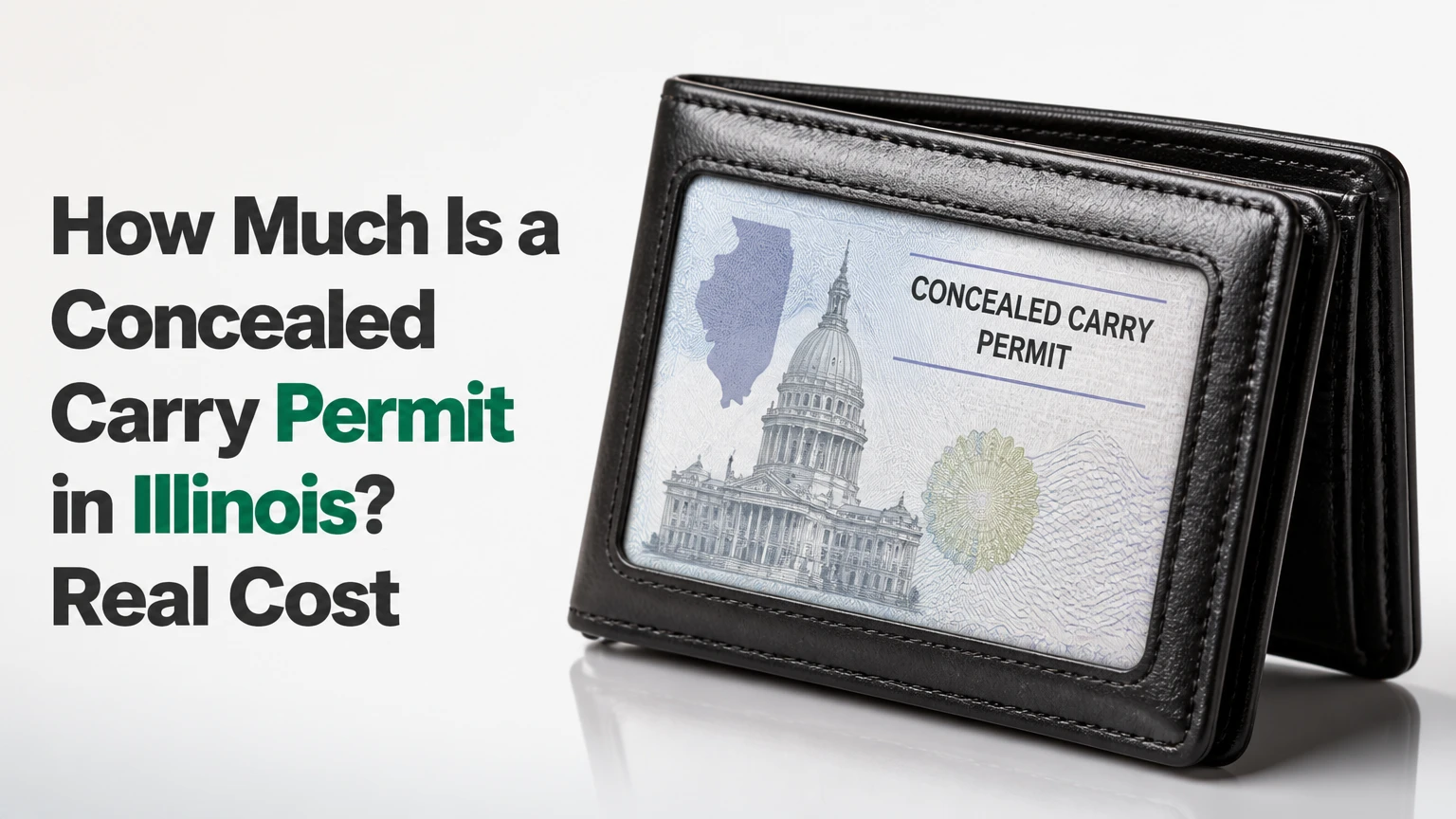
An Illinois Concealed Carry License costs $150 for an Illinois resident or $300 for an eligible nonresident, before training and optional fingerprinting. Most first-time residents should budget approximately $300-$500, while a low-cost application can be closer to $250 and a renewal usually costs less because training is shorter.
Key Facts at a Glance
- The Illinois State Police CCL application fee is $150 for residents and $300 for eligible nonresidents.
- A first-time Illinois resident usually pays about $250-$500 total after adding approved training, ammunition, range charges, and optional fingerprints.
- Illinois requires a 16-hour concealed-carry training course for most first-time applicants.
- Electronic fingerprints are optional, but fingerprints generally reduce the statutory ISP review period from 120 days to 90 days.
- Illinois CCL applicants generally need a valid FOID card, although the CCL application may be submitted while a FOID application is pending.
- A CCL does not authorize carrying in every public location, and Illinois does not automatically recognize another state’s concealed-carry permit.
How Much Is a Concealed Carry Permit in Illinois?
The state application fee is $150 for an Illinois resident and $300 for an eligible nonresident. The complete first-time cost is higher because Illinois requires approved training, including live-fire qualification, and applicants may pay separately for fingerprints, ammunition, targets, firearm rental, and range use.
The state fee is the predictable portion. Training prices vary by instructor and region, especially around Chicago, Rockford, Peoria, Springfield, and southern Illinois. A course advertised at $150 may exclude ammunition or range fees, so the advertised tuition is not always the final class price.
The following figures are planning ranges rather than a promise from every instructor. Confirm the current application fee and any electronic-payment charge in the Illinois State Police Firearms Services Bureau portal before submitting payment.
First-time cost scenarios
| Applicant scenario | State application | Training and range | Fingerprints and extras | Typical total |
|---|---|---|---|---|
| Lowest practical resident budget | $150 | $100-$150 | $0-$25 | $250-$325 |
| Typical resident application | $150 | $150-$225 | $55-$105 | $355-$480 |
| Resident with premium training | $150 | $225-$300 | $55-$105 | $430-$555 |
| Eligible nonresident application | $300 | $150-$225 | $55-$105 | $505-$630 |
| Veteran with approved credit | $150 | $100-$175 | $0-$105 | $250-$430 |
| CCL renewal applicant | $150 | $60-$125 | $0-$75 | $210-$350 |
The $250-$500+ range in many cost summaries is reasonable for residents, but nonresident applications can exceed $500 because the state fee is twice the resident fee. A person who already owns a suitable handgun, ammunition, and eye and ear protection can avoid several class-day charges.
What Fees Make Up the Illinois CCL Cost?
The Illinois CCL cost has four separate components: the ISP application fee, approved training, live-fire expenses, and optional fingerprinting. The FOID card is a separate credential, although most Illinois applicants need one to possess firearms and ammunition lawfully.
State application and FOID fees
| Item | Resident amount | Nonresident amount | When paid |
|---|---|---|---|
| Illinois CCL application | $150 | $300 | Online application |
| FOID application or renewal | Verify current ISP amount | Generally not applicable in the same way | FOID application |
| Electronic fingerprinting | $55-$75 typical | $55-$75 typical | At vendor or class |
| Digital photo | $0-$20 typical | $0-$20 typical | Before application |
| Portal or payment charge | Small variable amount | Small variable amount | Online checkout |
The Illinois State Police sets the CCL application fee through state law and the official application system. Third-party websites often display older FOID prices or estimated portal charges, so the amount shown in the ISP portal controls when you apply.
A FOID card and a CCL have different legal functions. The FOID card addresses possession of firearms and ammunition in Illinois; the CCL addresses carrying a loaded, concealed handgun in places where the Firearm Concealed Carry Act allows it. Paying the CCL fee does not replace the FOID requirement.
What does concealed-carry training cost?
An ISP-approved 16-hour course typically costs $145-$225 before optional fingerprinting. Some instructors include range time, targets, and ammunition, while other courses charge $20-$50 for range or ammunition expenses.
Training must cover Illinois firearm law, safe handling, storage, transportation, and practical shooting. The live-fire qualification commonly uses 30 rounds at distances of 5, 7, and 10 yards, with a 70% passing standard under the state training rules.
| Training expense | Typical price | Why the price varies |
|---|---|---|
| 16-hour course tuition | $145-$225 | Instructor, location, class size |
| Range or lane fee | $20-$40 | Indoor range and time reserved |
| Ammunition | $25-$60 | Caliber and local retail price |
| Firearm rental | $15-$40 | Only if the applicant rents |
| Targets and eye protection | $5-$25 | Included or purchased separately |
| Eight-hour veteran course or credit | $99-$175 | Instructor and documentation review |
A course priced at $125 is not automatically cheaper than a $200 course. Compare the included round count, range fee, firearm rental, certificate, and rescheduling policy before booking.
Do Illinois CCL Applicants Need Fingerprints?
Illinois does not generally require electronic fingerprints for a CCL application. Fingerprints are optional, but submitting them usually gives the Illinois State Police a 90-day statutory decision period instead of the 120-day period that applies when an applicant does not submit fingerprints.
The practical choice is speed versus price. Live Scan fingerprinting normally costs $55-$75, and the transaction control number must be entered accurately in the application. Fingerprints do not guarantee approval, eliminate every background-check delay, or override an objection from law enforcement.
| Application path | Fingerprint cost | Statutory review period | Best fit |
|---|---|---|---|
| With electronic fingerprints | $55-$75 | Up to 90 days | Applicant prioritizing a shorter statutory window |
| Without fingerprints | $0 | Up to 120 days | Applicant prioritizing minimum upfront cost |
| Fingerprint record mismatch | $55-$75 plus repeat fee | May require correction | Applicant whose TCN or identity data is wrong |
| Delayed background review | Variable | Can exceed statutory period | Applicant with unresolved records or objections |
Which fingerprint option is better?
Choose fingerprints when the additional $55-$75 is acceptable and a shorter statutory review window matters. Skip fingerprints when minimizing immediate spending matters more than potentially saving up to 30 days.
A common practitioner error is treating the 90-day period as a guaranteed approval date. The statutory period describes the ISP decision framework, not a promise that the license arrives on day 90. Record discrepancies, incomplete applications, local objections, or review-board activity can change the practical timeline.
What Are the Illinois CCL Training Requirements?
Most first-time applicants must complete a 16-hour ISP-approved course and pass a live-fire qualification. The course is commonly delivered over two eight-hour days, although the instructor’s schedule and approved curriculum determine the exact format.
Applicants should bring a government-issued photo ID, the firearm and caliber allowed by the instructor, ammunition, eye and ear protection, and any required training documentation. Some instructors provide a handgun and ammunition for an extra charge, but rental availability should be confirmed before class.
Military and veteran training credit
Veterans and some active-duty military applicants may receive credit for prior firearms training and complete a reduced eight-hour course, subject to Illinois requirements and acceptable documentation. A DD-214 or qualifying military record may be required.
Military credit is not the same as a complete exemption from Illinois training. The applicant should ask the instructor which records qualify before paying for a reduced course. An instructor cannot create a state credit that the applicant’s documentation does not support.
Renewal training
An Illinois CCL renewal generally requires a shorter three-hour training course rather than the original 16-hour course. The renewal application fee remains a separate cost, and applicants should confirm the current renewal instructions in the ISP portal before the license expires.
| License stage | Training requirement | Typical class price | Planning note |
|---|---|---|---|
| First resident application | 16 hours | $145-$225 | Includes live-fire qualification |
| Veteran or military credit path | 8 hours | $99-$175 | Documentation may be required |
| CCL renewal | 3 hours | $60-$125 | Confirm current renewal curriculum |
| Failed qualification retest | Instructor-specific | $25-$100 typical | May require additional ammunition |
How Do You Apply for an Illinois CCL?
An Illinois CCL application involves six practical steps: establish FOID eligibility, complete approved training, prepare documents, choose fingerprints, submit through the ISP portal, and monitor the application.
Step 1: Confirm FOID and eligibility status
Verify that your FOID card is valid or that your FOID application is pending. Review age, criminal-history, mental-health, substance-use, and domestic-violence restrictions before paying for training.
Step 2: Complete approved training
Select an instructor listed or recognized through the Illinois State Police approval system. Confirm that the tuition includes the live-fire qualification and ask for the exact ammunition and firearm requirements.
Step 3: Prepare the application materials
Prepare a compliant digital photograph, identifying information that matches your state ID and FOID record, training certificate details, and your fingerprint transaction control number if using fingerprints.
Step 4: Submit through the ISP portal
Create or access the Illinois State Police Firearms Services Bureau account, complete the CCL form, upload the requested information, and review every field before payment. Small identity mismatches can create manual review problems.
Step 5: Pay the state fee
Pay the $150 resident or $300 eligible nonresident fee through the official portal. Save the confirmation number, receipt, training certificate, and fingerprint paperwork.
Step 6: Monitor the application
Check the portal for status changes, requests, and notices. Keep your address current and respond promptly if the ISP asks for clarification.
The application succeeds when the name, date of birth, address, FOID information, training record, photograph, and fingerprint data all point to the same identity. The most avoidable failure is a transcription mismatch, not a complicated legal issue.
How Long Does an Illinois CCL Take?
The statutory Illinois review period is generally up to 90 days with fingerprints and up to 120 days without fingerprints. Actual processing can take longer when the ISP must resolve incomplete information, background records, local objections, or Concealed Carry Licensing Review Board issues.
Applicants should not schedule travel or make legal decisions based only on the statutory maximum. A pending application does not authorize concealed carry. Carrying before the license is issued can create serious criminal and licensing consequences.
| Event | Typical planning period | Applicant action |
|---|---|---|
| Find and book training | 1-4 weeks | Confirm ISP approval and inclusions |
| Complete 16-hour course | 2 days typical | Pass classroom and live-fire work |
| Fingerprint appointment | Same day to 2 weeks | Retain the TCN |
| ISP review with fingerprints | Up to 90 days | Monitor portal |
| ISP review without fingerprints | Up to 120 days | Monitor portal |
| Correct an application error | Several days to weeks | Follow ISP instructions promptly |
Who Can Apply, and Can Nonresidents Get an Illinois CCL?
Illinois residents who meet statutory eligibility requirements can apply for an Illinois CCL. Nonresidents face substantially stricter rules and should verify current eligibility with the Illinois State Police because Illinois limits nonresident licensing to residents of states that meet specified legal criteria.
A nonresident should not assume that residence in any state creates eligibility. The official ISP nonresident application page and current state list control, and that list can change after legislative or administrative updates.
Illinois uses a shall-issue framework, but shall-issue does not mean automatic approval. The ISP conducts background checks, and law-enforcement objections or statutory disqualifiers can send an application to additional review.
What can cause a denial or delay?
Potential problems include qualifying felony convictions, certain violent misdemeanors, domestic-violence restrictions, disqualifying orders, recent multiple DUI convictions, mental-health restrictions, substance-related restrictions, and inaccurate application information. The exact legal effect depends on the record, date, disposition, and applicable statute.
Two DUI convictions within the relevant statutory period and certain misdemeanors involving force or violence are frequently cited warning categories, but applicants should not rely on a simplified online list. A criminal-defense attorney can assess an unclear record before the applicant spends money on training.
Where Can You Carry With an Illinois CCL?
An Illinois CCL permits concealed carry only where the Firearm Concealed Carry Act allows it. Illinois restricts firearms in numerous locations, including schools, courthouses, government facilities, public transit areas, childcare facilities, and certain establishments that serve alcohol, subject to statutory details and posted notices.
The license does not authorize open carry, unrestricted vehicle carry, or possession in federally prohibited locations. Property owners and private businesses may also post legally effective signs that prohibit firearms.
A responsible license holder checks the current Illinois prohibited-location list before entering a building. A valid license is not a defense to every location-based violation.
Does Illinois Recognize Other States’ Concealed-Carry Permits?
Illinois generally does not recognize another state’s concealed-carry permit as a substitute for an Illinois CCL. Reciprocity is primarily relevant when an Illinois license holder travels elsewhere, and recognition depends on the destination state’s current law.
Reciprocity maps can become outdated after legislative changes. Check the destination state’s official police, attorney general, or legislative source before carrying across state lines, and account for magazine restrictions, vehicle rules, storage requirements, prohibited locations, and duty-to-inform laws.
Is the Illinois CCL Worth the Cost?
The Illinois CCL is financially easier to justify for someone who expects to carry regularly and can complete training safely and lawfully. The license is a poor substitute for legal advice, firearms practice, secure storage, or location research, so the applicant should budget for those responsibilities separately.
Budget-conscious applicant
Use a competitively priced 16-hour class, bring an approved firearm and ammunition if permitted, and skip optional fingerprints if the longer review period is acceptable. A realistic target is approximately $250-$350 before unexpected expenses.
Applicant who needs a shorter review window
Pay for electronic fingerprints and select a course with clearly bundled range costs. A typical total is approximately $355-$480 for a resident, excluding travel and equipment purchases.
Veteran or active-duty applicant
Ask an ISP-approved instructor to review military documentation before enrollment. If the eight-hour credit applies, the total may fall below the ordinary 16-hour applicant’s cost.
Existing CCL holder renewing
Plan for the $150 renewal fee plus a three-hour class, commonly producing a total near $210-$350. Apply early enough to avoid a gap between expiration and renewal approval.
Honest limitation
A license cannot compensate for weak judgment or unfamiliarity with Illinois location restrictions. Applicants who want the card only for occasional travel may find that training, storage, renewal, and compliance costs outweigh the practical benefit.
Common Cost and Application Mistakes
- Comparing tuition without comparing inclusions: A $125 class can cost more than a $190 class after ammunition, range, rental, and certificate fees.
- Using an outdated FOID fee: Older websites often repeat historical amounts. Confirm the current charge in the ISP system.
- Entering a mismatched address: Match the legal name and address format used by your identification and ISP records.
- Losing the fingerprint TCN: The transaction control number connects the fingerprint submission to the CCL application.
- Assuming pending means licensed: An application under review does not authorize concealed carry.
- Applying with an unclear criminal record: Pay for legal review before training when a conviction, expungement, supervision, or domestic incident may affect eligibility.
- Ignoring renewal timing: A three-hour renewal class does not extend an expired license by itself.
Frequently Asked Questions
Is the Illinois CCL fee refundable if the application is denied?
The state application fee is generally treated as a processing fee rather than a refundable deposit. Applicants should assume the $150 resident or $300 nonresident payment will be lost if the application is denied, then verify current refund rules with the Illinois State Police before filing.
Can I apply for a CCL while my FOID application is pending?
Illinois permits applicants to submit a CCL application while a FOID application is pending, subject to the ISP application process and eligibility requirements. A pending FOID application does not waive the underlying FOID and firearm-possession rules or guarantee CCL approval.
Can I use a privately owned handgun during the qualification?
Many approved instructors allow a student to use a privately owned handgun, but the firearm, caliber, ammunition, holster, and safety equipment must meet the instructor’s range rules. Ask before class because some ranges prohibit certain ammunition or require a specific firearm configuration.
Does an Illinois CCL let me carry openly?
No. An Illinois CCL authorizes concealed carry under the Illinois Firearm Concealed Carry Act, not unrestricted open carry. The handgun must remain concealed, and the license holder must also comply with prohibited-location, vehicle, signage, and federal restrictions.
What should I do if the ISP review exceeds 90 or 120 days?
Check the ISP portal for requests, status changes, or review-board activity, and retain proof of submission, fingerprints, payment, and training. If the application remains unresolved, contact the Illinois State Police through its official firearms-services channels or consult an Illinois attorney.
How much should I save before starting?
A resident should save at least $350 for a realistic first application with training and possible fingerprints. A nonresident should plan for $500 or more because the state application fee is $300, while a veteran or renewal applicant may need less if reduced training applies.
The Bottom Line
The answer to how much is concealed carry permit in Illinois is $150 for the resident state application fee, but the realistic first-time budget is approximately $250-$500. Add $55-$75 for optional electronic fingerprints, confirm whether training includes ammunition and range charges, and verify current fees in the Illinois State Police portal. A nonresident should budget at least $500 and confirm eligibility before purchasing a course.