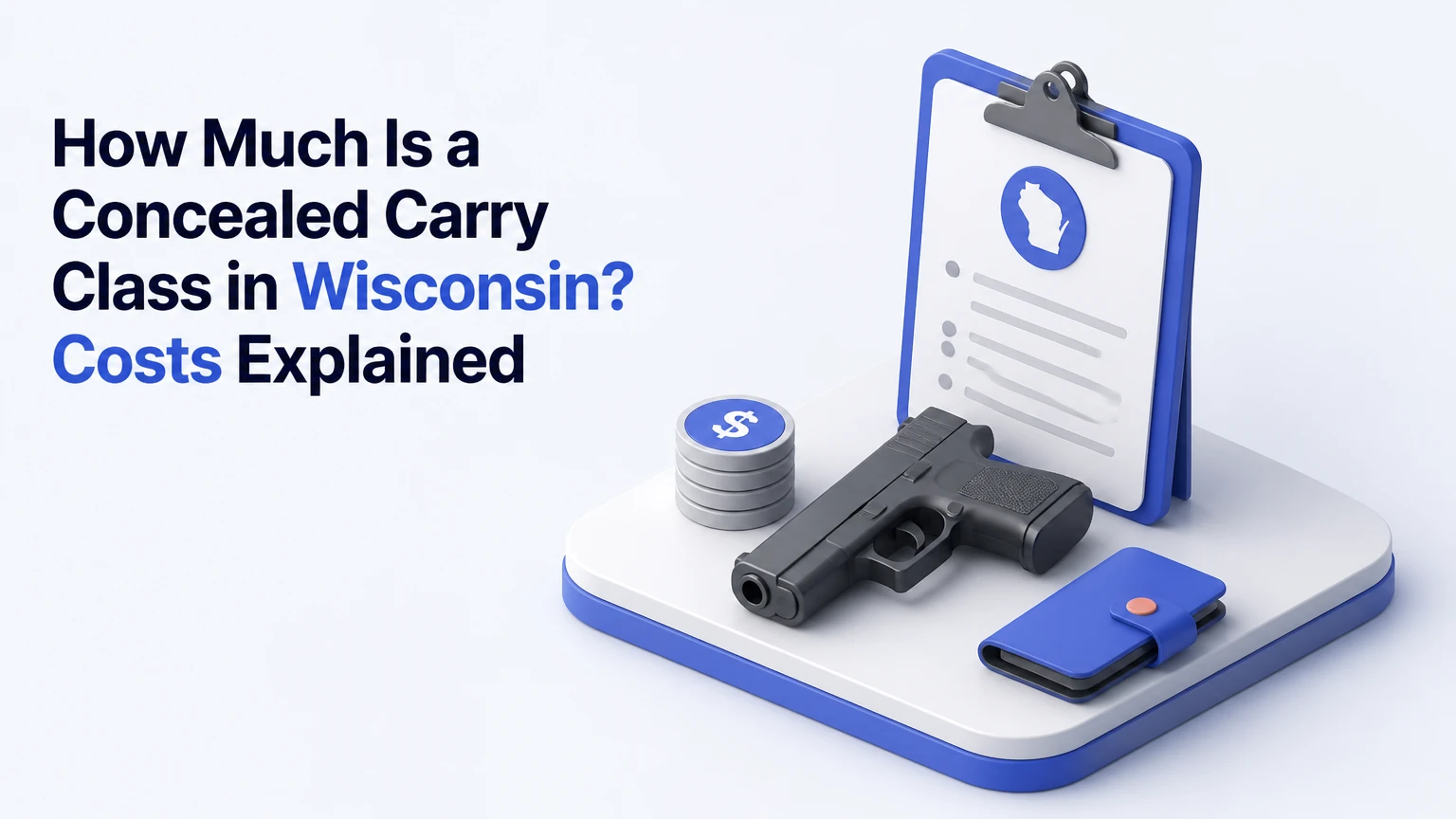
A concealed carry class in Wisconsin typically costs $50-$100, depending on the instructor, course length, and whether range instruction is included. A Wisconsin Concealed Weapons License application adds a $40 state fee, making the usual basic first-time budget approximately $90-$140, before optional firearm rental, ammunition, travel, or advanced training costs.
Key Facts at a Glance
- A Wisconsin concealed carry course commonly costs $50-$100 for classroom instruction.
- The Wisconsin Department of Justice application fee is $40, subject to current state instructions.
- Wisconsin does not generally require a live-fire qualification for the standard CWL training requirement.
- A Wisconsin Concealed Weapons License is generally valid for five years after issuance.
- A qualifying training certificate may remain useful after the class, but applicants should retain the original documentation.
- A course certificate and a state-issued license are different documents with different legal functions.
What Does a Wisconsin Concealed Carry Class Cost?
A Wisconsin concealed carry class usually costs $50-$100 for tuition, with lower-priced classroom courses near $50-$65 and longer or range-inclusive courses often costing $100 or more. Prices vary by county, instructor credentials, facility costs, class size, and whether firearm handling, ammunition, or range time is included.
The class price is only one part of the permit budget. Most applicants should also account for the Wisconsin DOJ application fee, transportation, optional document fees, and training upgrades. A basic classroom applicant may spend about $90-$140 in total, while a beginner choosing a range-based course can spend $150-$275 after adding firearm rental and ammunition.
Wisconsin DOJ materials identify the state application charge separately from instructor tuition. That distinction matters because an inexpensive class does not reduce the government fee, and a premium class does not accelerate the state’s licensing decision.
Typical Wisconsin Cost Breakdown
| Expense | Typical amount | Usually paid to | Required for every applicant? |
|---|---|---|---|
| Classroom-only course | $50-$89 | Private instructor or training provider | Usually required unless another qualifying training record applies |
| Extended or range-based course | $100-$175 | Range, college, or private provider | No, but useful for inexperienced shooters |
| Wisconsin CWL application | $40 | Wisconsin Department of Justice | Yes, for a new application under current fee instructions |
| License renewal | $22 | Wisconsin Department of Justice | Only when renewing an existing license |
| Firearm rental | $15-$35 per session | Shooting range | No |
| Practice ammunition | $25-$60 per session | Retailer or range | No, and price depends on caliber and quantity |
| Passport photo or document service | $10-$20 | Retailer or service provider | Usually no for the standard application process |
These are typical planning figures, not guaranteed provider prices. Instructors can change tuition without changing Wisconsin law, so verify the advertised price, refund policy, included materials, and current DOJ fee before registering.
What Does the Class Actually Teach?
A Wisconsin concealed carry class teaches firearm safety, Wisconsin carry restrictions, defensive-force law, storage and transport principles, and the responsibilities that accompany a concealed weapon license. The legal minimum is therefore different from a complete beginner shooting course.
Wisconsin Statute § 175.60 establishes the state’s concealed weapons licensing framework, while Wisconsin DOJ explains the application and training documentation process. A compliant class normally focuses heavily on legal knowledge and safe handling. The course may not include drawing from concealment, live-fire practice, holster selection, or individualized shooting instruction.
A certificate proves completion of qualifying education. It does not prove that a student can safely operate a particular handgun under stress. That is the most important practical distinction in the entire cost question.
What a Standard Course May Include
- The four fundamental firearm-safety rules
- Safe loading, unloading, and storage concepts
- Wisconsin concealed-carry restrictions
- Prohibited locations and posted private property
- Defensive-force and self-defense law
- Interaction with law enforcement
- Transport and vehicle-related considerations
- How to preserve training records and submit them with an application
Course content differs by instructor. Ask for a written syllabus before paying, especially if the course description uses “CCW” but does not identify Wisconsin law, qualifying credentials, or the proof-of-training document supplied at completion.
Does Wisconsin Require Live-Fire Training?
Wisconsin generally does not require a standard live-fire shooting qualification for a Concealed Weapons License application. A qualifying classroom course can satisfy the state training requirement without a scored range test, although practical shooting instruction remains valuable for people who lack safe firearm-handling experience.
That structure explains why some Wisconsin classes cost less than training programs in states that mandate a minimum number of rounds or a demonstrated accuracy score. The legal requirement answers whether an applicant has qualifying training evidence. It does not answer whether the applicant has enough practice to carry responsibly.
Course Formats and Their Trade-Offs
| Course format | Typical price | Typical duration | Range requirement | Best fit |
|---|---|---|---|---|
| Wisconsin legal-minimum class | $50-$89 | 2.5-4 hours | None in many offerings | Experienced hunters, veterans, and legally focused applicants |
| Beginner safety plus law | $90-$150 | 4-6 hours | Sometimes optional | New owners who need handling instruction |
| Range-inclusive Wisconsin course | $125-$200 | 5-8 hours | Included | Students seeking supervised practical experience |
| Wisconsin plus multistate course | $100-$175 | 4-8 hours | Depends on added state | Travelers who need separate destination-state training |
| Private coaching package | $150-$300 or more | 2-4 private hours | Usually included | Students needing individualized instruction |
A classroom-only class is not a substitute for basic handgun instruction. Conversely, a range course is not automatically better for legal compliance if the provider fails to document qualifying Wisconsin training.
How Long Does the Class Take?
A standard Wisconsin concealed carry class usually takes 2.5-4 hours, while beginner-oriented or range-inclusive programs commonly take 5-8 hours. The course duration often tracks the price because range rental, instructor time, equipment, and smaller student groups increase operating costs.
A short course can be appropriate for someone with prior firearms education, but time alone does not establish quality. A three-hour class with a clear Wisconsin-law syllabus may be more useful for the application than an eight-hour event that spends most of its time on unrelated material.
Questions to Ask Before Registering
- Does the provider issue a Wisconsin-qualifying proof-of-training certificate?
- Is the $40 state application fee separate from tuition?
- Does the course include range time, firearm rental, or ammunition?
- Are unloaded firearms allowed, prohibited, or simply unnecessary?
- What happens if the class is canceled or the student cannot attend?
- Is the instructor’s qualifying credential identified in the registration materials?
- Will the provider explain current Wisconsin application instructions?
Never bring a firearm or ammunition to a rented classroom unless the instructor gives explicit written or verbal directions. Many meeting rooms, schools, and businesses prohibit weapons even when the class itself concerns firearms.
What Is the Total Cost to Get a Wisconsin CWL?
The usual total cost for a first-time Wisconsin CWL applicant is $90-$140 for a basic class plus the $40 state application fee. A beginner who adds range practice, rental equipment, ammunition, or private coaching may spend $150-$300 or more before receiving the license.
| Applicant scenario | Course cost | State fee | Optional costs | Typical total |
|---|---|---|---|---|
| Experienced applicant, classroom only | $50-$65 | $40 | $0-$15 | $90-$120 |
| Typical first-time applicant | $65-$100 | $40 | $0-$25 | $105-$165 |
| Beginner with supervised range session | $100-$150 | $40 | $40-$95 | $180-$285 |
| Multistate traveler | $100-$175 | $40 | $25-$75 | $165-$290 |
| Private instruction plus application | $150-$300 | $40 | $0-$50 | $190-$390 |
The largest hidden cost is often not the class. It is buying or renting equipment before the student knows which setup is safe, comfortable, and legally practical. A beginner should budget for instruction first and treat equipment purchases as a separate decision.
Expert Insight: The Cheapest Class Can Produce the Highest Total Cost
An economy course costs less only when the student already has basic firearm knowledge. A novice may later pay for a second safety course, range coaching, ammunition, and corrective instruction, so the lowest tuition can become the most expensive route when it leaves important skills unaddressed.
How Do You Apply for a Wisconsin Concealed Weapons License?
Applicants generally apply through the Wisconsin DOJ concealed-carry portal or by mailing the state’s paper application, attaching identity information and acceptable proof of training, then paying the required fee. The Wisconsin DOJ reviews the application and issues or denies it under the statutory process, commonly described as a 21-day decision period for a complete application.
Step 1: Complete Qualifying Training
Choose a course or other training record that Wisconsin recognizes. Obtain the proof-of-training document before leaving the class, and check that your name is legible and consistent with the application.
Step 2: Prepare Identity Information
Use the current name and address associated with your Wisconsin identification documents. Applicants who recently moved should resolve address discrepancies before submitting the application because inconsistent records can trigger clarification or delay.
Step 3: Submit Online or by Mail
The online portal may reduce handling errors because it guides the applicant through required fields. A mailed application requires careful completion, an acceptable payment method, supporting documents, and an original signature where the form requires one.
Step 4: Pay the State Fee
The current Wisconsin DOJ application fee is generally $40. Instructor tuition is separate and is not paid through the course provider unless the provider clearly offers an optional application service.
Step 5: Monitor the Application
Keep the confirmation, receipt, training certificate, and copies of submitted materials. A statutory processing period does not guarantee approval when an application is incomplete, information conflicts with state records, or additional review is necessary.
What Training Can Replace a New Class?
A new classroom course may not be necessary if the applicant already has another form of training that Wisconsin law accepts as proof. Possible categories include qualifying hunter education, firearms training completed through recognized organizations, military or law-enforcement training, or certain prior license-related education.
The exact category matters. A hunting license by itself is not automatically the same as a hunter-education certificate, and informal experience with firearms is not the same as documented training. Wisconsin DOJ’s current application instructions control which records are acceptable.
| Existing background | May help satisfy training evidence? | What to verify |
|---|---|---|
| Wisconsin hunter education | Often, if the applicant has the qualifying certificate | Certificate type, issuing authority, and document availability |
| Military firearms training | Potentially | Service documentation and whether the training meets the statutory category |
| Law-enforcement firearms training | Potentially | Agency records and applicable statutory qualification |
| NRA or USCCA course | Potentially | Course content, instructor credential, and Wisconsin acceptance |
| Prior Wisconsin CWL training | Often retained as prior proof | Original certificate and current application instructions |
| Informal range experience | Generally insufficient by itself | Obtain documented qualifying instruction |
The practical rule is simple: do not assume a prior credential qualifies merely because it involved a firearm. Compare the record with the current Wisconsin DOJ list before paying for a duplicate class or submitting an uncertain application.
Which Wisconsin Class Format Should You Choose?
The best Wisconsin concealed carry class depends on prior training, practical firearm experience, and whether the applicant needs only Wisconsin compliance or broader education. Experienced shooters often choose a $50-$89 legal-focused class, while beginners usually benefit from a longer course with supervised handling and optional range instruction.
For a Beginner
Choose a course lasting roughly 4-8 hours with a clear safety module and supervised practice. The goal is not to pass a legal formality quickly; the goal is to identify unsafe handling habits before carrying in public.
A beginner should ask whether the class permits questions, supplies training equipment, and offers a separate introductory handgun course. Carry-law instruction cannot replace learning how to safely load, unload, store, and transport a firearm.
For a Hunter or Experienced Shooter
A $50-$89 classroom course may provide better value when the student already understands basic safety. Spend the extra time on Wisconsin defensive-force law, prohibited locations, vehicle rules, and communication with law enforcement.
Familiarity with long guns or hunting does not automatically transfer to concealed handgun handling. Confirm that the course addresses handgun-specific responsibilities rather than assuming all firearm experience is equivalent.
For a Cross-Border Commuter
Choose a Wisconsin course only after checking the law of the state where you will carry. Wisconsin licensing does not create one universal permit, and Minnesota, Illinois, Michigan, Iowa, and other states can impose different recognition rules, application standards, or location restrictions.
A multistate class may provide useful education, but marketing claims about “50-state coverage” do not replace checking each state’s official government source before travel.
Expert Insight: Reciprocity Counts Are Moving Targets
Published reciprocity totals vary because states change recognition rules, distinguish resident from nonresident licenses, and impose different restrictions on vehicles, schools, alcohol-serving businesses, or posted premises. A provider’s claim that a Wisconsin license works in a specific number of states is not a permanent legal fact.
Where Can You Carry With a Wisconsin CWL?
A Wisconsin CWL does not authorize carry in every location. Wisconsin law and private-property rules restrict carry in places such as courthouses and other restricted facilities, while a private business can prohibit weapons through legally effective notice or posted signage.
Rules can also change based on the exact building, security screening, government function, school-related status, or sign language. Airports illustrate the need for precision: sterile areas and secured sections follow additional federal and facility rules, and a permit does not override those restrictions.
Before carrying, check:
- Wisconsin DOJ guidance and current statutory text
- Signage at the specific business or property
- Building-specific security rules
- Federal restrictions
- Alcohol-related and school-related limitations
- Vehicle transport and storage rules
- Whether the license is recognized in the destination state
A permit reduces one legal barrier. It does not eliminate the duty to identify location-specific restrictions.
Why Are Wisconsin Applications Delayed or Rejected?
Wisconsin CWL applications are commonly delayed by incomplete forms, inconsistent identity information, missing training proof, payment problems, or documentation that does not establish qualifying education. A short advertised processing period cannot correct an application defect.
Common Failure Modes and Fixes
| Problem | Likely consequence | Practical correction |
|---|---|---|
| Old address on identification | Online verification problem or delay | Update identification records before applying |
| Name differs from certificate | Request for clarification | Use matching legal name or supply supporting documentation |
| Missing training certificate | Application cannot establish eligibility | Obtain a replacement from the instructor or use another qualifying record |
| Unclear course credentials | Training may not be accepted | Confirm provider and instructor qualification before enrollment |
| Reproduced or invalid signature on paper form | Mail submission may be returned | Sign the form according to current DOJ instructions |
| Firearm brought to a prohibited classroom | Removal from class or venue violation | Bring no firearm unless the instructor specifically requires it |
| Assuming a pending application permits carry | Potential unlawful carry | Wait for the license and comply with all other restrictions |
Keep the course receipt and certificate together. If the instructor closes a business or stops teaching, replacing proof later can be more difficult than preserving it when the class ends.
How Long Does a Wisconsin License Last?
A Wisconsin Concealed Weapons License generally lasts five years from issuance, and the renewal fee is commonly listed as $22. Wisconsin does not generally require a new training course for each renewal, but the applicant must follow the current renewal process and remain legally eligible.
The training certificate and CWL have separate lifespans. A certificate may not carry an expiration date, while the license has an expiration date printed by the state. An expired certificate does not automatically extend an expired license.
Apply for renewal according to the notice and instructions provided by Wisconsin DOJ. Do not assume a pending renewal gives the same authority as an active license unless current Wisconsin law expressly provides that protection.
What Should You Verify Before Paying?
Verify the provider’s Wisconsin qualification, exact curriculum, total price, certificate policy, cancellation terms, and range inclusions before registering. Course advertisements often use “concealed carry” as a broad marketing phrase, while the applicant needs a specific proof-of-training document accepted by Wisconsin DOJ.
Use this five-minute verification checklist:
- Read the full course description, not only the headline price.
- Confirm whether the $40 state fee is excluded.
- Ask whether firearm rental and ammunition are included.
- Confirm the instructor’s recognized credential.
- Ask when and how the training certificate is issued.
- Check whether the venue prohibits firearms.
- Save the registration receipt and cancellation policy.
- Compare the class date with your application timeline.
The most reliable price is the final checkout price. Advertised tuition can exclude range fees, taxes, processing charges, or optional equipment.
Frequently Asked Questions
Can I take a Wisconsin concealed carry class online?
An online course may be accepted only if it meets Wisconsin’s current training requirements and produces acceptable proof of training. Do not assume that a video certificate qualifies merely because the course is labeled Wisconsin CCW. Confirm the provider’s documentation and current Wisconsin DOJ instructions before enrolling.
Do I need to own a handgun before taking the class?
You generally do not need to own a handgun to complete a classroom-focused Wisconsin course. A range-based class may provide rental firearms, require specific equipment, or prohibit personal firearms at the classroom portion. Ask the instructor for written equipment rules before bringing anything to the venue.
Is a Wisconsin CWL required to carry openly?
Wisconsin law distinguishes open carry from concealed carry, but legality still depends on eligibility, location restrictions, property notice, and other state and federal rules. A person should not treat open carry as a way around prohibited-location rules or as proof that every firearm-related activity is lawful.
Does a Wisconsin license work in Minnesota?
A Wisconsin license is not automatically valid in Minnesota for every traveler or circumstance. Recognition can depend on the license type, reciprocity rules, and current law. Check Minnesota’s official requirements immediately before travel because a multistate class cannot itself create recognition where the destination state does not provide it.
Can I get a refund if Wisconsin denies my application?
The state application fee and private course tuition are separate transactions. Wisconsin DOJ generally does not refund a private instructor’s tuition because an application is denied, and the instructor’s cancellation policy controls the class payment. Review eligibility requirements before enrolling and retain proof of every submission.
Is the cheapest class the best choice?
The cheapest class is usually the best financial choice for an experienced applicant who needs documented Wisconsin training and legal instruction. A new shooter may save money overall by choosing supervised safety and range education first, because a short classroom course does not establish practical competence with a handgun.
The Bottom Line
A Wisconsin concealed carry class usually costs $50-$100, and the state application fee generally adds $40, producing a basic first-time budget of approximately $90-$140. Choose a classroom-only course when you already have safe firearm experience and need Wisconsin legal education; choose a longer range-based course when you need supervised practice. Before applying, verify the training certificate, current Wisconsin DOJ fee, address information, processing instructions, and every location rule that will affect how you carry.