Shooting classes typically cost $75-$250 for group instruction, while private coaching costs about $60-$150 per hour and advanced courses cost $250-$600 or more. A beginner who rents a handgun should usually budget $130-$180 after adding ammunition, range time, targets, and eye and ear protection.
Key Facts at a Glance
- A basic handgun class usually costs $75-$150 in tuition and $130-$180 with typical beginner fees included.
- Concealed-carry instruction commonly costs $100-$250 before state application, fingerprinting, and equipment charges.
- Private firearms coaching generally costs $60-$150 per hour, excluding ammunition and range fees.
- Advanced defensive or tactical courses can cost $250-$600 in tuition and $500-$1,000 or more with ammunition.
- A class advertised at $40-$50 may exclude mandatory rental, range, target, or ammunition charges.
- State licensing rules determine whether a class certificate is accepted for a concealed-carry application.
What Is Included in a Shooting Class?
A shooting class is structured firearms instruction that combines safety, equipment orientation, supervised practice, and feedback from an instructor. Beginner courses normally cover safe handling, loading and unloading procedures, grip, stance, sight alignment, trigger control, range commands, and basic marksmanship.
The instructor may hold credentials from organizations such as the National Rifle Association, United States Concealed Carry Association, a state agency, or a law-enforcement or military training program. A credential alone does not guarantee strong teaching, so students should also check the instructor’s current authorization, reviews, class size, and curriculum.
The NRA’s widely repeated safety rule, “Always keep the gun pointed in a safe direction,” illustrates the priority of foundational handling before accuracy work. State agencies and training providers may phrase requirements differently, so a certificate accepted in one state may not satisfy another state’s licensing process.
What Happens During a Shooting Class?
A standard beginner session takes about 3-5 hours and moves through five stages:
- Registration and safety briefing: Students complete waivers, confirm identification, and review range rules.
- Classroom instruction: The instructor explains firearm parts, ammunition, safe storage, loading procedures, and basic legal responsibilities.
- Dry practice: Students rehearse grip, sight picture, loading motions, and trigger control with unloaded firearms or inert training aids.
- Supervised live fire: Students fire a controlled number of rounds at paper targets while the instructor monitors handling and technique.
- Debrief and documentation: The instructor reviews performance and may issue a completion certificate or training record.
A class with a 1-to-4 instructor-to-student ratio usually provides more correction than a crowded introductory session. Live-fire time may be shorter than expected because safety briefings, lane setup, equipment checks, and individual coaching consume much of the scheduled block.
How Much Does Shooting Classes Cost by Type?
The following typical U.S. price ranges describe tuition before local taxes and unusual travel costs. Range pricing, ammunition restrictions, instructor credentials, and state mandates can move the total substantially.
| Class type | Typical tuition | Typical duration | Common additional cost |
|---|---|---|---|
| Introductory handgun | $75-$150 | 3-5 hours | $35-$75 for ammo, rental, range, and protection |
| Concealed-carry course | $100-$250 | 4-16 hours | $65-$180 for application, fingerprints, and range items |
| Private coaching | $60-$150 per hour | 1-2 hours | $25-$100 for lane time, targets, and ammunition |
| Defensive shooting | $150-$350 | 4-8 hours | $75-$250 for ammunition and equipment |
| Tactical or multi-day course | $250-$600+ | 1-3 days | $150-$400+ for ammunition and travel |
| Rifle or shotgun basics | $100-$200 | 3-6 hours | $20-$100 for shells, targets, rental, and range fees |
| Clay-target instruction | $100-$200 | 2-4 hours | $20-$60 for shells and clay targets |
| Competition introduction | $100-$250 | 4-8 hours | $50-$200 for ammunition, match fees, and equipment |
Tuition is only one part of the purchase decision. A class with a $125 registration fee and included range time can be cheaper than a $75 class that requires a $30 lane fee, $20 rental, and ammunition purchased at an elevated range price.
How Do Costs Vary by Firearm and Discipline?
Handgun instruction often has the lowest entry cost because many indoor ranges rent common pistols and sell 9mm ammunition. Shotgun classes may charge more for clay targets or instructor time, while rifle courses can require outdoor-range access, specialized targets, and a larger travel commitment.
| Discipline | Typical class rounds | Typical ammunition cost | Equipment issue |
|---|---|---|---|
| Basic 9mm handgun | 50-100 rounds | $25-$60 | Rental pistols often available |
| .22 handgun or rifle | 50-150 rounds | $8-$35 | Lower recoil and lower ammunition cost |
| Defensive handgun | 100-300 rounds | $50-$180 | Holster and magazine requirements may apply |
| Rifle fundamentals | 50-150 rounds | $30-$150 | Optic, sling, or outdoor range may add cost |
| Shotgun fundamentals | 50-100 shells | $35-$90 | Shell gauge and clay fees vary |
| Clay target lesson | 50-100 shells | $35-$90 | Clay targets often cost $10-$30 |
| Competition orientation | 100-300 rounds | $50-$180 | Match, belt, magazine, or eye protection fees |
Round counts are typical planning figures, not universal requirements. The syllabus should state the minimum ammunition quantity, approved calibers, firearm restrictions, and whether students may bring ammunition purchased elsewhere.
What Does a First Handgun Class Cost All In?
A first handgun class usually costs $130-$180 for a student who owns no equipment and rents a standard handgun. The most common budget includes approximately $100 tuition, $15 firearm rental, $25 for 50 rounds of ammunition, $20 range access, $5 protection rental, and $2 for targets.
| Expense | Typical low | Typical high | Usually included? |
|---|---|---|---|
| Class tuition | $75 | $150 | Sometimes |
| Handgun rental | $10 | $25 | Often separate |
| 9mm ammunition, 50 rounds | $20 | $40 | Rarely |
| Range or lane fee | $15 | $30 | Sometimes |
| Eye and ear protection | $0 | $10 | Frequently rentable |
| Targets | $2 | $5 | Sometimes |
| Estimated total | $122 | $260 | Depends on provider |
The table shows why advertised tuition and actual checkout price differ. A student using a personally owned firearm, bringing approved ammunition, and receiving included range access may spend close to the tuition price, while a renter purchasing all supplies at the facility may approach the high end.
An additional cost can arise when a range requires its own ammunition for rental firearms. Some indoor facilities prohibit steel-case or specialty ammunition, and others restrict outside ammunition entirely. Ask about those policies before arriving.
Which Hidden Costs Change the Final Price?
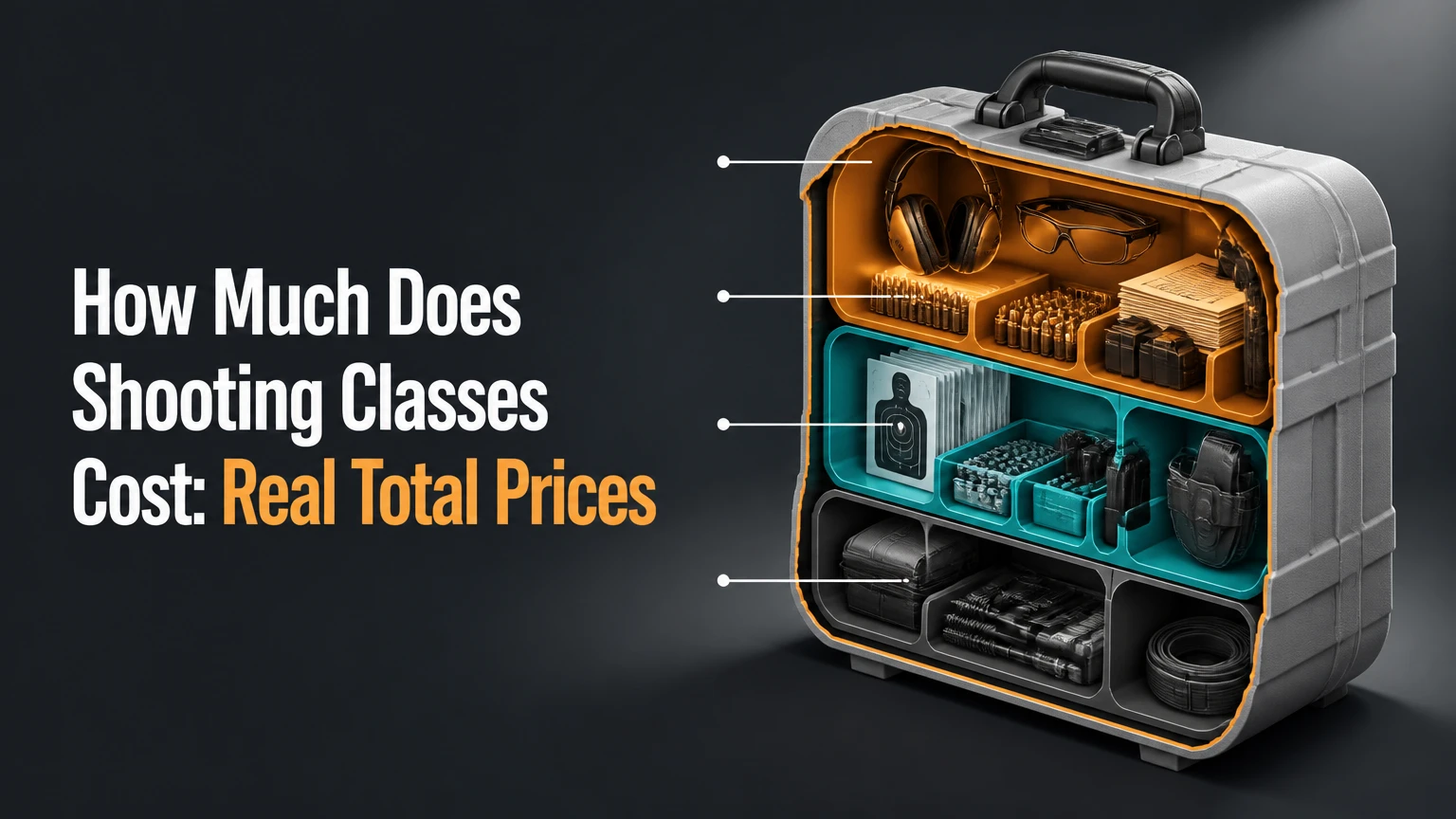
Ammunition is usually the largest variable expense after tuition, especially in defensive and multi-day courses. Firearm rental, lane fees, protective equipment, targets, licensing charges, travel, and meals can also change the final price by $25-$400.
Use this calculation before registering:
Total attendance cost = tuition + ammunition + firearm rental + range fee + targets + safety gear + licensing charges + travel.
Ammunition and Firearm Rental
A basic class may require 50 rounds, while a defensive class may require 100-300 rounds per day. Ammunition cost depends on caliber, local supply, manufacturer, and whether the facility permits ammunition from outside vendors.
A rental firearm commonly costs $10-$25 per session, but some ranges waive the fee when the student purchases a class package. Rental fees may not include magazines, specialty optics, or required accessories.
Range Access and Protective Equipment
Range fees commonly fall between $15 and $30 for a lane or session. Outdoor facilities may price access by the day, while instruction providers sometimes include range access in tuition.
Eye and ear protection can be free when supplied by the school, $5-$10 to rent, or $20-$60 to purchase. Personal protection can make sense for students who expect to attend multiple classes, but buying a firearm before receiving basic instruction is usually a poor first purchase decision.
Concealed-Carry Application Costs
A concealed-carry course is not the same as the complete licensing process. Depending on the state, applicants may separately pay an application fee, fingerprints, photographs, background-check charges, and permit issuance fees.
| Permit-related expense | Typical amount | When paid | Key variable |
|---|---|---|---|
| Training course | $100-$250 | Before certificate | State curriculum |
| Application fee | $50-$150 | Application submission | State and resident status |
| Fingerprinting | $15-$50 | Application submission | Vendor and location |
| Passport photograph | $10-$25 | Application submission | Some agencies accept digital photos |
| Permit renewal | $25-$150 | Renewal cycle | State validity period |
| Optional private lesson | $60-$150 per hour | Before or after course | Instructor and range |
Do not assume a completion certificate guarantees permit approval. The issuing agency decides whether the course meets current state requirements and whether the applicant satisfies all other legal criteria.
How Do Group and Private Lessons Compare?
Group classes usually provide the lowest total price per student, while private lessons offer more feedback per minute and better accommodation for anxiety, disability, language needs, or a specific skill goal. The best value depends on whether the student needs broad orientation or individualized correction.
| Training format | Typical price | Instructor attention | Best use |
|---|---|---|---|
| Group class, 6-15 students | $75-$200 | Shared, often 1 instructor per 6-15 students | First exposure and basic safety |
| Small group, 3-5 students | $100-$250 | Moderate, often 1 instructor per 3-5 students | Beginners wanting more correction |
| Private lesson | $60-$150 per hour | Dedicated | Anxiety, disability, or targeted skills |
| Hybrid classroom and range | $50-$175 | Limited online, direct at range | Schedule flexibility |
| Multi-day academy | $250-$600+ | Structured, intensive | High practice volume and progression |
Private training is not automatically better. A one-hour private session without a structured safety curriculum may leave a novice with less preparation than a well-designed half-day group class.
Online instruction is useful for terminology, laws, storage principles, and pre-class preparation. It is not a substitute for supervised handling and live-fire coaching when a student has never operated a firearm.
Which Format Fits Each Student?
- First-time student: Choose a small group introductory handgun course with rental equipment.
- Nervous or physically limited student: Choose private instruction and disclose relevant needs before booking.
- Permit applicant: Choose a state-approved course that explicitly provides the required documentation.
- Experienced owner: Choose a skills-specific class rather than repeating introductory material.
- High-volume enthusiast: Compare multi-day tuition, round count, instructor ratio, and travel cost together.
What Should You Bring and Wear?
A student should bring government-issued identification, payment, prescription eyewear if needed, water, and any firearm and ammunition the instructor has approved in advance. Wear closed-toe shoes, a high-neck shirt, durable pants, and clothing that covers the torso because hot cartridge cases can contact exposed skin.
Confirm these details before attending:
- Identification and age: State and facility rules may require government identification or a minimum age.
- Firearm status: Ask whether rental guns are available and whether students may bring a personal firearm.
- Ammunition: Confirm caliber, round count, bullet type, and outside-ammunition restrictions.
- Safety equipment: Determine whether eye and ear protection is supplied or must be purchased.
- Storage and transport: Follow local transport laws and the range’s unloaded-case policy.
- Physical requirements: Tell the instructor about hearing, vision, mobility, or hand-strength limitations.
The instructor should explain range commands and emergency procedures before live fire begins. A student should pause and ask for clarification whenever a command, loading procedure, or equipment instruction is unclear.
How Can You Avoid a Poor-Value Class?
A reliable class publishes its curriculum, total required equipment, instructor credentials, duration, cancellation policy, and certificate conditions before payment. A vague advertisement that emphasizes a very low tuition price but hides ammunition, rental, or range charges deserves additional scrutiny.
Use this screening checklist:
- Verify that the instructor’s credential is current and relevant to the course.
- Confirm whether the class satisfies your state’s current licensing requirement.
- Ask for the exact round count and approved ammunition types.
- Request the complete price, including range access, rental, targets, and protection.
- Check the student-to-instructor ratio and maximum enrollment.
- Read the cancellation, rescheduling, weather, and missed-class policies.
- Confirm whether the certificate is issued only after completing classroom and live-fire requirements.
- Ask how the facility handles students who need additional coaching.
A $50 class can be legitimate, especially when students provide their own firearm, ammunition, and protection. The price becomes suspicious when the provider refuses to disclose mandatory fees or pressures students to buy unnecessary equipment.
What Are the Most Common Budget Mistakes?
Buying a firearm first: A beginner may choose an uncomfortable grip, excessive recoil, or unsuitable controls. Renting approved firearms during instruction lets the student compare fit before making a major purchase.
Underestimating ammunition: A course requiring 300 rounds can add $75-$180 for common handgun ammunition, depending on caliber and local pricing. Request the round count before comparing tuition.
Confusing a permit class with complete licensing: Training may cost $100-$250, while application and fingerprinting charges add another $65-$200. The certificate is one component of the application.
Ignoring cancellation terms: A missed reserved lane may produce a forfeited deposit or rescheduling fee. Read the policy before selecting a date.
Choosing a class by tuition alone: Instructor ratio, live-fire time, equipment access, and curriculum quality affect value more than the registration number.
When Does Online or Hybrid Training Make Sense?
Online or hybrid training makes sense when the student needs scheduling flexibility or must complete classroom material before a supervised range appointment. The format is weak for correcting grip, loading, muzzle direction, trigger control, and other hands-on behaviors without an in-person instructor.
A hybrid course commonly costs $50-$175 for the educational portion and may charge separately for the range qualification. Students should verify whether their state accepts online coursework for the intended license because legal recognition varies by jurisdiction.
Hybrid training can reduce travel and classroom time, but it does not remove live-fire expenses. Budget separately for the in-person range session, ammunition, firearm rental, and protective equipment.
How Much Should Follow-Up Practice Cost?
A follow-up practice visit commonly costs $30-$100 before travel, depending on whether the student rents a firearm, pays a lane fee, and fires 50-100 rounds. A private coaching session usually costs $85-$250 after one hour of instruction, ammunition, range access, and targets.
| Follow-up option | Typical frequency | Typical per-visit total | Suitable objective |
|---|---|---|---|
| Self-directed range practice | Monthly | $35-$100 | Reinforce basic handling |
| Private coaching | Every 1-3 months | $85-$250 | Correct a specific technique |
| Skills refresher group | Every 3-6 months | $75-$200 | Rebuild fundamentals |
| Defensive skills course | Annually | $150-$400 | Structured supervised practice |
| Competition practice | Weekly or monthly | $40-$150 | Match preparation |
A single introductory class does not create durable proficiency. Safe handling, equipment familiarity, and accuracy improve when practice is repeated under appropriate supervision and within the student’s legal and physical limits.
An honest limitation matters here: low-cost practice is not always productive practice. Unsupervised repetition can reinforce unsafe handling or poor technique, while a short coaching session can identify a problem that several range visits would otherwise preserve.
Which Budget Fits Your Goal?
A total beginner should plan on $130-$180 for a basic class with a rental handgun and 50 rounds. A permit applicant should reserve $165-$450 for training plus common application expenses, while an enthusiast attending a multi-day course should plan on $500-$1,000 or more.
| Student goal | Recommended starting option | Tuition budget | Practical total |
|---|---|---|---|
| First firearm experience | Introductory handgun class | $75-$150 | $130-$180 |
| Personal safety education | Basic class plus private coaching | $135-$300 | $200-$400 |
| Concealed-carry application | State-approved licensing course | $100-$250 | $165-$450 |
| Rifle or shotgun recreation | Basic long-gun instruction | $100-$200 | $130-$300 |
| Competitive shooting | Competition orientation | $100-$250 | $175-$450 |
| Advanced skill development | One- to three-day academy | $250-$600+ | $500-$1,000+ |
The cheapest appropriate option is usually a supervised introductory class, not an online-only course or an unstructured range visit. Students should match the class to the intended outcome because licensing, recreation, competition, and defensive education require different curricula.
FAQ
Is $100 Enough for a Shooting Class?
A $100 budget may cover tuition for an introductory class, but it may not cover the complete visit. Students who need a rental firearm, 50 rounds of ammunition, range access, targets, and protective equipment should usually budget $130-$180. Call the provider to confirm which charges are included before paying.
Do Shooting Classes Provide the Firearm?
Some shooting classes provide or arrange a rental firearm, but many require students to bring an approved firearm. Rental fees commonly cost $10-$25, and facilities may require ammunition purchased on-site for rental guns. Confirm firearm availability, caliber restrictions, magazine access, and rental conditions during registration.
How Long Does a Beginner Shooting Class Take?
A beginner shooting class usually takes 3-5 hours, including classroom safety instruction, dry practice, range orientation, live fire, and debriefing. Concealed-carry courses may take 4-16 hours because state curricula can require additional legal, safety, or qualification content.
Is a Concealed-Carry Class the Same as a Basic Pistol Class?
A concealed-carry class is not necessarily the same as a basic pistol class. Basic pistol instruction focuses on safe operation and marksmanship, while a state-approved carry course may add legal responsibilities, storage, transportation, and a qualification. Verify the state’s current requirements before enrolling.
Can You Take a Shooting Class Without Owning a Gun?
Many introductory shooting classes allow students to attend without owning a gun because the range or instructor provides rentals. Students should reserve equipment in advance, confirm ammunition rules, and ask whether the class is designed for complete beginners. Buying a firearm is not required to learn basic safety and handling.
How Often Should You Take Firearms Training?
A refresher or skills class every three to six months is a reasonable planning interval for many new shooters, with supervised practice between classes. Students pursuing competition or defensive education may train more often. The appropriate schedule depends on experience, goals, access to a range, and the instructor’s assessment.
The Bottom Line
The answer to “how much does shooting classes cost” is usually $75-$250 for tuition, but a realistic first visit costs about $130-$180 when rental equipment, ammunition, range access, targets, and protection are included. Compare the complete price, round count, instructor credentials, class size, and state recognition before booking.