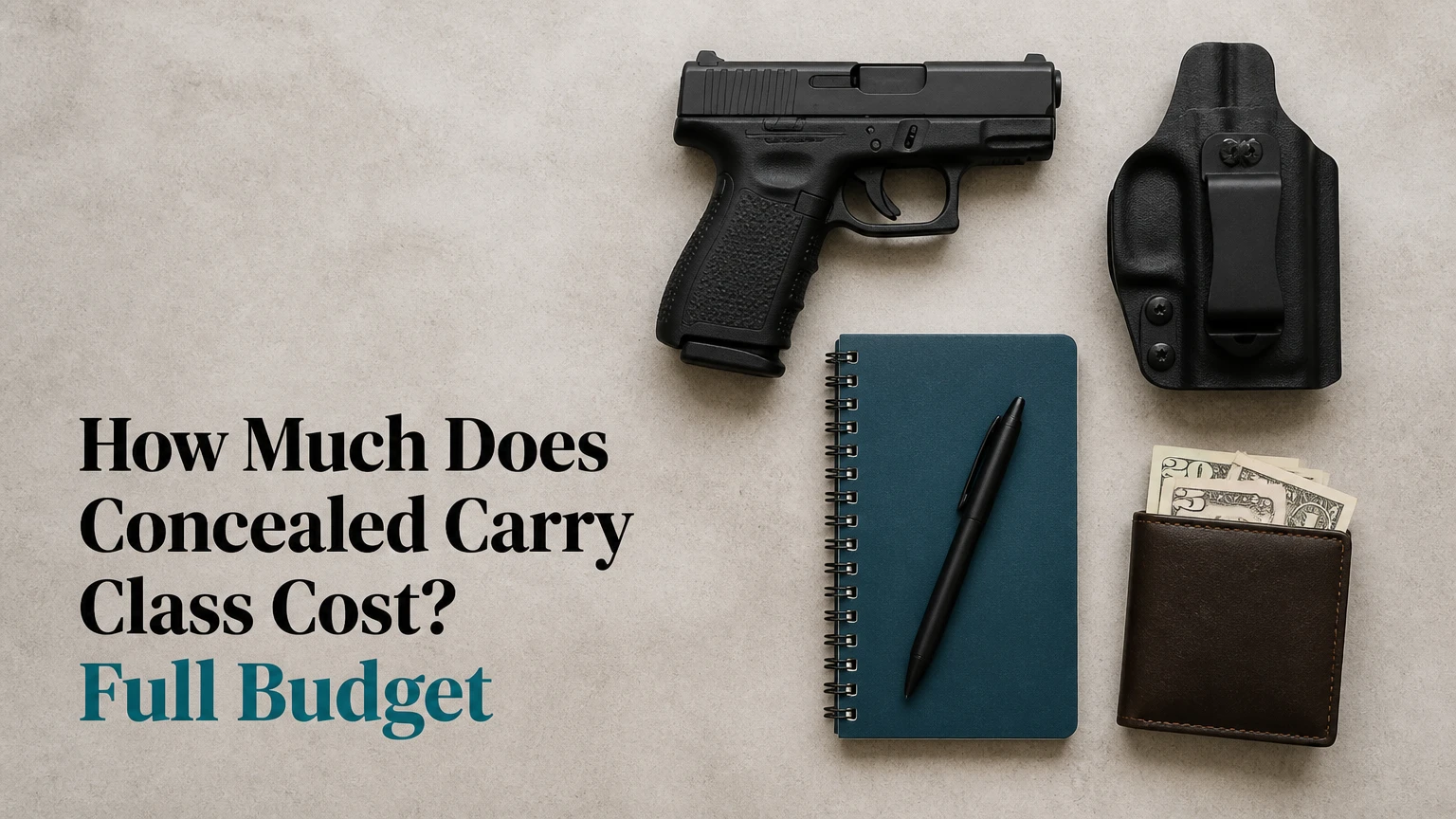
A concealed carry class typically costs $60-$150 for a basic state permit course, $150-$300 for stricter state requirements, and $200-$350 for many multi-state courses. After licensing fees, fingerprints, ammunition, range charges, and equipment, a realistic first-time budget is often $150-$400, before buying a firearm.
Key Facts at a Glance
A basic concealed carry class commonly costs $60-$150.
A strict-state course may cost $150-$300 because it requires more instruction or range time.
Multi-state permit classes commonly cost $200-$350, excluding separate state application fees.
Advanced defensive handgun training usually costs $300-$500 or more and may not satisfy a permit requirement.
Total first-time expenses commonly reach $150-$400 before firearm, holster, safe, and defensive-training purchases.
State law determines whether online instruction, live-fire qualification, fingerprints, and a certificate are accepted.
What Is the Typical Concealed Carry Class Price?
The typical concealed carry class price is $60-$150 for a basic, in-person permit course, but the advertised tuition does not always equal the final cost. A course may include classroom instruction and a certificate while charging separately for range time, targets, ammunition, firearm rental, or eye and ear protection.
Local market prices vary because state mandates vary. A short course in a state with minimal training requirements can cost less than a two-day course requiring a written test and documented shooting qualification. Urban ranges also tend to charge more for facility use than rural clubs.
| Course type | Typical tuition | Typical duration | Common purpose |
|---|---|---|---|
| Basic state permit class | $60-$150 | 4-8 hours | Initial resident permit |
| Strict-state compliance class | $150-$300 | 8-16 hours | State-specific training mandate |
| Multi-state nonresident class | $200-$350 | 8-12 hours | Applications in multiple states |
| Advanced defensive handgun course | $300-$500+ | 1-3 days | Skill development beyond minimum law |
| Private one-on-one instruction | $75-$150 per hour | 1-4 hours | Remediation or tailored coaching |
A low price is not automatically a problem. A $99 class with range fees, targets, ammunition, and certification included can be less expensive than a $65 course that adds $85 at checkout.
What Does the Tuition Cover?
Concealed carry class tuition commonly covers a state-law lecture, firearm safety instruction, basic handling, and a completion certificate, while live-fire expenses may be separate. The registration page should identify each included item in writing because “all-inclusive” can mean only classroom admission and instructor paperwork.
Typical classroom subjects include firearm storage, transportation, prohibited locations, defensive-force rules, safe loading and unloading, and the consequences of displaying or firing a weapon. Some instructors also cover holster selection, medical response, conflict avoidance, and interaction with law enforcement.
A permit class is usually compliance-oriented. It is not necessarily a complete defensive-handgun program. A student may pass a state qualification without learning safe movement, decision-making under stress, low-light identification, or reliable concealed draws.
| Possible charge | Typical amount | Often included? | Question to ask |
|---|---|---|---|
| Classroom tuition | $60-$300 | Yes | Is the certificate included? |
| Range or lane fee | $15-$40 | Sometimes | Is the range booked by the instructor? |
| Ammunition | $20-$75 | Sometimes | How many rounds are required? |
| Firearm rental | $15-$35 | Sometimes | Can students use a rental firearm? |
| Targets and supplies | $5-$15 | Sometimes | Are targets included in tuition? |
| Eye and ear protection | $5-$20 | Sometimes | May personal protection be used? |
Ask whether the certificate is valid for the exact permit application you intend to submit. An instructor’s general firearms certificate may not satisfy a state agency’s mandated curriculum.
How Long Does the Process Take?
The class itself commonly takes 4-16 hours, but obtaining the permit may take several weeks to several months. The controlling variables are the state’s minimum training hours, appointment availability for fingerprints, application completeness, and the issuing agency’s processing workload.
The usual sequence is:
- Verify state eligibility and training rules. Check the official state police, department of public safety, sheriff, or licensing agency website.
- Complete approved instruction. Attend the required classroom hours and any mandated examination.
- Complete live-fire qualification. Follow the instructor’s safety and accuracy requirements with an approved firearm.
- Receive the certificate. Confirm that the certificate contains the correct name, date, instructor credentials, and required signatures.
- Submit the application. Include photographs, fingerprints, identity documents, certificate, and the correct fee when required.
- Monitor processing and expiration dates. Keep copies of every submission and respond promptly to agency requests.
A course certificate does not itself authorize concealed carry. The permit, if the state requires one, is issued by the designated government agency after eligibility review.
How Much Do Extra Permit Costs Add?
Extra permit costs commonly add $50-$200 to the class price, although some jurisdictions charge more. The largest variables are the state application fee and fingerprinting method; ammunition and rental costs matter most when the class does not provide range equipment.
| Added expense | Typical cost | When charged | Cost-control question |
|---|---|---|---|
| State application fee | $40-$150 | Permit submission | Is the fee refundable? |
| Fingerprints | $10-$60 | Initial application | Is electronic capture mandatory? |
| Photograph | $0-$20 | Application packet | Does the agency provide a photo service? |
| Ammunition | $20-$75 | Range session | What caliber and round count are required? |
| Firearm rental | $15-$35 | Range session | Is a rental firearm permitted for qualification? |
| Range fee | $15-$40 | Live-fire session | Is lane time included? |
| Permit renewal | $25-$150 | Renewal cycle | When does the permit expire? |
The most useful budgeting distinction is class price versus completion price. A $125 course can become $220 after $75 in ammunition and range charges, while a $175 package can remain $175 if it includes those items.
What is a realistic first-time budget?
A realistic first-time budget is $150-$400, excluding the firearm and long-term equipment. Applicants who need a firearm rental, buy ammunition at retail, pay separate fingerprints, and submit a relatively expensive state application should budget toward the upper end.
| Applicant scenario | Class | Added fees and supplies | Estimated total |
|---|---|---|---|
| Existing firearm owner | $99 | $50-$125 | $149-$224 |
| Beginner using rental equipment | $125 | $85-$175 | $210-$300 |
| Strict-state applicant | $200 | $75-$200 | $275-$400 |
| Multi-state applicant | $250 | $100-$250 | $350-$500 |
| Advanced training student | $400 | $75-$200 | $475-$600 |
These are typical planning ranges, not government fee schedules. Confirm current prices with the issuing agency and instructor before payment.
Do State Requirements Change the Price?
State requirements change the price because mandated hours, curriculum topics, shooting qualifications, and approved-instructor rules determine how much labor and facility time a course requires. A state with a short safety class can support lower tuition than a state requiring a full day or multiple days of instruction.
Examples illustrate the difference, but no example replaces current agency guidance. Illinois generally requires a 16-hour concealed-carry training course for an application, while Utah’s permit training has historically centered on a shorter course and does not use the same live-fire model as every other state. California requirements can vary by issuing county, including course length and qualification details.
New York, Maryland, and other restrictive jurisdictions may impose detailed applicant, training, or qualification requirements that affect both class length and price. Local agencies can also publish approved-provider lists or additional instructions.
The legal framework changes. Use the state licensing agency as the controlling source, not a national reciprocity chart, a social-media post, or an instructor’s old handout.
Are Online Concealed Carry Classes Accepted?
Online concealed carry classes cost roughly $40-$80, but online completion is accepted only where the relevant state and issuing authority recognize that format. Many jurisdictions require in-person instruction, live-fire qualification, an approved instructor, or all three.
An online course may be useful for general safety education or as one component of a hybrid program. It cannot replace hands-on correction when a student is handling a firearm for the first time, and a completion screen may not satisfy a government certificate requirement.
Before buying an online course, verify:
- The exact state and permit type covered.
- Whether the provider is approved by the issuing authority.
- Whether an in-person range qualification remains mandatory.
- Whether the certificate includes the required instructor credentials.
- Whether the course reflects current statutes and agency rules.
- Whether refunds are available if the certificate is rejected.
A website promising permits in every state for one payment deserves additional scrutiny. Permit recognition and training acceptance are separate legal questions.
Do Multi-State Classes Provide Better Value?
Multi-state classes provide better value only for applicants who regularly travel and can legally obtain the selected nonresident permits. A $200-$350 class may reduce duplicate classroom costs, but it does not guarantee that every state will recognize the resulting permits or that the applicant meets each state’s eligibility rules.
Reciprocity is conditional. A state may recognize a permit only for residents of the issuing state, only for permit holders meeting a minimum age, or only under specified weapon and location restrictions. Some states also impose different rules for vehicles, restaurants, schools, posted premises, and duty to inform law enforcement.
Use official state government sources to verify:
- Whether the destination recognizes the permit.
- Whether recognition applies to nonresident permits.
- Whether the traveler’s age and permit type qualify.
- Which prohibited locations and storage rules apply.
- Whether the destination imposes a duty to inform.
- Whether the permit must remain valid for the entire trip.
A multi-state certificate is a convenience, not a legal shield. The traveler remains responsible for destination-state law.
What Should Beginners Bring to Class?
Beginners should bring government identification, payment confirmation, eye and ear protection if permitted, a notebook, water, and only the firearm and ammunition specified by the instructor. Students should not bring a loaded firearm into a classroom unless the instructor and facility have issued clear transport and handling instructions.
Call before arriving and ask about:
- Approved firearm calibers.
- Required ammunition quantity.
- Whether brass-cased ammunition is required.
- Firearm rental and magazine availability.
- Clothing restrictions for range work.
- Holster requirements, if any.
- Whether personal firearms must be unloaded and cased.
- Whether guests or observers are allowed.
Do not buy a concealed-carry handgun solely because it appears small. Very small pistols can have sharp recoil, short grips, difficult sights, and controls that challenge inexperienced users. Renting several lawful models under instructor supervision can prevent an expensive mismatch.
A permit class is also not a substitute for secure storage. A lockbox or safe, especially one that prevents unauthorized access by children or visitors, should be part of the ownership budget.
What If You Fail the Live-Fire Qualification?
If you fail a live-fire qualification, stop and ask the instructor for the specific cause, then confirm the available remediation or retest procedure. Common outcomes include same-day coaching, a scheduled retest, a separate range fee, or a requirement to repeat part of the course.
Typical remediation charges are $20-$75, but state rules and instructor policies differ. Some qualifications are pass-fail with a fixed course standard; others allow the instructor to document additional training before a second attempt.
The most common preventable failures are unsafe muzzle direction, poor trigger-finger discipline, inability to unload safely, and insufficient accuracy. Accuracy practice should occur with an instructor before the qualification, not during an improvised session immediately beforehand.
A reputable instructor should explain the standard before live fire begins. A course that guarantees a certificate regardless of unsafe conduct creates a serious safety concern.
Do Permitless-Carry States Still Require a Class?
Permitless-carry states may not require a class to carry under qualifying state law, but training can still matter for safe handling, legal boundaries, and obtaining a permit for interstate travel. Permitless carry does not eliminate age limits, prohibited locations, prohibited-person rules, or restrictions on carrying while impaired.
The benefits of obtaining a permit vary by jurisdiction. A permit may improve reciprocity, change vehicle-carry rules, or affect the process for carrying in another state. It does not automatically create nationwide recognition, remove every firearm-purchase waiting period, or guarantee favorable treatment after a defensive incident.
Formal training also does not provide automatic legal protection. In District of Columbia v. Heller, 554 U.S. 570 (2008), Justice Antonin Scalia wrote, “Like most rights, the right secured by the Second Amendment is not unlimited.” The quote captures the practical point: lawful ownership and lawful defensive use remain bounded by federal, state, and local rules.
Anyone relying on permitless carry should read the current statute and agency guidance. A class can improve competence, but it cannot change the law.
Which Class Is the Best Value?
The best-value class is an approved in-person course with transparent pricing, a manageable student-to-instructor ratio, state-specific legal instruction, and included or clearly itemized range costs. The cheapest advertised tuition is a poor value if the certificate is unusable or the student receives no supervised handling feedback.
Evaluate the provider using these criteria:
- Approval: The instructor’s credential and course format satisfy the issuing authority.
- Price transparency: Tuition, ammunition, range fees, rentals, and retests are listed.
- Class size: The instructor can observe each student safely during live fire.
- Curriculum: The course covers current state law rather than generic national material.
- Range supervision: Students receive direct correction before qualification.
- Administrative accuracy: Certificates contain the information the agency requires.
- Post-class support: The provider explains application submission and retesting.
Which option fits each applicant?
| Applicant profile | Recommended course | Expected tuition | Main reason |
|---|---|---|---|
| First-time firearm student | 8-hour in-person class | $100-$200 | Supervised handling and legal basics |
| Budget-focused resident | All-inclusive local class | $75-$150 | Fewer surprise range charges |
| Frequent interstate traveler | Verified multi-state course | $200-$350 | Multiple eligible permit pathways |
| Permitless-carry resident | Voluntary safety course | $75-$200 | Competence without assuming permit necessity |
| Experienced shooter | State-specific compliance class | $60-$175 | Avoid paying for unnecessary advanced content |
| Defensive-skills learner | Permit class plus advanced course | $400-$900 total | Compliance and skill training are separate goals |
The practitioner rule is simple: buy the course that satisfies your legal objective and corrects your actual skill deficit. A multi-state lecture cannot replace practice, and an advanced tactical course cannot replace a state-required certificate unless the agency explicitly accepts it.
What Are the Most Common Cost Mistakes?
The most common cost mistake is comparing tuition without comparing the complete completion price. Students should request one written estimate that includes required ammunition, range access, equipment rental, fingerprints, photographs, application fees, and retest charges.
Other frequent mistakes include:
- Booking before checking state acceptance. A convenient online certificate may be rejected.
- Assuming reciprocity is permanent. States can change recognition rules and prohibited-location laws.
- Buying a firearm before training. A poor fit can create additional replacement and holster costs.
- Confusing a permit class with defensive training. Minimum qualification does not establish advanced judgment or draw skill.
- Ignoring renewal dates. An expired permit can invalidate travel plans and create new application costs.
- Choosing a crowded class. A low per-person price may reduce individual range supervision.
- Using old legal material. Carry statutes and agency procedures change more often than equipment.
An instructor who cannot identify the current issuing agency, certificate standard, or qualification procedure should not be the first choice.
How Can You Verify the Final Price Before Booking?
Verify the final price by checking two independent sources: the official issuing agency for government charges and the instructor for course-specific charges. Record the date of verification because fees, accepted training formats, and application procedures can change.
Use this five-minute checklist:
- Find the official permit application page.
- Write down the application, fingerprint, photo, and renewal fees.
- Confirm required training hours and live-fire rules.
- Ask the instructor for an itemized invoice.
- Confirm rental firearm, ammunition, range, and retest policies.
- Check whether the course certificate expires or has a submission deadline.
- Save the agency page and instructor receipt as PDFs.
This approach catches the most expensive error: completing a course that cannot be used for the intended permit.
Frequently Asked Questions
Does a concealed carry class include the permit fee?
Usually, no. Concealed carry class tuition generally pays the instructor and training provider, while the permit fee is paid separately to a state, county, sheriff, or police agency. Some providers sell packages that include administrative assistance, but applicants should confirm whether the government fee itself is included.
Can you take a concealed carry class without owning a gun?
Often, yes. Many ranges offer rental firearms, and some instructors provide training firearms, but the policy varies by facility. Ask about rental availability, approved calibers, ammunition rules, magazine access, and whether a new shooter must attend a safety orientation before live fire.
How many rounds are needed for a CCW class?
A typical live-fire qualification may use 50-150 rounds, but the exact quantity depends on the state, instructor, and qualification course. Bring only the ammunition specified by the provider, because some ranges restrict steel-core, aluminum-case, or reloaded ammunition.
Is a CCW class the same as a handgun safety class?
No. A handgun safety class usually emphasizes safe storage, handling, loading, unloading, and basic operation. A concealed carry class adds state-specific carry law and may include a qualification, while advanced defensive training covers skills that neither minimum course necessarily teaches.
How often should concealed carry training be renewed?
Legal renewal requirements depend on the permit’s expiration period and state law. Even where no refresher class is required, periodic supervised practice is sensible because safe handling, equipment fit, and legal knowledge can deteriorate. Verify the renewal rule with the issuing authority rather than relying on an instructor’s general schedule.
The Bottom Line
How much does concealed carry class cost? Plan on $60-$150 for a basic course, $150-$300 for stricter state compliance, and $200-$350 for many multi-state classes. The realistic first-time total is often $150-$400 after application fees, fingerprints, ammunition, range charges, and rentals.
Choose an approved course based on the complete price and the state’s current rules. Treat the permit class as legal and safety compliance training, then add separate practice or defensive instruction if your goal extends beyond passing the minimum qualification.