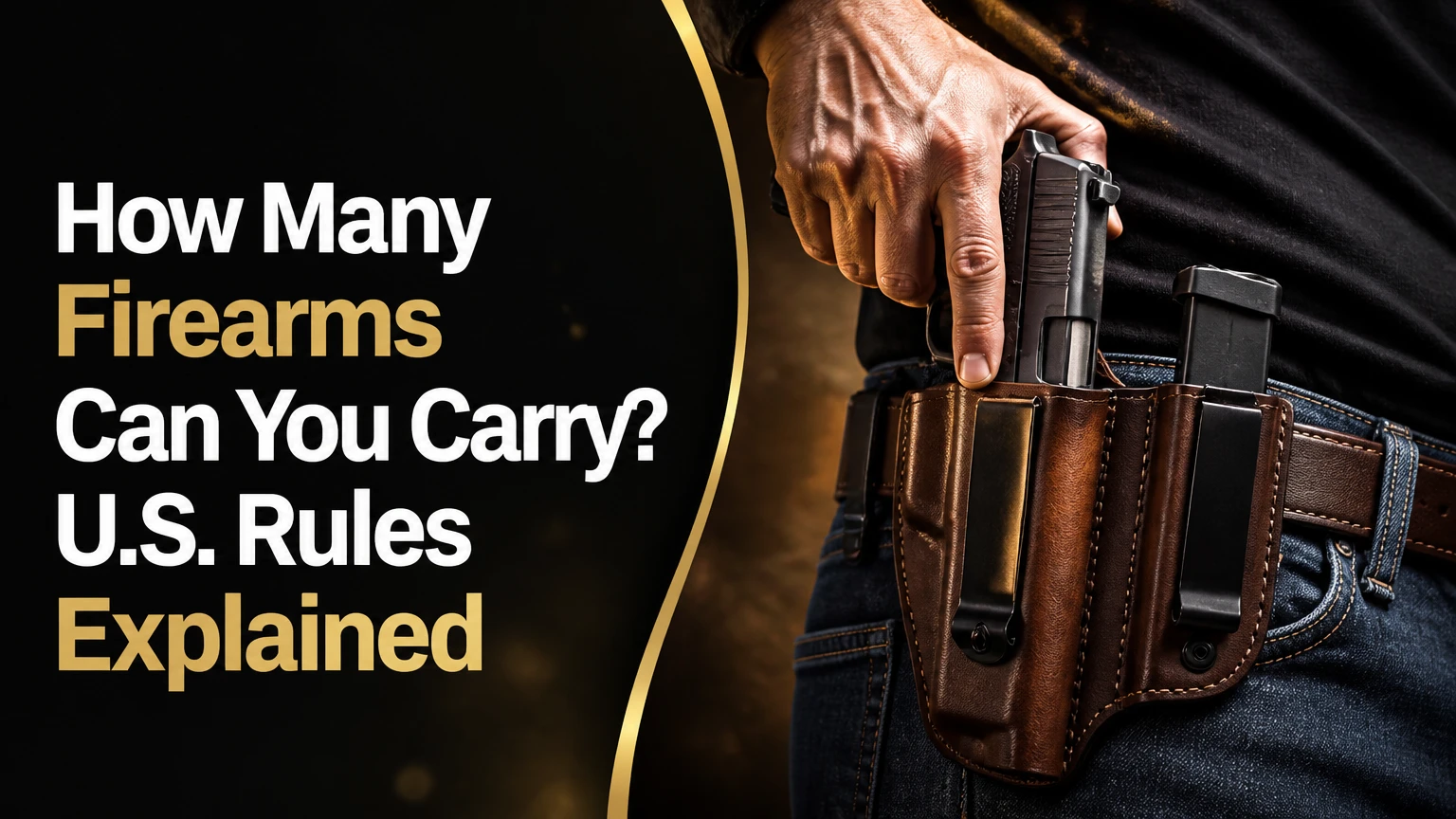
In the United States, federal law generally does not impose one universal numerical limit on how many firearms an eligible civilian may carry. The actual limit comes from the state and locality, the carry permit’s conditions, the firearm’s loaded or concealed status, the location, and whether another state recognizes the permit.
Key Facts
Federal law generally has no nationwide numerical ceiling on firearms carried by an otherwise eligible civilian.
A state may regulate the number of firearms, the types of firearms, the manner of carry, or the locations where carry is allowed.
A concealed-carry permit may regulate eligibility and conduct without listing every firearm that the license holder owns.
Federal law separately restricts firearms in places such as federal facilities and certain school-zone circumstances.
Permit reciprocity recognizes a license only under the receiving state’s conditions.
One properly secured and consistently practiced carry system is usually simpler to manage than multiple firearms.
How Many Firearms Can You Carry Under U.S. Law?
Most eligible civilians can carry one or more firearms unless a specific federal, state, local, permit, or property rule sets a different limit. The answer is therefore not a single national number. A person may be allowed to possess several firearms at home but be restricted from carrying any firearm in a particular courthouse, school, airport area, or private business.
The legal analysis has separate layers. First, federal law determines whether the person is prohibited and whether a federal location or circumstance applies. Second, the state where the person is physically located controls ordinary open-carry, concealed-carry, loaded-carry, vehicle, and permit rules. Third, a permit, employer policy, private-property rule, or posted restriction may narrow the practical answer.
The phrase “carry” also matters. Carrying a loaded handgun concealed in a holster, transporting an unloaded rifle in a locked case, and storing a firearm in a vehicle are legally different activities in many jurisdictions. A numerical answer without those facts can be misleading.
Is There a Federal Number Limit?
Federal law generally does not set a maximum number of firearms that an eligible civilian may carry on the person. Federal restrictions instead focus on prohibited persons, firearm categories, locations, and conduct, including 18 U.S.C. § 922 and 18 U.S.C. § 930.
That does not mean federal law permits carry everywhere. Section 922(q), the Gun-Free School Zones Act, regulates firearm possession in or near school zones and contains important exceptions. Section 930 regulates firearms in federal facilities, with separate rules and exceptions. Airport sterile areas, federal court facilities, and certain other federally controlled places can impose additional restrictions.
The federal baseline is best stated this way: there is usually no federal count limit, but federal law can still prohibit the carry event itself. State law remains the main source of quantity and manner-of-carry rules for ordinary public carry.
Does a Concealed-Carry Permit Limit the Number?
A concealed-carry permit limits the number of firearms only when the issuing jurisdiction’s law or permit conditions expressly make firearm quantity or firearm identity a condition of lawful carry. Many permits authorize the person to carry a concealed handgun without listing every make, model, or serial number.
Permit systems differ significantly. Some jurisdictions historically required qualification with a particular handgun or recorded approved firearms. Others issue a license tied primarily to the license holder’s eligibility. The wording on the permit, the application materials, administrative regulations, and current statutes control.
A permit can also restrict more than quantity. Conditions may address loaded carry, sensitive places, permit display, renewal, reporting a lost license, or carrying while intoxicated. A permit issued by one state does not override the law of another state.
What Does “Listed Firearm” Mean?
A listed-firearm rule means the issuing authority identifies the specific firearm or firearms that the permit holder may carry. Such a rule can limit the lawful firearm selection even when the state does not impose a general numerical ceiling.
Permit language deserves direct inspection. Look for terms such as “approved firearm,” “qualified weapon,” “listed handgun,” “serial number,” or “firearm endorsement.” A permit that contains a firearm description does not automatically mean every jurisdiction uses that description as a count limit, so the statute and agency guidance should be read together.
A common error is treating online summaries as controlling law. A permit office, state police agency, attorney general publication, or current statutory text is stronger evidence than a retailer’s article or an old training handout.
| Permit feature | Typical legal effect | Verification source | Common error |
|---|---|---|---|
| Holder-based license | Authorizes an eligible person to carry under stated conditions | Current state statute | Assuming every owned handgun is automatically covered |
| Firearm-specific endorsement | May restrict carry to listed or qualified firearms | Permit card and issuing agency | Carrying an unlisted handgun |
| Permitless carry | May remove the license requirement for qualifying people | State statute and attorney general guidance | Assuming every person and location qualifies |
| Nonresident permit | Operates only where another state recognizes it | Receiving state reciprocity statute | Applying home-state rules elsewhere |
Can You Carry Two or More Concealed Firearms?
A person may be able to carry two or more concealed firearms when the state permits concealed carry, the permit or permitless framework does not restrict quantity, and no location or conduct rule prohibits the firearms. The second firearm does not create a nationwide federal violation by itself.
The practical and legal analysis changes with each additional firearm. Every firearm must be carried in a manner that satisfies the applicable concealment and loaded-status rules. A firearm placed in a purse, backpack, vehicle console, or other container may be treated differently from a firearm secured in a holster on the body.
Multiple firearms also increase the chance of an accidental exposure, negligent handling event, retention problem, or inconsistent response under stress. The National Rifle Association’s basic safety rules begin with treating every gun as loaded, keeping the muzzle pointed in a safe direction, and keeping the finger outside the trigger guard until ready to shoot. Those rules apply independently to every firearm carried.
A backup gun is not a legal category that automatically receives special treatment. It is a practical term for a secondary firearm, and the same laws apply to it as to the primary firearm.
Which States Limit Multiple-Firearm Carry?
States can limit multiple-firearm carry through direct numerical rules, firearm-specific permit conditions, loaded-carry restrictions, prohibited-location rules, or regulations that make a particular setup unlawful. Because statutes change, a state-by-state answer requires the current law for the exact date and location.
California illustrates why broad internet summaries require caution. California regulates concealed carry through Penal Code sections 26150 and following, and permit conditions, sensitive-place rules, local enforcement practices, and firearm restrictions can affect the result. A blanket claim that California universally imposes a two-firearm carry limit should not be accepted without identifying the exact statute, permit condition, and carry circumstance.
New York, New Jersey, Illinois, Maryland, Massachusetts, Connecticut, and the District of Columbia have also changed or maintained detailed rules affecting permits, sensitive places, transport, or handgun possession. The relevant question is not simply whether a state is “strict” or “permitless.” The relevant questions are whether the person qualifies, whether the firearm qualifies, whether the location qualifies, and whether the manner of carry complies.
Does Permitless Carry Remove the Limit?
Permitless carry removes a license requirement for qualifying people in specified circumstances; it does not remove every other firearm restriction. A permitless-carry state may still regulate age, prohibited persons, loaded carry, sensitive places, vehicles, private property, alcohol, and travel.
A permit can remain useful even in a permitless state. It may provide reciprocity in another state, simplify certain transport questions, or document training or eligibility where another jurisdiction requires a license. Reciprocity is never automatic.
The most reliable verification sequence is:
- Identify the state and municipality where the firearm will be carried.
- Confirm the person’s age, residency, eligibility, and permit status.
- Determine whether the firearm will be open, concealed, loaded, or stored.
- Check location restrictions, including schools, government buildings, courthouses, and private property.
- Read the permit conditions and current agency guidance.
- Confirm recognition in every state crossed during travel.
Does Open Carry Change the Number?
Open carry can change the answer because states often regulate open and concealed carry differently. A state may allow one method, require a permit for another, prohibit open carry in a city, or apply different loaded-firearm rules to each method.
Open carry means the firearm is carried visibly or in a manner that does not meet the jurisdiction’s definition of concealed. A covering garment, vehicle compartment, bag, or case can change the legal classification. The same firearm may therefore be lawful in one configuration and unlawful in another.
Open carry also creates private-property and law-enforcement concerns. A business may prohibit firearms even when the state permits open carry, and a property owner may direct a person to leave. Refusing to leave after notice can create a separate offense unrelated to the number of firearms.
How Many Firearms Can You Carry in a Vehicle?
Vehicle carry depends on the state, the vehicle’s location, the firearm’s loaded status, the container, the person’s permit, and whether the vehicle is on restricted property. Some jurisdictions allow a loaded handgun in a vehicle for a licensed person, while others impose separate transport rules for rifles, shotguns, or unlicensed individuals.
Federal law can also matter when a vehicle enters a school zone, federal facility, military installation, national park, or other specially regulated area. National parks generally apply state firearm law, but federal buildings within those parks remain subject to federal restrictions.
For interstate travel, the Firearm Owners’ Protection Act, 18 U.S.C. § 926A, may protect certain lawful transport when firearms are unloaded, inaccessible, and transported between places where the person may lawfully possess them. Section 926A is not a general concealed-carry authorization and does not eliminate every state or local transport rule.
| Situation | Typical controlling issue | Typical safer transport condition | Verification point |
|---|---|---|---|
| Loaded handgun in personal vehicle | State carry and vehicle law | Secured holster, no unauthorized access | State statute and permit terms |
| Unloaded rifle between states | Transport law and route restrictions | Locked case, ammunition separated where required | 18 U.S.C. § 926A and state law |
| Vehicle on school property | School-zone and property rules | Do not assume a vehicle exception applies | 18 U.S.C. § 922(q), state law |
| Firearm in airport baggage | Airline and TSA rules | Unloaded, locked hard-sided case, declared at counter | TSA and airline policy |
| Federal building parking area | Federal property rules | Avoid entering the building with the firearm | Agency-specific federal rule |
Which Locations Commonly Prohibit Carry?
Common restricted locations include federal facilities, federal court facilities, schools, airport sterile areas, correctional institutions, and certain government buildings. State law may add bars, polling places, hospitals, public transit, parks, places of worship, or private businesses.
The number of firearms is irrelevant when the location prohibits the carry of any firearm. Carrying two firearms does not create a special exception, and a valid state permit generally does not override a federal prohibition.
The term “gun-free zone” is too imprecise for legal analysis. A post office, federal courthouse, school zone, airport screening area, and private restaurant can be governed by different statutes, exceptions, signage rules, and enforcement standards.
A person should confirm the exact property boundary. For example, a federal facility may include a building and defined grounds, while a privately operated business may control only its premises. The responsible agency or property owner is the appropriate source for current rules.
Is Carrying One Firearm Better Than Carrying Two?
For most everyday civilian carriers, one familiar firearm in a compliant holster is simpler to secure, conceal, draw, inspect, and practice with than two firearms. Carrying a second firearm may provide redundancy, but it adds weight, equipment, retention concerns, training requirements, and more opportunities for a legal or safety mistake.
A sound comparison considers the person’s role rather than assuming more equipment is better. A uniformed security worker, armed professional, rural resident, and ordinary office worker face different access, retention, clothing, and policy constraints.
The most important practical rule is consistency. The National Shooting Sports Foundation’s safety guidance emphasizes responsible handling, storage, and training, while law-enforcement training organizations commonly stress that equipment must remain accessible only to the authorized user. Neither source establishes a universal legal advantage for carrying two guns.
| Configuration | Typical equipment weight | Training burden | Main legal exposure | Best fit |
|---|---|---|---|---|
| One compact handgun | 20-32 ounces unloaded | One manual of arms | Location and permit compliance | General daily carry |
| One full-size handgun | 28-40 ounces unloaded | One manual of arms | Concealment and retention | Uniformed or outer-garment carry |
| Handgun plus backup handgun | 40-65 ounces combined | Two access points and systems | Added exposure and retention issues | Specialized professional use |
| Unloaded firearm in locked case | 3-12 pounds depending on firearm | Transport procedures | Route and destination restrictions | Interstate transport |
Why Does a Second Firearm Add Risk?
A second firearm increases the number of loaded chambers, trigger areas, holsters, and access points that must remain controlled. If the firearms use different controls, magazine releases, safeties, or holster systems, the carrier must maintain separate operating habits.
Multiple-carry systems are also vulnerable to retention failures. An exposed firearm can be grabbed, a loose off-body bag can be stolen, and an ankle or pocket setup can be difficult to access without compromising balance or awareness. A second firearm is not useful if the carrier cannot lawfully access, retain, and safely handle it.
A practitioner rule of thumb is to add equipment only after the carrier can perform administrative loading, unloading, holster inspection, and safe storage consistently with the primary firearm. More equipment should solve a defined problem, not compensate for inadequate familiarity.
What Does Multiple-Firearm Carry Cost?
The typical additional equipment cost for carrying a second firearm is $75-$250 for a dedicated holster, belt or support equipment, secure storage, and practice ammunition, excluding the firearm itself. Permit costs commonly range from $25-$300, while processing can take 2-16 weeks depending on the jurisdiction.
Those figures are typical planning ranges, not legal fees or guaranteed processing times. State application fees, fingerprinting, training, background checks, renewal periods, and local administrative charges vary substantially.
A complete budget should include secure storage and training. A lockbox may cost $30-$150, a quality holster commonly costs $40-$180, and a basic defensive-handling class may cost $75-$300. Ammunition prices vary by caliber and market conditions.
| Cost item | Typical range | Main variable | When paid |
|---|---|---|---|
| Initial carry permit fee | $25-$300 | State and local agency | Application |
| Required training | $50-$250 | Course length and provider | Before application |
| Fingerprints and processing | $15-$100 | Vendor and jurisdiction | Application |
| Dedicated holster | $40-$180 each | Material and retention design | Before carry |
| Secure lockbox | $30-$150 | Size and locking method | Before storage |
| Renewal fee | $15-$250 | License period and state | Every 2-8 years |
How Do You Verify Your Legal Carry Capacity?
Verify the answer through current primary sources before carrying, especially when crossing a state line. A reliable review takes 20-60 minutes for a straightforward state, but complicated permit, vehicle, or travel questions may require a qualified firearms attorney.
Use this checklist:
- Confirm eligibility. Review federal and state prohibited-person rules, age requirements, residency rules, and any disqualifying convictions or orders.
- Identify the activity. Separate possession, transport, open carry, concealed carry, and vehicle storage.
- Read the issuing law. Determine whether a permit is required and whether the permit identifies firearms or only the holder.
- Check loaded-status rules. A state may treat a loaded handgun, loaded long gun, and ammunition stored near a firearm differently.
- Map restricted places. Check federal buildings, schools, courthouses, airport areas, government offices, and private-property restrictions.
- Check local rules. Determine whether the city or county has additional restrictions authorized by state law.
- Verify reciprocity. Use the receiving state’s official government source, not only a commercial map.
- Save proof. Keep the current permit, agency guidance, and travel requirements accessible before departure.
USCCA and other commercial reciprocity maps can help identify states for further research, but the receiving state’s statute and official agency guidance control. A map may not display temporary court orders, local policies, location-specific exceptions, or recent legislative changes.
Common Mistakes That Change the Answer
Assuming ownership equals carry authorization
Owning several firearms does not establish a right to carry them in public. Possession at home, transport to a range, open carry, and concealed carry can use different legal standards.
Fix: Classify the activity before counting firearms.
Treating a permit as nationwide permission
A home-state permit does not automatically apply in every state. Recognition may depend on residency, age, permit type, vehicle rules, and location restrictions.
Fix: Verify each state crossed and each overnight destination.
Relying on an old permit condition
Permit forms and agency policies can change after statutory amendments or court decisions. An old training document may describe a firearm-listing requirement that no longer applies, or omit a new sensitive-place rule.
Fix: Check the current issuing agency and statutory text.
Ignoring private-property restrictions
A state may allow carry while a private employer, landlord, hotel, or business prohibits firearms. Trespass consequences can follow a refusal to leave after notice.
Fix: Read posted policies and comply with a property owner’s direction.
Confusing transport with carry
An unloaded handgun in a locked case may be lawful transport but not lawful concealed carry. A firearm in a glove compartment may be treated differently from one in a locked trunk.
Fix: Follow the destination state’s exact transport definitions.
Carrying a second firearm without a retention plan
A backup firearm can add access and handling problems, especially when carried in a loose bag or an exposed holster.
Fix: Use secure storage, dedicated equipment, and supervised training appropriate to the setup.
How Do Rules Apply in Common Situations?
A permit holder carrying two concealed handguns: This may be lawful if the state permits the method, the permit does not restrict firearm identity or quantity, and the location is lawful. The permit holder must still follow loaded-status, private-property, and sensitive-place rules.
A person carrying one handgun and transporting a rifle: The handgun may be governed by carry law while the rifle is governed by transport law. The rifle’s case, unloaded condition, ammunition placement, and vehicle location can determine legality.
A traveler crossing three states: The traveler must satisfy the law of each state, not merely the law of the departure state. A permit recognized in State A may not be recognized in States B and C.
A person entering a post office: The federal-property restriction can apply regardless of whether the firearm is concealed and regardless of the number carried. A state permit does not generally erase the federal rule.
A person carrying on private property: The property owner’s policy, signage standard, and notice procedure may determine whether carry is allowed or whether remaining on the property creates a separate issue.
Frequently Asked Questions
Can you carry a different handgun from the one used for training?
Sometimes. Some jurisdictions issue a holder-based permit, while others require a specific listed or qualified handgun. The permit card, issuing agency, and current statute must be checked before substituting a different model, caliber, or serial-numbered firearm.
Does a larger magazine reduce the number of firearms you can carry?
Usually, magazine capacity is a separate legal issue from firearm quantity. A state may impose magazine restrictions, ammunition rules, or weapon-specific limits even when it does not limit the number of firearms. Check both rules independently.
Can a prohibited person carry one firearm if someone else owns it?
No general ownership workaround exists. Federal and state prohibited-person laws can restrict possession, control, access, or constructive possession, even when another person owns the firearm. A qualified attorney should address any situation involving a conviction, restraining order, adjudication, or prohibited status.
Can an employer prohibit firearms at work?
Often, yes, subject to state law and the employment setting. An employer may regulate firearms inside buildings, vehicles, parking areas, or work-issued equipment differently. Workplace policy can prohibit carry even when public carry is otherwise lawful.
Do national parks allow concealed firearms?
National parks generally apply the firearm law of the state where the park is located, but federal buildings inside national parks remain subject to federal restrictions. Park boundaries, state law, and building access rules should be checked together.
What should you do if a carried firearm is lost or stolen?
Report the loss or theft promptly to the appropriate law-enforcement agency and follow any state reporting requirement. Secure the remaining firearms, preserve relevant details, and avoid altering the scene if the loss may involve a crime. Reporting deadlines vary by jurisdiction.
The Bottom Line
The answer to how many firearms can you carry is usually not a fixed federal number. An eligible civilian may be able to carry more than one firearm, but state law, permit conditions, loaded-status rules, location restrictions, private-property policies, and reciprocity determine whether that specific carry arrangement is lawful.
The safest legal method is to verify the exact state, activity, firearm type, location, and permit wording before carrying. For most civilians, one securely carried firearm with consistent training creates fewer legal and handling problems than a multiple-firearm setup. When the facts involve interstate travel, a prohibited location, a listed-firearm permit, or a complicated eligibility history, obtain current legal advice rather than relying on a general internet summary.