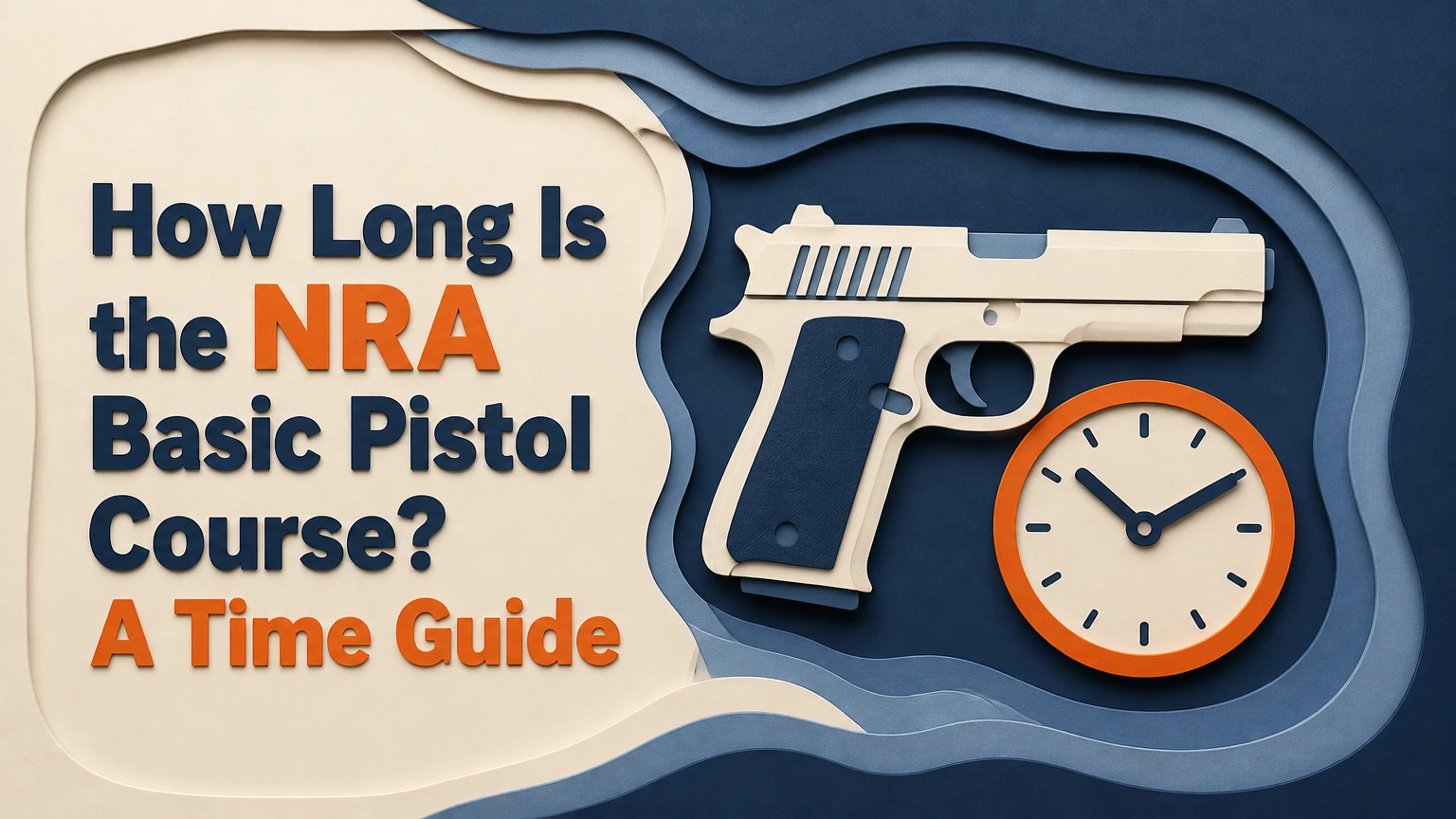
The NRA Basics of Pistol Shooting Course typically takes 8-10 hours in an instructor-led format and about 11-13 total hours in blended learning. Instructor-led classes usually combine classroom instruction and range practice in one day or two evenings, while blended courses add self-paced online study before the in-person session.
Key Facts at a Glance
- The instructor-led NRA Basics of Pistol Shooting Course typically requires 8-10 hours of scheduled instruction.
- The blended-learning version typically requires 11-13 hours total, including online study and an in-person range session.
- A one-day class may run beyond its advertised time because range access, demonstrations, testing, and student remediation vary.
- Tuition commonly falls between $100 and $150 for instructor-led classes, before ammunition, rental, and range charges.
- NRA FIRST Steps Pistol is a shorter orientation, typically about 3 hours, but it covers less material and may not satisfy a permit requirement.
- A course certificate does not automatically meet every state’s concealed-carry training standard.
How Long Is the NRA Basic Pistol Course in Each Format?
The NRA Basics of Pistol Shooting Course has two common delivery formats, and the format determines the timetable more than the shooting qualification does. Instructor-led training is usually 8-10 hours, while blended learning combines approximately 8-10 hours of online and in-person work with a total learner commitment of roughly 11-13 hours.
The exact schedule is controlled by the certified instructor, host range, class size, and state-specific requirements. A posted “one-day course” may include a 7:30 a.m. start, meal breaks, safety briefings, written testing, and a range session ending in the late afternoon or evening. Ask whether the advertised duration includes registration, breaks, range setup, and cleanup.
| Course format | Typical total time | Common schedule | Main time variable |
|---|---|---|---|
| Instructor-led only | 8-10 hours | One full day or two evenings | Range access and class size |
| Blended learning | 11-13 hours | Online phase plus scheduled workshop | Student pace and workshop availability |
| NRA FIRST Steps Pistol | About 3 hours | One short orientation session | Single-pistol focus and range procedures |
| Private instruction | 2-6 hours per session | Customized appointment | Student goals and remediation |
The NRA’s official course catalog and local instructor listing should control over older advertisements. Course names, digital platforms, and scheduling practices can change, so confirm the current format before paying.
Is the Instructor-Led Course One Full Day?
The instructor-led NRA pistol course is commonly completed in one full day, although many instructors divide the 8-10 hours across two evenings. A full-day schedule offers continuity, while an evening format reduces fatigue but may require a separate range appointment.
A typical one-day timetable might look like this:
| Course block | Typical duration | Content |
|---|---|---|
| Registration and safety orientation | 30-45 minutes | Administrative checks and universal firearm rules |
| Classroom instruction | 4-5 hours | Pistol operation, ammunition, storage, maintenance, and selection |
| Unloaded practical work | 1-2 hours | Grip, stance, sight alignment, and trigger-control practice |
| Live-fire range session | 2-3 hours | Supervised shooting and qualification |
| Written test and wrap-up | 30-60 minutes | Knowledge assessment, review, and certificate process |
The timetable is not a guarantee. A large beginner class may need additional time for safe loading procedures, pistol manipulation, individual coaching, and correcting unsafe habits. A small class can finish nearer the lower end of the range when the facility is ready and every student progresses safely.
Why can an advertised eight-hour class take longer?
An advertised eight-hour class can take nine or ten hours when the instructor includes setup, breaks, equipment fitting, written testing, and live-fire delays. Safety work should not be rushed to preserve a marketing schedule.
Common causes include:
- The range opens later than the classroom.
- Students need additional unloaded practice before handling live ammunition.
- The instructor must demonstrate both a revolver and a semi-automatic pistol.
- A lane becomes unavailable or a cease-fire interrupts the session.
- Students need remediation before attempting the qualification.
- Cleaning and safe-storage demonstrations take longer than expected.
A practical rule is to reserve an extra 60-90 minutes beyond the posted end time, particularly for a first-time student.
How Does Blended NRA Pistol Training Work?
Blended NRA pistol training normally places academic material in an online phase and hands-on instruction in a scheduled in-person phase. The full commitment is typically 11-13 hours because online lessons, quizzes, reading, login issues, and review time are added to the live workshop.
The online phase may cover safety rules, pistol components, ammunition, maintenance, storage, and selection. The in-person phase then concentrates on supervised manipulation, unloaded exercises, live-fire practice, qualification, and any required examination.
| Blended component | Typical time | Completed where | Student dependency |
|---|---|---|---|
| Online lessons | 6-8 hours | Home or another approved location | Self-paced progress |
| Online quizzes and review | 1-2 hours | Online portal | Passing module checks |
| In-person safety review | 1-2 hours | Classroom or range | Instructor verification |
| Practical and live-fire work | 2-3 hours | Approved firing range | Safe performance under supervision |
Blended learning is not automatically faster. It reduces classroom scheduling pressure, but a student who pauses frequently, repeats modules, or struggles with the portal may spend more time than the typical estimate.
What Does the NRA Basic Pistol Course Teach?
The NRA Basics of Pistol Shooting Course teaches safe handgun ownership, basic operation, foundational marksmanship, and responsible storage. The course is broader than a short pistol orientation because students commonly study both semi-automatic pistols and revolvers, along with ammunition identification and maintenance.
What happens in the classroom?
Classroom instruction typically takes 4-5 hours and establishes the knowledge required before live-fire practice. Topics include the NRA’s fundamental safety rules, handgun actions, ammunition components, loading and unloading procedures, storage, cleaning, and purchase considerations.
The NRA’s published safety guidance includes the rule, “Keep the gun pointed in a safe direction.” It also teaches keeping the trigger finger off the trigger until ready to shoot and keeping the firearm unloaded until ready to use. Students should treat every firearm as loaded and follow the range’s stricter commands when those rules differ in wording.
The course may use training aids, inert ammunition, and disabled firearms for demonstrations. Live ammunition should remain separate from classroom exercises unless the instructor specifically directs students to move it to the firing line.
What practical skills are practiced?
Practical exercises usually take 1-2 hours before live ammunition is introduced. Students practice a stable two-handed grip, a comfortable standing position, sight alignment, sight picture, trigger control, loading and unloading procedures, and basic pistol handling.
The instructor may demonstrate benchrest and standing positions, including commonly taught two-handed stances. The objective is safe, repeatable control rather than defensive movement, rapid shooting, or advanced tactical performance.
A student should be able to identify the pistol’s controls, keep the muzzle pointed safely, operate the action under instruction, and respond correctly to range commands before progressing. Competence matters more than completing a demonstration quickly.
How much range time is included?
The live-fire portion typically takes 2-3 hours, although range availability and student pace can change that figure. Students fire under direct instructor supervision while practicing fundamental marksmanship and completing the course’s qualification requirements.
Ammunition quantities are instructor-dependent. Many providers plan for approximately 100-200 rounds, but the exact count can change with the pistol type, repetitions, qualification design, and remedial practice. Buy only the cartridge specified for the firearm and confirm the quantity, bullet type, and range rules before arriving.
What Are the Course Tests and Qualification Requirements?
The NRA course commonly includes a written knowledge assessment and a practical shooting qualification, but the exact test administration belongs to the current course materials and certified instructor. Some providers describe a 50-question exam with a 90 percent passing threshold, while local permit rules may impose additional tests or documentation.
| Assessment | Typical requirement | What it measures | What can delay completion |
|---|---|---|---|
| Safety demonstration | Instructor verification | Safe muzzle, trigger, and loading habits | Repeated unsafe handling |
| Written examination | Often 50 questions | Rules, operation, ammunition, and storage | Failed or incomplete answers |
| Shooting qualification | Structured target exercise | Basic accuracy and firearm control | Poor grip, flinching, or unfamiliar pistol |
| Course paperwork | Instructor completion | Identity, attendance, and certificate records | Missing identification or forms |
The shooting qualification is not a defensive shooting test. It generally measures controlled basic marksmanship at specified distances and target sizes. Passing it does not prove that a person can safely carry, draw, move, make rapid decisions, or respond to a defensive encounter.
How Much Does NRA Basic Pistol Training Cost?
Typical tuition is about $100-$150 for instructor-led training, excluding several possible range expenses. Blended learning often adds an online fee, commonly around $60, plus an instructor or range fee that may add $50-$100.
| Expense | Typical amount | Usually paid to | Cost trigger |
|---|---|---|---|
| Instructor-led tuition | $100-$150 | Certified instructor | Course enrollment |
| Blended online phase | About $60 | NRA or approved platform | Digital registration |
| Blended in-person phase | $50-$100 | Instructor or range | Workshop attendance |
| Ammunition | $35-$100 | Retailer or range | Approximately 100-200 rounds |
| Pistol rental | $20-$50 | Range | Student does not bring a suitable pistol |
| Eye and ear protection | $10-$40 | Range or retailer | Student lacks required equipment |
Local ammunition prices, range policies, taxes, targets, insurance fees, and firearm rental rules can change the total. A realistic all-in budget is often $150-$300, but a student using a personal pistol and existing protective equipment may spend less.
Ask four pricing questions before booking: whether the handbook is included, whether range time is included, whether ammunition is included, and whether a rental pistol is available for the qualification.
Does the Course Qualify You for a CCW Permit?
The NRA Basics of Pistol Shooting Course may satisfy a state or local concealed-carry training requirement, but the certificate alone is not universally sufficient. Permit agencies can require a specific number of hours, a state-approved curriculum, live-fire documentation, fingerprints, legal instruction, or a particular instructor credential.
The course’s educational scope also differs from a state permit’s legal standard. For example, a jurisdiction may require instruction on use-of-force law, transportation, prohibited locations, or state-specific carry rules that are not fully covered in a general national course.
Before enrolling, check the issuing agency’s current website and ask the instructor for written confirmation that the exact course format is accepted. Do not rely on a range advertisement that says “CCW approved” without naming the state agency or rule.
Which Format Should a Beginner Choose?
A complete beginner will usually benefit more from instructor-led training because an instructor can observe every handling step in real time. Blended learning can work well for a disciplined student who can complete online material independently and has a confirmed appointment for supervised practical training.
| Student situation | Better starting option | Reason | Main caution |
|---|---|---|---|
| Never handled a handgun | Instructor-led | Immediate correction during every handling task | Reserve a full day |
| Needs a permit quickly | Whichever state accepts | Compliance matters more than convenience | Verify the exact format |
| Already owns a pistol | Blended or instructor-led | Existing familiarity can shorten explanations | Familiarity may hide unsafe habits |
| Needs help with anxiety or recoil | Small instructor-led class | More direct coaching and repetition | Ask about class size |
| Wants one-pistol orientation | FIRST Steps Pistol | Narrow equipment-specific introduction | Limited scope and permit value |
A current owner should not assume basic familiarity makes online learning equivalent to supervised coaching. Many unsafe habits are automatic and become visible only when the student loads, unloads, clears, or responds to a range command.
What Should You Bring to the Class?
Bring government identification, required eye and ear protection, a crew-neck shirt, long pants, and closed-toe shoes unless the instructor provides a different list. Transport the unloaded firearm and ammunition according to local law, the range’s policy, and the instructor’s written instructions.
Use this preparation checklist:
- Confirm the exact pistol caliber before purchasing ammunition.
- Ask whether the range permits outside ammunition.
- Bring only the number of magazines or speedloaders the instructor requests.
- Wear a baseball cap or brimmed hat to reduce contact with falling brass.
- Avoid low-cut shirts, loose necklines, sandals, and open footwear.
- Leave live ammunition outside the classroom unless directed otherwise.
- Bring water, food, and any required course confirmation.
- Tell the instructor about relevant physical limitations before practical work begins.
A student using a rental pistol should ask whether the range offers the same action type used in class. Switching between a semi-automatic pistol and a revolver during a qualification can add handling complexity for a novice.
What Problems Commonly Add Time?
The most common time-consuming problems are unfamiliar equipment, unsafe loading habits, ammunition mistakes, and flinching. Each problem requires additional supervised repetition because the instructor cannot safely move ahead while a student is uncertain about muzzle direction, trigger control, or the pistol’s operating cycle.
Ammunition mismatch
Ammunition must match the cartridge marking on the firearm and the instructor’s range requirements. A box that looks similar but carries a different cartridge designation should not be used; ask the instructor or range staff before opening it.
Flinching and anticipation
Flinching occurs when a student pushes, tightens, or closes the eyes before the shot breaks. The instructor may return the student to unloaded practice, use inert training aids, reduce the pace, and rebuild a smooth trigger press.
Confusing pistol actions
A revolver and a semi-automatic pistol have different controls, loading procedures, and malfunction responses. Learning both expands the course’s knowledge base, but a student who owns only one type may need extra time to distinguish the mechanisms.
Fatigue
A full-day firearms class combines concentration, standing, noise, and repeated safety decisions. Fatigue can reduce attention late in the range session, so instructors may schedule breaks or postpone a qualification rather than force an unsafe completion.
Range interruptions
Cease-fires, lane closures, weather, equipment failures, and facility rules can extend the session. These delays are outside the instructor’s control and explain why a posted eight-hour class should not be scheduled immediately before a flight, work shift, or other fixed appointment.
Is FIRST Steps Pistol a Shorter Alternative?
NRA FIRST Steps Pistol is typically about 3 hours and focuses on the safe operation and basic use of one specific pistol. It is a shorter orientation, not a complete substitute for the broader Basics of Pistol Shooting curriculum.
| Attribute | NRA Basics of Pistol Shooting | NRA FIRST Steps Pistol |
|---|---|---|
| Typical duration | 8-10 hours instructor-led | About 3 hours |
| Equipment scope | Revolvers and semi-automatic pistols | One specific pistol |
| Classroom depth | Safety, operation, ammunition, storage, maintenance | Basic orientation and operation |
| Permit usefulness | May be accepted in some jurisdictions | Often insufficient for full permit training |
| Best fit | New owners seeking broad fundamentals | Owners needing model-specific introduction |
FIRST Steps can be appropriate when a buyer wants a supervised orientation before handling one newly purchased pistol. It is not a shortcut to advanced defensive skills, and its shorter certificate should never be assumed to satisfy a concealed-carry agency.
What the Course Does Not Teach
The NRA Basics of Pistol Shooting Course is foundational safety and marksmanship training, not a complete defensive-carry program. It generally does not replace dedicated instruction in concealed drawing, movement, low-light decisions, defensive tactics, medical response, or state-specific use-of-force law.
The course also cannot determine whether a particular person is ready to carry daily. Readiness requires safe storage, lawful transport, regular practice, continuing education, and a clear understanding of local restrictions. A certificate records course completion; it does not guarantee skill retention.
This limitation matters because new owners sometimes treat qualification as an endpoint. A better progression is basic pistol training, supervised practice, dry-fire only when the firearm is verified unloaded and the environment is safe, then specialized defensive training from a qualified provider if lawful carry is the goal.
The Bottom Line on How Long Is the NRA Basic Pistol Course
The NRA Basics of Pistol Shooting Course takes about 8-10 hours in instructor-led training and approximately 11-13 hours in blended learning. Budget at least one additional hour for delays, and confirm whether tuition includes range fees, ammunition, firearm rental, testing, and the certificate.
Choose instructor-led training for maximum real-time supervision, blended learning for schedule flexibility, and FIRST Steps Pistol only when a short one-pistol orientation meets your actual objective. For a permit, verify the current state requirement before selecting any format.
Frequently Asked Questions
Can I finish the NRA pistol course in two evenings?
Many instructors divide the instructor-led course into two evening sessions, commonly splitting classroom instruction from practical and range work. The schedule is not standardized nationally, so ask whether both evenings include live-fire practice, testing, and qualification or whether the range session requires a separate appointment.
Do I need to own a pistol before enrolling?
You usually do not need to own a pistol because many ranges offer rentals, but policies differ by facility. Confirm the permitted firearm type, rental fee, ammunition rule, and whether a first-time renter must attend with another qualified adult, since some ranges restrict solo rental by inexperienced customers.
Can I fail the shooting qualification?
A student can fail to complete the qualification if accuracy or safe handling does not meet the instructor’s standard. Many instructors provide coaching and another attempt when time and ammunition allow, but no student should expect an automatic pass or treat the qualification as a casual formality.
Is online NRA pistol training enough by itself?
Online material alone is generally not enough for the practical portion of the NRA course because safe manipulation and live-fire qualification require in-person supervision. A blended course is complete only after the student finishes the online phase and attends the required instructor-led workshop.
How often should I retake basic pistol training?
There is no universal retake interval for basic pistol training, and state renewal rules may differ from NRA course policy. Retaking a class after acquiring a different handgun, experiencing a long gap in practice, or noticing unsafe handling can provide useful correction, while regular supervised practice maintains skills between courses.