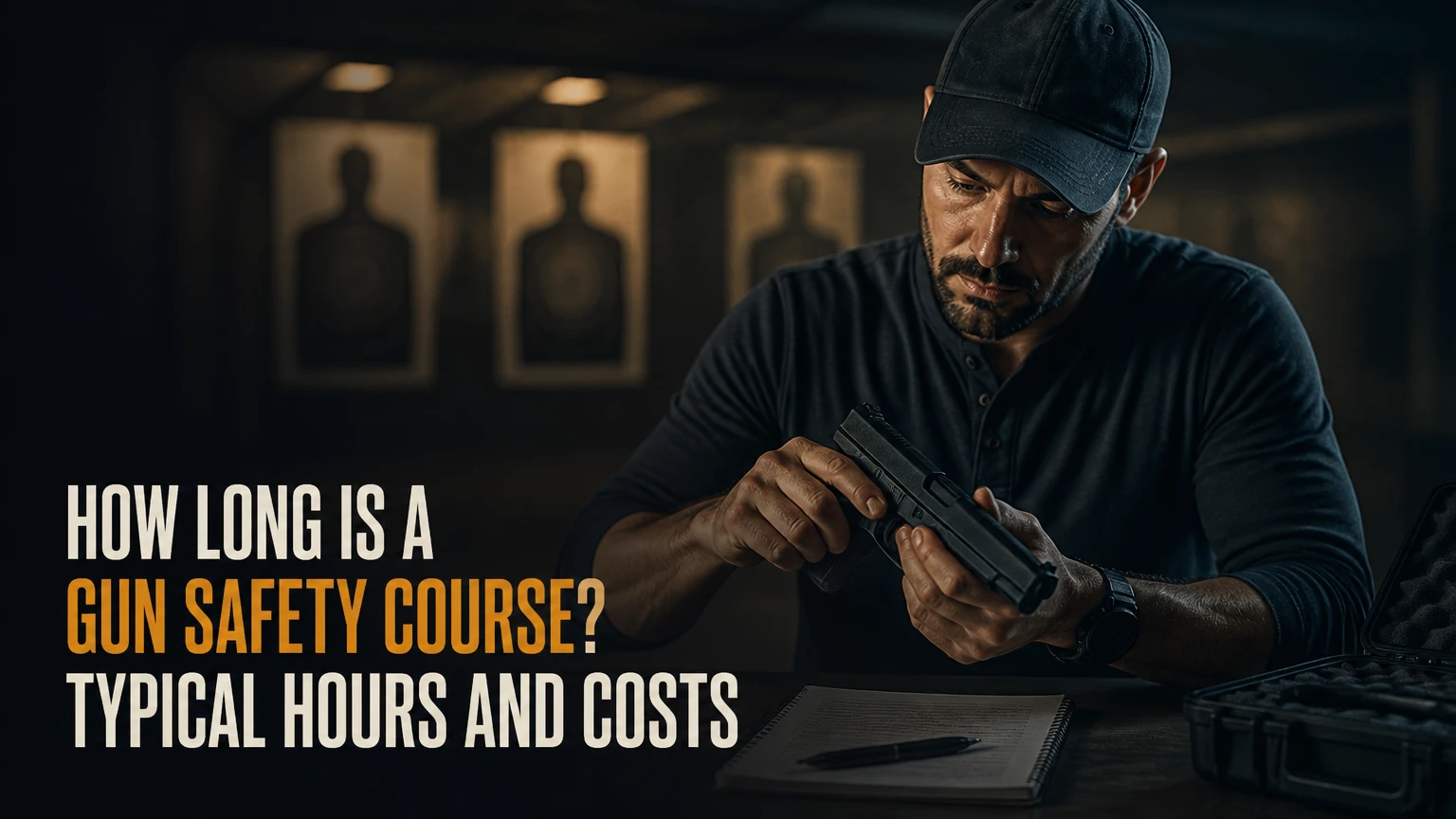
A gun safety course typically takes 3-8 hours in person, including classroom instruction, practical handling, testing, and sometimes live-fire range work. A short online refresher may take 1-3 hours, while state-required concealed-carry classes and advanced defensive courses commonly take 8-16 hours or more. State law determines whether that time satisfies a permit requirement.
Key Facts
A basic in-person firearm safety class usually requires 3-8 hours.
A live-fire qualification commonly adds 1-2 hours to classroom instruction.
Online firearm courses often take 1-3 hours but may not satisfy a permit or licensing rule.
Concealed-carry instruction commonly ranges from 4-16 hours, depending on the state.
Hunter education courses often require 8-12 hours, sometimes divided across multiple sessions.
Total cost can exceed tuition because ammunition, firearm rental, range fees, fingerprints, and permit charges may be separate.
How Long Is a Gun Safety Course?
A standard gun safety course takes about 4-6 hours when it combines classroom teaching, supervised handling, a written assessment, and basic range practice. A short introductory class may finish in 3 hours, while a course with a state-mandated qualification, multiple firearms, or extensive legal instruction may take 8-16 hours.
The advertised duration does not always equal time spent learning on the firing line. A four-hour class may include registration, safety demonstrations, breaks, a written test, and only 60-90 minutes of live fire. Conversely, an eight-hour course may use several hours for defensive law, storage planning, ammunition selection, and repeated supervised practice.
Course providers also schedule differently. Some teach the classroom and range portions on one day. Others separate them into two sessions because the range is at another location or because students need additional preparation before handling live ammunition.
Typical durations by course type
| Course type | Typical time | Live-fire time | Common purpose |
|---|---|---|---|
| Online safety overview | 1-3 hours | 0 hours | Rules, terminology, legal overview |
| Introductory firearm class | 3-4 hours | 0-1 hour | First supervised orientation |
| Basic pistol course | 6-8 hours | 1-3 hours | Handgun operation and fundamentals |
| Concealed-carry course | 4-16 hours | 0-4 hours | State permit application |
| Hunter education | 8-12 hours | 0-2 hours | Hunting-license education |
| Defensive skills course | 8-24 hours | 3-12 hours | Practice under changing scenarios |
The safest estimate is to reserve a full day for a first in-person class. Arriving with too little time creates pressure during the assessment and may leave no margin for a delayed range start, equipment problem, or required remediation.
What Happens During the Course?
A typical firearm safety class moves from rules and demonstrations to unloaded practice, supervised live fire, and assessment. Students normally learn safe direction, trigger-finger discipline, firearm condition checks, loading and unloading procedures, storage, transport, and basic operation before attempting a qualification.
A typical four-to-six-hour schedule
| Course segment | Typical duration | Main content | Student checkpoint |
|---|---|---|---|
| Check-in and briefing | 15-30 minutes | Identification, range rules, ammunition control | Student follows facility procedures |
| Safety rules | 30-45 minutes | Muzzle direction, trigger discipline, target awareness | Student explains the core rules |
| Firearm operation | 45-75 minutes | Parts, action types, loading, unloading | Student identifies firearm condition |
| Handling practice | 30-60 minutes | Grip, ready position, holster or case procedures | Student handles an unloaded trainer safely |
| Storage and maintenance | 20-40 minutes | Locks, safes, transport, cleaning | Student selects an appropriate storage plan |
| Live-fire practice | 60-120 minutes | Stance, sights, trigger control, coached drills | Student maintains safe control on the range |
| Test and certification | 20-45 minutes | Written test, practical check, paperwork | Student meets the provider’s standard |
Instructors often begin with disabled firearms, replicas, or “blue guns” so students can practice direction, grip, loading motions, and trigger-finger placement without live ammunition. That sequence matters because mechanical familiarity reduces unnecessary handling at the firing line.
A responsible class keeps live ammunition out of the classroom unless the instructor has a documented reason and controlled procedure. Students should follow the range’s specific commands rather than improvise from online videos or prior informal experience.
Does Firearm Type Change the Schedule?
Firearm type changes course length because handguns, rifles, and shotguns have different controls, loading methods, sighting systems, and safe-storage considerations. A single-firearm introductory class can finish in 3-4 hours, while a class covering several platforms usually needs 6-8 hours or multiple sessions.
| Firearm focus | Typical class length | Skills added | Common scheduling issue |
|---|---|---|---|
| Semi-automatic handgun | 4-8 hours | Magazine loading, slide operation, chamber checks | More time for holster and malfunction procedures |
| Revolver | 3-5 hours | Cylinder operation, loading, unloading | Different carry and reload concepts |
| Rimfire rifle | 3-5 hours | Stock position, manual safety, sight alignment | Usually simpler controls for beginners |
| Centerfire rifle | 4-8 hours | Cartridge handling, recoil management, optic use | Ammunition and range restrictions |
| Shotgun | 4-8 hours | Shell loading, action type, patterning | More time for stance and recoil adjustment |
| Mixed platforms | 6-12 hours | Cross-platform safety and operation | Students can confuse controls |
A handgun class often requires more deliberate handling practice because the firearm is compact, close to the body during storage or transport, and frequently associated with holster use. A rifle class may require more time for fit, stock placement, optic adjustment, and recoil management.
The firearm’s action also matters. A student who learns one semi-automatic pistol has not automatically demonstrated safe operation of a different pistol with another magazine release, manual safety, slide stop, or loading procedure. Training transfers at the level of safety principles, not every mechanical detail.
How Much Time Is Spent at the Range?
Live-fire range time usually lasts 1-2 hours in a basic class, although the student’s individual firing time may be shorter when several people share one instructor or lane. Qualification time depends on the course standard, ammunition supply, lane availability, weather, and whether students need additional coaching.
A range segment normally starts with a command review and dry practice. The instructor may then demonstrate loading, firing, unloading, cease-fire procedures, and recovery from a stoppage using the specific firearm. Students usually fire at short distances while the instructor monitors muzzle direction, trigger contact, grip, stance, and response to commands.
Range time is not a reliable measure of course quality. A two-hour range block with poor supervision can teach less than 45 minutes of closely coached practice. For a beginner, safe manipulation and consistent response to commands matter before accuracy scores.
Practitioner insight: The most common scheduling mistake is treating range time as a fixed appointment. A first class may lose 20-40 minutes to lane assignment, firearm rental, ammunition counting, or a range-wide cease fire, so students should reserve the provider’s entire stated block rather than planning a tight departure.
What Does a Written or Practical Test Add?
A written test usually adds 20-45 minutes, and a practical assessment can add another 10-30 minutes per student. Providers may test universal safety rules, firearm parts, safe storage, ammunition identification, legal responsibilities, and the correct loading and unloading sequence.
Passing standards are not universal. Many private providers use a 70-80% written-test threshold, but a state licensing agency may impose a different score, require a separate shooting qualification, or accept only certificates from approved instructors.
A practical test should evaluate safe behavior, not only marksmanship. Typical checkpoints include keeping the muzzle in a safe direction, keeping the trigger finger indexed, following commands, identifying whether the firearm is loaded, and safely securing the firearm after firing.
Certification paperwork can extend the end of class. Students may need to check their legal name, date of birth, instructor number, course approval code, or range qualification result before leaving. Errors can delay a permit application even when the training itself was completed.
How Long Does a Permit or Concealed-Carry Course Take?
A concealed-carry or firearms-permit course commonly takes 4-16 hours, but the legally accepted duration varies by state and sometimes by permit type. Some jurisdictions require classroom instruction, a live-fire qualification, or both, while others do not require a training course for every applicant.
The course can be longer than a basic safety class because it may cover concealed-carry equipment, prohibited locations, defensive-force law, interaction with law enforcement, transport, storage in a vehicle, alcohol-related restrictions, and the consequences of using force.
| Permit-course component | Typical duration | Why it may be required | Verification source |
|---|---|---|---|
| Firearm safety fundamentals | 1-3 hours | Safe operation and storage | State licensing agency |
| State firearms law | 1-4 hours | Carry restrictions and legal duties | State statute or agency |
| Defensive-force law | 1-4 hours | Justification and aftermath | Approved curriculum |
| Live-fire qualification | 1-4 hours | Demonstrated handling or accuracy | State-approved instructor |
| Application administration | 15-60 minutes | Certificate, fingerprints, photographs | Permit office |
A provider’s claim that a course is “valid everywhere” deserves scrutiny. Permit recognition, training approval, and reciprocity change by jurisdiction, and a certificate accepted in one state may have no legal effect in another. Check the current official licensing page before paying for a class.
Can an Online Course Replace In-Person Training?
An online firearm safety course can replace classroom instruction only when the relevant state, employer, range, or licensing agency explicitly accepts it. Online training cannot demonstrate safe muzzle control, trigger-finger placement, loading and unloading, recoil management, or live-fire competence.
Online learning is useful for terminology, universal safety principles, legal reading, storage planning, and preparation before attending a range. It also helps experienced owners complete a knowledge refresher without spending several hours in a classroom.
It is a poor substitute for a first-time shooter who has never held the relevant firearm. A video cannot identify that a student is sweeping a doorway with the muzzle, placing a finger inside the trigger guard, or failing to recognize an open action.
| Format | Typical time | Practical verification | Best use |
|---|---|---|---|
| Self-paced online module | 1-3 hours | Quiz only | Knowledge refresher |
| Live virtual class | 2-6 hours | Instructor questions | Classroom preparation |
| In-person classroom | 2-5 hours | Handling observation | Beginner instruction |
| In-person range class | 1-4 hours | Live-fire assessment | Qualification and coaching |
The safest sequence for a beginner is online preparation followed by in-person instruction with the actual firearm type. Online completion should never be presented as proof of competence unless the approving authority defines it that way.
What Does a Gun Safety Course Cost?
A basic gun safety course commonly costs $50-$150 in tuition, while a permit course often costs $75-$250 before ammunition, range fees, fingerprints, and government charges. Advanced defensive training can cost $200-$500 or more because it uses additional instructor time, ammunition, equipment, and range access.
| Course or expense | Typical price | Typical duration or quantity | Often included |
|---|---|---|---|
| Online safety class | $20-$50 | 1-3 hours | Digital instruction and quiz |
| Basic in-person class | $50-$150 | 3-8 hours | Classroom and certificate |
| Permit course | $75-$250 | 4-16 hours | Approved instruction |
| Ammunition | $25-$100 | 50-200 rounds | Usually separate |
| Firearm rental | $15-$50 | One range session | Usually separate |
| Range fee | $15-$40 | 1-3 hours | Lane access |
| Fingerprints or photographs | $15-$100 | One application | Government or vendor fee |
| Permit application | $30-$150 | Multi-year permit | State-specific |
Ask for an itemized price before booking. A class advertised at $75 may become $160 after a $40 range fee, $50 of ammunition, and a $15 firearm rental. Conversely, a higher-priced class may include a firearm, eye and ear protection, ammunition, range access, and the completion certificate.
Hunter education is often less expensive because state wildlife agencies or conservation programs subsidize it. The lower price does not mean it is a shortcut to concealed-carry approval. Its curriculum centers on hunting conduct, wildlife law, field safety, and firearm handling in hunting settings.
Which Course Fits Your Purpose?
The best course depends on the intended outcome: safe ownership, a permit application, hunting-license eligibility, or defensive skill development. A basic class is the correct starting point for a new owner, while an advanced course should follow demonstrated safe handling rather than replace it.
| Learner situation | Recommended course | Typical time | What to confirm |
|---|---|---|---|
| Never handled a firearm | Beginner in-person class | 4-8 hours | Firearm and ammunition availability |
| Buying a first handgun | Basic pistol course | 6-8 hours | Multiple handgun models if possible |
| Applying for a carry permit | State-approved permit course | 4-16 hours | Current state approval and range test |
| Seeking a hunting license | Hunter education | 8-12 hours | State wildlife agency recognition |
| Returning after years away | Refresher plus coached range session | 2-4 hours | Live handling, not quiz-only content |
| Experienced owner learning defense | Defensive skills course | 8-24 hours | Prerequisites and safety screening |
A person choosing a first handgun benefits from a class that supplies several rental options, because fit, controls, recoil, and grip reach cannot be evaluated from specifications alone. A home-defense learner should add secure storage, family access rules, emergency communication, and legal decision-making to basic operation.
A permit applicant should prioritize legal validity over the shortest schedule. A three-hour certificate is not useful if the state requires eight hours and a documented live-fire qualification.
What should a beginner bring?
Bring government identification if required, eye and ear protection, closed-toe shoes, water, a notebook, and the provider’s requested ammunition or firearm. Do not bring a loaded firearm or live ammunition into a classroom unless the instructor’s written policy specifically directs a safe transport procedure.
Call before the class if you have no firearm. Many providers supply a training pistol, rental firearm, ammunition, locks, or protective equipment, but those items may require advance reservation and additional payment.
Wear clothing that permits safe movement and does not interfere with hearing protection or eye protection. Avoid loose garments that can obstruct the instructor’s view of the hands or firearm.
What If You Feel Nervous or Inexperienced?
A nervous beginner should tell the instructor privately before the class begins and request slower demonstrations, extra unloaded practice, or a lane with fewer distractions. Anxiety is manageable when the instructor can adjust the pace, but a student should stop immediately if concentration or physical control deteriorates.
Good instructors use a staged progression: observe a demonstration, handle a disabled trainer, rehearse commands, and then fire under close supervision. Students should never hide confusion about whether a firearm is loaded, which direction is safe, or how to respond to a command.
Common student errors and corrections
- Finger enters the trigger guard early. Move the index finger straight along the frame until the sights are on target and the decision to fire has been made.
- Muzzle sweeps another person. Stop the movement, keep the firearm pointed in the safest available direction, and wait for instructor direction.
- Student turns with a firearm in hand. Freeze rather than rotate, then follow the instructor’s command for lowering or placing the firearm.
- Recoil causes flinching. Return to unloaded practice, confirm grip and stance, and use an instructor-approved lower-recoil training option.
- Student loses track of firearm condition. Stop handling and ask the instructor to verify whether the action is open and the chamber is clear.
- Noise or stress overwhelms attention. Pause at the firing line and notify the range officer; safety takes priority over completing the drill.
Practitioner insight: Never solve a confidence problem by increasing speed. A student who can perform a slow, repeatable unloading sequence safely is closer to useful competence than a student who fires quickly but loses muzzle and trigger control.
What Happens If You Fail or Miss Part of the Class?
If a student fails a written or practical assessment, the provider may offer coaching and a same-day retest, require a new appointment, or issue no certificate. The policy is controlled by the instructor, range, or approving state agency, so students should ask about remediation before enrollment.
A failed qualification does not automatically mean the student is unsafe forever. It identifies a gap that may involve firearm operation, range commands, accuracy, legal knowledge, or stress management. The correct response is targeted practice with an instructor, not unsupervised repetition.
Missing the live-fire portion creates a different problem from failing it. A provider may refuse to certify an incomplete course even if the classroom test was passed. Some programs allow the range portion on another date, while others require repeating the entire class.
What does a certificate prove?
A certificate generally proves that a named student completed a defined curriculum with a particular provider on a particular date. It may prove course completion, but it does not necessarily prove broad firearm competence, legal authorization to carry, or approval for every state.
Read the certificate for the course title, instructor credentials, approval number, training date, student identity, and practical qualification details. Keep the original and a secure digital copy if a permit application requires it.
How Should You Verify State Requirements?
Verify course duration and approval with the state agency that issues the permit, hunting license, or professional credential. A commercial training website can describe its class accurately while still being outdated, incorrectly interpreting a statute, or failing to meet a newly revised curriculum rule.
Use the agency’s current website or telephone number and confirm five points:
- Minimum classroom hours.
- Live-fire or shooting qualification requirements.
- Approved instructor or provider status.
- Certificate expiration or acceptable completion date.
- Whether online, out-of-state, military, or hunter education certificates qualify.
State law may also differ for residents, nonresidents, renewals, instructor licensing, and permitless-carry jurisdictions. “No training required to carry” does not mean training is unnecessary for safe ownership, and it may not eliminate separate rules for purchasing, transporting, or carrying in restricted locations.
The Safety Principles That Should Not Be Rushed
The core firearm safety rules should receive enough practice that the student can apply them under distraction. Colonel Jeff Cooper’s widely published formulation begins, “All guns are always loaded,” a deliberately conservative mental rule that prevents assumptions about an unfamiliar firearm’s condition.
Common safety frameworks also require keeping the muzzle pointed in a safe direction, keeping the trigger finger outside the trigger guard until ready to fire, and knowing the target and what lies beyond it. Different organizations phrase the rules differently, but the behavior is consistent.
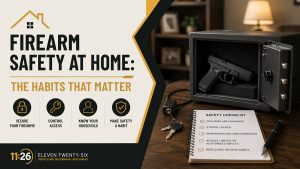
Safe storage requires more than owning a lock. The owner must decide who can access the firearm, how ammunition is controlled, how the firearm is transported, and what happens during a visitor’s stay, household crisis, or temporary absence.
Storage and transport topics
A complete beginner course should address cable locks, lockboxes, full-size safes, unloaded transport, vehicle storage, and unauthorized access. The appropriate solution depends on the household, local law, firearm type, and the time needed to access the firearm.
The Firearm Owners Protection Act includes federal transport provisions for certain interstate journeys, but state and local rules can impose additional requirements. Students should verify the laws of every jurisdiction along a route rather than relying on a general summary.
FAQ
Can you finish a gun safety course in one day?
Yes, many introductory and basic pistol courses finish in one day, usually within 4-8 hours. A one-day schedule may include classroom instruction, unloaded handling, live fire, testing, and certification. Permit courses with 12-16 required hours may use two days or several evening sessions instead.
How long is a gun safety course for a first-time owner?
A first-time owner should reserve 4-8 hours for a supervised in-person class and range session. The exact duration depends on firearm type, class size, and whether the provider supplies equipment. A short online quiz is not an equivalent substitute for observed handling practice.
Can I take a course without owning a firearm?
Yes, many instructors provide training firearms or offer rental equipment, although availability and fees vary. Confirm the exact firearm model or action type before booking, because learning a semi-automatic handgun does not fully prepare you to operate every other handgun safely.
Does a gun safety certificate expire?
A certificate may not have a universal expiration date, but a state permit office can impose a deadline for using it in an application. Renewal courses may also require recent training. Confirm the certificate’s acceptance period with the agency that will receive it.
Is hunter education the same as a basic firearm course?
Hunter education overlaps with firearm safety but is not identical to a general ownership or concealed-carry class. Hunter education commonly covers hunting ethics, wildlife regulations, field conduct, and firearm handling. A permit authority may accept it only if its rules specifically list hunter education as an approved credential.
How often should someone retake firearm safety training?
Retake formal instruction after a long period without practice, when learning a new firearm type, after a serious handling error, or before beginning defensive training. A short refresher every one to three years can reinforce storage, loading, unloading, and range-command habits, but practice should never replace current legal verification.
The Bottom Line
How long is a gun safety course? Plan on 3-8 hours for a standard in-person class, 1-3 hours for an online refresher, 4-16 hours for many permit courses, and 8-24 hours for advanced defensive training. The deciding factors are state approval, firearm type, live-fire requirements, class size, and the student’s prior experience.
For a first-time owner, choose supervised in-person instruction with practical handling and range coaching. For a permit applicant, verify the current state requirement before registering. For an experienced owner, use a refresher to reinforce safe habits, then select advanced training only after basic operation is reliable.