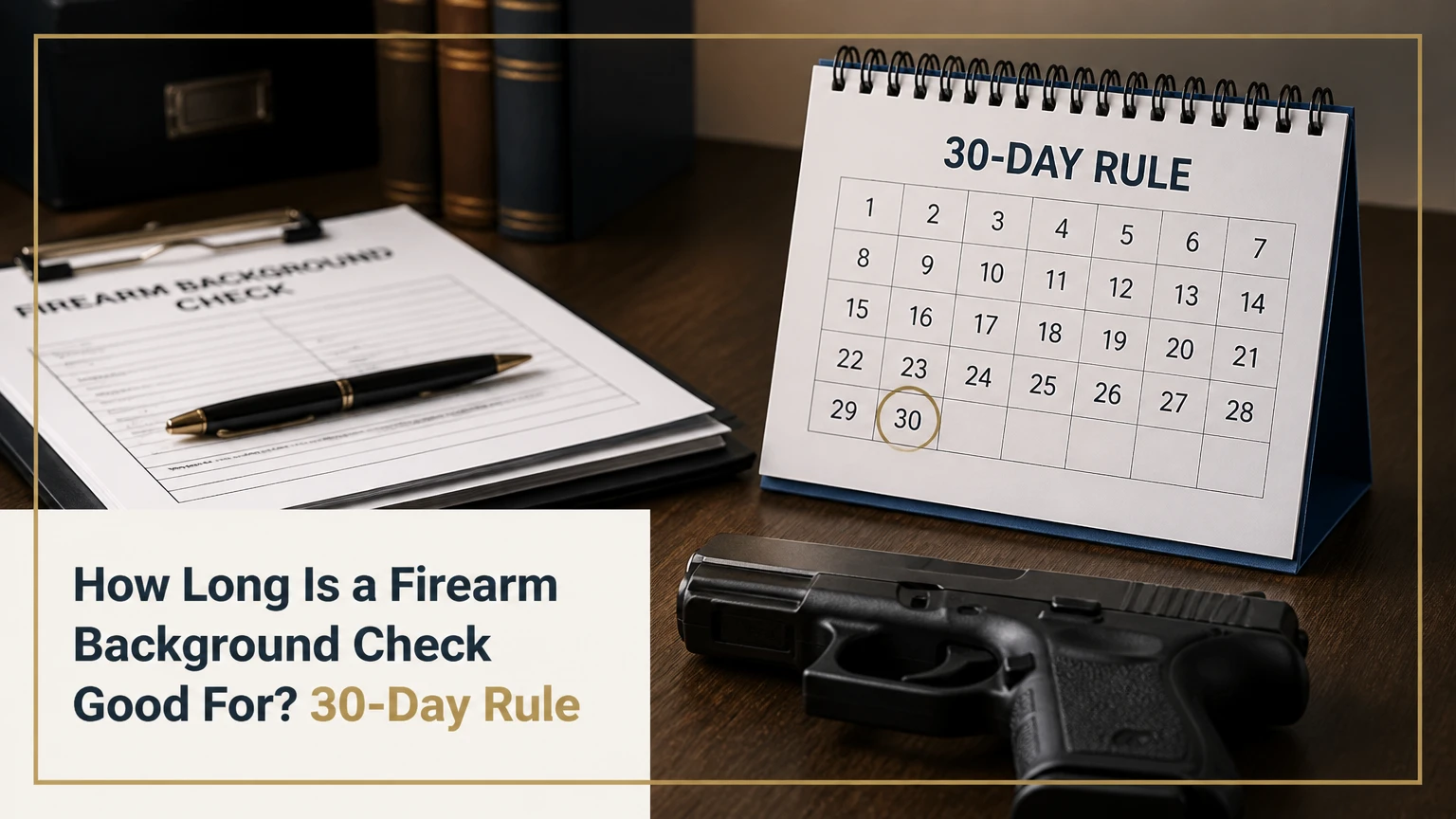
A federal point-of-sale firearm background check is generally valid for 30 calendar days from the date the dealer initiates the NICS inquiry, and only for the specific transaction recorded on ATF Form 4473. If the dealer does not transfer the firearm within that period, the check cannot be reused, so the dealer normally must complete a new Form 4473 and background check.
Key Facts at a Glance
- The federal NICS inquiry is generally usable for 30 calendar days from initiation.
- The 30-day period applies to one firearm transaction documented on one Form 4473.
- A delayed response does not create a new 30-day period when NICS later returns Proceed.
- A dealer may be permitted to transfer after a federal delay lasting three business days, but federal law does not require the dealer to do so.
- State waiting periods, permits, and Point of Contact procedures can impose stricter requirements.
- A qualifying concealed-carry permit may replace a point-of-sale NICS check, but the permit’s validity is not the same as NICS validity.
How Long Is a Firearm Background Check Good For?
The federal validity period is 30 calendar days, counted from the date the licensed dealer initiates the background-check inquiry. The check is tied to the transaction on Form 4473, so an approved inquiry is not a reusable purchaser credential for later purchases.
The Bureau of Alcohol, Tobacco, Firearms and Explosives states that a NICS check is valid for 30 days. In practice, the dealer must complete the transfer within that period unless a different lawful procedure applies, such as use of a qualifying permit or a separate state process.
The federal rule answers the central question, but state law can add a waiting period, permit requirement, or state approval step. A buyer should therefore treat 30 days as the federal outer validity period for the inquiry, not as a guarantee that every state permits pickup on day 30.
When Does the 30-Day Period Begin?
The clock begins when the dealer contacts the FBI NICS system or the applicable state Point of Contact agency, rather than when a background examiner later reaches a decision. A delayed transaction therefore does not receive 30 fresh days after a Proceed response.
For example, if a dealer initiates a check on June 1 and NICS returns Proceed on June 18, the remaining federal window is limited to the original 30-day period. A dealer’s software, state law, or internal compliance policy may require earlier action, so the dealer’s stated deadline controls the practical pickup decision.
Does One Check Cover Multiple Firearms?
One background check can cover multiple firearms when the firearms are transferred as one transaction and properly recorded on the same Form 4473. A separate purchase on another date, a new Form 4473, or a transaction that the dealer treats as separate generally requires another inquiry.
The distinction is transaction-based, not simply firearm-count-based. Two rifles transferred together may appear on one transaction, while a handgun picked up later may require a new form and new check even if the buyer passed yesterday.
What Does a Firearm Background Check Actually Check?
A firearm background check evaluates whether a prospective transferee is prohibited from receiving or possessing firearms under federal and applicable state law. The dealer submits identifying information from Form 4473, and NICS or a state agency compares it with criminal, warrant, protection-order, mental-health, immigration, and other disqualifying records.
Federal law requires a licensed dealer to contact the national system before transferring a firearm to a person who is not exempt under the statute. Section 922(t)(1) of Title 18 directs that, “the licensee shall contact the national instant criminal background check system.” The exact databases and workflow vary when a state operates its own Point of Contact agency.
Which Systems Supply the Records?
The FBI identifies three principal federal data sources used by NICS:
| System | Primary information | Example relevance |
|---|---|---|
| Interstate Identification Index | State and federal criminal-history records | Felony conviction or qualifying misdemeanor |
| National Crime Information Center | Warrants, protection orders, and wanted-person records | Qualifying restraining order or active warrant |
| NICS Index | Records specific to firearm prohibitions | Certain disqualifying mental-health adjudications |
| State databases | State criminal and court records | Local disposition or state prohibition |
NICS does not make every legal judgment from a name alone. Examiners compare identifiers such as date of birth, state, address, and physical descriptors, then seek a final disposition when a record may belong to the purchaser.
What Information Goes on Form 4473?
ATF Form 4473 records the buyer’s identity, residence, citizenship or immigration information, answers to prohibited-person questions, firearm details, and dealer certification. The purchaser signs under penalty of law, so an inaccurate answer can create consequences beyond a failed sale.
A valid government-issued photo identification document normally must establish identity and current residence. A dealer may accept supplemental documents in circumstances allowed by ATF rules, but a buyer should ask the dealer before arriving because state-issued identification practices differ.
What Do Proceed, Delayed, and Denied Mean?
A Proceed response means the federal system found no disqualifying record that prevents the transfer at that point. A Denied response means NICS or the state authority determined that the transfer may not proceed. A Delayed response means the agency needs more research and has not yet issued a final determination.
| Response | Legal meaning | Buyer consequence | Typical next event |
|---|---|---|---|
| Proceed | No current prohibiting record identified | Transfer may continue if other rules are satisfied | Dealer completes sale after waiting requirements |
| Delayed | Research remains incomplete | No automatic buyer entitlement to immediate transfer | NICS investigates or dealer follows state procedure |
| Denied | Transfer may not proceed | Dealer cannot complete the transaction | Buyer may request the denial reason or appeal |
| Canceled | Inquiry withdrawn or transaction changed | Original inquiry cannot complete the sale | Dealer may need a new inquiry |
A Proceed response is not a permanent finding that the buyer will always be eligible. It authorizes the dealer to proceed with the identified transaction under the applicable rules, while a later transaction requires its own compliance review.
Can a Dealer Transfer After Three Business Days?
Federal law may allow a dealer to transfer a firearm after NICS has delayed the check for three business days without a final denial, but the dealer is not required to make that transfer. State law may prohibit the transfer, and many dealers adopt policies requiring a Proceed response.
The three-business-day period is not the same as three calendar days. The relevant federal calculation excludes certain days, and state Point of Contact systems may apply different procedures. A dealer may wait longer when the law permits, when company policy requires it, or when the state has an independent waiting period.
Does a Delayed Check Stay Valid for 90 Days?
A delayed check does not become a 90-day transfer authorization. Some NICS transaction records may remain available for administrative follow-up for a period such as 90 days, but record retention does not extend the 30-day validity period for completing the identified transfer.
That distinction prevents a common mistake: a buyer may still have an open administrative record while the dealer can no longer use the original inquiry for a transfer after the 30-day window. The dealer must determine the correct next step under current ATF, FBI, and state instructions.
What Happens When the 30 Days Expire?
After the federal validity window expires without a completed transfer, the dealer normally must start a new transaction record and submit a new background-check inquiry. The buyer should not assume that the original Proceed response can be copied into a later sale.
A new inquiry can produce a different result because databases, warrants, court dispositions, addresses, or state rules may have changed. The dealer may also require a new identification document, updated Form 4473, or revised state paperwork.
How Do Multiple Purchases Affect Validity?
The following examples show why purchase scheduling matters:
| Situation | Form 4473 treatment | New check usually needed? | Practical result |
|---|---|---|---|
| Two firearms picked up together | One transaction lists both firearms | No, if dealer transfers together | One inquiry may support the combined transfer |
| Second firearm picked up next day | New or separate transaction | Yes | Dealer runs another inquiry |
| Firearm reserved but not transferred | Sale remains incomplete | No automatic extension | Dealer tracks the original deadline |
| Transfer delayed beyond day 30 | Original inquiry has expired | Yes | New paperwork and inquiry normally required |
The dealer’s records determine whether a later firearm is part of the same transaction. A buyer should ask before splitting a pickup, especially when a state waiting period or permit process is involved.
How Do State Rules Change the Federal Answer?
State law can make the practical deadline shorter or impose an additional condition even when the federal NICS inquiry remains within 30 days. States may operate a Point of Contact system, require a waiting period, mandate a permit to purchase, or regulate private transfers through an FFL.
The FBI publishes a list of states that use NICS directly and states that route checks through a state agency. In a state Point of Contact model, the state agency may conduct both federal and state searches, collect a state fee, and apply state-specific transfer rules.
| Requirement type | Federal baseline | State variation | Buyer should verify |
|---|---|---|---|
| Background check | Dealer contacts NICS unless exempt | State agency may process it | State police or attorney general guidance |
| Waiting period | No universal federal waiting period | Several states impose fixed periods | Earliest lawful pickup date |
| Purchase permit | Not required by federal law for every purchase | Some states require one for particular firearms | Permit issuance and expiration date |
| Private transfer | Federal rules apply to prohibited persons and interstate transfers | State may require dealer processing | Whether an FFL and check are mandatory |
| Permit exemption | Qualifying permit may substitute for NICS | State may impose separate purchase rules | Permit type, issuing state, and expiration |
A buyer in California, Colorado, Florida, Illinois, Maryland, New Jersey, Nevada, or another regulated state should not rely on a federal 30-day summary alone. The dealer is the operational source for the transaction, while the state agency or official statute is the authority for the legal requirement.
Is a Concealed-Carry Permit Good for Five Years of Purchases?
A concealed-carry permit is not a five-year firearm background check. A qualifying permit may exempt the dealer from a new point-of-sale NICS inquiry while the permit remains valid, but the permit’s duration, issuing authority, and eligibility-review system determine whether the exemption applies.
The ATF maintains a Brady permit chart identifying permits that qualify for the federal exemption. The chart can change as state permit systems change, and a permit that authorizes concealed carry is not automatically a qualifying NICS alternative.
| Document or process | Common validity range | Replaces federal NICS? | Important limitation |
|---|---|---|---|
| Standard NICS inquiry | 30 calendar days | Not applicable | One identified transaction |
| State purchase permit | 10 days to 1 year, typical range | Sometimes, under state law | Firearm type and state rules vary |
| Concealed-carry permit | 3-7 years, typical range | Only if ATF-qualified | Permit must be valid and acceptable |
| Firearm safety certificate | Often 1-5 years, where used | Usually no | May satisfy training, not NICS |
A permit can reduce point-of-sale delays, but it does not erase prohibited-person laws, waiting periods, dealer recordkeeping, or state transfer restrictions. The correct question is whether the specific permit qualifies for the specific transaction in the state where the dealer operates.
How Much Does a Background Check Cost and How Long Does It Take?
The federal government generally does not charge a consumer fee for a direct NICS inquiry, but dealers may charge a transfer or processing fee, and states may impose their own fee. A typical dealer processing charge is about $20-$50, while state fees commonly range from $10-$35, although actual amounts vary substantially.
Many uncomplicated checks return quickly, sometimes within minutes. A delay can last hours or several business days, and a state review or waiting period can extend the overall transaction to multiple days or weeks.
| Component | Typical amount or time | Who controls it | What it covers |
|---|---|---|---|
| Direct federal NICS fee | $0 | Federal system | NICS inquiry itself |
| Dealer transfer fee | $20-$50 | FFL | Receiving, records, and transfer work |
| State processing fee | $10-$35 | State agency | POC or state background-check processing |
| Immediate NICS response | Under 15 minutes, typical | FBI or state system | Straightforward automated result |
| State review | 1-15 days, typical | State agency | Manual records and state requirements |
These figures are planning ranges, not national prices. A dealer may bundle fees, and a state may prohibit or regulate certain charges.
What Should You Do If the Check Is Delayed or Denied?
A buyer with a delayed or denied transaction should obtain the transaction details from the dealer, verify that Form 4473 information is accurate, and use the FBI NICS appeal process when the result appears to involve mistaken identity or an incomplete record. The buyer should not attempt a second purchase to evade a denial.
The dealer can identify the NICS Transaction Number, or NTN, and explain whether the response came from the FBI or a state agency. The FBI provides appeal instructions and allows eligible applicants to seek a Unique Personal Identification Number through the Voluntary Appeal File.
Steps for Resolving a Problem
- Ask the dealer for the current status. Confirm Proceed, Delayed, Denied, or another state-specific response.
- Check the submitted information. Compare spelling, birth date, residence, citizenship information, and government identification.
- Request the NTN or state transaction identifier. The number helps connect an appeal to the correct inquiry.
- File an FBI NICS appeal when applicable. Follow the FBI’s current identity and document requirements.
- Gather court dispositions. Certified records can resolve an incomplete conviction or dismissal record.
- Consider a UPIN for repeated false matches. A UPIN helps NICS distinguish the applicant from another person with similar identifiers.
A UPIN does not guarantee approval. It improves identity matching, but the applicant remains subject to every applicable prohibition.
What Are the Most Common Validity Mistakes?
The most expensive mistake is confusing approval with completed transfer. A Proceed response authorizes the dealer to continue, but the firearm still must be transferred within the applicable federal and state requirements.
Other recurring errors include:
- Counting from the Proceed date: The 30-day period relates to the inquiry date, not the day approval arrives.
- Treating a permit as universal: A concealed-carry permit qualifies only under the ATF and state rules that apply to that permit.
- Assuming three business days requires transfer: Federal law may permit a transfer, but the dealer can wait and state law can impose stricter limits.
- Splitting one purchase: Picking up firearms on different days may create separate transactions.
- Ignoring the state waiting period: A valid Proceed response does not cancel a state-mandated waiting period.
- Submitting inconsistent addresses: A current residence requirement can make an otherwise valid identification document insufficient.
A practical rule is to schedule pickup as soon as the dealer reports Proceed, then ask for the exact last lawful transfer date if circumstances prevent immediate collection. That approach avoids relying on calendar counting, dealer software, or assumptions about a state exception.
Can a Private Sale Use the Same 30-Day Rule?
The 30-day NICS rule does not turn every private sale into a federally identical dealer transaction. Federal law generally requires an FFL to conduct the check for a dealer transfer, while private transfers are governed by separate federal restrictions and state laws.
An interstate private transfer generally must go through an FFL in the recipient’s state, and the dealer then follows Form 4473 and background-check procedures. Intrastate private transfers may be subject to state universal-background-check laws, age rules, permit requirements, and waiting periods.
A buyer should use a licensed dealer when state law requires a check or when the transfer crosses state lines. The seller and buyer should not treat an old NICS result as transferable proof of eligibility.
FAQ
Can I Pick Up a Firearm on Day 30?
Usually, a dealer may complete the transfer on the final day of the applicable federal validity period if every other legal requirement is satisfied. State waiting periods, dealer policies, business hours, and the precise inquiry date can change the practical deadline, so confirm the date directly with the FFL.
Does NICS Keep My Background Check Forever?
The FBI retains NICS transaction information under specific administrative and legal rules, but retention does not mean the check remains reusable. A retained record, an NTN, and a valid authorization to transfer are different concepts.
Can a Dealer Reuse My Background Check for a New Gun?
A dealer may be able to use one inquiry for multiple firearms transferred together as one documented transaction. A new date, separate Form 4473, or separate pickup commonly requires a new inquiry, even when the buyer passed a previous check.
Why Has My Background Check Been Delayed for More Than Three Days?
A delay can result from a possible record match, missing court disposition, incomplete state data, or an identity issue. Three business days may create a federal option for the dealer, but it does not force NICS to issue a final response or require the dealer to transfer the firearm.
Does a UPIN Make a Background Check Instant?
A UPIN can reduce repeated false delays by helping NICS distinguish an applicant from another person with similar identifiers. It does not bypass the background check, guarantee a Proceed response, or override a valid federal or state prohibition.
What Is the Safest Way to Confirm My Deadline?
Ask the dealer for the date the inquiry was initiated, the response status, and the dealer’s final transfer date. Then confirm any waiting period, purchase permit expiration, or state Point of Contact requirement through the relevant state authority.
The Bottom Line
A federal firearm background check is generally good for 30 calendar days from the date the dealer initiates the inquiry, and the inquiry applies to one documented transaction rather than every future purchase. A delay does not restart the clock, a Proceed response does not bypass state law, and a qualifying carry permit is an exemption document rather than a five-year NICS check. For the exact deadline, confirm the initiation date and state requirements with the licensed dealer handling the transfer.