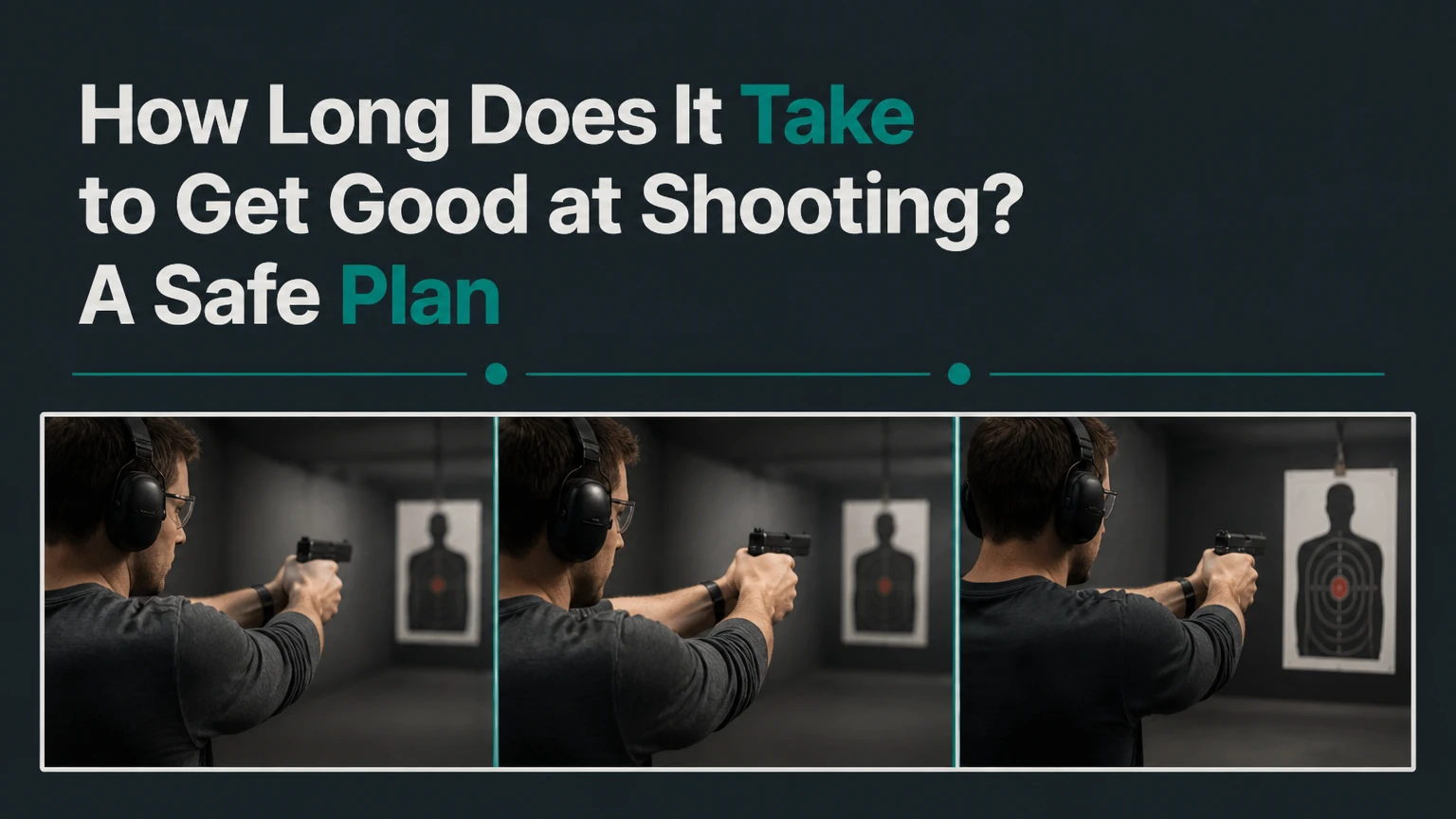
Getting good at shooting usually takes 3-6 months for basic recreational competence, 6-18 months for dependable performance, and several years for advanced competition or long-range skill. The timeline depends more on safe instruction, feedback, firearm fit, and consistent practice than on the number of rounds fired. “Good” must be defined for a specific discipline.
Key Facts at a Glance
A beginner can usually build safe handling and basic target consistency in 10-20 focused hours.
Recreational competence commonly requires 3-6 months of regular practice.
Practical handgun, shotgun, or carbine competence often takes 6-12 months.
Precision rifle performance develops more slowly because wind, ballistics, position, and distance add separate skills.
One coached session with measurable targets can produce more progress than several unstructured range visits.
Shooting skill declines when practice stops, so maintenance sessions matter after the initial learning period.
How Long Does It Take to Get Good at Shooting?
Most new shooters need about 3-6 months to become reliably competent at a recreational level when they receive qualified instruction and practice at least twice per month. A person who practices weekly with useful feedback may progress faster, while occasional, unsupervised shooting can leave basic errors unchanged for years.
A beginner’s first milestone is not a fast shot or a small group. It is safe firearm handling, consistent loading and unloading procedures, a stable position, controlled trigger movement, and the ability to place shots predictably on an appropriate target under calm conditions.
The word “good” changes by discipline. A clay target shooter measures broken targets, a precision rifle shooter measures repeatable groups and wind calls, and a handgun student may focus on safe presentation, accuracy, and decision-making under an instructor’s supervision. None of those standards transfers perfectly to another discipline.
A practical timeframe by practice volume
Calendar time hides the most important variable: quality repetitions. The following estimates are typical planning ranges, not guarantees.
| Practice pattern | Approximate yearly hours | Typical result after six months |
|---|---|---|
| One range visit monthly | 12-24 hours | Safe familiarity and inconsistent basic groups |
| Two coached or structured sessions monthly | 24-48 hours | Repeatable fundamentals at modest distances |
| Weekly structured practice | 50-100 hours | Recreational competence and measurable improvement |
| Two to four sessions weekly | 100-200 hours | Strong foundation, competition preparation, or advanced coaching needs |
A session should have a defined objective, such as confirming sight alignment, recording group size, or practicing a safe positional transition. Firing ammunition without recording results creates activity, not necessarily learning.
What Does “Good” Mean in Shooting?
Good marksmanship means producing safe, repeatable results under the conditions relevant to the shooter’s goal. Accuracy, consistency, firearm manipulation, judgment, and discipline-specific technique matter more than an isolated small group or a single fast time.
A useful standard has four parts:
- Safety: The shooter follows range commands, muzzle-direction rules, loading procedures, and storage requirements without prompting.
- Consistency: Groups and hit patterns remain reasonably similar across multiple strings rather than appearing once by chance.
- Control: The shooter maintains a stable position, manages the trigger smoothly, and avoids rushing after a miss.
- Adaptability: The shooter can apply the same fundamentals from a different supported position, distance, light level, or clay-target presentation when that situation is legally and safely supervised.
The National Rifle Association’s widely repeated first safety rule is, “Always keep the gun pointed in a safe direction.” That rule is more important than every speed or accuracy milestone in this article.
Competence is not the same as expertise
Competence means a shooter can perform a defined task safely and repeatedly. Expertise means the shooter can diagnose errors, adapt to changing conditions, coach others responsibly, and maintain performance under demanding but controlled conditions.
A person who shoots a tight group from a bench may still lack the skills needed for field positions. A fast competitor may not be prepared to teach beginners. A hunter who can hit a paper target may still need more practice judging ethical shot opportunities and field limitations.
What Is the Safest Learning Path?
The safest learning path is instruction first, fundamentals second, measurement third, and increased complexity last. Beginners should start with a certified instructor or reputable shooting club, use equipment that fits their body and purpose, and follow local laws and range rules before handling a firearm independently.
Step 1: Establish a safety baseline
Learn the firearm’s operating procedures from the owner’s manual and an instructor familiar with that model. Confirm local requirements for age, licensing, transport, storage, and range access.
A first lesson should cover safe direction, trigger-finger placement, loading and unloading, ammunition identification, hearing and eye protection, malfunction response, and what to do when uncertain. The success checkpoint is simple: the student can explain and perform the safety procedures without being rushed.
Step 2: Build a mechanical foundation
Practice a stable stance or supported position, a repeatable grip where appropriate, sight alignment, sight picture, breathing, and smooth trigger control. The instructor should correct one or two high-impact errors at a time rather than giving a beginner ten simultaneous adjustments.
Live-fire should begin at a distance and target size that allow the student to succeed without flinching. A target that is too difficult encourages anticipation, excess muscular tension, and hurried trigger movement.
Step 3: Measure performance
Record the firearm, ammunition, distance, target, group size or hit percentage, environmental conditions, and the session’s objective. A simple log reveals whether progress is real or whether a single unusually good group created false confidence.
Use repeatable tests. For example, a recreational rifle shooter might record five-shot groups from a supported position, while a clay shooter might record hits by target presentation. The test should remain stable long enough to show trends.
Step 4: Add complexity only after consistency
Increase distance, target difficulty, position changes, time limits, or environmental variation one factor at a time. Do not add speed, movement, darkness, or stress simultaneously for a beginner.
A qualified instructor should supervise any practice involving holsters, movement, unusual positions, or scenario-based training. Dry practice must follow the firearm manufacturer’s instructions and the range or instructor’s safety protocol, with live ammunition physically separated from the practice area.
Which Shooting Discipline Reaches Competence Fastest?
Clay-target shooting and basic recreational carbine or rimfire-rifle shooting often produce visible early progress within 3-6 months. Handgun shooting commonly takes longer to feel consistent because the shorter sight radius, smaller grip area, and greater sensitivity to trigger movement expose errors quickly.
| Discipline | Typical time to basic competence | Typical startup cost | Typical monthly practice cost | Useful beginner measure |
|---|---|---|---|---|
| Rimfire rifle | 1-3 months | $300-$900 | $30-$100 | Repeatable groups at 25-50 yards |
| Clay target shotgun | 3-6 months | $800-$2,500 | $100-$250 | 18-22 hits per 25 targets |
| Handgun target shooting | 3-9 months | $500-$1,500 | $75-$250 | Consistent groups at 5-10 yards |
| Precision centerfire rifle | 9-24 months | $2,000-$6,000 | $150-$500 | Repeatable groups with verified data |
| Action shooting competition | 6-18 months | $1,000-$3,500 | $150-$600 | Safe stage completion and scoring trend |
These figures are typical United States ranges and exclude travel, membership, taxes, and specialized coaching. Regional ammunition prices and range fees can change the total substantially.
Handgun shooting
Handgun competence usually requires careful attention to grip, trigger control, sight tracking, and recoil response. Small changes in finger placement or grip pressure can shift groups several inches at short distances.
New handgun shooters often improve rapidly during their first few lessons, then encounter a plateau caused by anticipation or inconsistent grip. Coaching, low-volume deliberate practice, and a firearm that fits the hand usually outperform buying a heavier trigger or a new sight system.
Any concealed-carry training should include applicable law, secure storage, conflict avoidance, judgment, and decision-making. A fast draw benchmark from a training advertisement is not a universal definition of readiness.
Rifle shooting
Rifle shooting often feels easier initially because the longer sighting system, shoulder support, and larger stock provide more stability. That advantage does not eliminate the need to learn natural point of aim, breathing control, trigger technique, zero confirmation, and safe loading procedures.
A rimfire rifle can provide economical practice at short distances. Centerfire rifles add ammunition cost, recoil, noise, trajectory, and environmental effects, which can slow learning if introduced before the fundamentals are stable.
Shotgun and clay targets
Clay shooting has a shorter early learning curve for some people because the activity supplies immediate visual feedback. The challenge is different from punching groups in paper because target speed, angle, lead, mounting technique, and visual focus interact continuously.
A beginner may break several targets during a lesson and still need months to perform consistently across stations. The most useful record is the hit percentage by target presentation, not the best single round.
Precision and long-range rifle
Long-range competence generally takes 9-24 months because the shooter must combine rifle fundamentals with ammunition consistency, zero management, range estimation, trajectory data, wind reading, position building, and environmental observation. A benchrest group does not prove field or match readiness.
The Precision Rifle Series is a competition framework, not a universal skill standard. Long-range shooters should verify ballistic data at known distances, learn from a qualified coach, and treat every unfamiliar target area as a safety problem before it becomes a marksmanship problem.
How Much Practice Is Enough?
A practical beginner schedule is one structured range session every one or two weeks, supported by short review sessions that comply with the firearm manual and local safety rules. Fifteen to thirty minutes of focused practice can help, but only when the practice is safe, technically correct, and followed by measurable feedback.
| Goal | Weekly practice pattern | Expected progress window | Main constraint |
|---|---|---|---|
| Safe recreational shooting | 30-60 minutes of structured practice | 3-6 months | Consistency and instruction |
| Clay target improvement | 1 lesson or round weekly | 3-6 months | Visual timing and repetition |
| Handgun fundamentals | 1 range session plus approved dry practice | 3-9 months | Grip and trigger control |
| Local competition | 2-4 structured sessions | 6-18 months | Coaching and match experience |
| Precision rifle | 1 technical session plus data review | 9-24 months | Wind, ammunition, and distance |
More ammunition is not automatically better. Fatigue changes grip, posture, visual focus, and judgment, so a shorter session with a clear stopping point can produce better learning than a long session in which the final rounds reinforce poor technique.
Why dry practice has limits
Dry practice can reinforce sight alignment, trigger movement, rifle position, or shotgun mount mechanics when performed with an unloaded firearm under strict controls. It cannot fully reproduce recoil, noise, projectile feedback, range communication, ammunition handling, or the consequences of a poor position.
Never assume a firearm is unloaded because a previous check occurred. Follow the manufacturer’s exact dry-practice instructions, remove all live ammunition from the room or practice area, inspect the firearm as directed, and stop if the procedure is unclear. An instructor should approve any dry-practice routine involving holsters or unusual handling.
What Does It Cost to Become Proficient?
A realistic beginner budget is about $600-$1,500 for basic handgun or rimfire equipment, $800-$2,500 for clay shooting, and $2,000-$6,000 for a precision-rifle setup. Instruction, range access, secure storage, hearing and eye protection, ammunition, targets, and transport often cost more than the firearm over the first year.
| Cost category | Typical one-time cost | Typical recurring cost | What changes the price |
|---|---|---|---|
| Qualified instruction | $100-$300 per lesson | $300-$1,500 yearly | Course length and region |
| Eye and hearing protection | $30-$180 | $20-$80 yearly | Electronic hearing protection |
| Secure storage | $40-$400 | $0-$100 yearly | Lockbox, cabinet, or safe |
| Range access | $0-$500 membership | $15-$40 per visit | Indoor versus outdoor facility |
| Ammunition and targets | $50-$300 initial supply | $50-$500 monthly | Caliber and practice volume |
| Equipment maintenance | $20-$150 initial kit | $20-$100 yearly | Firearm type and usage |
A beginner should budget for instruction and safe storage before accessories. A new optic, trigger, compensator, or specialized stock cannot correct unsafe handling or an inconsistent firing process.
What Slows Progress the Most?
The most common causes of slow progress are uncorrected technique, excessive difficulty, irregular practice, poor equipment fit, and fatigue. Beginners often blame ammunition or firearm accuracy when the larger problem is that the same error appears across every session.
Shooting without feedback
Repeatedly firing while ignoring group shape, target location, or instructor correction can stabilize a bad habit. Use a simple question after each string: what changed, what stayed constant, and what single adjustment will be tested next?
Anticipating recoil
Anticipation can move the firearm before the shot breaks, creating low groups or inconsistent impacts. A qualified instructor can use safe diagnostic exercises, including controlled dummy-round procedures when permitted by the range, manufacturer, and local rules. Never allow live ammunition to be mixed casually into an exercise.
Practicing beyond current ability
A target that is too small, a distance that is too long, or a time limit that is too short can turn practice into repeated failure. Reduce one variable until the shooter can perform the movement safely and accurately, then increase difficulty gradually.
Changing equipment too soon
Changing firearms, sights, ammunition, and grips at the same time destroys useful comparisons. Keep the setup stable while fundamentals develop, and change one variable only when a specific limitation has been demonstrated.
Ignoring firearm fit
Grip circumference, stock length, comb height, eye relief, recoil, and trigger reach affect control. A smaller or lighter firearm is not automatically easier for a beginner, because reduced weight can increase felt recoil and make sight movement more visible.
How Do You Know When You Are Improving?
Improvement appears as a stable trend across several sessions, not as one exceptional target. A useful training record contains at least the date, firearm, ammunition, distance, position, target, result, and one technical observation.
Track measures that match the discipline:
- Paper targets: group size, group location, and consistency across repeated groups.
- Clay targets: hit percentage by station and target presentation.
- Precision rifle: verified group size, zero consistency, position, wind conditions, and data quality.
- Competition: safe completion, penalties, accuracy, stage score, and whether errors repeat.
- General handling: safety procedures performed correctly without prompts or rushed decisions.
A shooter should seek coaching when progress stops for three or four structured sessions, when recoil produces persistent flinching, when vision interferes with sight focus, or when the shooter is uncertain about a safety procedure. A medical or vision professional may be appropriate for persistent visual difficulty, pain, or hand-strength limitations.
How Do You Retain Shooting Skill?
Shooting skill is perishable, so maintenance practice is necessary after a beginner reaches competence. A practical maintenance plan is one short review session every two to four weeks, with a longer supervised range session every one to three months depending on the discipline and legal responsibility involved.
Skill retention varies by task. Safety procedures may remain familiar, while fine trigger control, visual timing, and performance under pressure can deteriorate sooner. Someone preparing for a hunting season should confirm equipment, zero, position, and ethical shot limits well before the first hunt rather than relying on one last-minute visit.
| Maintenance frequency | Suitable use | Review focus | Limitation |
|---|---|---|---|
| Every 2 weeks | Active recreational shooting | Fundamentals and consistency | Requires a safe practice environment |
| Monthly | General skill retention | Basic groups or target hits | May not preserve advanced timing |
| Every 2-3 months | Infrequent hobby use | Instructor-led review and zero | Skill may feel rusty between sessions |
| Before hunting season | Field preparation | Position, equipment, and ethical limits | Does not replace year-round familiarity |
Can You Get Good With Occasional Practice?
Occasional practice can produce safe familiarity, but it rarely produces dependable advanced performance. A person who visits a range every two months may retain basic procedures while losing fine accuracy, visual timing, recoil tolerance, or confidence with unfamiliar positions.
The solution is not necessarily high-volume shooting. Short, safe, structured reviews can preserve fundamentals between range visits, while an instructor-led session can identify errors before they become habits. People with limited access should choose a simple measurable goal and avoid claiming proficiency beyond the conditions they have practiced.
Which Training Approach Fits Your Goal?
The best training approach is determined by the intended activity, available time, legal environment, and feedback quality. A recreational target shooter needs a different plan from a clay competitor, hunter, or person completing a lawful concealed-carry course.
Recreational target shooter
Plan on 3-6 months of twice-monthly practice to build basic consistency. Start with an easy-to-control firearm, use a qualified instructor, and prioritize safe handling and repeatable groups over distance.
Clay-target beginner
Expect visible improvement in 3-6 months with weekly or fortnightly practice. Instruction on mount, visual focus, and target presentation is usually more valuable than immediately buying a specialized shotgun.
Aspiring competitor
Allow 6-18 months to become comfortable and safe in local matches, with longer development toward strong classification results. Competition adds stage planning, equipment management, rules, time pressure, and mental recovery after errors.
Precision hunter
Plan for 9-24 months if the goal includes reliable field positions and varied distances. Practice should include supported and improvised positions, equipment checks, trajectory verification, weather observation, and conservative ethical limits.
Infrequent firearm owner
Prioritize a refresher lesson before independent use, safe storage, and a maintenance schedule every one to three months. Infrequent users should avoid interpreting basic familiarity as readiness for difficult or high-consequence situations.
The Bottom Line
How long does it take to get good at shooting? Most people need 3-6 months of regular, supervised practice for basic recreational competence and 6-18 months for dependable performance in a chosen discipline. Advanced competition, hunting, or long-range ability commonly takes several years because each adds judgment, environmental factors, and specialized feedback.
The fastest safe path is not maximum ammunition volume. It is qualified instruction, a firearm that fits, simple measurable goals, careful recordkeeping, and gradual increases in difficulty. Define “good” before choosing a timeframe, and continue periodic practice after reaching the first milestone.
Frequently Asked Questions
Is shooting hard to learn for a complete beginner?
Shooting fundamentals are learnable for most beginners, but safe handling must come before accuracy or speed. A qualified instructor can establish basic procedures during the first lesson, while consistent groups and recoil control usually require several weeks or months of structured practice.
How many rounds does it take to become proficient?
No universal round count predicts proficiency because ammunition quality, instruction, firearm fit, and feedback vary widely. A beginner may gain basic competence in 10-20 focused hours, but firing more rounds without correcting technique can reinforce errors rather than accelerate learning.
Is rifle shooting easier than handgun shooting?
Rifle shooting often feels easier initially because the shoulder stock and longer sighting system provide more stability. Handgun shooting exposes grip and trigger errors more clearly, although advanced rifle shooting becomes demanding when distance, wind, position, and ballistic variation enter the task.
Should beginners buy an expensive firearm?
Beginners usually benefit more from instruction, safe storage, protective equipment, and practice access than from premium firearm upgrades. A reliable, properly fitted firearm is generally a better starting point than an expensive model selected without testing fit, recoil, controls, and local support.
How often should a hunter practice before hunting season?
A hunter should begin several months before the season and practice often enough to confirm zero, equipment function, field positions, and personal ethical limits. A final supervised confirmation session close to the season is useful, but it should verify preparation rather than create it.
When should a shooter hire a coach?
Hire a coach at the beginning, after three or four stagnant sessions, or whenever a safety, vision, recoil, or equipment problem remains unclear. Qualified feedback can identify the cause of a recurring error faster than changing ammunition or buying accessories.