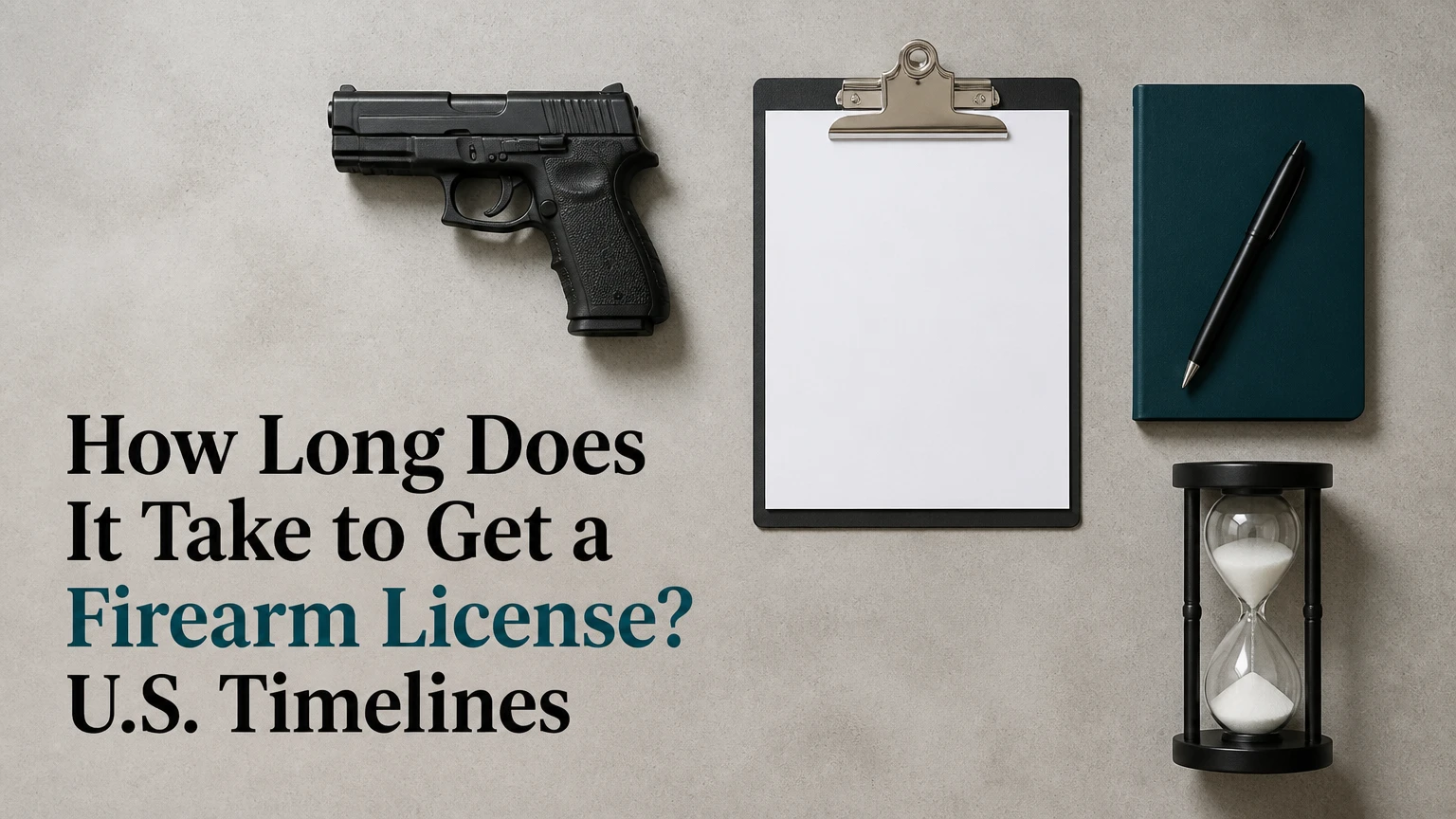
Getting a firearm license can take from the same day to more than six months, depending on the country, state or city, and credential involved. In the United States, a dealer’s purchase background check may clear in minutes, while a purchase card, concealed-carry permit, or Federal Firearms License commonly takes 30-90 days or longer.
Key Facts at a Glance
A firearm license timeline depends on the legal activity: purchasing, possessing, carrying, manufacturing, importing, or dealing.
A same-day NICS approval is a dealer-transfer decision, not a universal firearm license.
U.S. concealed-carry applications commonly take 30-90 days after complete submission, although statutory limits vary.
Restrictive municipal and international licensing systems can take 90-180 days or more.
A Federal Firearms License application has a 60-day statutory processing framework under federal law, but missing information can extend the practical timeline.
Training, fingerprints, records checks, and agency workload usually determine the elapsed time.
What Determines How Long a Firearm License Takes?
Jurisdiction, license type, applicant eligibility, and application completeness determine how long a firearm license takes. A state purchase card may take 30-45 days, a concealed-carry license may take 30-90 days, and a commercial FFL may use a 60-day federal framework, while local backlogs can extend any of those periods.
The phrase “firearm license” covers several legally different credentials. A permit to purchase authorizes a transaction or acquisition; a possession card may regulate ownership; a concealed-carry license authorizes a specific type of public carry; and an FFL authorizes a business activity regulated by the Bureau of Alcohol, Tobacco, Firearms and Explosives.
The first practical question is therefore not “How fast is the license?” It is “Which authority must approve which activity?” The answer changes when a person wants a handgun rather than a long gun, wants public carry rather than home possession, or applies as a business rather than an individual.
Purchase, Possession, and Carry Are Different
A purchase authorization, possession credential, and carry permit are separate legal concepts even when one document covers more than one activity. A person may be allowed to possess a firearm at home but still need a license to carry it concealed in public.
| Credential or decision | What it controls | Typical U.S. timing | Main authority |
|---|---|---|---|
| Dealer transfer approval | One purchase transaction | Minutes to several days | FBI NICS or state point of contact |
| Permit to purchase | Eligibility to acquire a firearm | 30-60 days | State police or local agency |
| Possession card | Possession or ownership eligibility | 30-90 days | State agency |
| Concealed-carry permit | Carrying a concealed handgun | 30-120 days | State or local licensing agency |
| Commercial FFL | Dealing, manufacturing, or importing | Up to 60 days statutory framework | ATF |
The distinction prevents a common mistake: assuming that a cleared background check creates a general license. A NICS transaction response normally addresses a particular dealer transfer. It does not automatically authorize concealed carry, replace a state permit, or establish that every firearm-related law has been satisfied.
How Long Does It Take to Get a Firearm License in the United States?
In the United States, an individual firearm credential usually takes 30-90 days, but the full range runs from same-day purchase approval to more than six months for restrictive local or international-style systems. The state, application category, statutory deadline, fingerprint quality, and background-check complexity determine the result.
The following figures are typical planning ranges, not guarantees. The controlling number is the deadline published in the statute, regulation, or application instructions for the issuing agency.
| Application type | Typical processing range | Typical applicant cost | Common delay source |
|---|---|---|---|
| Dealer purchase check | 5 minutes to 3 business days | $0-$50 state or dealer fee | Record match or state review |
| Maryland HQL-style purchase license | 30-60 days | $50-$150 including prints | Fingerprints or incomplete file |
| Illinois FOID card | 30-90 days or longer during backlog | About $10 statutory fee | State Police workload or records review |
| Standard concealed-carry permit | 30-90 days | $40-$300 plus training | Training, prints, local review |
| Restrictive city carry license | 90-180+ days | $400-$900+ in some systems | Interviews, references, local scrutiny |
| Commercial FFL | Up to 60 days under federal framework | $30-$3,000 per three-year period | Premises, zoning, or application defects |
A state may publish a shorter target while applicants experience a longer queue. Conversely, a complete electronic application with clean records can finish well before the maximum period. Applicants should record the submission date, not the date they began training, because agencies generally measure processing from a complete and accepted application.
Is a Firearm Purchase Approval Immediate?
A firearm purchase approval can be immediate when the dealer receives a “Proceed” response, but immediate approval is not the same as receiving a firearm license. The FBI explains that NICS checks can produce an immediate response, while delayed transactions require further research or may be governed by additional state waiting periods.
Federal law does not impose one universal waiting period for every U.S. purchase. State law may require a fixed waiting period, a permit before purchase, or review by a state police agency. A dealer may also follow a longer store policy or wait for a state response.
A “Delayed” response does not automatically mean denial. It means the system needs more time to resolve a possible record, identity match, or missing disposition. The dealer and the relevant point of contact can explain the applicable procedure. Never attempt to bypass a delay through a private transfer or another dealer without confirming that the alternative transaction is lawful.
How Long Does a Concealed-Carry Permit Take?
A concealed-carry permit commonly takes 30-90 days after a complete application, although restrictive jurisdictions may take 90-180 days or more. Required training, fingerprints, mental-health or criminal-record checks, interviews, and local agency workload create most of the variation.
For example, the Maryland State Police Wear and Carry application requires an application process that includes documentation and electronic fingerprints for relevant applicants. The exact requirements and processing rules can change, so the agency’s current instructions control rather than a private checklist.
Permitless carry also needs careful interpretation. A state may allow a qualifying adult to carry without a carry license while still requiring a permit to purchase, prohibiting possession by certain people, restricting locations, and imposing rules on loaded transport. “No permit required” describes one activity under defined conditions. It does not erase the rest of the firearms code.
What Is the Application Process?
A typical individual application involves eligibility screening, training where required, identity documents, fingerprints, payment, agency review, and issuance. Applicants who prepare every required item before filing usually avoid the longest preventable delay, because an incomplete submission may not enter the processing queue.
Step 1: Confirm the Exact Credential
Identify whether the application is for purchase, possession, concealed carry, open carry, employment, or a commercial FFL. Check residency, age, firearm category, reciprocity, renewal, and location rules on the issuing authority’s official website.
Do not rely on a neighboring state’s process. State statutes differ in waiting periods, training hours, fingerprint rules, application portals, and appeal deadlines.
Step 2: Check Eligibility and Gather Records
Review disqualifying categories before paying a nonrefundable fee. Depending on jurisdiction, the review may consider felony convictions, qualifying domestic-violence convictions, certain protective orders, unlawful controlled-substance use, adjudicated mental-health conditions, immigration status, age, and dishonorable military discharge.
Gather court dispositions for arrests or charges that ended without conviction. A dismissed charge may not prohibit ownership, but an inaccurate answer can create a separate problem. The application wording determines what must be disclosed.
Step 3: Complete Required Training
Required carry training commonly takes 4-16 hours and may include classroom instruction, legal responsibilities, safe handling, and a live-fire qualification. Some states accept only approved instructors or certificates issued within a defined validity period.
Training does not usually start the agency’s review clock. Applicants should complete the course early enough that the certificate remains valid when the application is filed.
Step 4: Obtain Fingerprints and Photographs
Use the fingerprint vendor or law-enforcement channel specified by the licensing authority. Electronic LiveScan prints often reduce mailing errors, but they do not guarantee a fast decision.
Poor ridge detail, incorrect ORI codes, wrong service categories, and mismatched names can force resubmission. Keep the receipt, transaction number, and date because those details help the agency locate a missing submission.
Step 5: Submit the Complete Application
Upload or mail the application, identification, proof of residency, training certificate, fingerprints, photographs, and fee exactly as instructed. Save a PDF of every page and a screenshot of the confirmation page.
The processing period often begins only after the agency accepts the file as complete. A payment confirmation proves that money was received, not necessarily that all required documents passed intake.
Step 6: Monitor the Review and Respond Promptly
Check the official portal or contact the licensing unit if the agency requests clarification. Answering a records question quickly can prevent a file from sitting in a correspondence queue.
Do not send repeated duplicate applications unless the agency tells you to do so. Duplicate files can create conflicting records and make status tracking harder.
Step 7: Receive, Verify, and Use the Credential
Inspect the issued card for name, birth date, expiration date, and restrictions. Confirm whether the credential authorizes purchase, possession, open carry, concealed carry, or only a narrower activity.
A license may arrive after the legal issuance decision, so mailing time can add several business days. Carry only after confirming that the permit is active and that the destination, firearm type, and method of carry comply with current law.
Which Firearm Credentials Are Fastest?
A dealer transaction check is generally the fastest route to a lawful purchase when no separate permit is required, while a commercial FFL and restrictive carry license require substantially more review. The fastest option depends on the activity, because a purchase check cannot substitute for a carry permit.
| Goal | Fastest lawful pathway where available | Time expectation | What it does not authorize |
|---|---|---|---|
| Buy from a licensed dealer | Complete dealer transfer check | Minutes to several days | Public carry in restricted states |
| Possess at home | State purchase or possession credential | 30-90 days | Carry outside the home |
| Carry concealed | State concealed-carry application | 30-120 days | Carry in prohibited locations |
| Deal firearms commercially | ATF FFL application | Up to 60 days framework | Personal exemption from state law |
| Collect qualifying antiques | Type 03 FFL, where eligible | Several weeks to 60 days | General retail dealing |
A Type 03 FFL is a collector’s license for curios and relics, not a shortcut for running a firearms business. The ATF application, federal eligibility rules, state restrictions, and recordkeeping duties still apply. A collector should confirm that each intended firearm qualifies before relying on that credential.
Does a Federal Firearms License Take 60 Days?
A commercial Federal Firearms License has a 60-day statutory processing framework under 18 U.S.C. § 923, but 60 days is not a guaranteed approval date. ATF reviews the application, conducts required compliance steps, and may need information about the premises, local zoning, business activity, or responsible persons.
The ATF Firearms and Ammunition Technology Division states in its licensing guidance, “The application process may take up to 60 days.” That federal estimate does not replace local requirements. A business applicant should verify zoning and licensing before submitting the federal application because a suitable federal application can still fail as a business plan if local authorities prohibit the proposed activity.
An FFL is also not an individual firearm ownership permit. It regulates commercial dealing, manufacturing, importing, or specified collecting activities. State and local laws may impose additional permits, inspections, storage rules, and tax obligations.
How Much Does a Firearm License Cost?
A firearm license commonly costs $40-$300 for an individual carry permit before training, fingerprinting, and photographs, while purchase credentials may cost $10-$150 and restrictive local licenses can exceed $400. Commercial FFL fees range from about $30 to $3,000 for a three-year federal license category.
| Cost item | Typical price range | When charged | Can it be avoided? |
|---|---|---|---|
| State application fee | $10-$300 | Initial filing or renewal | Usually no |
| Fingerprinting | $20-$100 | Before submission | Sometimes, if prints are reused |
| Safety or carry course | $50-$250 | Before filing | Only where training is optional |
| Photograph | $0-$25 | With application | Sometimes, with a free compliant photo |
| Dealer transfer fee | $20-$100 | At purchase | Only with a lawful alternative |
| Commercial FFL fee | $30-$3,000 per 3 years | Federal application | No, for the selected category |
The advertised application fee is rarely the full cost. A carry applicant should budget the fee, approved training, fingerprints, photographs, travel, and any required renewal expenses before starting.
Why Do Firearm License Applications Take Longer?
Firearm license applications take longer when an agency cannot verify identity, eligibility, training, residency, or required records without additional work. The most common preventable causes are incomplete forms, incorrect fingerprint submissions, undisclosed records, expired certificates, and applications filed with the wrong authority.
Common Delay Causes
- Incomplete documents: Missing proof of address, training records, photographs, or court dispositions can stop intake.
- Identity mismatches: Different names, dates of birth, or Social Security information can produce a manual review.
- Poor fingerprints: Rejected prints require a new appointment and may restart part of the verification process.
- Unresolved records: Arrests, protective orders, military records, and old dispositions can require agency-to-agency confirmation.
- Residency problems: A local permit office may reject an applicant who lives outside its jurisdiction.
- Agency backlog: A complete file can still wait behind statutory renewals, new applications, and staffing limits.
A counterintuitive rule matters here: supplying extra documents is not always faster. Unrequested material can obscure the required evidence, while the correct court disposition or certified record directly resolves the question the reviewer must answer.
What Should You Do if the Application Is Delayed?
If a firearm license application exceeds the published processing period, confirm that the agency marked the file complete, check the official status portal, and contact the licensing unit with the receipt number and submission date. Ask whether the delay is administrative, records-related, or awaiting applicant action.
Use the agency’s written status or appeal procedure rather than relying on an informal promise. Some jurisdictions impose a deadline for requesting review, filing an appeal, or seeking a hearing after a denial or constructive denial.
Do not assume silence equals approval. Unless the governing law expressly provides otherwise, carrying or acquiring a firearm before the license is issued can create a criminal or regulatory violation.
What Happens if a Firearm License Is Denied?
A denied firearm license normally requires the agency to provide a reason or appeal pathway, although the exact notice and deadline depend on jurisdiction. Read the denial carefully, obtain the underlying record where permitted, and correct factual errors before submitting an appeal or new application.
Typical denial issues include a disqualifying conviction, an active protective order, an incorrect response on the form, inadequate proof of training, failed residency verification, or unresolved identity data. A denial for a disqualifying condition is different from a denial caused by an incomplete file.
Applicants should not conceal an old arrest, expungement, dismissal, or treatment history when the form asks about it. The legally correct answer depends on the wording and jurisdiction. A firearms attorney can interpret ambiguous questions, especially when a record involves diversion, juvenile court, expungement, or domestic-violence allegations.
How Do U.S. Timelines Compare With Other Countries?
International firearm licensing commonly takes several weeks to many months and often requires a stated purpose, safe-storage evidence, club membership, references, interviews, or police investigation. Foreign licensing systems cannot be mapped directly onto U.S. purchase checks because they may authorize possession only after a broader suitability assessment.
| Jurisdiction or system | Credential example | Typical published or reported range | Distinct requirement |
|---|---|---|---|
| United Kingdom | Firearm or shotgun certificate | Several weeks to months | Police suitability review and secure storage |
| Canada | Possession and Acquisition Licence | Several weeks or longer | Safety course and references |
| Australia | State or territory firearms licence | Several weeks to months | Genuine reason and local approval |
| South Africa | Firearm licence per firearm | Several months is common | Competency certificate and motivation |
| Trinidad and Tobago | Firearm User’s Licence | Variable, often months | Police application and local requirements |
These are planning ranges, not guarantees. Canada’s Royal Canadian Mounted Police, UK police forces, Australian state agencies, and South African authorities publish the controlling requirements for their systems. An applicant moving between countries must also account for import permission, customs, and transport rules, which are separate from possession licensing.
What Can Applicants Do to Reduce Avoidable Delay?
Applicants can reduce avoidable delay by using the correct official form, checking eligibility first, completing approved training, submitting readable documents, and retaining every tracking number. No applicant can force a records search or legally bypass a statutory waiting period.
Use this pre-submission checklist:
- Confirm the issuing authority for the exact city, county, or state.
- Read the current instructions, including residency and age rules.
- Obtain required court, military, immigration, or name-change records.
- Complete training with an approved instructor.
- Schedule fingerprints using the agency’s required vendor or code.
- Check that the certificate and photograph meet date and format rules.
- Submit one complete application and save the confirmation.
- Calendar the statutory response date and appeal deadline.
- Contact the agency only through its published channel.
- Verify issuance before buying, possessing, or carrying.
The practitioner rule is simple: treat “complete application accepted” as day zero. Counting from the day a training course was booked produces misleading expectations and makes a normal intake delay look like agency inaction.
Frequently Asked Questions
Can I Buy a Firearm While Waiting for a Carry Permit?
You may be able to buy a firearm while waiting for a carry permit if your jurisdiction allows the purchase, you pass the required dealer check, and no separate purchase or possession credential is pending. A carry application does not automatically authorize acquisition. Confirm the purchase rules with the state agency and dealer before attempting the transaction.
Does a Clean Background Check Guarantee License Approval?
A clean dealer background check does not guarantee license approval. Licensing authorities may evaluate training, residency, fingerprints, mental-health disqualifiers defined by law, protective orders, local requirements, and application accuracy. A NICS “Proceed” response usually clears one transfer, while a license decision covers the broader legal requirements for the credential.
How Long Does Renewal Take Compared With a First Application?
Renewal may take less time than a first application when the agency can reuse identity data and the applicant files before expiration, but renewal backlogs can still exceed the original timeline. Some jurisdictions require fresh fingerprints, training, or a new background check. Submit early enough to avoid an expiration gap.
Can Moving to Another State Cancel a Firearm License?
Moving can cancel, invalidate, or restrict a firearm license because many credentials depend on residency or the issuing agency’s jurisdiction. Reciprocity also varies by destination and may exclude locations, firearm types, or carry methods. Update the issuing authority and check the destination state’s current law before transporting or carrying.
What Is the Fastest Legal Way to Get Permission to Carry?
The fastest legal carry route is the ordinary application in a jurisdiction that offers a clear, shall-issue process, accepts the required training, and has a short published review period. A purchase approval, permitless-carry rule, or nonresident permit cannot be treated as universal permission. Location-specific restrictions still apply.
Where Can I Find the Exact Processing Deadline?
The exact deadline appears in the current statute, regulation, application instructions, or official agency service standard for the issuing jurisdiction. Search the state police, attorney general, licensing bureau, or ATF website rather than relying on dealer estimates. Ask the agency when the complete-file clock started and what appeal process applies.
The Bottom Line
The answer to “how long does it take to get a firearm license” ranges from minutes for some dealer purchase checks to 30-120 days for many individual permits and more than six months in restrictive or international systems. Identify the exact activity, jurisdiction, and credential first, then use the official agency’s complete-application date and statutory deadline to plan accurately.