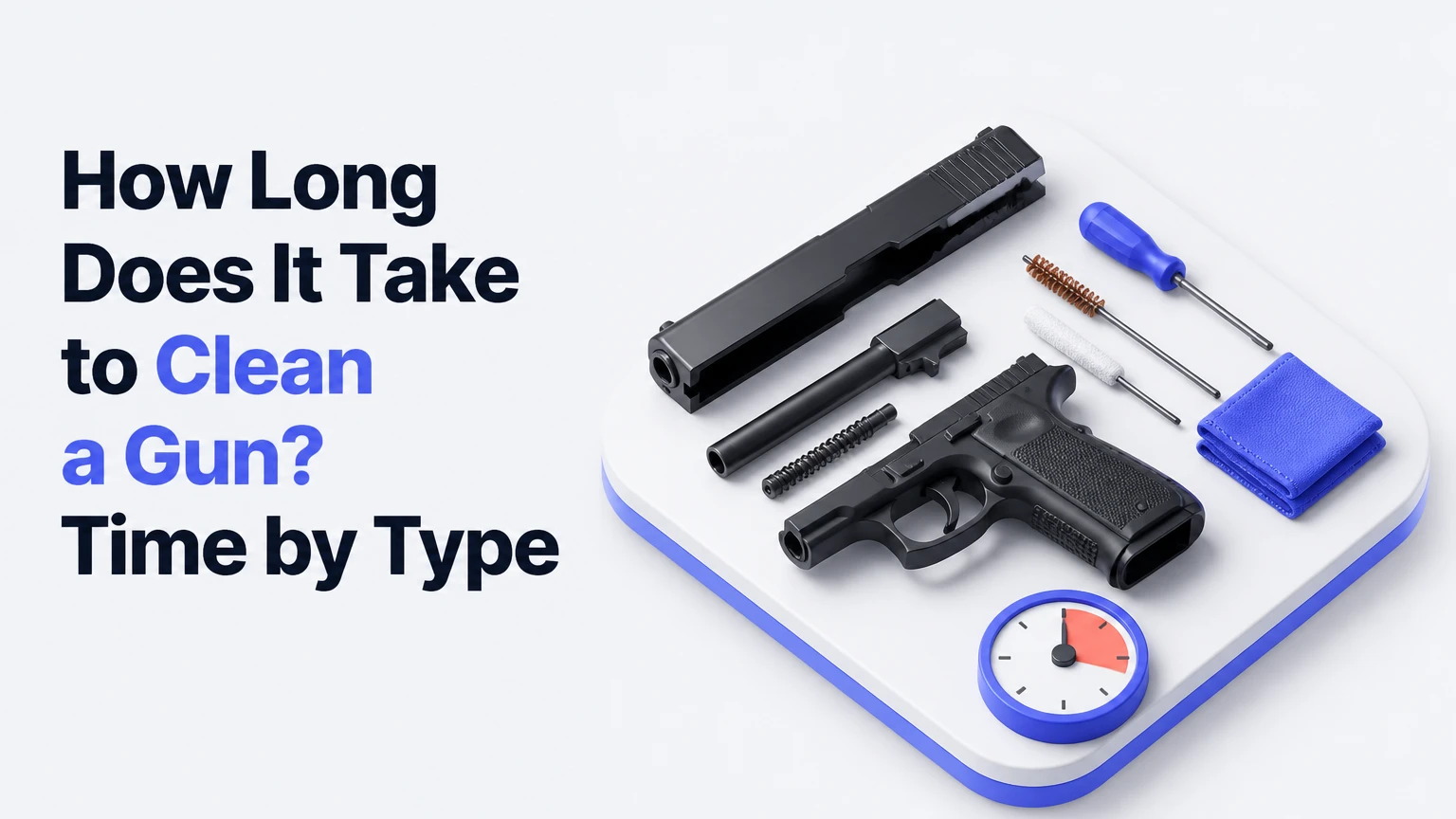
Cleaning a gun typically takes 10-30 minutes for routine field maintenance, 30-60 minutes for a thorough clean, and 60-90 minutes for heavy fouling, copper removal, rust treatment, or unfamiliar disassembly. The firearm’s action, condition, ammunition, cleaning method, and the owner’s experience determine the actual time.
Key Facts
A routine handgun cleaning usually takes 10-20 minutes after the firearm is confirmed unloaded.
An AR-15 or similar semiautomatic rifle commonly takes 20-40 minutes for field-level maintenance.
A two-minute bore-snake pass removes loose residue but does not replace a complete inspection and lubrication.
Deep carbon, copper, rust, or suppressor fouling can extend cleaning to 60-90 minutes or longer.
Manufacturer instructions control disassembly, solvent compatibility, lubrication points, and post-cleaning checks.
A gunsmith is the safer choice for seized components, unknown firearm condition, damaged parts, or internal detail work.
How Long Does It Take to Clean a Gun?
A typical gun-cleaning session takes 10-30 minutes when the firearm has ordinary powder residue and needs routine field maintenance. The shortest useful session may take 5-10 minutes for inspection and light wipe-down, while a first-time cleaning, deep fouling removal, or complete detail strip can take 60-90 minutes.
The timing begins after a safe work area is prepared and the firearm is unloaded. Searching for tools, reading an unfamiliar manual, or correcting a disassembly mistake can add 10-30 minutes, so experienced owners often finish faster than first-time cleaners even when they perform the same tasks.
| Cleaning level | Typical time | Typical condition | Result |
|---|---|---|---|
| Inspection and wipe-down | 5-10 minutes | Light handling residue | Exterior cleaned, bore visually checked |
| Routine field clean | 10-30 minutes | Normal range session | Bore, action, slide or bolt, and lubrication points serviced |
| Thorough cleaning | 30-60 minutes | Heavy powder or grime | More complete carbon removal and detailed inspection |
| Deep cleaning | 60-90 minutes | Copper, rust, baked carbon, suppressor residue | Extended solvent work or professional-level attention |
The quoted 10-90 minute range is a useful planning boundary, not a universal rule. A neglected rimfire rifle may exceed 90 minutes, while a lightly used revolver may need less than 15 minutes.
What Is the Safe Cleaning Sequence?
The safe cleaning sequence is unload, separate ammunition, verify the chamber and magazine area, consult the manual, field-strip only as authorized, clean from the correct direction, lubricate sparingly, reassemble, and perform a non-live function check. Safety takes priority over speed at every stage.
The NRA’s published firearm safety rule states, “Always keep the gun pointed in a safe direction.” The National Shooting Sports Foundation also emphasizes treating every firearm as loaded and keeping the finger outside the trigger guard until firing. Those rules apply during cleaning, even when the owner believes the firearm is empty.
Before You Start
Prepare a stable bench with adequate lighting and no ammunition on the work surface. Use the firearm’s owner’s manual for its exact unloading, field-stripping, and reassembly procedure.
| Preparation item | Typical requirement | Why it affects time |
|---|---|---|
| Work surface | 1 stable, well-lit bench | Prevents dropped springs and parts |
| Cleaning mat | 1 padded mat, typically $10-$40 | Keeps small components visible |
| Eye protection | 1 pair | Protects against solvent and spring tension |
| Nitrile gloves | 1 pair | Limits solvent and lead-residue contact |
| Owner’s manual | 1 firearm-specific manual | Prevents incorrect disassembly |
| Ammunition | 0 rounds on the bench | Removes a major safety hazard |
Remove the magazine, open the action, and inspect the chamber, magazine well, and feed area. Use a flashlight when the chamber is difficult to see. If the firearm has an unfamiliar design, stop at the manufacturer-approved field-strip level rather than improvising.
Step 1: Verify the Firearm Is Unloaded
Point the muzzle in a safe direction, remove the source of ammunition, open the action, and visually and physically inspect the chamber according to the manufacturer’s instructions. A cleaning session should not continue when the chamber, bore, or action cannot be confidently verified.
You will know this step is complete when the magazine or cylinder is empty, the chamber is open, and a second deliberate inspection finds no cartridge. The common mistake is checking only the magazine. A semiautomatic pistol, rifle, or shotgun can retain a chambered cartridge after the magazine is removed.
Step 2: Field-Strip Only to the Approved Level
Separate only the components identified in the owner’s manual for routine maintenance. A striker-fired pistol may allow slide, barrel, and recoil assembly removal, while a revolver often needs no routine internal disassembly.
You will know this step worked when each removed part has a documented position and no spring or pin was forced. The common mistake is treating a detail strip as ordinary cleaning. Internal timing parts, firing-pin assemblies, and small springs can require specialized tools and reassembly checks.
Step 3: Clean the Bore and Exterior Surfaces
Apply the manufacturer-compatible solvent to a patch or brush, pass it through the bore in the recommended direction, allow the solvent to work for the stated period, and follow with clean patches until residue decreases. Wipe exterior metal surfaces with a lightly treated cloth.
You will know the bore is acceptably clean when patches stop carrying substantial powder residue and the bore has no visible obstruction. The common mistake is scrubbing indefinitely for a mirror finish. Many firearms function safely without a visually perfect bore, and excessive brushing can damage a crown or finish.
Step 4: Clean the Action and Lubricate Lightly
Remove loose carbon and debris from accessible rails, locking surfaces, bolt areas, cylinder interfaces, and contact points with a nylon brush, cotton swab, or cloth. Apply only the lubricant quantity specified by the manufacturer, because oil that migrates into ammunition, primers, or a firing-pin channel creates problems.
You will know lubrication is adequate when moving contact surfaces have a thin film rather than visible pools. The common mistake is adding oil wherever metal appears. Excess lubricant attracts dust, softens fouling into abrasive paste, and can migrate into areas that should remain dry.
Step 5: Reassemble and Check Function Without Ammunition
Reassemble the firearm exactly as directed, confirm that controls move normally, and perform only the unloaded function checks specified in the manual. Keep ammunition away until the firearm has passed inspection and is being used at an appropriate range or storage location.
You will know the cleaning is complete when the action cycles normally, the bore is unobstructed, the safety or other controls behave as designed, and no part remains unexplained. The common mistake is forcing a component during reassembly. Stop immediately if the firearm does not fit together normally.
How Does Time Change by Firearm Type?
Firearm design changes cleaning time because the action contains different numbers of fouling-prone surfaces and removable parts. Revolvers often have a short exterior and bore routine, AR-15 rifles add a bolt carrier group, and rimfire firearms may produce unusually dirty residue despite their smaller size.
| Firearm type | Routine time | Thorough time | Main time driver |
|---|---|---|---|
| Striker-fired handgun | 10-20 minutes | 25-40 minutes | Slide rails, barrel locking surfaces, breech face |
| Revolver | 10-20 minutes | 30-45 minutes | Cylinder face, forcing cone, under-barrel area |
| AR-15 rifle | 20-40 minutes | 45-75 minutes | Bolt carrier group, chamber, carbon deposits |
| Bolt-action rifle | 15-30 minutes | 30-60 minutes | Bore length, bolt, precision bore care |
| .22 rimfire firearm | 15-30 minutes | 30-60 minutes | Fine powder residue and wax or lubricant buildup |
| Suppressed firearm | 25-50 minutes | 60-90 minutes | Increased backpressure and suppressor residue |
A striker-fired handgun usually has the shortest full routine because its field-stripped components are compact and accessible. An AR-15 takes longer when the owner cleans the bolt carrier group and chamber rather than merely pulling a patch through the bore.
A revolver can take longer than expected after extensive firing because residue accumulates on the cylinder face and around the forcing cone. A .22 rimfire can also need more attention than its size suggests, particularly when ammunition leaves wax or powder deposits.
When Does Cleaning Take 60-90 Minutes?
Cleaning reaches 60-90 minutes when the firearm needs repeated solvent cycles, copper removal, rust treatment, suppressor-residue work, or unfamiliar disassembly. Heavy fouling should be treated as a condition problem, not a reason to use excessive force or aggressive chemicals.
Copper fouling in a precision rifle bore may require a solvent dwell period and several inspection cycles. Carbon baked onto an AR-15 bolt carrier group can also extend the job, although scraping should remain limited to manufacturer-approved surfaces and tools.
An inherited firearm, a firearm exposed to saltwater, or a firearm with visible rust deserves a slower inspection. Do not assume that removing visible rust solves hidden pitting, weakened springs, damaged finishes, or unsafe headspace. A qualified gunsmith should assess questionable mechanical condition.
Is a Bore Snake Enough for Routine Cleaning?
A bore snake is enough for a quick post-range sweep when the firearm is lightly fouled and the owner also performs an exterior and chamber inspection. A bore snake is not a complete substitute for periodic field cleaning, lubrication, or inspection of the action.
A pull-through tool can remove loose residue quickly and reduce the chance that fouling sits in the bore between range visits. Its limitations include reduced control over solvent quantity, less effective removal of stubborn copper or carbon, and the possibility of dragging contaminated material through the bore repeatedly.
| Method | Typical time | Typical cost | Best use | Main limitation |
|---|---|---|---|---|
| Bore snake | 2-5 minutes | $15-$35 | Quick post-range pass | Limited deep-fouling removal |
| Rod and patch kit | 10-30 minutes | $25-$80 | Controlled routine cleaning | Slower setup and storage |
| Nylon brush and solvent | 15-40 minutes | $10-$35 supplies | Action and surface cleaning | Requires manual labor |
| Ultrasonic tank | 30-90 minutes total | $100-$500 equipment | Suitable removable metal parts | Not safe for every finish or assembly |
| Gunsmith service | 1-7 days typical turnaround | $50-$200+ | Rust, seized parts, detail work | More expensive than owner maintenance |
A practitioner rule of thumb is to use a bore snake as a maintenance interval tool, not as a repair tool. It cannot correct a blocked bore, remove every type of fouling, or reveal a cracked part.
Which Cleaning Method Is Fastest?
The fastest appropriate method is a bore snake for light post-range residue, while a rod-and-patch kit is faster and more controlled for routine complete cleaning. Ultrasonic cleaning can reduce hands-on labor, but setup, drying, compatibility checks, and lubrication still make the total process substantial.
Ultrasonic tanks are not universal shortcuts. Certain finishes, optics, polymers, adhesives, electronic components, and sealed assemblies may be damaged or contaminated by immersion. Follow the tank maker’s instructions and the firearm manufacturer’s warnings before placing any component in a cleaning solution.
Professional service is faster for a difficult or unfamiliar firearm when the alternative is forcing a part or losing reassembly time. The service price reflects inspection, specialized tools, liability, and the ability to identify mechanical defects.
How Often Should You Clean a Gun?
A gun should receive a basic inspection after every use and routine cleaning according to the manufacturer’s schedule, ammunition residue, storage humidity, and operating conditions. Round count alone does not determine the interval, because corrosive residue, rain, salt, and suppressor use can accelerate maintenance needs.
| User situation | Inspection timing | Routine cleaning timing | Additional attention |
|---|---|---|---|
| Defensive handgun | After every range session | Every range session or manufacturer interval | Monthly storage inspection |
| High-volume competition | During training changes | Same day or after each major session | Watch lubrication and carbon buildup |
| Precision rifle | After use and before storage | Based on accuracy and manufacturer guidance | Avoid unnecessary aggressive bore cleaning |
| Rimfire plinking | After every session | Every 200-500 rounds, typical | Check chamber and action residue |
| Wet or salty conditions | Immediately after exposure | Same day after drying | Inspect for corrosion within 24 hours |
Corrosive ammunition requires prompt residue treatment under the ammunition and firearm manufacturer’s instructions. Humid storage also changes the schedule, because surface rust can develop while a firearm appears clean.
Precision shooters should avoid assuming that more cleaning produces better accuracy. Excessive solvent, brushing, or incorrect rod contact can damage the crown or alter fouling conditions that a particular rifle consistently prefers.
What Does Cleaning Cost?
Owner-performed firearm cleaning typically costs $10-$80 in consumables and tools, while a gunsmith’s routine service commonly costs about $50-$200 or more. The final price depends on whether the firearm needs only a basic clean, detailed disassembly, rust treatment, or repair.
| Cleaning expense | Typical price | Replacement interval | Cost driver |
|---|---|---|---|
| Basic solvent and lubricant | $10-$25 | 1-3 years for occasional owners | Brand and container size |
| Patches, brushes, and swabs | $5-$20 | Several sessions | Caliber and cleaning frequency |
| Rod-based kit | $25-$80 | Several years | Materials and caliber adapters |
| Bore snake | $15-$35 | Replace when worn or contaminated | Caliber and construction |
| Ultrasonic cleaner | $100-$500 | Several years | Tank size and controls |
| Gunsmith routine cleaning | $50-$200 | Per service | Firearm condition and region |
A small handgun kit can support many routine sessions for less than the cost of one professional appointment. Professional service becomes economically sensible when incorrect disassembly could damage an expensive firearm or when rust and seized components require specialized work.
Why Does Cleaning Take Longer Than Expected?
Cleaning takes longer than expected when residue is baked on, the owner lacks a firearm-specific manual, parts are cleaned in the wrong sequence, or the firearm has been exposed to moisture or corrosive ammunition. Time also increases when the owner repeatedly redoes disassembly because the initial parts layout was not documented.
Common delays have specific remedies:
- A stuck patch: Stop pulling harder. Use the correct caliber tool, follow the manufacturer’s method, and seek gunsmith help if the patch cannot be removed without force.
- Excess oil: Wipe the firearm with a clean cloth and remove visible pools from the chamber, bore, and action areas.
- A lost spring or pin: Stop searching with the action partially assembled. Use a tray, mat, and diagram before continuing.
- A dirty chamber after bore cleaning: Use the appropriate chamber brush or method described by the manual, rather than forcing a bore brush into an incompatible area.
- Visible rust: Do not polish aggressively. Surface rust and structural pitting require different assessments.
- A damaged bore crown: Stop using a rigid rod that contacts the muzzle edge. Crown damage can affect accuracy and requires professional evaluation.
The most counterintuitive mistake is cleaning until every dark mark disappears. Dark discoloration can be normal finish wear, carbon staining, or harmless fouling, while a small crack, bulge, or obstruction may matter far more than appearance.
Can You Clean a Gun Without Disassembly?
You can perform limited maintenance without disassembly by inspecting the bore, wiping exterior surfaces, cleaning accessible residue, and using a manufacturer-approved pull-through tool. You cannot reliably inspect or lubricate every internal contact surface without the field stripping specified for that firearm.
This approach suits a lightly used firearm between complete cleaning sessions. It is unsuitable after immersion, heavy fouling, a malfunction, corrosive ammunition, or storage in damp conditions. A non-disassembly wipe also cannot verify hidden carbon buildup or a damaged internal component.
Never insert tools into an unknown firearm based only on a generic video. Manufacturer designs vary, and a procedure that is safe for one pistol or rifle may damage another.
When Should a Gunsmith Handle It?
A gunsmith should handle a firearm with seized parts, significant rust, unknown provenance, suspected damage, a blocked bore, broken components, or failed post-cleaning function checks. Professional evaluation is also appropriate when the owner lacks the tools or confidence to reassemble the firearm safely.
Do not fire a firearm that has a bulged barrel, obstruction, cracked component, unexplained resistance, or abnormal function. Cleaning cannot repair unsafe headspace, damaged locking surfaces, timing problems, or weakened structural metal.
The best stopping point is before force becomes necessary. A professional service may take longer on the calendar, but it reduces the risk of turning a routine cleaning task into a repair.
Cleaning Variations for Common Situations
New Firearm
A new firearm may contain packing grease, corrosion protection, or manufacturing residue that requires removal before use. Read the manual first, inspect the bore and chamber, and follow the maker’s preparation instructions; a new firearm commonly takes 15-30 minutes to prepare.
Suppressed Firearm
A suppressed firearm often accumulates more residue in the action because of increased backpressure. Allow 25-50 minutes for routine maintenance, and follow the suppressor manufacturer’s rules for disassembly, solvents, drying, and service intervals.
After Rain or Saltwater Exposure
A wet firearm requires immediate unloading, drying, inspection, and corrosion prevention. Do not store it wet in a case, and do not assume exterior drying has removed moisture from the action, bore, or recesses.
Corrosive Ammunition
Corrosive ammunition requires the cleaning response specified by the firearm and ammunition manufacturers, with particular attention to residue-prone surfaces. Clean promptly after use rather than relying on a long-term oil coating.
Frequently Asked Questions
Does cleaning a gun after every range trip matter?
Cleaning after every range trip is sensible for defensive handguns, rimfires, suppressed firearms, and firearms exposed to moisture or corrosive ammunition. A lightly used precision rifle may follow a different manufacturer or accuracy-based schedule. Inspection after every use remains useful even when a full cleaning is deferred.
How long should I wait after using solvent?
Wait for the dwell time printed on the solvent label, because formulations differ in required contact time and material compatibility. After solvent work, remove excess liquid, allow parts to dry as directed, and apply only the manufacturer-approved lubricant amount before reassembly.
Can over-cleaning damage a firearm?
Over-cleaning can damage a firearm when the owner uses excessive force, an abrasive tool, an incompatible solvent, or a cleaning rod that contacts the muzzle crown. Routine cleaning should remove harmful residue without repeatedly polishing finishes or scrubbing a bore beyond the manufacturer’s guidance.
Should I clean the bore from the muzzle or the chamber?
Clean from the chamber end when the firearm’s design and cleaning equipment allow it, because that approach reduces contact with the muzzle crown. Some firearms require a different method or use a pull-through tool, so the firearm manual controls the procedure.
How long does an AR-15 take to clean?
An AR-15 typically takes 20-40 minutes for routine field maintenance and 45-75 minutes when the bolt carrier group, chamber, and heavy carbon receive detailed attention. Suppressor use, high round counts, and extended firing sessions can increase the time substantially.
The Bottom Line
How long does it take to clean a gun? Plan on 10-30 minutes for routine maintenance, 30-60 minutes for a thorough session, and 60-90 minutes for heavy fouling, copper, rust, suppressor residue, or unfamiliar disassembly. The safest schedule follows the manufacturer’s manual and the firearm’s actual condition.
A bore snake can handle a quick light-residue pass, but it does not replace inspection, lubrication, or periodic field cleaning. Separate ammunition, verify the firearm is unloaded, stop when parts resist, and use a gunsmith for damage, rust, obstructions, seized components, or uncertain reassembly.