Firearm training takes about 2-4 hours for a basic safety introduction, 4-16 hours for many permit courses, 8-40 hours for structured skills training, and 100 or more hours for some professional programs. The correct duration depends on the learner’s goal, local law, firearm type, prior experience, instructor standards, and practice between lessons.
How long does a first firearm safety class take?
A first firearm safety class typically takes 2-4 hours, including classroom instruction, supervised handling, and sometimes a short live-fire session. A beginner who needs equipment orientation, accessibility accommodations, or additional coaching may need a private lesson lasting 3-6 hours instead.
A basic class normally covers the universal safety rules, firearm parts, ammunition identification, loading and unloading concepts, safe storage, transportation, range commands, and lawful ownership responsibilities. Some providers include 10-20 rounds of supervised shooting, while others remain entirely classroom-based.
The National Rifle Association’s published safety guidance states, “Always keep the gun pointed in a safe direction.” That rule is a practical screening test for every lesson: the instructor should repeatedly observe muzzle direction, trigger-finger position, and handling behavior rather than treating attendance as proof of competence.
A two-hour class is an introduction, not a complete defensive or occupational qualification. A student should leave knowing how to behave safely around firearms and where to obtain supervised practice, but should not assume that one short class creates reliable judgment under pressure.
What does firearm training include?
Firearm training combines cognitive instruction, supervised manipulation, and live-fire application. A complete beginner curriculum usually progresses from safety and law to equipment handling, then to controlled shooting, cleaning, storage, and a written or practical assessment.
Classroom instruction
The classroom portion establishes vocabulary and decisions before ammunition is introduced. Topics can include firearm actions, ammunition matching, basic ballistics, safe transport, child-access prevention, range etiquette, emergency procedures, and the legal limits of defensive force.
Legal instruction is location-specific. In the United States, state agencies may impose different rules for permits, minimum course hours, qualification standards, renewals, and recognized instructors. A national online certificate may therefore fail to satisfy a particular state or local requirement.
Dry practice and inert handling
Dry practice uses an unloaded firearm or approved training device without live ammunition. It can develop safe administrative habits and improve familiarity, but it must follow the instructor’s safety procedure, occur in a designated area, and remain physically separated from live ammunition.
Dummy rounds or inert training aids can help teach loading, unloading, inspection, and malfunction-recognition concepts under supervision. They do not reproduce recoil, blast, range distractions, or the consequences of poor muzzle control.
Supervised live fire
Live-fire instruction introduces noise, recoil, target confirmation, range commands, and ammunition management. The instructor should control the pace, verify the firing line is safe, and stop the exercise immediately when a student loses attention or cannot follow directions.
Training quality matters more than round count. A high-volume session can create fatigue and reinforce poor movement, grip, or trigger habits if the learner receives little feedback.
How long does training take for different goals?
Goal-based firearm training ranges from a single afternoon to a continuing professional development program. The table below separates typical course duration from the broader time required to become consistently competent.
| Training goal | Typical formal instruction | Typical total initial commitment | Typical listed tuition |
|---|---|---|---|
| Safety orientation | 2-4 hours | 2-6 hours | $50-$150 |
| New-owner fundamentals | 4-8 hours | 6-12 hours | $100-$300 |
| Permit or concealed-carry course | 4-16 hours | 8-24 hours | $75-$300 |
| Marksmanship or defensive fundamentals | 8-16 hours | 12-30 hours | $150-$500 |
| Competition preparation | 16-40 hours | 30-100+ hours | $400-$1,500+ |
| Law-enforcement or security academy | 100-300+ hours | Several weeks or months | Employer or academy-specific |
| Instructor development | 40-120+ hours | 60-200+ hours | $500-$3,000+ |
These are typical planning ranges, not universal requirements. A state may require a specific number of classroom hours, a live-fire qualification, a written test, or an approved instructor credential, while another jurisdiction may require none of those elements.
How long does permit or concealed-carry training take?
Permit-related training commonly takes 4-16 hours, but the legally required duration must come from the relevant state or local authority. Illinois, for example, has historically required a 16-hour concealed-carry curriculum, while other states have used shorter courses or no mandatory training for certain permit categories; rules can change.
The course fee is only one part of the schedule. Application paperwork, fingerprinting, background checks, qualification appointments, travel, and processing time can add days or weeks, even when classroom instruction takes one day.
A permit course may establish legal eligibility without establishing advanced defensive skill. Learners should check whether the curriculum includes holster handling, decision-making, storage, and conflict avoidance, then schedule separate supervised practice where lawful and appropriate.
How long does advanced or professional training take?
Advanced civilian courses commonly last 16-40 hours over 2-5 days. Professional pathways can exceed 100 hours because they combine firearms qualification with law, ethics, judgment, communication, first aid, reporting, physical conditioning, and agency procedures.
The term “tactical” does not identify a consistent standard. One provider may use it for an advanced range class, while an employer may require a documented academy, periodic qualification, and recurring in-service training.
Professional learners should ask for the governing standard. The hiring agency, licensing board, military branch, or security regulator determines whether a private certificate is accepted.
What is the total cost of firearm training?
Total first-year cost commonly falls between $200 and $1,500 for a civilian learner, depending on course level, ammunition, equipment, range fees, and travel. A basic class can cost $50-$150, but an advanced course may exceed $1,500 after ammunition and lodging are included.
| Cost category | Basic class | Permit course | Two-day skills course | Professional program |
|---|---|---|---|---|
| Tuition | $50-$150 | $75-$300 | $300-$1,500 | $500-$3,000+ |
| Ammunition | $0-$40 | $20-$80 | $100-$350 | $200-$1,000+ |
| Range fee | $0-$40 | $0-$50 | $30-$100 | $50-$300 |
| Eye and ear protection | $20-$60 | $20-$60 | $20-$100 | $30-$150 |
| Target and classroom materials | $5-$30 | $10-$50 | $15-$75 | $25-$200 |
| Travel or lodging | $0-$150 | $0-$250 | $0-$800 | $100-$2,000+ |
Ammunition estimates vary by curriculum and firearm. A short introductory session may use 10-20 rounds, a fundamentals class may use 100-300 rounds, and a high-volume multi-day course may require 300-800 rounds. The instructor or course notice should provide the exact requirement.
Private coaching usually costs more per hour than a group class, but one carefully chosen two-hour lesson can prevent several sessions of correcting unsafe or inefficient habits. Cost should therefore be compared against instructor attention, not tuition alone.
Which training format fits your situation?
Private lessons generally suit anxious beginners, people with accessibility needs, and students who need remediation. Group classes usually provide the lowest tuition and a predictable curriculum, while multi-day academies offer immersion at the highest time, ammunition, and travel cost.
| Format | Typical duration | Typical price | Best use |
|---|---|---|---|
| Group introduction | 2-4 hours | $50-$150 | First safety orientation |
| Private lesson | 1-3 hours | $75-$250 per hour | Personalized beginner coaching |
| Permit class | 4-16 hours | $75-$300 | Jurisdictional application |
| Weekend skills course | 16 hours | $300-$1,500 | Structured skill development |
| Multi-week coaching | 6-12 sessions | $600-$2,500 | Measured improvement |
| Professional academy | 100-300+ hours | $500-$3,000+ | Employment or licensing |
A group class is not automatically inferior. A qualified instructor with a small student-to-instructor ratio can provide safer oversight than a poorly designed private lesson.
What should you check before booking?
Verify the instructor’s credentials, insurance or facility authorization, class size, safety policy, equipment rules, curriculum, refund policy, and legal recognition. Ask how the instructor handles a student who cannot safely continue, because stopping unsafe practice is a mark of sound instruction.
Check whether the course is suitable for the specific firearm type. A rifle, shotgun, and handgun have different controls, recoil characteristics, storage considerations, and range requirements.
How long until a beginner is competent?
A beginner often needs 6-12 hours of supervised instruction plus several short practice sessions before basic handling becomes consistent. Competence is not a fixed number of hours: it means the learner can follow safety rules, operate the specific firearm correctly, recognize uncertainty, and stop when confused.
A practical readiness checklist includes these observable behaviors:
- Keeps the muzzle in a safe direction without repeated reminders.
- Keeps the trigger finger outside the trigger guard until instructed to fire.
- Identifies the correct ammunition and follows range commands.
- Loads, unloads, and stores the firearm according to the instructor’s procedure.
- Maintains attention despite noise, delay, and ordinary range distractions.
- States when help is needed instead of guessing.
Accuracy alone does not establish competence. A person can hit a stationary target while mishandling the firearm, ignoring commands, or failing to secure it afterward.
The counterintuitive practitioner rule is simple: stop a lesson before fatigue turns a safe learner into an unpredictable one. Short sessions of 60-120 minutes often produce better retention than a single exhausting day for a new shooter.
Can online training replace in-person instruction?
Online firearm education can supplement classroom learning, but it cannot replace supervised hands-on and live-fire instruction where those skills are required. Videos and online tests can explain laws, terminology, storage, and mechanical concepts, yet they cannot verify muzzle control, trigger-finger discipline, loading procedures, or recoil management.
An online course may satisfy a legal requirement only if the applicable authority explicitly recognizes it. A certificate from a private website does not automatically create a permit, authorization, or qualification.
Use online material to prepare questions and review safety concepts. Complete practical training at an authorized range with an instructor who can observe the firearm, student, environment, and ammunition together.
How often should firearm training be repeated?
A reasonable maintenance schedule is a supervised or structured practice session every 1-3 months, with a formal refresher at least annually for most civilian owners. Permit holders, armed professionals, and people who carry regularly may need more frequent qualification under employer, agency, or local rules.
| Learner profile | Suggested practice interval | Formal review | Reason |
|---|---|---|---|
| New owner | Every 2-4 weeks initially | After 3-6 months | Build safe handling habits |
| Occasional recreational shooter | Every 2-3 months | Annually | Prevent skill decay |
| Permit holder | Monthly or quarterly | Annually | Maintain lawful handling and judgment |
| Competitive shooter | Weekly or biweekly | Each season | Support match-specific skills |
| Armed professional | Agency schedule | Quarterly or annually | Meet policy and qualification rules |
Practice should include safe handling, storage decisions, equipment checks, and supervised shooting when possible. Dry practice is not a substitute for live fire, and live fire is not a substitute for legal or judgment training.
What mistakes make training take longer?
The most common time-wasting mistake is rushing to live ammunition before the learner understands safe handling. Instructors then spend later sessions correcting flinching, inconsistent grip, unsafe finger placement, or confusion about the firearm’s controls.
Other delays have predictable causes:
- Choosing excessive recoil: Discomfort can produce flinching and early fatigue. A qualified instructor should select an appropriate training platform.
- Using the wrong ammunition: Caliber and cartridge compatibility must be confirmed from the firearm and manufacturer guidance.
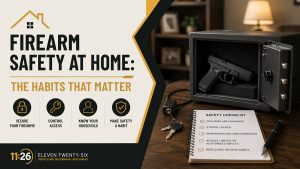
- Skipping storage planning: A learner may understand range handling but lack a safe, lawful home-storage procedure.
- Ignoring hearing or eye protection: Noise, blast, and poor vision reduce concentration and shorten useful practice time.
- Overloading the schedule: A first-time student may retain less after six continuous hours than after two focused lessons.
- Practicing without feedback: Repeating an unsafe or inefficient movement creates a correction problem rather than a skill gain.
A practitioner should never diagnose a handling problem by handing the learner more ammunition. First make the firearm safe, identify the source of confusion, and return to supervised fundamentals.
What should you do if the learner struggles?
Stop the exercise, make the firearm safe under the instructor’s direction, and identify whether the problem is knowledge, equipment fit, fatigue, anxiety, vision, hearing, or physical accessibility. Continuing through confusion increases risk and usually extends the total training time.
Common adjustments include reducing session length, changing the training firearm, adding inert-handling practice, using clearer demonstrations, increasing instructor attention, or scheduling a private lesson. A responsible instructor should not shame a student for pausing or declining a drill.
Low or inconsistent target hits can have many causes, including poor sight alignment, movement during the trigger press, an unsuitable grip, vision limitations, or equipment issues. The safe response is controlled diagnosis by a qualified instructor, not improvised corrections based on internet comments.
Firearm training is also unsuitable for a person who is impaired by alcohol, drugs, illness, extreme fatigue, or an acute mental-health crisis. Postpone the session and address safety first.
How do age, accessibility, and location change the schedule?
Age alone does not determine training time, but legal minimum ages, physical strength, vision, hearing, cognition, and emotional readiness can change the course design. A minor may require guardian consent or a specialized youth program, while an older adult may benefit from larger controls, shorter sessions, and additional hearing protection.
Location affects both law and logistics. Urban ranges may have limited lane time and higher fees, rural courses may require longer travel, and local fire restrictions or weather can cancel outdoor training.
Before enrollment, confirm:
- Minimum age and identification requirements
- State or provincial recognition of the instructor
- Whether the range permits the relevant firearm
- Required ammunition, targets, and protective equipment
- Accessibility for mobility, hearing, or vision needs
- Emergency procedures and instructor-to-student ratio
- Rescheduling rules for weather or illness
A course that technically lasts four hours may occupy a full day once travel, check-in, safety briefing, equipment setup, and administrative processing are included.
What course should you take first?
Most new owners should begin with a basic safety and orientation class, then take a fundamentals course before considering permit-related or advanced training. The exception is a legally mandated permit class that includes adequate beginner instruction, although an additional private lesson may still be sensible.
| Goal | First course | Next course | Approximate initial time |
|---|---|---|---|
| Home safety | 2-4 hour safety class | Private fundamentals lesson | 4-8 hours |
| Lawful carry | State-approved permit class | Supervised handling fundamentals | 8-24 hours |
| Recreation | Range orientation | Marksmanship fundamentals | 4-16 hours |
| Competition | Fundamentals class | Match-specific coaching | 16-40 hours |
| Security employment | Employer-approved academy | Agency qualification | 100-300+ hours |
Do not treat an advanced course as a shortcut around fundamentals. Dynamic environments add complexity, and the learner must already handle the firearm safely before adding movement, time pressure, low light, or other stressors.
What does a realistic training plan look like?
A realistic civilian plan usually begins with one 2-4 hour orientation, continues with one or two private or group fundamentals sessions, and adds short supervised practice over the next several months. The initial formal commitment is often 8-24 hours, while maintenance continues indefinitely.
For a home-safety learner, schedule a safety class, create a storage plan, and arrange a follow-up lesson focused on the specific firearm. For a permit applicant, confirm the state requirement first, then add practical instruction if the legal class does not provide enough hands-on time.
For a serious sport or defensive learner, plan 16-40 hours of formal training over several months rather than compressing every subject into one weekend. Professional learners should follow the employer or regulator’s written curriculum and qualification calendar.
The most useful measure is not “hours completed.” It is whether the learner can demonstrate safe, repeatable behavior and recognize when conditions exceed current training.
Frequently Asked Questions
Does a firearm safety certificate make someone proficient?
No. A certificate usually confirms course attendance, successful completion of a test, or compliance with a specific legal requirement. Proficiency requires observed handling, supervised practice, safe storage knowledge, sound judgment, and periodic reinforcement with the firearm the person actually uses.
Is a four-hour course enough to learn handgun skills?
A four-hour course can introduce handgun safety, controls, and basic supervised shooting. It is rarely enough for consistent proficiency, concealed handling, defensive decision-making, or reliable performance in stressful conditions. A beginner should ask the instructor what practical behaviors the course assesses before treating completion as readiness.
How many rounds are needed during beginner training?
A typical beginner session may use 10-50 rounds, while a fundamentals course may use 100-300 rounds. The correct quantity depends on the curriculum, firearm, range rules, learner fatigue, and instructor feedback. More ammunition cannot compensate for an unsafe environment or inadequate supervision.
Should someone buy a firearm before taking training?
Not necessarily. Many ranges and instructors provide suitable training firearms, allowing a beginner to learn safe handling before choosing equipment. If a person already owns one, the instructor should confirm its condition, ammunition compatibility, and suitability before live-fire practice begins.
Do firearm training requirements expire?
Course certificates, permits, and qualifications can have different validity periods. A permit may require renewal every few years, while an employer may require annual or quarterly qualification. The issuing state, licensing authority, or employer policy controls the deadline, so verify the current rule directly.
How long does firearm training take for a job?
Job-related firearm training commonly takes 100-300 or more hours when the curriculum includes law, judgment, first aid, communication, physical skills, reporting, and qualification. A short private shooting course may improve range ability but usually does not replace an employer’s academy or licensing requirements.
The Bottom Line
How long does firearm training take? Plan on 2-4 hours for a basic safety introduction, 4-16 hours for many permit courses, 8-40 hours for structured civilian skill development, and 100 or more hours for some professional pathways. The appropriate answer depends on local law, the learner’s goal, prior experience, equipment, instructor standards, and supervised practice.
A short course can establish safe foundations. It cannot guarantee lasting proficiency. Choose an authorized instructor, verify the legal requirement, budget for ammunition and follow-up practice, and judge readiness by observable safe behavior rather than by attendance or round count.