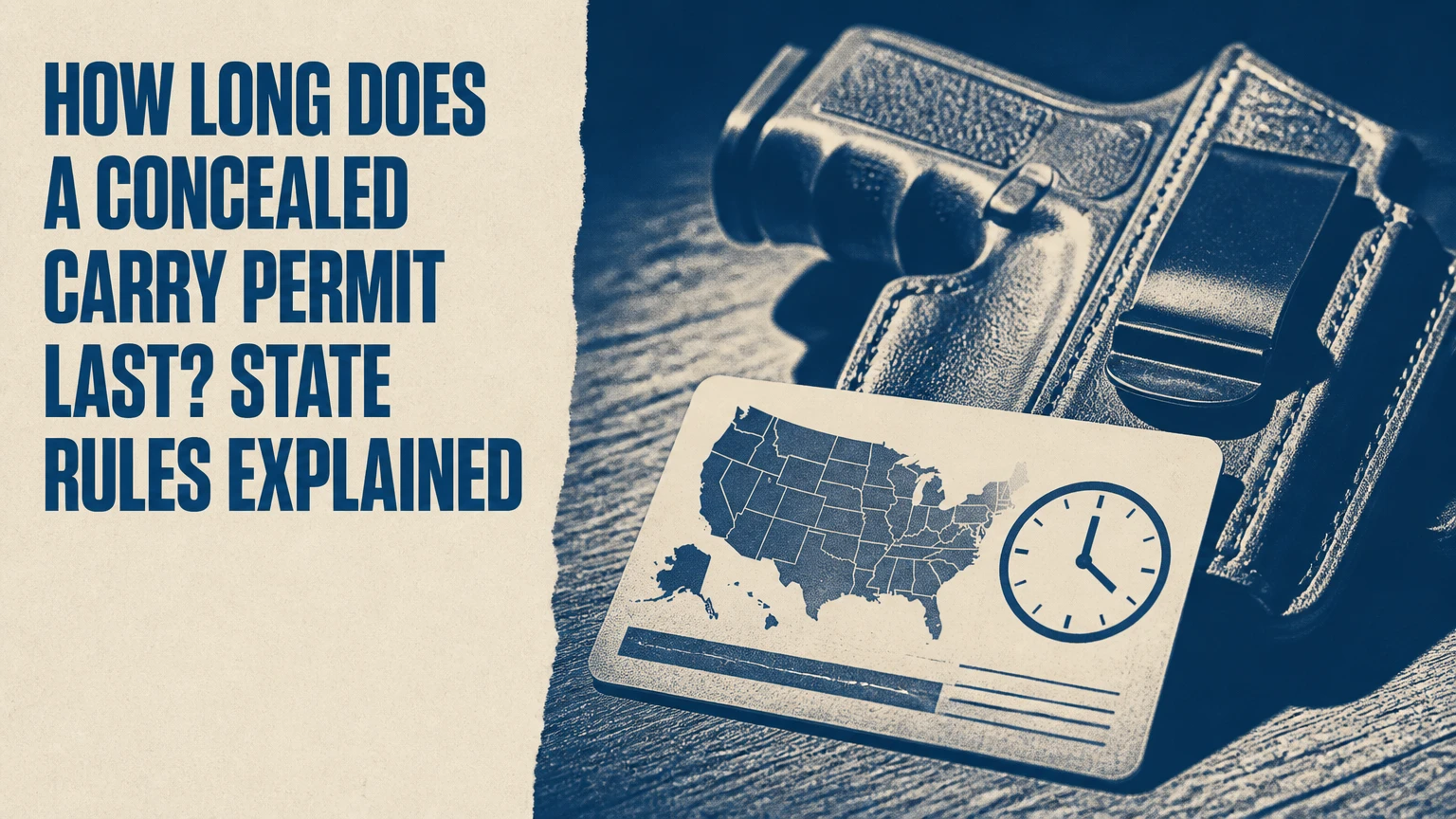
A concealed carry permit usually lasts between 2 and 8 years, although the exact validity period depends on the issuing state, permit class, and the expiration date printed on the credential. Some states offer lifetime permits, while temporary or restricted credentials can last only weeks or months. There is no federal duration standard.
Key Facts at a Glance
- A concealed carry permit is valid only until the expiration date established by the issuing state.
- Standard permits commonly last 5 years, but California generally uses a shorter term and Florida uses a 7-year term.
- A renewal application does not automatically extend a permit unless state law expressly provides an extension.
- A permit from one state does not override the carry restrictions of the state being visited.
- Permitless-carry laws may remove a permit requirement for some residents while leaving training, age, location, and reciprocity rules in place.
- A lifetime permit can eliminate routine expiration, but it does not freeze future carry laws or guarantee recognition in another state.
How Long Does a Concealed Carry Permit Last?
A standard concealed carry permit most often lasts 5 years, but state law controls the actual period. Common examples include 2 years in California, 5 years in Texas, Arizona, Utah, Virginia, Washington, and Ohio, 7 years in Florida, and 8 years for Tennessee’s enhanced handgun carry permit. Indiana and some other states offer lifetime options.
The printed expiration date is the controlling reference for an individual license. A state may calculate expiration from the issue date, approval date, birthday, or another statutory event, so a general duration cannot replace checking the card and the issuing agency’s record.
The term “concealed carry permit” covers several state credentials. States call them concealed weapons licenses, concealed handgun licenses, licenses to carry, handgun carry permits, or wear-and-carry permits. The name does not establish the duration. The statute and credential do.
The Supreme Court’s 2022 decision in New York State Rifle & Pistol Association v. Bruen addressed public carry rights and permitting standards, not a nationwide permit expiration period. Justice Clarence Thomas wrote that “the Second and Fourteenth Amendments protect an individual’s right to carry a handgun for self-defense outside the home.” States still administer their own licensing systems within the constitutional framework.
Which States Use Two-Year, Five-Year, or Longer Terms?
State examples show why the answer cannot be reduced to one national number. The following durations describe commonly issued credentials, but applicants should confirm the current rule with the state licensing authority or issuing sheriff before relying on a date.
| State or jurisdiction | Common credential | Typical validity | Important qualification |
|---|---|---|---|
| California | Carry Concealed Weapon license | 2 years | Issuing agencies may impose local application procedures and fees |
| Florida | Concealed weapon or firearm license | 7 years | The expiration date appears on the license |
| Texas | License to Carry | 5 years | Texas also permits certain unlicensed carry under state conditions |
| Arizona | Concealed weapons permit | 5 years | Permit remains useful for reciprocity and some legal distinctions |
| Utah | Concealed firearm permit | 5 years | Resident and provisional categories can have different requirements |
| Virginia | Concealed handgun permit | 5 years | Local circuit courts process applications and renewals |
| Ohio | Concealed handgun license | 5 years | Ohio also allows qualifying permitless carry |
| Maryland | Wear and Carry Permit | 2 years | Renewal and qualification rules are administered by Maryland State Police |
| Washington | Concealed pistol license | 5 years | Address changes and renewal timing have separate requirements |
| Tennessee | Enhanced handgun carry permit | 8 years | Tennessee also offers lifetime permit options under state law |
| Indiana | License to carry a handgun | Lifetime or 4 years | Lifetime and non-lifetime choices have different administrative value |
| New York | Concealed carry license | Varies by jurisdiction | New York City and other licensing authorities apply specific schedules |
A state can change the duration without changing the permit’s popular name. A reliable answer therefore identifies the issuing authority, the credential type, and the issue date rather than relying on a generic “CCW lasts five years” statement.
Can a Concealed Carry Permit Last Only 90 Days?
A 90-day period can apply to a temporary, provisional, employment-related, or emergency authorization, but it is not the normal duration for a standard resident concealed carry permit. Short-term credentials often limit the holder by purpose, employer, location, weapon, or work period.
An armed-security authorization illustrates the distinction. A security employee may hold a professional firearms credential that is tied to employment and training, while a resident’s ordinary carry license authorizes personal carry subject to the state’s general restrictions. The two documents should not be treated as interchangeable.
Read the credential’s scope as carefully as its expiration date. A license that remains unexpired can still be invalid for a particular weapon, location, activity, or employment status.
What Determines the Actual Expiration Date?
The issuing state determines the expiration date through statute, regulation, and the licensing agency’s record. The card’s expiration date normally controls, but a state may also require timely renewal, updated identification, continued residency, or compliance with a status-specific condition.
Check these four items:
- Credential type: Resident, nonresident, enhanced, provisional, lifetime, and professional permits can have different terms.
- Issue date and expiration date: Some licenses run for a fixed number of years; others use a statutory date calculation.
- Residency and address: Moving does not always cancel a license, but it can trigger an update deadline or change the issuing agency’s authority.
- Suspension or revocation: A license can stop authorizing carry before its printed expiration date if the state suspends or revokes it.
A name change, lost card, or address change is not the same event as expiration. Each may require a separate notification, replacement-card request, or amendment.
Does Permitless Carry Mean a Permit Is Unnecessary?
Permitless carry means a state allows some people to carry a concealed handgun without first obtaining a license. It does not create a nationwide right to carry without conditions, and it does not make a resident’s permit irrelevant.
A voluntary permit can provide practical advantages:
- Reciprocity: Another state may recognize a valid permit even though it does not recognize permitless carry from the traveler’s home state.
- Training evidence: A permit may document a state-approved qualification when a destination state requires one for recognition.
- Legal clarity: A permit can make eligibility easier to establish during a traffic stop or encounter, although notification duties vary.
- Age and location differences: Permitless carry may apply only to people of a certain age or may exclude places where licensed carry is treated differently.
Permitless carry is an alternative to licensing only inside the state that enacted it. A traveler must separately analyze the destination state’s recognition rules, prohibited locations, vehicle rules, magazine restrictions, and notification requirements.
What Are the Main Permit Classes?
Permit classes differ by duration, eligibility, training, and geographic usefulness. A standard resident license is usually the simplest baseline, while enhanced, nonresident, professional, and lifetime credentials solve different problems.
| Permit class | Typical validity | Common purpose | Main limitation |
|---|---|---|---|
| Standard resident permit | 2-7 years | Everyday carry by an eligible resident | Reciprocity varies by destination |
| Nonresident permit | 3-5 years | Travel recognition and interstate reciprocity | It does not replace the holder’s home-state rules |
| Enhanced permit | 5-8 years | Broader recognition or additional carry privileges | Training and qualification can be more demanding |
| Professional or restricted permit | 90 days-2 years | Security, employment, or specific assignments | Scope may be limited to work or named conditions |
| Lifetime permit | No routine expiration | Avoiding recurring renewals | Future law changes and destination rules still apply |
“Lifetime” means the credential has no ordinary renewal expiration under the issuing state’s law. It does not mean the license is immune from revocation, suspension, address requirements, or changes to reciprocity.
How Much Do Applications and Renewals Cost?
A typical initial application costs about $150-$400 when state fees, fingerprints, training, photographs, and local processing are combined. A typical renewal costs about $20-$150 before any required refresher course, but local agencies can charge substantially more.
| Cost component | Typical amount | When charged | Variable factor |
|---|---|---|---|
| State or agency application fee | $40-$150 | Initial application or renewal | State statute and local agency |
| Fingerprinting | $20-$60 | Usually initial application | Live Scan, sheriff, police, or vendor |
| Initial training | $75-$250 | Before initial submission or approval | Course length and instructor |
| Renewal training | $0-$200 | Only where required | Refresher, legal update, or qualification |
| Replacement card | $5-$50 | Lost, damaged, or amended card | Local administrative schedule |
| Lifetime upgrade | $100-$300 additional | At initial issue or conversion | State option and permit class |
San Jose, California, for example, has published unusually high local CCW fee schedules compared with ordinary statewide estimates. That type of local variation is why a national cost range should be treated as a planning figure, not a quote.
How Long Does Approval or Renewal Take?
Initial approval commonly takes 30-90 days, while a straightforward renewal may take less time, but statutory deadlines and backlogs differ sharply. Fingerprint processing, background investigations, incomplete forms, training verification, and local appointment availability often determine the real timeline.
Florida’s Department of Agriculture and Consumer Services, for example, describes an application process involving documentation and background checks. A complete file can move faster than a file requiring corrections, but an applicant should not assume that a statutory processing period creates temporary carry authority.
Start at least 90 days before expiration. In a high-backlog jurisdiction, 120 days is safer.
How Do You Renew a Concealed Carry Permit?
Renewal usually requires an application, identity verification, a fee, and any training or qualification required by the issuing state. The safest process begins before the renewal window opens and treats the renewal as incomplete until the agency confirms the new expiration date.
Step 1: Confirm the Renewal Window
Locate the expiration date and check the issuing agency’s current renewal window. Some states accept renewal months before expiration, while others distinguish early renewal from late renewal.
Step 2: Verify Training Requirements
Determine whether renewal requires a refresher course, legal-update class, live-fire qualification, or no additional training. California counties, for example, publish their own procedural details within California’s statutory framework, and requirements can differ by license type and local implementation.
Step 3: Submit the Correct Application
Use the official state or local portal, attach the requested documents, disclose required changes, and retain the confirmation number. A renewal submitted to the wrong agency can create delay even when the applicant acts before the deadline.
Step 4: Complete Fingerprints or Background Checks
Some jurisdictions require new fingerprints or a fresh background check; others reuse prior records. Follow the current instruction rather than assuming that a previous fingerprint appointment satisfies renewal.
Step 5: Confirm Approval and Carry Status
Do not treat a payment receipt, appointment confirmation, or pending application as a new permit unless the state expressly says it extends carry authority. Confirm the approved credential, effective date, and expiration date.
Expert rule: renew based on the expiration date, not the date a renewal notice arrives. Notices can be delayed, sent to an old address, or omitted without changing the statutory deadline.
Can You Carry After the Permit Expires?
Usually, no. An expired concealed carry permit generally no longer authorizes licensed concealed carry, and a pending renewal normally does not restore that authority unless state law creates a specific extension or grace period.
The legal consequence depends on the state and circumstances. Carrying after expiration may be treated as unlawful unlicensed carry, a licensing violation, or a more serious weapons offense if another restriction applies. The charge, penalty, and effect on future eligibility cannot be determined from the expired card alone.
A grace period is not automatically a carry period. Some states allow late renewal without treating the applicant as a first-time applicant, but that administrative benefit may not authorize carrying during the gap.
If the permit expired, stop relying on it, secure the firearm according to applicable transport law, contact the issuing agency, and ask whether the state allows late renewal, reinstatement, or a new application. For an active legal concern, consult a licensed attorney in the relevant state.
What Happens When Renewal Is Still Pending?
A pending renewal creates a legal gap unless the issuing state expressly extends the old permit. An application receipt proves that paperwork was submitted; it does not necessarily prove that the applicant may carry concealed.
Ask the issuing agency five precise questions:
- Does timely renewal extend the original permit?
- Is the extension automatic or does the agency issue a temporary document?
- Does the extension apply only inside the issuing state?
- Does the extension apply during interstate travel?
- What document must the holder carry as proof?
A state extension may not be recognized by another state. Reciprocity agreements commonly depend on possession of a valid license as defined by the destination state, so a temporary authorization can fail at the border even if the home state accepts it.
Does Moving or Changing Your Address Affect Validity?
Moving can affect a permit without changing the printed expiration date. Many states require an address update within a specified period, while others require an amended card, a replacement credential, or a new application after a change of residency.
Before moving, check:
- The address-update deadline.
- Whether the original issuing agency retains jurisdiction.
- Whether a resident license becomes a nonresident license.
- Whether the new state requires a separate permit.
- Whether the old state continues recognizing the credential after residency changes.
An address discrepancy can also prevent renewal notices from reaching the holder. Keep the issuing agency’s confirmation of every update, particularly when the license is used for interstate travel.
Does a Permit Remain Valid While Traveling?
A home-state permit remains valid under home-state law, but out-of-state carry depends on the destination state’s current recognition rules. Reciprocity is not permanent, national, or unlimited; states can change recognition, prohibited places, vehicle rules, and required conduct.
| Travel issue | Home-state permit effect | Destination-state question |
|---|---|---|
| License recognition | Shows an issued credential | Does the destination recognize that state’s license? |
| Permit expiration | Home state may allow renewal options | Does destination accept a temporary extension? |
| Firearm location | Home-state rules may differ | Are vehicles, hotels, parks, or businesses restricted? |
| Notification duty | May require notification at home | Must the traveler notify law enforcement there? |
| Ammunition and magazine rules | Permit may not affect them | Are separate equipment restrictions in force? |
Use the destination state’s official police, attorney general, or public safety resource immediately before travel. A commercial reciprocity map can be useful for orientation, but the controlling law is the destination state’s current law.
Which Duration Is Best for Different Users?
A five-year permit is usually the practical default for a local carrier who wants moderate cost and manageable renewal. A lifetime permit can suit someone who expects to remain eligible and in the state for many years, while a nonresident permit may help a frequent traveler only when its recognition benefits justify the extra cost and training.
| User situation | Usually practical choice | Why | Main caution |
|---|---|---|---|
| Local carrier, occasional use | Standard 5-year permit | Lower upfront commitment and ordinary renewal process | Track the expiration date |
| Frequent interstate traveler | Home-state plus recognized nonresident permit | May improve reciprocity coverage | Every destination’s restrictions still apply |
| Long-term resident | Lifetime option, if available | Avoids repeated renewal filings | Law and reciprocity can change |
| Applicant in a restrictive jurisdiction | Earliest available standard renewal | Reduces risk from appointment backlogs | Local fees and training may be high |
| Professional security worker | Employment-specific credential | Matches the work assignment | Personal carry may require another license |
A lifetime permit is not automatically the best value. If the holder moves, loses eligibility, or rarely travels, the higher initial fee may produce little benefit. A five-year license can also encourage periodic review of legal changes, which a lifetime credential does not require.
Common Expiration Mistakes and Fixes
- Waiting until the final week: Start 90-120 days ahead because appointments, fingerprints, and agency review can exceed the remaining validity.
- Assuming the receipt extends carry rights: Ask for the exact statutory authority or temporary credential; do not infer authorization from a submission confirmation.
- Relying on an old reciprocity chart: Verify the destination state’s current official guidance before crossing state lines.
- Ignoring an address change: Update the agency within the required period and retain proof of the update.
- Confusing a lifetime credential with permanent eligibility: A lifetime permit can still be suspended or revoked after a disqualifying event.
- Using a professional permit personally: Confirm whether the document is restricted to named employment, locations, hours, or weapons.
The most counterintuitive mistake is treating renewal as a clerical event. Renewal can trigger a fresh background review, new training requirement, updated medical or legal disclosures, and a different fee schedule.
The Bottom Line
The answer to “how long does a concealed carry permit last” is usually 5 years, but that figure is only a national rule of thumb. The actual answer comes from the issuing state, permit class, and expiration date printed on the credential. Examples range from California’s commonly issued 2-year licenses to Florida’s 7-year licenses, Tennessee’s 8-year enhanced permits, and lifetime options in states such as Indiana.
Begin renewal 90-120 days before expiration, verify any training requirement, and never assume that a pending application authorizes carry. A valid home-state permit also does not guarantee recognition during travel. Confirm the current rules with the issuing authority and every destination state.
Frequently Asked Questions
Can I renew a concealed carry permit after it expires?
Often, yes, but the process varies. Some states permit late renewal during a defined period, while others require a new application, new fingerprints, or complete initial training. Late renewal does not necessarily authorize carrying during the lapse. Contact the issuing agency and ask whether the state offers reinstatement or treats the filing as a new application.
Do concealed carry permits automatically renew?
No. Most concealed carry permits do not renew automatically. The holder normally must submit an application, pay the required fee, and complete any mandated training or background checks. A renewal notice is an administrative convenience, not the source of the legal deadline. The expiration date and state statute control even when no notice arrives.
Can I carry with an expired permit in a permitless-carry state?
Possibly, but only if you independently satisfy that state’s permitless-carry requirements. Those requirements can include age, residency, prohibited-person status, location restrictions, and vehicle rules. An expired permit does not become valid, and another state may still treat the holder as unlicensed. Analyze the permitless law separately from the expired credential.
Does a lifetime concealed carry permit expire when I move?
A lifetime permit may not have a routine expiration date, but moving can trigger address reporting, residency reclassification, or licensing consequences. The issuing state may continue recognizing the license, or it may require an amended record. The destination state does not have to recognize the lifetime permit merely because the issuing state does.
Is a concealed carry permit valid in every state?
No. A concealed carry permit is not a national license. Recognition depends on the destination state’s reciprocity law, the permit holder’s age and residency, the license type, and compliance with destination-state restrictions. Verify official recognition before travel, then review prohibited locations, vehicle transport, notification, and storage rules.
How can I find my permit’s exact expiration date?
Read the expiration field on the physical credential and verify it through the issuing agency’s official portal or licensing office. If the card is lost, damaged, or difficult to read, request confirmation or a replacement before carrying. Do not calculate the date solely from the application or approval date because state calculation methods differ.