First aid training basics teach people to recognize danger, summon emergency help, and provide immediate care for life-threatening injury or illness. The essential sequence is scene safety, responsiveness, airway, breathing, and circulation, followed by condition-specific actions such as CPR, AED use, bleeding control, choking relief, and recovery-position care.
Key Facts at a Glance
First aid aims to preserve life, prevent deterioration, and promote recovery until professional care arrives.
Adult CPR uses chest compressions at 100-120 per minute and a depth of about 5-6 cm.
A person who is unresponsive and not breathing normally needs emergency activation, CPR, and an AED as soon as possible.
Severe bleeding requires firm, continuous direct pressure; a tourniquet may be necessary for uncontrollable limb hemorrhage.
Online-only courses can teach knowledge but generally cannot validate hands-on CPR or satisfy workplace certification rules.
Most standard CPR and first aid credentials require renewal about every two years, but local rules and employers differ.
What Are First Aid Training Basics?
First aid is temporary care delivered at the scene of an injury or sudden illness before emergency medical professionals take over. First aid training basics combine risk assessment, emergency communication, practical procedures, and repeated skills practice so a responder can act without creating additional danger.
The traditional purpose is summarized as the 3 Ps:
- Preserve life: Address immediate threats such as cardiac arrest, airway obstruction, or catastrophic bleeding.
- Prevent worsening: Remove hazards, limit movement when appropriate, protect wounds, and avoid harmful treatments.
- Promote recovery: Reassure the person, reduce exposure to heat or cold, monitor changes, and arrange appropriate medical evaluation.
First aid is not a substitute for diagnosis, surgery, prescription treatment, or advanced airway management. A trained responder should provide care within their competence, follow the emergency dispatcher’s instructions, and transfer responsibility to clinicians when they arrive.
The American Heart Association’s 2020 CPR and Emergency Cardiovascular Care guidance emphasizes early recognition, emergency activation, high-quality CPR, and rapid defibrillation as linked actions in adult cardiac arrest. The chain matters because a technically correct procedure performed several minutes too late may be less effective than immediate, imperfectly performed care.
How Does the First Aid Response Sequence Work?
A primary survey identifies immediate threats in a fixed order: danger, response, airway, breathing, and circulation. Many courses teach DRABC, while programs in Australia and some other regions use DRSABCD, which adds send for help, automated external defibrillator, and formal danger checks.
Step 1: Check Danger
Look for traffic, fire, electricity, violence, chemical exposure, unstable structures, water hazards, and bodily fluids. Ask bystanders to control hazards, but do not enter an unsafe area without appropriate protection and training.
Use gloves or another barrier when available. Scene safety protects the responder, the injured person, and the emergency team that will follow.
Step 2: Check Response and Send for Help
Approach from the front, identify yourself, and ask loudly, “Are you okay?” Tap the shoulders of an adult or child gently, but do not shake an infant or move a person unnecessarily.
If the person does not respond, direct a specific bystander to call the local emergency number and another to retrieve an AED. Put the phone on speaker so the dispatcher can guide care.
Step 3: Open the Airway and Check Breathing
For an unresponsive adult without suspected spinal trauma, use a head-tilt and chin-lift. Look for normal breathing for no more than 10 seconds. Occasional gasping, called agonal breathing, is not normal breathing and should trigger CPR.
If a spinal injury is suspected, trained responders may use a jaw thrust, but airway and breathing take priority over theoretical spinal protection. Do not spend time searching for a pulse unless your training and local protocol require it.
Step 4: Start the Correct Immediate Care
An unresponsive person who is not breathing normally needs CPR and an AED. A person who is unresponsive but breathing normally should be placed in a recovery position when no major trauma concern prevents movement, then monitored continuously.
A conscious person with catastrophic bleeding needs immediate pressure control. First aid training teaches responders to match the intervention to the threat rather than apply a memorized sequence mechanically.
What Skills Does Basic First Aid Training Teach?
Basic courses usually combine CPR, AED operation, choking response, bleeding control, wound care, burns, fractures, shock, sudden illness, and incident communication. The exact curriculum depends on the issuing organization, national guidance, workplace regulation, and whether the course includes pediatric or wilderness content.
| Skill area | Typical learner action | Escalation trigger |
|---|---|---|
| Cardiac arrest | Start compressions, use AED, follow prompts | Unresponsive and not breathing normally |
| Severe bleeding | Apply pressure, pack wound, use tourniquet when indicated | Blood remains uncontrolled or spurting |
| Choking | Deliver age-appropriate back blows and thrusts | Person cannot cough, speak, or breathe |
| Burns | Cool under clean running water for 20 minutes | Large, deep, electrical, chemical, or facial burn |
| Stroke | Note face, arm, speech changes and call emergency services | Any sudden neurological deficit |
| Anaphylaxis | Help use prescribed epinephrine auto-injector | Breathing difficulty, swelling, collapse |
| Fracture | Keep the area still and support it | Deformity, open wound, numbness, or poor circulation |
| Shock | Lay the person appropriately, keep them warm, monitor | Altered consciousness, pale clammy skin, collapse |
How Do You Perform Adult CPR?
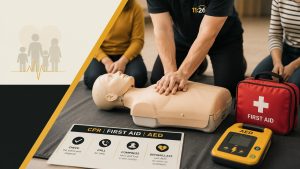
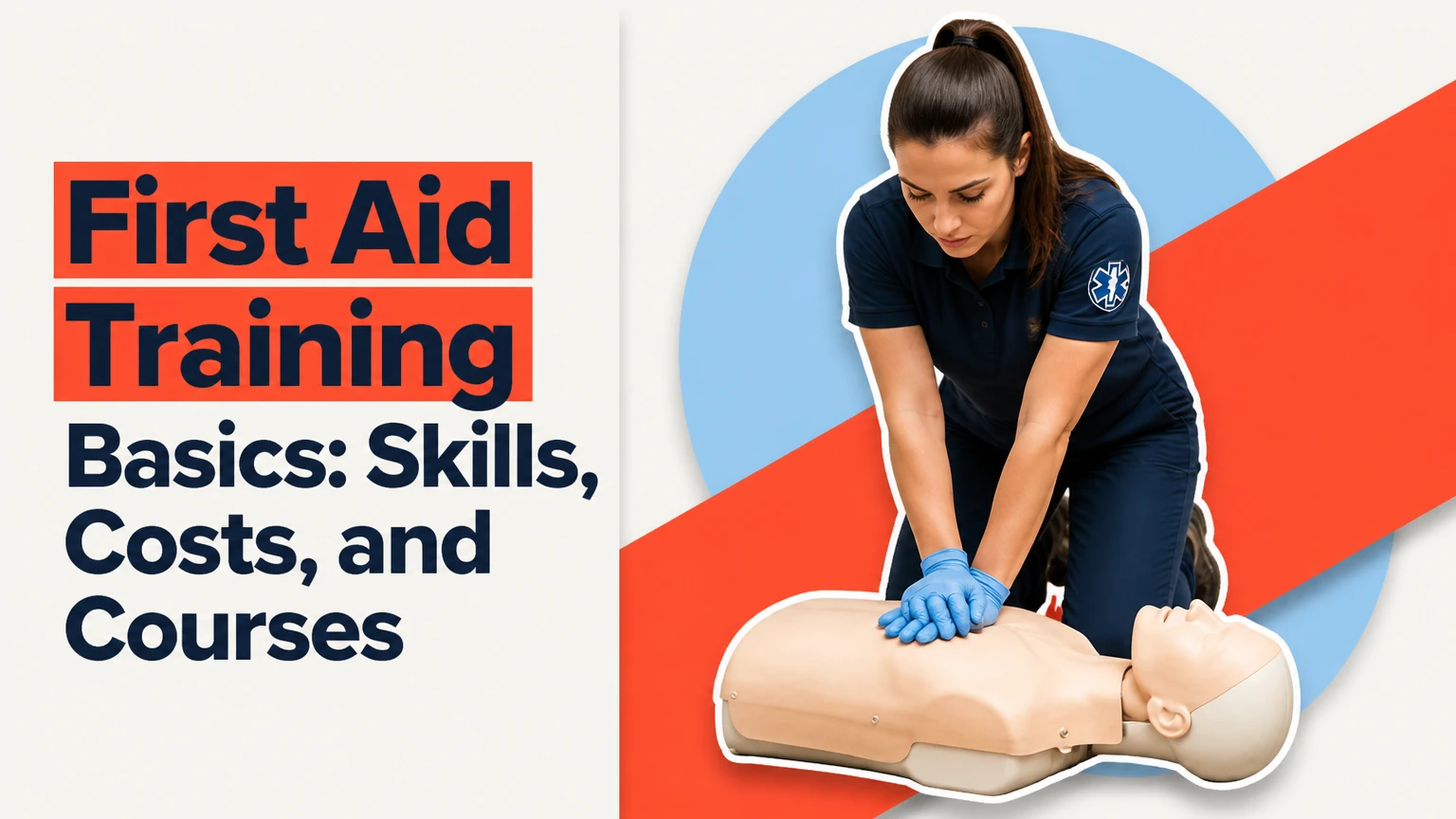
Adult CPR consists of emergency activation, continuous chest compressions, AED use, and rescue breaths when the responder is trained and willing. Place both hands on the center of the chest, compress 5-6 cm deep at 100-120 compressions per minute, allow full recoil, and minimize interruptions.
Use this sequence:
- Confirm unresponsiveness and absent normal breathing.
- Call emergency services or instruct a bystander to call.
- Send someone for an AED.
- Kneel beside the person and place the heel of one hand over the center of the chest, with the other hand on top.
- Compress hard and fast at 100-120 per minute.
- If trained and equipped, give two breaths after every 30 compressions.
- Continue until the person shows signs of life, an AED directs a pause, another trained responder takes over, or professional rescuers arrive.
Hands-only CPR is a reasonable alternative for an untrained bystander or anyone unwilling to give mouth-to-mouth breaths. The Resuscitation Council UK and American Heart Association both support immediate chest compressions when rescue breaths cannot be provided, although conventional CPR with breaths is especially important for children, infants, drowning, and respiratory causes of arrest.
A cracking sound does not automatically mean CPR should stop. Rib or cartilage injury can occur, but stopping compressions in cardiac arrest removes the person’s only circulating support.
How Is an AED Used?
An AED analyzes heart rhythm and delivers a shock only when its programmed criteria indicate one is appropriate. Turn on the device, expose and dry the chest, attach pads exactly as shown, stand clear during analysis and shock, then resume compressions when instructed.
Remove medication patches before placing a pad, and move the person away from standing water. Do not touch the casualty during analysis or shock. An AED does not replace CPR because rhythm analysis, pad placement, and charging create brief interruptions that should be kept as short as possible.
How Should You Control Severe Bleeding?
Severe bleeding requires immediate direct pressure with a gloved hand and dressing, followed by wound packing or a tourniquet when pressure alone fails. Keep constant pressure, add dressings over soaked material, and do not remove the original dressing to inspect the wound.
For a life-threatening limb hemorrhage:
- Apply firm, direct pressure immediately.
- If the wound is deep and in a suitable location, pack it tightly with gauze or a hemostatic dressing.
- If bleeding continues from an arm or leg, place a commercial tourniquet 5-7 cm above the wound and never directly over a joint.
- Tighten until bleeding stops, record the application time, and do not loosen it.
- Tell emergency clinicians the tourniquet time and any hemostatic product used.
A tourniquet is not a routine treatment for a small cut. It is an emergency measure for uncontrolled, life-threatening extremity bleeding. The American College of Surgeons Stop the Bleed program teaches direct pressure, wound packing, and tourniquet use because uncontrolled hemorrhage can become fatal before an ambulance arrives.
Do not use improvised cords, wire, or thin string when a proper tourniquet is available. Narrow materials can injure tissue while failing to compress the artery effectively.
What Should You Do for Choking?
Choking treatment depends on whether the person is an adult, child, or infant and whether the obstruction is partial or complete. Encourage a person who can cough forcefully to keep coughing, but act immediately when the person cannot speak, breathe, or produce an effective cough.
| Person and condition | Immediate response | Do not do |
|---|---|---|
| Conscious adult, effective cough | Encourage coughing and monitor | Do not strike the back unnecessarily |
| Conscious adult or child, ineffective cough | Up to 5 back blows, then up to 5 abdominal thrusts, repeat | Do not perform abdominal thrusts on an infant |
| Pregnant or markedly obese adult | Back blows and chest thrusts | Do not press the abdomen |
| Infant under 1 year | 5 back slaps, then 5 chest thrusts, repeat | Do not use blind finger sweeps |
| Unresponsive casualty | Lower safely, call emergency services, begin CPR | Do not delay compressions searching for an object |
For an infant, support the head and neck while placing the infant face-down along the forearm or thigh, deliver five back slaps, turn the infant face-up, and deliver five chest thrusts with two fingers. If the infant becomes unresponsive, begin CPR and look for an object only when opening the airway during compressions, removing it only if visible.
Blind finger sweeps can push an obstruction deeper. A conscious adult may receive abdominal thrusts, but pregnancy, obesity, and infant age require modified methods.
Which First Aid Course Should You Choose?
The right course depends on the population you may help, the environment, and whether an employer or regulator requires a recognized credential. Standard first aid with CPR and AED suits most households and workplaces, while BLS, pediatric, and wilderness programs address narrower risks.
| Course type | Typical duration | Typical US price | Main skills | Best fit |
|---|---|---|---|---|
| CPR and AED | 2-4 hours | $45-$100 | Adult CPR, AED, choking | General public and office staff |
| Standard first aid, CPR, AED | 4-8 hours | $60-$150 | Trauma, illness, CPR, AED | Workplaces and households |
| Pediatric first aid and CPR | 4-8 hours | $70-$160 | Infant and child emergencies | Parents, childcare, schools |
| BLS | 3-5 hours | $70-$150 | Team CPR, ventilation, AED | Healthcare professionals |
| Wilderness first aid | 16-40 hours | $200-$500 | Remote assessment and extended care | Hikers, guides, field workers |
Standard First Aid Versus BLS
Standard first aid covers common medical and trauma emergencies for lay responders, whereas BLS emphasizes high-quality resuscitation for healthcare professionals and clinical teams. BLS commonly includes bag-valve-mask ventilation, two-rescuer CPR, team roles, and healthcare-specific scenarios.
BLS is usually the wrong purchase for a parent who needs household injury skills, unless an employer or professional licensing body specifically requires it. Standard first aid is usually insufficient for a nurse, paramedic student, or clinical worker whose institution mandates BLS.
Pediatric First Aid Versus General First Aid
Pediatric first aid is preferable for anyone responsible for infants or children because airway size, anatomy, illness patterns, choking treatment, and CPR technique differ by age. A general adult course may mention children without providing enough repetition to build reliable infant skills.
Childcare workers should verify whether the course covers the age range and supervision setting specified by local licensing rules. Parents may reasonably choose a pediatric course even when no credential is legally required.
Wilderness First Aid Versus Standard First Aid
Wilderness first aid prepares responders for delayed evacuation, improvised equipment, environmental exposure, and patient monitoring over many hours. Standard first aid assumes emergency services can usually reach the scene relatively quickly and does not adequately teach prolonged remote care.
Wilderness first aid is not automatically better. It may omit workplace compliance content, costs more, and requires a longer practical commitment. Choose it when distance, terrain, weather, or communication failure changes the response problem.
How Do Online and In-Person Courses Compare?
In-person and blended courses validate practical skills more reliably than online-only programs, while online learning offers convenient knowledge refreshers. A certificate is meaningful only when the issuing organization, assessment method, expiration date, and employer acceptance are clear.
| Delivery format | Skills assessment | Typical time | Typical cost | Main limitation |
|---|---|---|---|---|
| In-person | Instructor observes manikin and AED practice | 4-8 hours | $60-$150 | Requires scheduled attendance |
| Blended | Online theory plus practical session | 3-6 total hours | $70-$170 | Skills session must be completed |
| Online-only | Usually quiz or video confirmation | 1-4 hours | $0-$80 | No reliable hands-on validation |
| On-site employer class | Instructor assesses a group | 4-8 hours | $60-$180 per learner | Course quality varies by provider |
The Occupational Safety and Health Administration in the United States requires workplace first-aid arrangements to reflect workplace hazards and access to medical care, but OSHA does not create one universal private certificate for every employee. Employers should verify the applicable standard, response time, staffing level, and accepted training provider.
An online-only course can be useful for orientation, revision, or low-risk personal education. It is a poor choice when a job, childcare regulator, school, insurer, or licensing authority requires demonstrated physical skills.
How Much Time and Money Does First Aid Training Require?
A typical standard first aid and CPR course takes 4-8 hours and costs about $60-$150 in the United States, before travel, replacement cards, or employer-specific fees. Prices vary by region, class size, equipment, instructor credentials, and whether the course includes pediatric content or an AED skills assessment.
| Cost or time factor | Typical range | Why it changes |
|---|---|---|
| CPR and AED class | $45-$100 | Shorter curriculum and fewer trauma modules |
| Standard first aid course | $60-$150 | Includes medical and injury response |
| Pediatric course | $70-$160 | Infant manikins and childcare scenarios |
| Renewal class | $50-$140 | Existing learners may need less theory |
| Wilderness course | $200-$500 | Two to five days, remote-care instruction |
| Replacement certificate | $10-$35 | Provider record and administrative fee |
Many recognized credentials expire after two years, but expiration is not the same as skill retention. The American Heart Association recommends renewing CPR training according to the course cycle, while organizations such as the Red Cross and St John Ambulance publish their own renewal policies.
Short practice sessions improve readiness. A household can rehearse emergency calling, AED location, recovery position, and kit access every three to six months without attempting unsupervised high-risk procedures.
What Should a First Aid Kit Contain?
A practical home or vehicle kit should contain gloves, dressings, tape, gauze, antiseptic supplies, a thermal blanket, scissors, tweezers, and written emergency information. Kit contents should match the environment, but no kit substitutes for training, emergency communication, or a tourniquet course when catastrophic bleeding is possible.
| Kit item | Suggested quantity | Inspection interval | Primary use |
|---|---|---|---|
| Nitrile gloves | 4-8 pairs | Every 6 months | Barrier protection |
| Sterile gauze pads | 10-20 | Every 6 months | Wound covering and pressure |
| Adhesive bandages | 20-40 | Every 6 months | Minor cuts |
| Roller bandages | 2-4 | Every 6 months | Securing dressings |
| Medical tape | 1-2 rolls | Every 6 months | Dressing fixation |
| Instant cold pack | 1-2 | Annually | Temporary swelling support |
| Thermal blanket | 1 | Annually | Heat loss prevention |
| Trauma shears | 1 pair | Every 6 months | Cutting clothing |
| Commercial tourniquet | 1-2 where justified | Monthly visual check | Life-threatening limb bleeding |
Keep medicines separate from core trauma supplies and label them with expiration dates. Check pediatric dosing with a pharmacist or clinician rather than placing guessed doses in a family kit.
What First Aid Mistakes Cause the Most Harm?
The most consequential first-aid mistakes are delayed emergency activation, unsafe scene entry, failure to recognize agonal breathing, insufficient bleeding pressure, and age-inappropriate choking or CPR techniques. Correcting these errors requires simpler decisions, faster escalation, and repeated hands-on practice.
- Waiting for certainty: Call emergency services when a person is unresponsive, severely short of breath, showing stroke signs, or bleeding uncontrollably.
- Stopping pressure to inspect a wound: Keep pressure continuous and add material over the first dressing.
- Using ice on a serious burn: Cool the burn under clean running water for about 20 minutes; avoid ice, butter, creams, and adhesive materials.
- Tilting forward incorrectly during a nosebleed: Sit the person upright, lean slightly forward, and pinch the soft nose continuously for 10-15 minutes.
- Removing an embedded object: Stabilize the object with bulky dressings and wait for emergency clinicians.
- Giving food or drink to an altered person: Reduced consciousness increases aspiration risk.
- Moving a trauma casualty unnecessarily: Move only for immediate danger, airway access, or emergency care that cannot otherwise be delivered.
A counterintuitive practitioner rule is that monitoring is an active skill, not passive waiting. Record changes in breathing, alertness, skin color, pain, and bleeding, then communicate the timeline to emergency personnel.
What Should You Do When First Aid Does Not Work?
When first aid fails, continue the life-saving action, reassess the threat, and escalate through emergency dispatch rather than repeatedly switching techniques. Chest compressions continue when an unconscious casualty remains without normal breathing, and bleeding pressure continues when dressings become saturated.
If rescue breaths do not make the chest rise, reopen the airway and improve the head position; do not perform prolonged blind searches. If vomiting occurs during CPR, turn the person briefly onto their side, clear visible material, return them to the back, and resume compressions.
If the person regains normal breathing, place them in a recovery position unless movement risks worsening major trauma. Continue to check breathing because improvement can reverse.
Dispatchers can provide instructions for CPR, choking, bleeding control, and naloxone or epinephrine use in many regions. Follow the local dispatcher first because emergency protocols and available resources differ by country.
How Do You Verify a First Aid Certificate?
Verify the provider, course title, practical assessment, expiry date, and employer acceptance before paying for training. A certificate should identify the issuing organization and make clear whether the learner completed a hands-on demonstration or only an online knowledge test.
Use this checklist:
- Confirm the employer, school, childcare authority, or regulator accepts the provider.
- Check whether CPR and AED skills are included.
- Confirm that an instructor observes compressions, ventilation when required, choking response, and AED operation.
- Ask how the provider records attendance and practical completion.
- Check the renewal period and replacement-card process.
- Confirm that the course covers the population you may assist, including infants or children when relevant.
- Ask whether the course follows current guidance from a recognized resuscitation council, health authority, or training organization.
Accreditation names vary internationally. The American Heart Association, American Red Cross, Resuscitation Council UK, St John Ambulance, and Australian Resuscitation Council operate in different systems, so “approved” has meaning only in relation to the local employer or regulator.
Which Training Fits Your Situation?
Most adults should begin with standard first aid, CPR, and AED training, then add pediatric or wilderness instruction when their responsibilities create those specific risks. Course selection should follow likely exposure, required credential, travel distance to professional care, and the age of people under the learner’s supervision.
- Parents and grandparents: Choose pediatric first aid and CPR with infant manikin practice.
- Babysitters and childcare workers: Select a regulator-accepted pediatric course with choking, allergic reaction, fever, and injury scenarios.
- Office employees: Choose standard first aid, CPR, and AED training, especially where an AED is installed.
- Healthcare workers: Choose the BLS course required by the employer or licensing body.
- Hikers and expedition travelers: Choose wilderness first aid, and consider wilderness first responder training for extended or professional field responsibilities.
- Drivers and travelers: Take standard first aid with bleeding, burns, fractures, heat illness, and emergency communication modules.
- People seeking a low-cost introduction: Use online education for theory, then complete an in-person skills assessment before relying on the training.
The best course is the one a learner will complete, remember, and legally use in the relevant setting. A prestigious credential that excludes pediatric skills is a poor fit for full-time childcare.
First Aid Training Basics FAQ
Is first aid training difficult for beginners?
First aid training is physically manageable for most beginners, although CPR practice can be tiring because effective compressions require sustained force and correct body position. Instructors can adapt practice for mobility limitations, but learners should disclose restrictions and understand which tasks they may need another responder to perform.
How often should first aid skills be practiced?
Practice emergency calling, AED access, recovery position, and kit location every three to six months, while formal certification commonly renews every two years. CPR confidence can decline before the certificate expires, so short refresher sessions and realistic drills are useful between formal classes.
Can a first aider diagnose a heart attack or stroke?
A first aider should recognize warning signs rather than diagnose the condition. Sudden facial drooping, arm weakness, speech difficulty, severe chest pressure, collapse, or breathing difficulty require emergency activation because only clinical assessment can distinguish competing causes.
Should a first aider remove a helmet after a crash?
Do not remove a helmet routinely after a crash unless it is necessary to access the airway, provide CPR, or address an immediate life threat. Helmet removal is safest with trained rescuers, because unnecessary movement can worsen an unstable neck injury.
Are first aiders legally required to help?
Legal duties vary by country, state, occupation, and relationship to the casualty. A responder should follow local law, obtain consent from a conscious adult, act within training, use reasonable care, and call emergency services; employers may impose separate workplace responsibilities.
What is the single most important first aid skill?
Recognizing a life threat and calling emergency services quickly is the most important first aid skill. A responder who identifies cardiac arrest, catastrophic bleeding, choking, or severe breathing difficulty early can activate professional resources while beginning the intervention most likely to preserve life.
The Bottom Line
First aid training basics cover a repeatable emergency system, practical CPR and AED use, bleeding control, choking response, common injury care, and safe escalation. Start with an in-person or blended standard course, choose pediatric or wilderness training for specialized responsibilities, and refresh skills before the certificate expires. The value of first aid training lies in rapid recognition, safe action, and continued monitoring until professional care arrives.