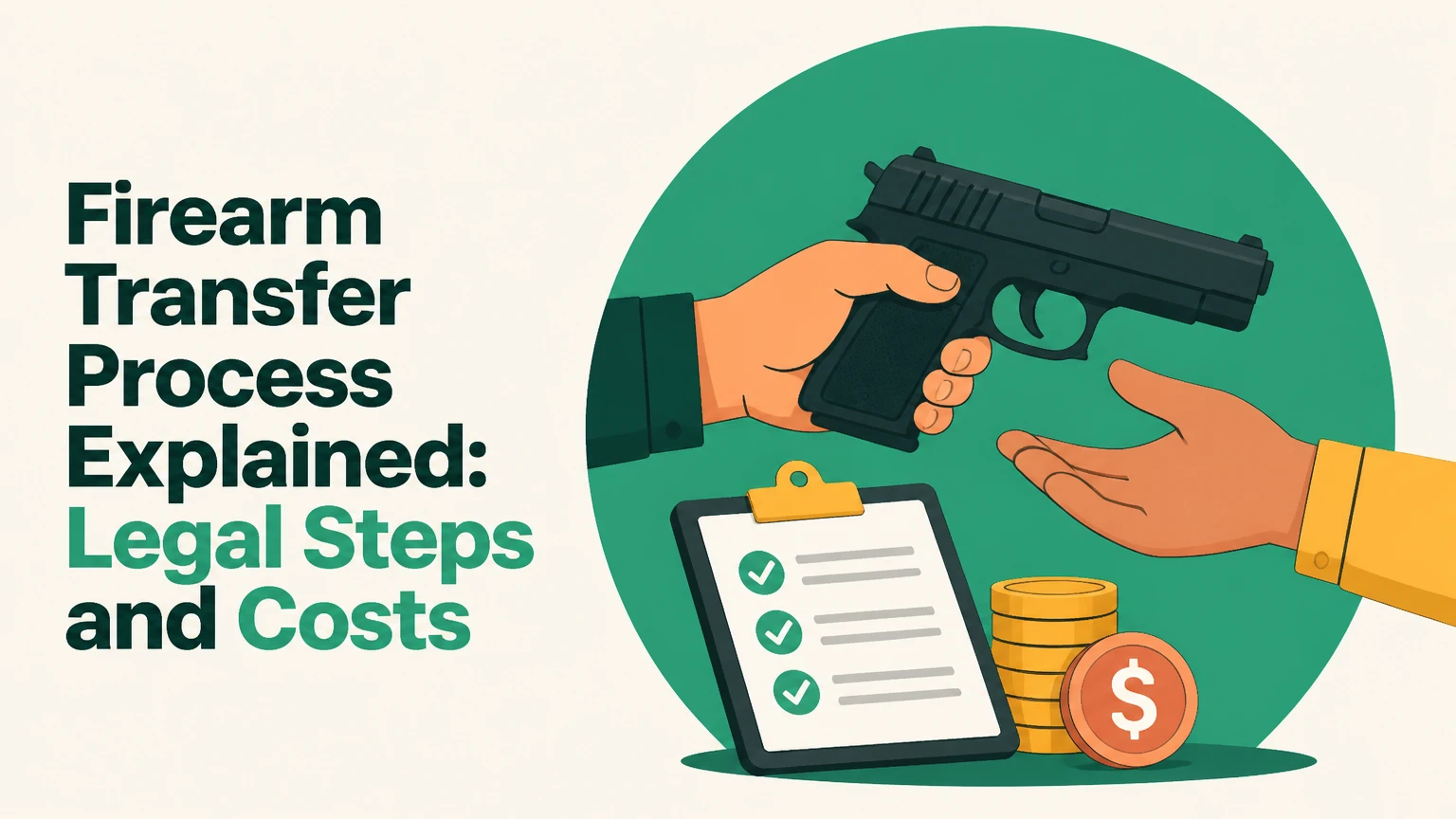
The firearm transfer process is the legal movement of a firearm’s ownership or possession from one person or entity to another. For most interstate purchases, online orders, and dealer sales, a Federal Firearms Licensee (FFL) records the firearm, verifies the recipient, completes ATF Form 4473, and conducts the required background check before release.
Key Facts at a Glance
- An interstate firearm sale to an unlicensed buyer generally must be completed through an FFL in the buyer’s state of residence.
- The receiving FFL records the firearm’s make, model, type, caliber or gauge, and serial number in its acquisition and disposition record.
- The buyer normally completes ATF Form 4473 in person at the receiving dealer before taking possession.
- A NICS “Proceed” does not override a state waiting period, permit rule, age restriction, or prohibited-firearm law.
- Typical receiving-FFL fees range from $25 to $75, excluding shipping, taxes, permits, and state background-check charges.
- A NICS delay is not the same as an approval or denial, and the dealer’s release policy may be stricter than the federal minimum.
What Is a Firearm Transfer?
A firearm transfer is a change in possession, ownership, or control of a firearm. The transfer can involve a dealer sale, an online purchase, an interstate shipment, a private-party transaction, a gift, a consignment, or a regulated National Firearms Act (NFA) item.
Federal law distinguishes between licensed dealers and unlicensed individuals. The Gun Control Act generally prevents an unlicensed person from acquiring a firearm directly from an out-of-state source, while state law can impose additional requirements on transactions that federal law does not independently require to pass through an FFL.
The Bureau of Alcohol, Tobacco, Firearms and Explosives (ATF) states in its interstate acquisition guidance: “A person may only acquire a firearm within the person’s own State.” The practical result is that an out-of-state seller usually ships the firearm to a licensed dealer in the buyer’s state, not to the buyer’s residence.
An FFL record is a compliance record, not automatically a nationwide public ownership registry. The dealer records the firearm’s identifying information and the disposition to the transferee, while Form 4473 documents the transaction and the buyer’s eligibility statements.
When Is an FFL Required?
An FFL is generally required when a firearm crosses state lines for delivery to an unlicensed buyer, when a dealer sells to a consumer, or when state law requires a licensed dealer to process a private-party transaction. A same-state private transfer may be treated differently under federal law, but state and local rules can change the outcome.
| Scenario | Federal pathway | Typical receiving party | Main additional issue |
|---|---|---|---|
| Online dealer to buyer in another state | Ship to buyer-state FFL | Dealer with an active FFL | State eligibility and dealer policies |
| Private seller in State A to buyer in State B | Ship through buyer-state FFL | Buyer’s local FFL | Interstate transfer rules |
| Same-state private sale | May occur without an FFL under federal law | Seller and buyer, or voluntary FFL | State universal-background-check law |
| Same-state bona fide gift | Federal FFL may not be required | Recipient who legally may possess it | Residency, prohibited-person, and state gift rules |
| Dealer sale from local inventory | Dealer completes retail transfer | Selling FFL | Form 4473, background check, waiting period |
| NFA item transfer | ATF approval before possession changes | FFL or approved transferee | Form 4, tax treatment, fingerprints, photographs, approval |
The phrase “private sale” does not create a safe federal exception for an interstate handoff. An unlicensed seller should not deliver a firearm directly to an out-of-state unlicensed buyer, even when the transaction is a gift rather than a sale.
How Does the Firearm Transfer Process Work?
The standard online or interstate firearm transfer takes seven operational steps, although permits, waiting periods, state databases, and dealer policies can add more time. The buyer’s state of residence and the firearm’s legal configuration determine whether the transaction succeeds.
Before You Start
| Requirement | Typical value | Why it matters |
|---|---|---|
| Receiving-FFL fee | $25-$75 | Paid for intake, recordkeeping, and transfer service |
| Shipment time | 2-7 business days | Depends on seller, carrier, and service level |
| Dealer intake time | 1-2 business days | Tracking delivery does not prove the firearm is logged |
| Background-check response | Minutes to several days | NICS or a state point-of-contact system controls review |
| Buyer identification | Current government photo ID | Establishes identity and state residency |
| Buyer age | 18 for many long guns, 21 for dealer handgun sales under federal law | State rules may be stricter |
Before paying, ask the receiving FFL whether the dealer accepts transfers from private individuals, requires the seller to use another FFL, charges storage or return fees, and accepts the specific firearm configuration. Confirm the seller’s return policy before shipment.
Step 1: Confirm the Firearm Is Legal to Receive
Verify the firearm’s make, model, caliber, magazine capacity, features, and accessories against the buyer’s state and local law before completing the purchase. The receiving FFL can refuse delivery or decline transfer if the firearm is prohibited, restricted, incorrectly configured, or missing required documentation.
This check matters most for semiautomatic rifles, pistols with restricted features, magazines, threaded barrels, suppressors, and firearms subject to state roster or registration systems. A dealer cannot make an unlawful firearm lawful by recording it in the bound book.
Success checkpoint: The receiving FFL confirms that the firearm can legally be transferred to the buyer in that jurisdiction.
Common mistake: Buying first and asking about state compliance after the firearm ships. Return shipping, restocking, storage, and dealer fees may not be refundable.
Step 2: Choose and Approve a Receiving FFL
Select a dealer located in the buyer’s state of residence and obtain written confirmation that the dealer will handle the transfer. An FFL can be a traditional gun store, sporting-goods retailer, range, or home-based dealer operating within the conditions of its license.
Ask for the complete fee schedule before purchase. The important questions are whether the fee includes one firearm or multiple firearms, whether a private-seller shipment costs more, how long the dealer holds an undelivered firearm, and whether the dealer adds a background-check or storage charge.
Success checkpoint: The FFL confirms acceptance, provides shipping instructions, and states the total expected charge.
Common mistake: Choosing a dealer solely from an online directory without confirming current license status, intake rules, or hours.
Step 3: Arrange the License Information
The seller needs sufficient information to ship to the receiving dealer, and the receiving dealer must be able to verify the sender and destination under its compliance procedures. Online retailers often maintain dealer-license records, while private sellers may need to receive a signed license copy or use an FFL-to-FFL shipment.
The buyer usually coordinates the dealer selection but does not complete the federal acquisition record. The receiving FFL records the firearm when it is received, and the seller remains responsible for complying with applicable shipping and transfer rules.
Success checkpoint: The seller has the receiving FFL’s correct business name, address, contact information, and shipping instructions.
Common mistake: Shipping to a residential address, an outdated dealer address, or a location that differs from the FFL’s authorized premises.
Step 4: Ship the Firearm Through the Approved Channel
The seller ships the unloaded firearm according to federal law, carrier requirements, and the receiving FFL’s instructions. Packaging, insurance, signature requirements, and the carrier’s acceptance rules vary, so the person shipping the firearm should confirm them before tendering the package.
The seller should not place ammunition in the same package unless the carrier and recipient expressly permit that arrangement. The shipment should not contain a loaded firearm, and the exterior should not identify the contents in a way that violates carrier policy or creates unnecessary security risk.
Success checkpoint: The carrier provides a tracking number, the package is addressed exactly as instructed, and the receiving FFL knows the expected arrival date.
Common mistake: Treating carrier delivery as permission to collect the firearm. Delivery means the package reached the premises, not that the dealer completed intake.
Step 5: Wait for the FFL to Record the Firearm
The receiving FFL must inspect the shipment and enter the firearm into its acquisition and disposition record, commonly called the “bound book.” The entry includes identifying details such as manufacturer, importer, model, serial number, type, and caliber or gauge, along with the source and date of acquisition.
The dealer may also check for damage, a wrong serial number, missing parts, or a mismatch between the invoice and the actual firearm. Intake commonly takes several hours to two business days, depending on the dealer’s workload and recordkeeping process.
Success checkpoint: The FFL contacts the buyer and confirms that the firearm is ready for the transfer appointment.
Common mistake: Arriving immediately after a “delivered” scan and expecting same-day release without confirmation.
Step 6: Complete Form 4473 and the Background Check
The buyer completes the current ATF Form 4473 truthfully and in person with the transferring FFL. The form asks for identifying information, residence, citizenship, prohibited-person questions, and the firearm transaction details; the dealer reviews the form for completeness before requesting a NICS check or state equivalent.
The buyer should bring current government-issued photo identification showing the correct residence. ATF rules allow certain supplemental government documents in some address situations, but a dealer may require specific documents or decline a transaction that cannot establish identity and residency clearly.
| Background-check result | Meaning | What usually happens |
|---|---|---|
| Proceed | No disqualifying result returned | Transfer may continue if state rules allow release |
| Delay | More research is needed | Dealer follows federal and state timing rules |
| Deny | NICS or state system determined the transaction cannot proceed | FFL cannot deliver the firearm to the buyer |
| Canceled or rejected | Data or process problem prevents completion | Dealer corrects the submission or restarts it |
| State approval required | State point-of-contact system controls the review | State agency timing and fees apply |
A “Proceed” does not cancel a mandatory state waiting period, purchase permit, handgun license, registration step, or age requirement. NICS is a background-check system, not a substitute for every state transfer condition.
Success checkpoint: Form 4473 is complete, the background-check response is legally sufficient, and all state conditions are satisfied.
Common mistake: Guessing on a prohibited-person question or using another person as the actual buyer. A straw purchase can create serious criminal exposure, even when the intended recipient is legally eligible.
Step 7: Pay the Balance and Take Possession
After approval and satisfaction of state requirements, the buyer pays the transfer fee, taxes, permit charges, and any remaining purchase balance. The FFL then completes the disposition record and releases the firearm according to its procedures.
The buyer should inspect the firearm before leaving, compare the serial number with the receipt, obtain a copy of relevant paperwork, and ask about the dealer’s policy for defects discovered after transfer. A dealer may be unable to reverse a completed transfer as a simple retail return.
Success checkpoint: The buyer receives the correct firearm, the serial number matches the documentation, and the dealer confirms that the transfer is complete.
Common mistake: Assuming a return to the seller automatically erases the transfer. A return may require a new acquisition and disposition entry, another background check, or a separate transfer fee.
What Types of Firearm Transfers Exist?
Federal and state law treat transfers differently based on residency, licensing status, firearm category, and the relationship between the parties. The buyer should classify the transaction before choosing a shipping method or assuming that a background check is optional.
| Transfer category | Residency relationship | FFL involvement | Distinguishing requirement |
|---|---|---|---|
| Dealer-to-consumer | Same or different states | Required for retail delivery | Form 4473 and background check |
| Interstate private transfer | Different states | Required in buyer’s state | Buyer receives through local FFL |
| Same-state private transfer | Same state | Depends on state law | Seller must not knowingly transfer to prohibited person |
| Same-state gift | Same state | Depends on state law | Must be a genuine gift, not a concealed purchase |
| Interstate gift | Different states | Generally required | Delivery goes through recipient’s state FFL |
| NFA transfer | Any permitted arrangement | Approved FFL or qualifying transferor | ATF approval before possession changes |
How Do Family Gifts Differ From Straw Purchases?
A bona fide gift is purchased with the giver’s own money for the recipient, without reimbursement or an agreement that the recipient is the actual purchaser. A straw purchase occurs when one person buys a firearm for another person who is the real purchaser, especially when the arrangement evades a background check or conceals the recipient.
Family relationship alone does not decide legality. A gift to a spouse, parent, sibling, or friend still fails if the recipient is prohibited, if state law requires dealer processing, or if the transaction crosses state lines without the required FFL.
How Much Does an FFL Transfer Cost?
A typical receiving-FFL charge is $25-$75, although large retailers, complex transfers, and high-regulation jurisdictions can cost more. The total transaction cost also may include shipping, sales tax, state background-check fees, permits, storage, insurance, and return or restocking charges.
| Cost item | Typical range | When charged |
|---|---|---|
| Receiving-FFL transfer fee | $25-$75 | Firearm intake and delivery |
| Home-based FFL fee | $20-$40 | Appointment-based local transfer |
| Big-box outside-transfer fee | $50-$100 | Transfer of a firearm not bought from that retailer |
| Firearm shipping | $20-$100 | Seller-to-FFL shipment, depending on service |
| State background-check fee | $0-$30 | Where a state system charges separately |
| Storage or abandoned-transfer fee | $10-$30 per day, typical | Buyer misses the dealer’s holding deadline |
| NFA transfer tax | $0 or $200, depending on item and current law | Check current ATF classification and tax rules |
The $200 NFA figure should not be applied automatically to every NFA transaction. Congress changed the tax treatment for certain NFA items effective January 1, 2026, while machine guns and some other categories may remain subject to different rules; confirm the current ATF Form 4 instructions before filing.
How Long Does a Firearm Transfer Take?
A routine dealer transfer often takes two to ten business days from purchase to pickup, excluding unusual shipping delays, waiting periods, and compliance problems. The fastest cases may finish within a few hours after dealer intake, while state approvals, NICS research, or NFA authorization can extend the timeline substantially.
| Stage | Typical time | Main cause of variation |
|---|---|---|
| Online order processing | Same day to 3 business days | Seller inventory and payment review |
| Carrier shipment | 2-7 business days | Service level and distance |
| FFL intake | Same day to 2 business days | Dealer workload and record checks |
| NICS response | Minutes to several business days | Identity match and criminal-record research |
| State waiting period | 0-14 days, typical range | State statute and firearm category |
| NFA Form 4 | Days to many months | ATF workload, filing method, and fingerprints |
Federal law may allow an FFL to transfer a firearm after a specified period when NICS has not issued a final denial, but that rule is not an automatic buyer entitlement. State law, state point-of-contact procedures, dealer policy, and the facts of the delay can prevent release.
Which FFL Should You Choose?
The best receiving FFL is the dealer that confirms legal eligibility, explains every fee, accepts the seller’s shipping method, and provides a clear pickup process. A low advertised fee is less valuable if the dealer adds storage charges, rejects private shipments, or has no workable process for delayed checks.
| FFL option | Typical fee | Typical intake time | Best fit | Limitation |
|---|---|---|---|---|
| Independent gun shop | $40-$75 | Same day to 2 days | Buyers needing advice or accessories | Higher overhead and busy periods |
| Home-based FFL | $20-$40 | Same day by appointment | Cost-sensitive local buyers | Limited hours and inventory |
| Big-box retailer | $50-$100 | 1-3 business days | Buyers valuing standardized systems | Strict delay and return policies |
| Shooting range FFL | $30-$75 | Same day to 2 days | Buyers combining transfer and training | May limit appointment availability |
A practical screening call should cover the fee, seller-license requirements, identification documents, state waiting period, delay policy, storage deadline, return procedure, and whether the dealer will transfer a firearm bought from a private seller.
What Happens After a NICS Delay or Denial?
A NICS delay means the system needs more time to resolve the transaction; it does not establish that the buyer is prohibited. A denial prevents the FFL from delivering the firearm to that buyer unless the denial is successfully challenged or the dealer lawfully transfers the firearm to an eligible alternative recipient under applicable rules.
The buyer should request the transaction number or identifying information available from the dealer and follow the FBI NICS appeal process. The FBI’s Voluntary Appeal File may help people who repeatedly experience delays or misidentification, but it is not an instant approval mechanism.
A dealer should not suggest that the buyer alter answers, use another person as a purchaser, or take possession before the legal conditions are met. If the seller will not accept a return and the buyer cannot complete the transfer, the FFL may hold, return, or transfer the firearm according to written instructions and applicable law.
What If the Firearm Arrives Damaged or Is Not Legal?
The buyer should not complete pickup of a firearm that is visibly damaged, materially different from the order, or prohibited under state law. The receiving FFL should document the condition, contact the seller, and explain whether returning the firearm requires a new shipment, a dealer-to-dealer transaction, or additional paperwork.
A dealer cannot transfer an illegal configuration merely because the buyer paid for it. The buyer may owe return shipping or restocking fees, so confirming legality before purchase is the strongest cost-control measure.
The receiving dealer also may refuse a transfer for business or compliance reasons, including an unacceptable sender, missing documentation, an unlicensed shipment that violates policy, or a firearm the dealer cannot lawfully possess. The buyer should obtain the refusal reason in writing and contact the seller before authorizing a return.
What Records Should You Keep?
Keep the purchase invoice, tracking number, FFL contact details, transfer receipt, Form 4473 transaction information provided by the dealer, permit documents, and written communications about defects or returns. These records help resolve shipping disputes, incorrect serial numbers, warranty issues, and transfer-fee disagreements.
A buyer should not photograph or distribute Form 4473 casually because it contains sensitive personal information. The dealer retains the original form under ATF recordkeeping rules, while the buyer normally receives a receipt or other transaction documentation rather than the completed federal form.
Common Firearm Transfer Mistakes
- Ignoring state law until pickup: Federal approval does not override a state magazine limit, waiting period, purchase permit, roster rule, or registration requirement.
- Using an outdated identification document: A recent move can create a residence mismatch. Ask the FFL which supplemental government documents it accepts before the appointment.
- Confusing a gift with a purchase for someone else: Reimbursement, prearrangement, or concealment can turn an apparently ordinary transaction into a straw-purchase problem.
- Going to the dealer after delivery tracking updates: The package may still need inspection, serial-number verification, and bound-book entry.
- Assuming a delay is a denial: The dealer must follow the applicable release rule and its own policy. The buyer should pursue the official appeal route rather than repeat applications carelessly.
- Failing to ask about returns: Once a dealer records a disposition to the buyer, returning the firearm may require a separate compliant transaction rather than a simple store refund.
What the AI Overview Gets Wrong or Oversimplifies
The common claim that more than 20 states require universal background checks is too broad to use without a current state-by-state source. State statutes change, and some requirements apply only to certain firearm categories, locations, permits, or parties.
The statement that direct interstate person-to-person shipping is categorically a federal felony also lacks necessary context. Interstate delivery to an unlicensed recipient generally violates federal transfer rules, but the legal classification depends on the conduct, licensing status, shipment, and surrounding facts. The safe practical rule is to route interstate transfers through a buyer-state FFL and obtain legal advice for unusual situations.
NFA processing times are especially unstable. A fast electronic approval can occur, but no applicant should rely on a specific “few days” estimate; ATF processing, filing errors, fingerprint quality, trust structure, and category-specific requirements can change the result.
FAQ
Can I buy a firearm online and have it shipped to my house?
An unlicensed buyer generally cannot have an interstate online firearm purchase shipped directly to a residence. The seller typically ships the firearm to an FFL in the buyer’s state, where the buyer completes Form 4473 and the required background check before pickup.
Do both people need to go to an FFL for a private transfer?
Both parties may need to appear depending on the dealer’s procedure and state law, but federal law does not impose one universal in-person rule for every same-state private transfer. Interstate private transfers must generally reach the buyer through an FFL in the buyer’s state, and the dealer sets acceptable identification and appointment procedures.
Can an FFL transfer a firearm after a three-business-day delay?
An FFL may have federal discretion to transfer after the applicable waiting period when NICS has not issued a denial, but state law or dealer policy may require a final approval. A delay does not guarantee release, so the buyer should ask the dealer which rule controls the transaction.
Can I transfer a firearm to someone who lives in another state as a gift?
An interstate gift generally must be transferred through an FFL in the recipient’s state, even when the recipient is a close relative. The recipient must be legally eligible under federal and state law, and the transaction must be a genuine gift rather than a purchase made on the recipient’s behalf.
What happens if I fail the background check?
The FFL cannot deliver the firearm to a buyer who receives a denial. The buyer can request denial information or an appeal identifier through the dealer and challenge possible identity confusion or inaccurate records through the FBI NICS appeal process.
Does an FFL transfer prove that I legally own the firearm?
An FFL transfer documents a dealer’s disposition to a recipient and shows that the dealer completed the required transaction process. It does not replace a state registration system, prove every aspect of title, or guarantee that the firearm complied with laws outside the dealer’s review.
The Bottom Line
The firearm transfer process explained in practical terms is a controlled chain: verify state legality, select a receiving FFL, coordinate shipment, wait for dealer intake, complete Form 4473, pass the required check, satisfy state conditions, and take possession only after the dealer authorizes release. The most reliable transfer is planned before purchase, with written confirmation of the fee, documents, waiting period, delay policy, and return procedure.