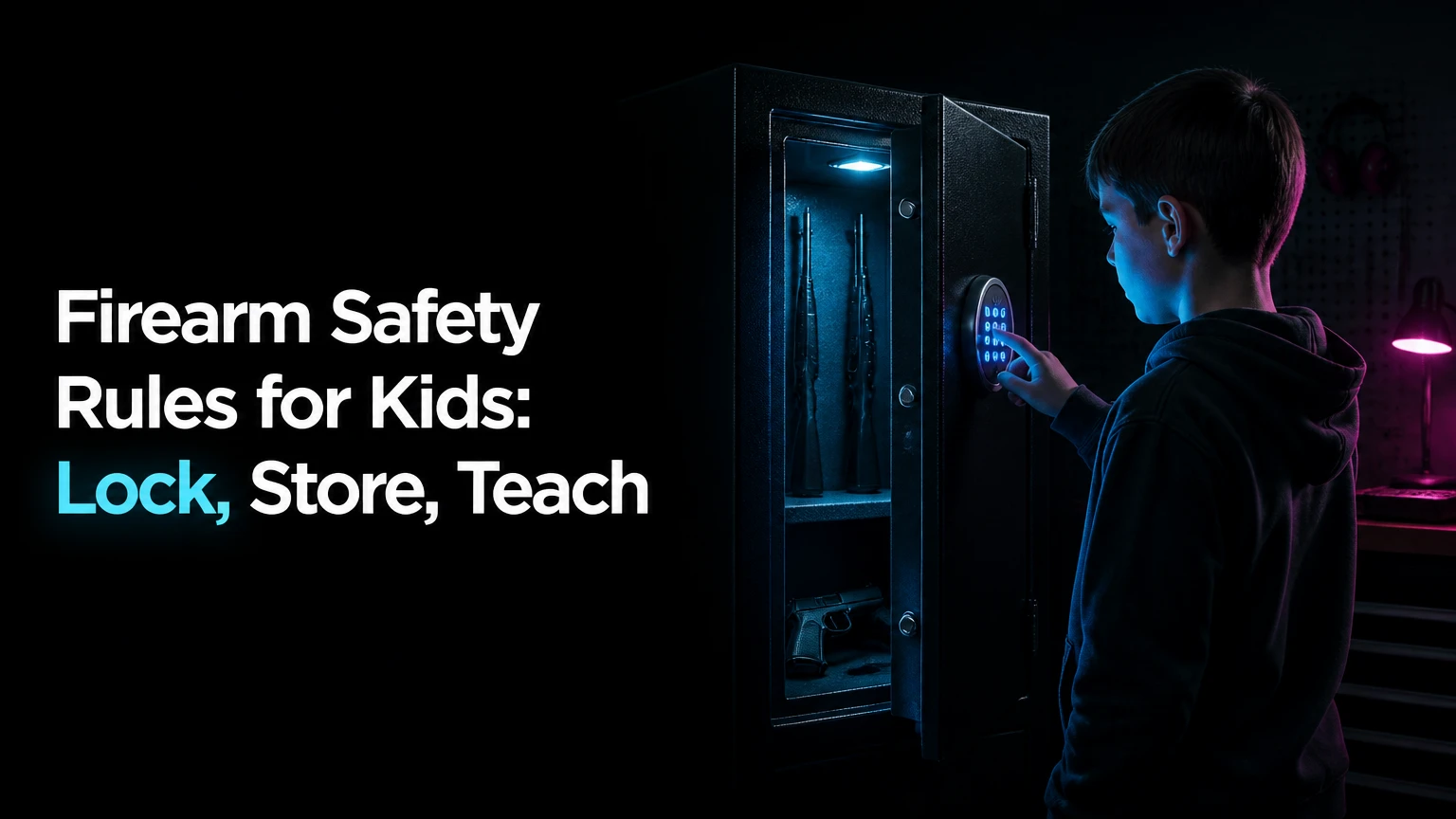
Firearm safety rules for kids have two parts: children must know to stop, avoid touching, leave the area, and tell a trusted adult, while adults must keep every firearm locked and inaccessible. Education reduces unsafe curiosity, but only locked storage, controlled keys or codes, and separate ammunition can prevent unauthorized access reliably.
Key Facts at a Glance
A child who finds a firearm should stop, avoid touching it, leave the area, and tell an adult immediately.
Adults, not children, carry responsibility for firearm storage and access control.
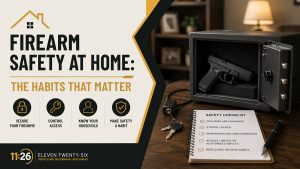
The safest household storage setup is a locked firearm, unloaded when feasible, with ammunition secured separately.
Hiding a firearm in a closet, drawer, vehicle, or bedside table is not secure storage.
Trigger locks can prevent firing but may not prevent theft, handling, or removal.
Safe-storage laws differ by jurisdiction, so owners should verify current local requirements.
What Do Firearm Safety Rules for Kids Mean?
Firearm safety rules for kids are behavioral instructions and adult-controlled storage practices that prevent a child from handling, firing, moving, or gaining access to a firearm. The child’s rule is simple and memorable; the adult’s duty is more demanding because children cannot reliably judge whether a firearm is loaded, functional, or safe.
The American Academy of Pediatrics has repeatedly used the statement, “The safest home for a child is a home without a gun.” That position addresses risk elimination. When firearms are present, the practical risk-reduction standard is locked storage that children, visitors, and unauthorized adults cannot defeat.
The system has two separate controls:
- Behavioral control: The child knows what to do after seeing a firearm.
- Physical control: The firearm remains locked, and access credentials stay with authorized adults.
The second control must work even when a child is curious, frightened, angry, sleep-deprived, influenced by peers, or unaware that a firearm is loaded. A child’s promise is not a storage device.
Why Does Education Alone Not Prevent Access?
Firearm safety education cannot eliminate access to an unlocked firearm. A child may remember the correct rule during a calm lesson but act differently when friends are present, when the gun resembles a toy, or when an older child claims the firearm is unloaded.
The American Academy of Pediatrics clinical report, “Firearm-Related Injuries and Deaths in Children,” published in Pediatrics in 2022, identifies secure firearm storage as a key prevention measure. Education remains useful, but it should function as a final barrier after physical access controls, not as the primary barrier.
A practical household rule is direct: teach every child what to do, then store every firearm as though the child will eventually discover it.
What Should a Child Do if They Find a Gun?
A child who encounters a firearm should stop immediately, avoid touching it, leave the area, and tell a trusted adult. The same four actions apply whether the firearm looks old, unloaded, broken, plastic, or familiar.
The Four-Step Emergency Rule
- Stop. Freeze and keep hands away from the firearm.
- Do not touch. Do not pick it up, open it, move it, pose with it, or test whether it works.
- Leave. Walk or run away from the area without returning for belongings.
- Tell. Report the location to a parent, teacher, caregiver, police officer, or another trusted adult.
This sequence resembles the National Rifle Association’s Eddie Eagle messaging, although families should understand its limit: the protocol teaches a child how to react after discovery; it does not make an unsecured firearm safe.
A child should not attempt to unload a firearm, remove a magazine, press a button, retrieve ammunition, or take the gun to an adult. If an adult cannot be reached, the child should tell a teacher, neighbor, emergency dispatcher, or police officer.
What If the Gun Is in a Vehicle or Public Place?
A child should leave the vehicle or immediate area if doing so is safe, warn nearby children not to touch the firearm, and tell an adult immediately. A child should not remain near the firearm to guard it or attempt to conceal it.
An adult who finds an unsecured firearm should keep people away, avoid manipulating the firearm unless immediate safety requires action, and contact law enforcement or the responsible owner. If a firearm is found at school or another controlled facility, notify staff or security rather than handling it.
How Should Adults Store Firearms Around Children?
Adults should store firearms unloaded when feasible, inside a locked container or with a locking device that prevents unauthorized access, while securing ammunition separately. The container should resist prying, remain anchored when theft is a concern, and stay inaccessible to children even when adults are asleep or away.
The strongest routine combines four controls:
- Unload the firearm before storage when the owner’s intended use permits it.
- Lock the action or firearm with a safe, lockbox, or compatible locking device.
- Lock ammunition separately in a different secured container when practical.
- Control access credentials by keeping keys, combinations, and phone-based permissions away from children.
The exact legal standard varies. For example, California, Massachusetts, New Jersey, and other jurisdictions have specific safe-storage rules, while requirements can also change after a firearm is left unattended or accessed by a minor. Owners should consult the current state statute, attorney general, police department, or official public-safety agency.
Why Is Hiding a Firearm Not Safe Storage?
Hiding a firearm fails because children search more effectively than adults expect, and household conditions change. A child may discover a firearm during a game, a cleaning project, a move, a sleepover, or an attempt to retrieve clothing from a closet.
A hidden firearm also remains vulnerable to visitors, contractors, burglars, and older children. A drawer, nightstand, sock basket, locked bedroom, or high shelf may delay discovery, but none provides controlled access comparable to a locked safe or lockbox.
Practitioner rule: If a child can reach the location, learn the location, or obtain the key, the firearm is not adequately secured.
Which Storage Device Is Appropriate for a Family?
No single lock fits every household. A portable lockbox supports rapid retrieval but may provide less theft resistance than an anchored safe, while a large mechanical safe protects several firearms but can be slower to open.
| Storage option | Typical price | Access method | Main limitation |
|---|---|---|---|
| Cable lock | $0-$20 | Key or combination | May not stop removal or theft |
| Trigger lock | $5-$25 | Key or combination | Compatibility varies; unsafe installation can obstruct handling |
| Portable lockbox | $20-$150 | Key, code, or biometric sensor | Limited capacity and pry resistance |
| Biometric lockbox | $80-$300 | Fingerprint plus backup access | Battery, sensor, and backup-key maintenance |
| Mechanical combination safe | $150-$1,000+ | Dial or mechanical code | Slower opening and heavier installation |
| Full-size anchored safe | $500-$2,500+ | Electronic or mechanical lock | Installation, weight, and access-code management |
Are Trigger Locks and Cable Locks Enough?
Trigger and cable locks can reduce firing or unauthorized use, but they are not equivalent to a locked safe. A trigger lock does not necessarily prevent a person from carrying the firearm away, and a cable lock may not provide meaningful theft protection unless the firearm is also inside a secured container.
A locking device must be compatible with the firearm and installed according to the manufacturer’s instructions. Owners should never use a lock in a way that leaves the firearm loaded when the device could press the trigger or interfere with safe unloading.
For a household with one unloaded firearm and low theft exposure, a lockbox may be a practical baseline. For multiple firearms, frequent visitors, or a firearm stored for long periods, an anchored safe offers stronger access and theft control.
Is a Biometric Safe Always the Best Choice?
A biometric safe is useful when an authorized adult needs fast access and can maintain the device. It is not automatically the safest option because fingerprints can fail after moisture, injury, dirt, cold temperatures, or sensor wear.
A biometric lockbox should have a tested backup method, such as a mechanical key or code, and the owner should verify operation at least monthly. Store backup keys outside the child’s reach and never attach them to the safe.
| Household situation | Preferred primary storage | Secondary control | Check interval |
|---|---|---|---|
| No firearms in home | Ask about storage before visits | Teach the four-step rule | Before each playdate |
| One unloaded sporting firearm | Lockbox or cable-secured container | Separate ammunition lockbox | Monthly |
| Multiple long guns | Anchored full-size safe | Separate ammunition compartment | Monthly |
| Home-defense firearm | Purpose-built rapid-access safe | Unloaded storage when feasible | Weekly function check |
| Frequent young visitors | Locked safe inaccessible to guests | No shared codes or keys | Before and after visits |
| Moving or renovation | Locked portable case under adult control | Ammunition separately locked | Each transport |
How Do You Teach Firearm Safety by Age?
Children should receive short, repeated instructions matched to their developmental ability, while adults maintain the same physical storage standard at every age. Older children may learn supervised range procedures, but greater knowledge does not justify unsupervised access.
| Approximate age | Teaching objective | Language to use | Adult boundary |
|---|---|---|---|
| 2-5 years | Recognition and avoidance | “A gun is not a toy. Stop and get me.” | No handling |
| 6-8 years | Four-step response | “Stop, do not touch, leave, tell.” | No access to keys or codes |
| 9-12 years | Context and peer pressure | “Never believe someone who says it is unloaded.” | No unsupervised handling |
| 13-15 years | Media realism and judgment | “A real firearm can injure without warning.” | Supervision remains mandatory |
| 16-17 years | Formal safety and legal responsibility | “Treat every firearm as loaded and follow range commands.” | Law and household rules still apply |
Children should practice the words without using a real firearm or realistic replica as a prop. Parents can present scenarios verbally: “You see a gun under a bed,” “A friend shows you something in a backpack,” or “You find a gun in a car.” The child should answer with the four actions.
A child who has completed a hunter-education or shooting course still needs locked storage. Training improves safe conduct under supervision; it does not remove impulsivity, peer pressure, or the possibility of suicide risk.
Are Toy Guns, BB Guns, and Air Guns Included?
Toy guns, BB guns, pellet guns, airsoft guns, and paintball markers should receive separate but serious safety rules because many resemble real firearms and can injure eyes, skin, or internal organs. A child should never point any gun-shaped object at a person, animal, or vehicle.
Realistic replicas also create an identification problem. A child may not know whether an object is a toy, unloaded firearm, air gun, or functional weapon, especially when the object is partially hidden.
Use separate storage for realistic replicas and functioning firearms, and avoid normalizing firearm handling through unsupervised play. Bright colors or orange markings do not guarantee that another person will recognize an object as harmless.
Expert insight: Teaching “never touch any gun-shaped object” is safer than asking a young child to distinguish a real firearm from an imitation.
What Should Parents Ask Before a Playdate?
Parents should ask the hosting adult whether firearms are present and whether every firearm is locked and inaccessible. The question is reasonable, specific, and easier to answer when framed as a routine safety check rather than an accusation.
A practical script is: “Before the kids visit, does your home have firearms, and are they stored locked and inaccessible, with ammunition secured?”
Parents can also ask:
- Are firearms stored in a locked safe or lockbox?
- Are keys, codes, and biometric backups inaccessible to children?
- Are ammunition and firearms secured separately?
- Will firearms remain secured while adults are sleeping or outside?
- Does the home contain realistic replicas, BB guns, or airsoft guns?
- Who should the child contact if they discover a firearm?
If the answer is vague, dismissive, or dependent on a child’s promise, choose another location. A temporary visit can be moved to a library, park, or the non-owner household.
How Much Do Child-Safety Storage Measures Cost?
Basic firearm locking devices commonly cost $0-$25, portable lockboxes typically cost $20-$300, and larger anchored safes commonly cost $500-$2,500 or more. Installation may take 30 minutes for a small lockbox or 2-4 hours for a heavy safe, depending on the wall, floor, and anchoring method.
| Measure | Typical cost | Typical setup time | Best use |
|---|---|---|---|
| Free cable lock | $0 | 5-15 minutes | Basic action-locking layer |
| Trigger lock | $5-$25 | 5-10 minutes | Compatible unloaded firearm |
| Portable lockbox | $20-$150 | 10-30 minutes | One firearm and limited capacity |
| Biometric lockbox | $80-$300 | 15-45 minutes | Rapid authorized access |
| Full-size safe | $500-$2,500+ | 2-4 hours | Multiple firearms and theft resistance |
| Safety course | $50-$150 typical | 2-4 hours | Supervised handling education |
Prices vary by region, brand, capacity, certification, and whether delivery or installation is included. Many police departments, public-health agencies, hospitals, and firearm retailers distribute cable locks at no cost, but availability changes by location.
Cost should not determine whether a firearm is locked. A free compatible lock or a lower-cost lockbox is safer than hiding a firearm while waiting to purchase a larger safe.
What Common Storage Failures Should Families Fix?
The most common failures involve access credentials, temporary handling, and false confidence in concealment. Families should inspect the entire system rather than checking only whether a safe door is closed.
Failure 1: The Key or Code Is Accessible
A locked safe provides little protection if a child knows the combination, finds the key, or can open an adult’s phone account. Change codes after disclosure and store keys separately from the safe.
Failure 2: Ammunition Is Stored in the Same Unlocked Area
Separate locked ammunition storage adds another access barrier. A locked firearm container with ammunition beside it is weaker than two locked containers, particularly when several children or visitors are present.
Failure 3: The Safe Battery Is Dead
Test electronic and biometric systems weekly in households that require rapid access. Replace batteries on a fixed schedule, keep the approved backup method secure, and do not leave the safe open while waiting for replacement parts.
Failure 4: The Firearm Is Temporarily Left Out
Cleaning, showing, photographing, moving, and loading create short periods of exposure. Use a timer, close and lock the safe immediately after handling, and keep children out of the room until the firearm is secured.
Failure 5: The Vehicle Becomes Unattended Storage
A locked vehicle is not a substitute for a locked container. When a firearm must remain in a vehicle, use a secured, concealed, vehicle-anchored container where lawful, and remove it whenever practical.
Failure 6: Parents Do Not Recheck After a Household Change
New babysitters, visiting relatives, remodeling, divorce, medication changes, adolescent distress, or a move can alter access risk. Reassess storage after each change rather than relying on the previous arrangement.
What Should Adults Do After a Firearm Injury?
After a firearm injury, call emergency services immediately, keep other people away from the firearm, and follow the dispatcher’s instructions. Do not delay professional care to unload, photograph, or move the firearm unless an immediate danger requires moving it.
Adults should apply direct pressure to severe bleeding with available cloth or a first-aid dressing if they can do so safely. They should not place fingers into a wound, remove embedded objects, or transport the firearm with the injured person unless law enforcement directs them.
If the firearm remains nearby, move children and bystanders away first. Tell the dispatcher that a firearm is present, whether the weapon is known to be loaded, and whether anyone else may have access.
How Often Should Families Audit Their Storage?
Families should test storage access monthly and test rapid-access devices weekly when the household depends on them. The audit should confirm that the firearm is secured, ammunition is secured, keys and codes remain controlled, and no child can reach or observe an access method.
Use this five-minute audit:
- Confirm every firearm is inside its locked container.
- Confirm the firearm’s condition matches the household storage plan.
- Confirm ammunition is separately locked when feasible.
- Test the lock without allowing children to observe the code or key.
- Check battery status, mounting hardware, and signs of forced entry.
- Ask whether a visitor, babysitter, or adolescent could gain access.
- Record needed repairs and complete them immediately.
An owner should replace a damaged lock, failed safe, forgotten combination, or missing key before storing the firearm again. Temporary unsecured storage is the failure point that matters most.
Frequently Asked Questions
Should children ever handle a firearm?
Children should not handle a firearm without direct, competent adult supervision and a structured safety setting. A formal range or hunter-education course can teach handling, loading procedures, and range commands, but supervised training does not change the requirement for locked storage at home.
Is an unloaded firearm safe for children?
An unloaded firearm is safer than a loaded firearm, but it is not automatically safe because children may not know its condition and adults may make unloading errors. Store the unloaded firearm locked, secure ammunition separately, and apply the same no-touch rule to every firearm.
What if another child brings a gun to my house?
Move children away from the firearm, tell them not to touch it, and contact the responsible adult or emergency services when necessary. Do not allow children to handle, hide, unload, or return the gun. Afterward, notify the other child’s caregiver and review storage expectations before another visit.
Can a child learn to recognize a real gun?
A child can learn that firearms are dangerous, but young children should not be expected to identify every real firearm, replica, BB gun, or toy accurately. The safer instruction is to avoid touching every gun-shaped object and report it to an adult.
Where can families find free firearm locks?
Families can ask local police departments, public-health departments, hospitals, firearm retailers, and community injury-prevention programs about free cable locks. Availability and eligibility vary by location, so confirm compatibility with the firearm and follow the manufacturer’s installation instructions.
Does safe storage prevent suicide risk?
Safe storage can create time and distance between a person in crisis and a firearm, which can reduce the likelihood of an impulsive outcome. The CDC and American Academy of Pediatrics identify secure storage as a prevention measure, but families should also seek immediate crisis or emergency support when someone may hurt themselves.
The Bottom Line
The most reliable firearm safety rules for kids are simple: stop, do not touch, leave, and tell an adult. The adult standard is equally clear: keep firearms locked, control every key and code, secure ammunition separately when feasible, and recheck the arrangement after household changes. Education supports the system, but physical access denial is the protection that must never depend on a child’s judgment. Families searching for firearm safety rules for kids should begin with that four-step response and an immediate storage audit.