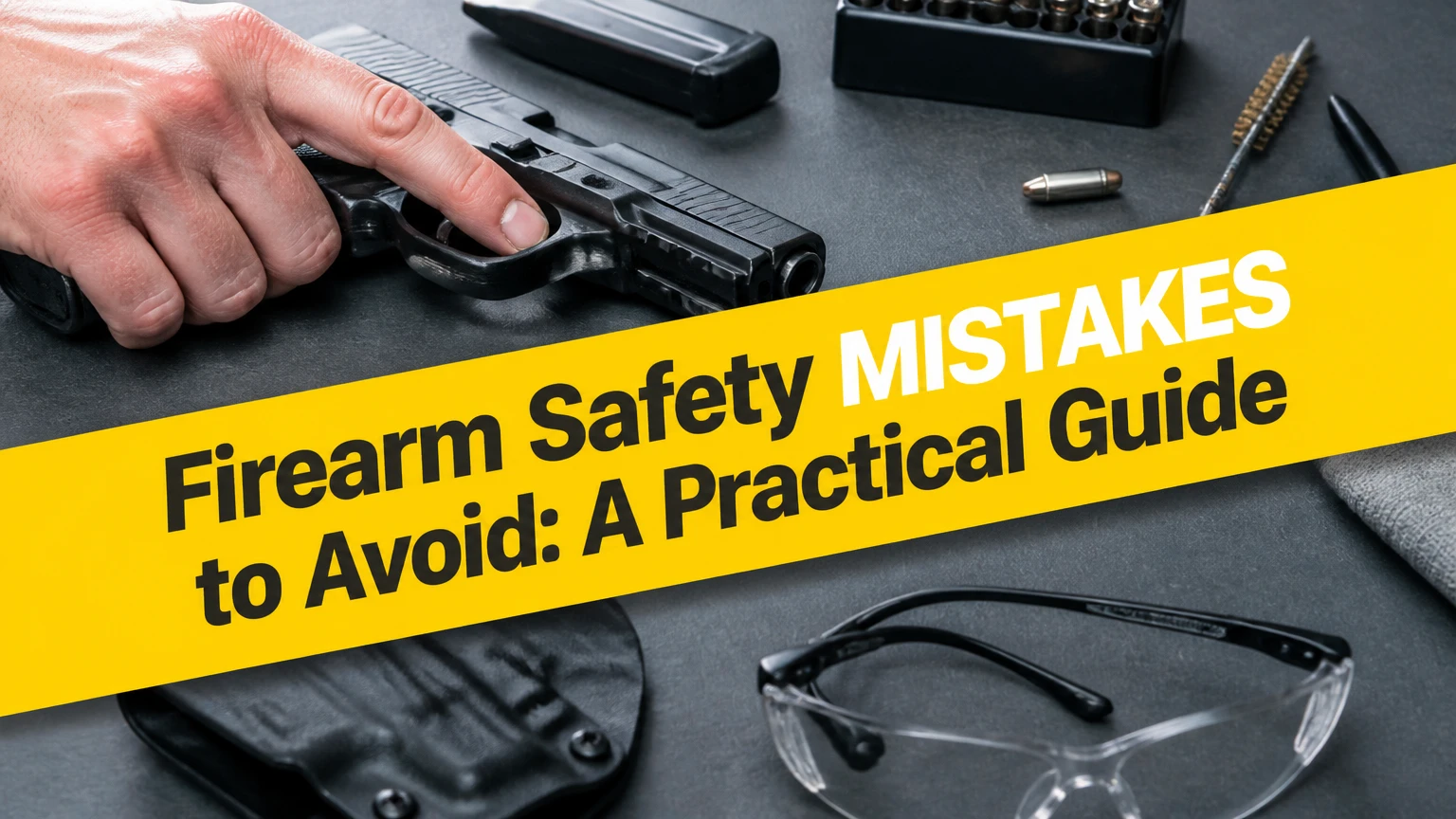
Firearm safety mistakes to avoid include treating a gun as unloaded, allowing the muzzle to cover people, touching the trigger before deciding to fire, and ignoring the target’s surroundings. Safe firearm handling uses several independent barriers: disciplined behavior, verified firearm condition, suitable ammunition, a reliable backstop, protective equipment, and secure storage.
Key Facts
A removed magazine does not prove that a semiautomatic firearm’s chamber is empty.
A manual safety is a supplemental device, not a substitute for muzzle and trigger discipline.
Safe storage must block unauthorized access, especially by children, visitors, and prohibited users.
A weak pop, abnormal recoil, or missing impact can indicate a bullet lodged in the barrel.
Hearing protection and impact-rated eye protection belong on the shooter and nearby spectators.
If a firearm’s condition is uncertain, stop handling it and ask a qualified instructor or gunsmith for help.
What Are the Four Rules of Firearm Safety?
The four widely taught firearm safety rules are to treat every firearm as loaded, keep the muzzle pointed in a safe direction, keep the trigger finger indexed until ready to fire, and identify the target and what lies beyond it. The NRA publishes substantially the same principles, including the instruction, “Always keep the gun pointed in a safe direction.”
These rules are redundant by design. If a person mistakenly touches the trigger, a safe muzzle direction can prevent injury. If a firearm unexpectedly fires, an identified backstop can contain the projectile. Redundancy does not make careless handling acceptable; it reduces the chance that one error becomes a fatal event.
Why does a firearm remain dangerous when unloaded?
A firearm remains hazardous because its condition can be misunderstood, ammunition can be hidden in the chamber, and mechanical parts can fail. “Unloaded” is not a verbal status. It is a condition verified according to the firearm’s design, manufacturer instructions, and a direct visual inspection.
The four rules apply during cleaning, dry practice, storage, transport, loading, unloading, and handoffs. A gun that was safe on a bench can become unsafe when someone picks it up, changes its direction, or inserts ammunition.
How Do You Verify That a Firearm Is Unloaded?
To verify a firearm is unloaded, point it in a safe direction, keep the trigger finger outside the trigger guard, remove the ammunition source, open the action, and visually inspect the chamber, magazine well, and applicable feed path. Follow the owner’s manual because clearing procedures differ among pistols, revolvers, rifles, and shotguns.
Use this sequence whenever practical:
- Point the muzzle in a safe direction. Choose a direction with a suitable backstop and no person, animal, or valuable object in line with the bore.
- Keep the trigger untouched. Do not press the trigger to “test” whether the firearm is loaded.
- Engage the manual safety if the design provides one. A safety can reduce risk during handling, but it cannot replace the other rules.
- Remove the ammunition source. Remove a detachable magazine, open a revolver cylinder, or unload a tube or internal magazine according to the manual.
- Open and lock the action. A slide, bolt, or action should remain open when the firearm design permits it.
- Inspect directly. Look into the chamber and feed area from a safe position. Use a flashlight when lighting is poor.
- Confirm with a qualified person if uncertain. Stop if the action does not behave normally or the firearm’s design is unfamiliar.
Do not insert a finger into a chamber as a routine substitute for visual inspection. Fingers can obstruct the view, contact sharp surfaces, or encourage handling from an unsafe angle. In darkness or when a chamber cannot be inspected confidently, maintain control and obtain professional assistance.
| Firearm type | Ammunition source | Condition to verify | Safe handling note |
|---|---|---|---|
| Semiautomatic pistol | Detachable magazine | Magazine removed and chamber visibly empty | Many pistols can fire with the magazine removed |
| Revolver | Cylinder or loading gate | Every chamber visibly empty | Check all chambers, not only the one aligned with the barrel |
| Bolt-action rifle | Internal or detachable magazine | Bolt open and chamber empty | Keep the muzzle controlled while operating the bolt |
| Pump shotgun | Tube magazine | Chamber and loading port empty | A shell may remain in the chamber after cycling stops |
| Break-action shotgun | Hinge-open action | Chamber and breech visibly empty | Keep the open muzzle pointed away from people |
Which Firearm Safety Mistakes to Avoid First?
The highest-priority firearm safety mistakes to avoid are those that can immediately place a loaded muzzle or trigger under uncontrolled conditions. Handling a firearm while impaired, pointing it at a person, assuming a removed magazine means empty, and firing without a verified backstop require immediate correction.
Mistakes during handling and loading
- Relying on the mechanical safety. Safeties can be left off, misunderstood, damaged, or defeated by an unintentional trigger press.
- Assuming the magazine is the whole ammunition supply. A chambered cartridge can remain after the magazine is removed.
- Passing a firearm without clearing it. The person receiving it should still verify the condition independently.
- Catching a dropped firearm. Let it fall while keeping people away from the muzzle; grabbing for it can reach the trigger.
- Placing a finger inside the trigger guard while moving or holstering. Keep the index finger straight against the frame or receiver.
- Pointing at a person during demonstrations. A firearm is never a pointer, prop, or joke.
- Using an unfamiliar action without instruction. Ask a range safety officer, certified instructor, or gunsmith rather than experimenting with a loaded firearm.
A practitioner rule is simple: hands should do one safety-critical task at a time. Remove ammunition before manipulating controls, and keep the muzzle fixed in a safe direction while doing so.
Mistakes during shooting
- Failing to identify the target and backstop. A target is not safe merely because it is visible. Bullets can pass through paper, wood, walls, vehicles, and brush.
- Firing at movement or sound. Positive identification must precede any trigger decision.
- Ignoring people who move downrange. Stop firing immediately when a person, animal, or unknown object enters the range area.
- Using loose clothing or unsecured accessories. Hot brass can distract a shooter, but distraction never justifies turning the muzzle toward another person.
- Shooting without eye and ear protection. Case fragments, primer material, and debris can cause eye injuries, while impulse noise can damage hearing.
- Continuing after an abnormal report. A weak pop or unusual recoil is a stop signal, not a reason to fire the next round.
What Ammunition Mistakes Cause the Most Risk?
Incorrect, damaged, contaminated, or incompatible ammunition can produce misfires, excessive pressure, firearm damage, or injury. The cartridge designation on the firearm and ammunition must match exactly where the manufacturer specifies, and ammunition should be inspected before loading.
Never rely on appearance alone. Some cartridges look similar while having different dimensions, pressure levels, or intended chambers. Examples include .223 Remington and 5.56 NATO, or .300 Blackout and 5.56 NATO. Compatibility depends on the firearm’s chamber marking and manufacturer guidance, not internet assumptions.
| Ammunition condition | Visible or audible warning | Correct response | Do not do |
|---|---|---|---|
| Wrong cartridge designation | Different label or uncertain fit | Stop and consult the manual or a gunsmith | Do not force the cartridge |
| Corroded case | Pitting, green residue, damaged primer | Segregate and ask a qualified dealer or gunsmith | Do not load it |
| Bulged or split case | Distorted brass or damaged case mouth | Dispose of it according to local guidance | Do not fire it |
| Wet or contaminated ammunition | Oil, water, dirt, or solvent exposure | Keep it out of the firearm | Do not “test” it |
| Damaged bullet | Setback, deformation, loose projectile | Remove from service | Do not reseat it casually |
| Unknown reload | No reliable components or inspection history | Use verified factory ammunition instead | Do not assume it meets factory pressure |
Ammunition should be stored cool, dry, labeled, and separate from incompatible cartridges. Cleaning solvent and oil can contaminate primers and powder, so ammunition should not be placed on a freshly lubricated work surface.
What Should You Wear and Check at a Shooting Range?
Shooters should use impact-rated eye protection, hearing protection, suitable clothing, closed-toe footwear, and equipment that cannot interfere with the trigger or action. The Centers for Disease Control and Prevention identifies firearm noise as a hearing hazard, while OSHA and NIOSH treat impulse noise as capable of causing immediate damage at high levels.
Firearms commonly produce impulse levels above 140 dB at the shooter’s position, although the exact exposure varies by firearm, ammunition, barrel, suppressor, environment, and measurement method. Electronic earmuffs improve communication but do not eliminate the need for a proper fit.
ANSI/ISEA Z87.1 markings indicate impact-performance testing for protective eyewear, but ordinary fashion glasses are not automatically ballistic protection. At indoor ranges or near high-powered firearms, wearing earplugs under earmuffs provides an additional barrier.
Before shooting, check the firearm’s visible condition, ammunition identity, magazine or loading device, holster or case, and the range’s posted commands. A range safety officer has authority to stop shooting when a safety condition changes.
How Should You Respond to a Misfire, Squib, or Malfunction?
When a firearm fails to fire or produces an abnormal report, keep the muzzle pointed in a safe direction, keep the trigger finger away, stop shooting, and follow the manufacturer’s malfunction procedure or range officer’s instructions. Do not immediately cycle the action or fire another round when a squib load is possible.
Misfire or delayed ignition
A click without a report can indicate a faulty primer, ammunition problem, or a mechanical issue. Maintain muzzle control and wait for the period specified by the owner’s manual or range procedure, because different firearms and ammunition have different manufacturer instructions. Keep your face away from the ejection port and ask a range officer for assistance.
Squib load
A squib load may produce a weak report, unusually light recoil, smoke without normal bullet impact, or a projectile that fails to reach the target. Stop immediately, keep the firearm pointed safely, and do not fire another cartridge.
A qualified person should clear and inspect the firearm. Never look through the barrel from the muzzle end, and never use an improvised object to push out a lodged projectile. A gunsmith can determine whether the barrel, action, and ammunition remain safe.
Feeding or extraction failure
A failure to feed, extract, or lock open can result from ammunition, grip, magazine, fouling, or a damaged component. Do not diagnose the problem while the firearm is pointed toward people. Stop, maintain the safe direction, unload only as trained, and refer persistent or unusual failures to a qualified gunsmith.
The AI Overview’s universal 60-second rule is not a substitute for the firearm manual or range policy. Timing guidance varies, and a person who lacks training should not continue troubleshooting a loaded firearm.
Which Storage Method Prevents Unauthorized Access?
The safest storage method is the one that prevents unauthorized access while matching the owner’s real access needs, firearm type, and household risks. A locked container or locking device should be used consistently, with ammunition secured according to local law and household circumstances.
A trigger lock is not a complete storage system when the firearm can be stolen or handled by someone who obtains the key. A cable lock can block operation, but it may not prevent removal. A safe should be anchored when its weight and design permit, because an unsecured container can be carried away.
| Storage option | Typical purchase range | Access method | Main limitation |
|---|---|---|---|
| Basic cable lock | $10-$30 | Key or combination | Can be defeated with tools and may not prevent theft |
| Trigger lock | $10-$40 | Key or combination | Must fit correctly and should not be forced onto a loaded firearm |
| Mechanical handgun lockbox | $100-$300 | Push-button or mechanical code | Usually stores one or two handguns |
| Electronic or biometric lockbox | $100-$400 | Keypad, fingerprint, or backup key | Batteries, sensors, and wet or dirty fingers can affect access |
| Full-size gun safe | $500-$2,500+ | Keypad, dial, or key | Heavy, expensive, and slower to access |
| Lockable transport case | $30-$250 | Key or combination | Must be secured and used according to transport law |
Biometric access is not automatically more reliable than mechanical access. Owners should test the chosen method periodically, maintain backup access, and prevent children or visitors from learning codes. Fire-resistant ratings also have limits; a fire-rated safe is not a guarantee that firearms or ammunition will survive every fire.
How should families reduce child access?
Families should use locked storage and prevent children from accessing keys, codes, backup keys, and unsecured ammunition. The American Academy of Pediatrics recommends that firearms be stored locked, unloaded, and separate from ammunition when they are not in use.
A conversation does not replace physical barriers. The “Stop, Don’t Touch, Leave the Area, Tell an Adult” message can give children a response plan, but adults remain responsible for access control. Ask about firearm storage before children visit another home.
What Are the Safe Rules for Transport and Carry?
Transport a firearm unloaded, secured against unauthorized access, and contained in a case appropriate to the firearm and local law. Concealed carry requires a rigid holster that fully covers the trigger guard, retains the firearm during normal movement, and prevents foreign objects from reaching the trigger.
Do not carry a handgun loose in a pocket, purse, backpack, glove compartment, or vehicle console. Keys, clothing, pens, and other objects can enter the trigger area. A holster should remain attached to the body or a designed carry platform rather than being removed with the firearm still inside.
Transport rules vary substantially by jurisdiction, including requirements for locked cases, ammunition separation, loaded magazines, vehicle placement, and stops during travel. Check the current rules from the relevant state police, attorney general, or other official authority before crossing state lines.
| Situation | Minimum safe practice | Added concern | Better control |
|---|---|---|---|
| Range trip | Unloaded firearm in a closed case | Unauthorized access in vehicles | Lock the case when required or practical |
| Long-distance vehicle travel | Follow every jurisdiction’s transport law | Heat, theft, and unattended vehicles | Keep the firearm out of sight and with the responsible adult |
| Concealed carry | Rigid holster covering the trigger guard | Foreign objects and poor retention | Test fit and retention before carrying |
| Air travel | Follow current airline and federal requirements | Declaration and case rules | Verify directly with the airline and TSA |
| Temporary storage in a hotel | Locked container under the owner’s control | Housekeeping and visitors | Use a portable lockbox and do not leave it visible |
When Should Someone Refuse to Handle a Firearm?
A person should refuse to handle or fire a firearm when impaired, angry, fatigued, unfamiliar with the platform, pressured by others, or unable to identify a safe direction and backstop. Alcohol, cannabis, recreational drugs, and some prescription medicines can affect judgment, coordination, reaction time, or perception.
The safest decision is to stop and secure the situation. Hand the firearm to a qualified instructor or range officer only when the transfer itself can occur safely; otherwise, keep the muzzle controlled and call for professional assistance.
Do not modify a defensive firearm’s trigger, safety, firing-control parts, or drop-protection features without competent gunsmith evaluation. An unusually light trigger can reduce the margin for error during stress, gloves, movement, or startled reactions. Factory specifications and a documented professional inspection are safer than improvised modifications.
What Dry-Fire Mistakes Should You Avoid?
Dry-fire practice should occur only with a firearm confirmed unloaded, all live ammunition removed from the room, a safe direction selected, and the manufacturer’s instructions followed. Some firearms, especially certain rimfire designs or specific older mechanisms, can be damaged by dry firing without approved snap caps or other manufacturer-authorized equipment.
Use a fixed routine:
- Remove all ammunition and magazines from the practice area.
- Inspect the chamber and action.
- Move to a location where an unintended discharge would not injure anyone.
- Confirm the firearm’s manual permits dry firing.
- Keep the muzzle controlled and the finger indexed until the intended practice action.
- Stop when live ammunition returns to the room, then repeat the clearing process.
Dry fire does not make a firearm safe for casual pointing. It trains manipulation, so poor dry-fire habits can reinforce unsafe muzzle movement and trigger behavior.
What Should Beginners, Hunters, and Homeowners Do Differently?
The core rules never change, but the hazards change by context. Beginners need supervised instruction, hunters need target and movement identification, home-defense owners need access control and a documented plan, and families need layered barriers that do not depend on a child’s judgment.
- Beginners: Take an in-person course with a qualified instructor before loading or firing. Learn the specific firearm’s controls from its manual rather than from a generic video.
- Hunters: Identify the species, direction of travel, companions, and background before mounting or firing. Treat brush and a skyline as poor target environments.
- Homeowners: Decide storage, emergency communication, and family responsibilities before a crisis. A loaded firearm left on a nightstand is not secure storage when children or visitors can enter.
- Concealed carriers: Use a purpose-built holster that covers the trigger guard. Do not reholster around foreign objects, and seek instruction for drawing and holstering.
- Parents and hosts: Ask where firearms are stored before allowing children to visit. If the answer is uncertain, change the plan.
What Should You Do After a Safety Violation?
After a safety violation, stop shooting, keep the firearm pointed in a safe direction, place the firearm in a safe condition only if trained to do so, and notify the range officer or instructor. Do not conceal the mistake or continue because no injury occurred.
A near miss reveals a failed barrier. Record what happened, including the firearm condition, ammunition, environment, human action, and equipment involved. Correct the system before resuming: improve instruction, change storage, replace damaged equipment, separate ammunition, or end the session.
If someone is injured, call emergency services, secure the area without creating another hazard, and apply appropriate first aid if trained. A firearm injury can be life-threatening even when the wound appears small.
Firearm Safety Mistakes to Avoid: Quick Reference
The most effective prevention system combines the four rules with verified unloading, compatible ammunition, safe storage, protective equipment, impairment avoidance, and professional help for anomalies. Firearm safety mistakes to avoid are usually ordinary shortcuts that remove one of those barriers.
| Risk area | Mistake | Replacement behavior | Verification |
|---|---|---|---|
| Muzzle | Pointing at a person or unsafe surface | Maintain a safe direction | Identify a suitable backstop |
| Trigger | Finger inside the guard while moving | Index finger along the frame | Check before every movement |
| Condition | Trusting a verbal claim or removed magazine | Open and inspect the action | Confirm chamber and feed path |
| Ammunition | Using an uncertain or damaged cartridge | Match markings and inspect rounds | Stop when compatibility is unclear |
| Malfunction | Cycling and firing after a weak report | Stop and seek trained assistance | Inspect for a possible obstruction |
| Storage | Leaving access to children or visitors | Lock firearm and control keys or codes | Test the storage routine |
| Transport | Carrying loose in a vehicle or bag | Use a suitable closed case or holster | Check local transport law |
| Judgment | Handling while impaired or angry | End the session | Resume only when fit and calm |
Expert insights that prevent repeat failures
- A chamber check is a process, not a glance. The most common verification error is checking only the magazine. The chamber, feed path, and cylinder chambers must match the firearm’s design.
- Access speed and security are opposing design pressures. A rapid-access lockbox is useful only when it remains locked and tested; a high-security safe is unsuitable if its owner routinely leaves the firearm outside because access is inconvenient.
- A malfunction is information. A weak report, unusual recoil, or failure pattern should change the shooter’s plan immediately. Continuing to fire converts an uncertain mechanical condition into a predictable hazard.
Frequently Asked Questions
Is a gun safe if the safety is on?
No. A manual safety reduces the chance of a trigger-actuated discharge, but it can be disengaged, misunderstood, damaged, or absent from the design. Keep the muzzle pointed safely, keep the trigger finger indexed, and treat the firearm as loaded until its condition is independently verified.
Can a firearm fire without a magazine?
Yes, many semiautomatic firearms can fire a chambered cartridge after the magazine is removed. Some designs include magazine-disconnect features, but owners must not assume that feature exists or works correctly. Remove the magazine, open the action, and inspect the chamber according to the manufacturer’s instructions.
How often should firearm storage locks be checked?
Check storage locks during setup and periodically afterward, with a practical interval of at least monthly for frequently used equipment. Test batteries, codes, hinges, cables, anchors, and backup keys. Replace any lock that does not close, latch, or release predictably under controlled conditions.
Are regular glasses enough for shooting?
Regular glasses are not automatically suitable for shooting because they may lack impact testing, side coverage, or adequate retention. Use eye protection marked for an applicable impact standard, such as ANSI/ISEA Z87.1, and choose coverage appropriate to the range, firearm, and activity.
What is the safest response when a firearm is dropped?
Do not try to catch a falling firearm. Allow it to fall, keep people away from the muzzle, and wait until it is stable before handling it with the four safety rules applied. If its condition or damage is uncertain, leave it alone and ask a range officer or gunsmith for assistance.
Should ammunition be stored separately from a firearm?
For long-term household storage, storing ammunition separately from the firearm adds a safety barrier and follows guidance commonly recommended by public-health and safety organizations. Local law and the owner’s situation may differ. Whatever arrangement is used, unauthorized people must not be able to access either the firearm or ammunition.
The Bottom Line
Firearm safety mistakes to avoid are preventable when owners use redundant controls instead of relying on memory, a safety lever, or another person’s assurance. Treat every firearm as loaded, control the muzzle, keep the trigger finger indexed, verify the target and backstop, secure access, and stop immediately when ammunition or mechanical behavior is uncertain.