Firearm safety for teenagers combines safe storage, consistent handling rules, adult supervision, and direct planning for peer pressure and mental-health crises. The most reliable protection is layered: keep firearms unloaded and locked, secure ammunition and access credentials, teach teens never to touch an unfamiliar gun, and require immediate reporting to a trusted adult.
Key Facts at a Glance
The safest storage condition is unloaded, locked, and inaccessible to unauthorized users, including teenagers.
A teenager who finds a firearm should stop, avoid touching it, leave the area, and tell a trusted adult.
Hiding a firearm is not the same as securing it because children and visitors may discover hiding places.
A cable or trigger lock should not replace locked storage when a teenager or visitor could reach the firearm.
During a suicide or violence concern, adults should immediately remove access to firearms and ammunition and contact emergency or crisis services.
Firearm age, transport, storage, and supervised-use laws differ by jurisdiction, so local rules must be checked.
What Does Teen Firearm Safety Include?
Teen firearm safety is a prevention system with four connected parts: physical access control, safe behavior, competent adult supervision, and communication about risk. A safety lecture alone cannot compensate for an accessible loaded firearm, and a lock alone cannot replace a teen knowing what to do when an unsecured gun appears elsewhere.
The American Academy of Pediatrics stated in its firearm policy guidance, “The safest home for a child is one without a gun.” Families that keep firearms should therefore treat storage as the primary control, not as an optional supplement to education. The CDC identifies firearms as a leading cause of death among U.S. children and adolescents ages 1-19, with intentional and unintentional circumstances both contributing to the burden.
The goal is not to make a teenager feel like a trained adult after one class. The goal is to prevent access, interrupt unsafe behavior, and create a predictable response under stress.
What Are the Four Basic Firearm Rules?
The four basic rules are to treat every firearm as loaded, keep the muzzle pointed in a safe direction, keep the finger outside the trigger guard until ready to fire, and identify the target and what lies beyond it. Teenagers should apply the same rules to unfamiliar firearms, even when someone claims that a gun is unloaded.
| Rule | Observable teen behavior | Why it matters | Adult verification |
|---|---|---|---|
| Treat every gun as loaded | Never test, handle, or demonstrate an unfamiliar gun | “Unloaded” status may be misunderstood or changed | Teen explains without touching |
| Safe muzzle direction | Keep the barrel away from people and valuable property | A discharge can injure beyond the immediate room | Adult watches supervised handling |
| Finger off trigger | Rest the trigger finger straight along the frame | Startle reactions can cause negligent discharges | Adult checks finger position |
| Know target and beyond | Do not fire without a lawful target and safe background | Bullets can pass through or miss a target | Certified instructor evaluates |
These rules are handling principles, not permission to handle a gun. A teenager who finds a firearm without an adult present should not attempt to unload, clear, photograph, or relocate it.
What Should a Teen Do After Finding a Firearm?
A teenager who finds an unattended firearm should stop, avoid touching it, leave the area, and tell an adult immediately. The teen should treat a handgun, rifle, airsoft gun, BB gun, and realistic replica as potentially dangerous until a responsible adult or emergency professional makes the situation safe.
Use a short script that is easy to remember:
- Stop. Freeze and do not approach.
- Do not touch. Keep hands, clothing, and objects away from the firearm.
- Leave. Move away and keep other children away without confronting someone holding it.
- Tell. Report the exact location to a parent, teacher, school administrator, police officer, or another trusted adult.
If the firearm is at school, in a public area, or near someone behaving dangerously, the teen should create distance and call emergency services when safe. If the firearm is at a friend’s home, the teen can leave and call a parent, rather than relying on the friend’s assurances.
Adults should avoid blaming the reporting teen. A calm response increases the chance that the teenager will report the next dangerous discovery.
How Should a Household Store Firearms?
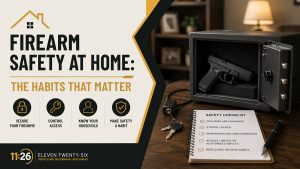
A household with teenagers should store every firearm unloaded, locked in a secure container, and inaccessible to unauthorized people, while storing ammunition locked separately when practical. The responsible adult should control keys, combinations, biometric enrollment, and backup access; a teenager should not know or guess the access code unless a specific lawful training arrangement has been evaluated by the parent and instructor.
The storage system must withstand ordinary attempts to access it. A locked bedroom drawer, a high closet shelf, or a container hidden under clothing does not meet that standard if a teen can locate or defeat it.
Which Storage Method Fits the Household?
No single lock works for every purpose. A bedside lockbox favors rapid authorized access, while a heavy safe provides better theft resistance but usually takes longer to open.
| Storage method | Typical cost | Typical capacity | Main strength | Main limitation |
|---|---|---|---|---|
| Cable lock | $10-$30 | 1 firearm | Low cost and portability | Does not prevent theft or secure every design |
| Trigger or chamber lock | $10-$40 | 1 firearm | Blocks firing mechanism | Must fit correctly; firearm condition still matters |
| Small steel lockbox | $40-$180 | 1-2 handguns | Faster controlled access | Limited theft and fire resistance |
| Biometric lockbox | $80-$250 | 1-2 handguns | Fingerprint entry and quick access | Batteries, recognition errors, and backup keys require testing |
| Full-size steel safe | $400-$2,500 or more | 5-30 firearms | Theft resistance and organized storage | Cost, weight, space, and slower access |
| Lockable storage cabinet | $150-$900 | 3-20 firearms | Moderate capacity and visibility control | Construction varies widely by model |
A trigger or cable lock is useful for transport or as an additional barrier, but it is not a universal substitute for a locked safe. A lockbox marketed as “biometric” may still fail when a battery is depleted, a finger is wet, or the sensor does not recognize the enrolled print. Every access method needs a tested backup plan that does not place the key or override code where teenagers can find it.
How Much Does Safe Storage Cost?
A basic single-firearm setup typically costs $20-$100, while a secure multi-firearm arrangement commonly costs $400-$2,500 or more. Typical cost depends on the number of firearms, theft resistance, fire rating, installation, and whether ammunition receives a separate locked container.
| Household need | Typical setup | Typical initial cost | Review interval |
|---|---|---|---|
| One stored handgun | Steel lockbox plus separate ammunition container | $60-$250 | Monthly |
| Several sporting firearms | Full-size safe with internal lockbox | $500-$2,500+ | Monthly |
| Transport to a range | Unloaded case plus compliant lock | $30-$180 | Before every trip |
| Crisis-period access removal | Safe storage away from the home or trusted lawful custodian | $0-$300 | Daily until risk resolves |
Prices are market ranges, not legal requirements. A low-cost lock that is consistently used is safer than an expensive safe left open, but the inexpensive option may provide less protection against theft or forced entry.
Why Is Hiding a Firearm Not Safe Storage?
Hiding a firearm is weaker than locking it because secrecy does not block access, theft, discovery, or a visitor’s curiosity. Teens may observe where adults place firearms, learn locations from siblings or friends, or find a weapon during cleaning, moving, or an emergency.
A practical home audit takes about 10 minutes:
- List every firearm, including inherited, antique, disabled, and rarely used guns.
- Record the storage location without writing access codes in the same place.
- Confirm that each firearm is unloaded and secured.
- Confirm that ammunition is locked and inaccessible.
- Test the safe, lock, battery, hinge, cable, and backup key.
- Check garages, vehicles, bedside furniture, bags, and temporary storage areas.
- Repeat the audit after visitors, travel, maintenance, or a change in household relationships.
The most common failure is temporary access. An adult removes a gun from the safe for cleaning or a range trip, places it on a nightstand, and forgets it during a phone call. The prevention rule is simple: the firearm returns to locked storage before attention moves elsewhere.
How Should Adults Teach Without Creating False Confidence?
Adults should teach recognition, refusal, and reporting before teaching operation. A teen who understands how a firearm works may still lack the judgment, legal authority, and emotional control required for unsupervised handling.
Use a direct conversation rather than a dramatic warning. Explain that firearms are not toys, that an unfamiliar gun must never be touched, and that reporting a dangerous adult or friend is protective rather than disloyal. Ask the teen to repeat the four-step response and practice the words they would use: “There is a gun in the garage. I did not touch it.”
Avoid claiming that a teenager becomes safe after a fixed number of repetitions. The AI Overview’s suggestion of 1,000 dry repetitions or 3-6 months of practice is not a general evidence-based threshold. Readiness depends on instruction quality, observed behavior, local law, the firearm type, household access, and the teen’s response to distraction and peer pressure.
What Does a Safe Training Progression Look Like?
A safe progression moves from verbal recognition to supervised instruction, with each stage requiring consistent behavior rather than a calendar date. Formal training should come from a qualified instructor or recognized program, such as a state-approved hunter education course or an established range safety program.
| Stage | Permitted activity | Minimum control | Advancement evidence |
|---|---|---|---|
| Recognition | Discuss parts, rules, and emergency response | No firearm handling | Correctly recites response |
| Supervised handling | Instructor-directed handling of an unloaded firearm | Adult within arm’s reach | Repeated rule compliance |
| Supervised shooting | Lawful range or hunting activity | Qualified adult maintains control | Safe behavior under noise and distraction |
| Advanced participation | Transport or use allowed by local law | Parent and instructor approval | Consistent competence and mature judgment |
The exact age for hunting, possession, transport, or range use varies by state, province, country, firearm type, and activity. A course certificate does not override a jurisdiction’s law or a parent’s responsibility to control access.
What Rules Apply in Hunting and Sporting Households?
Hunting and sporting households should use direct supervision, locked transport, range-specific commands, and a written privilege progression. A teen should never handle a firearm alone merely because the teen completed a class or has used the firearm successfully before.
Before each activity, the supervising adult should confirm the firearm’s condition, ammunition compatibility, eye and hearing protection, weather, backstop, communication plan, and emergency route. During a hunt, the adult should control loading and unloading decisions until the teen has demonstrated reliable muzzle and trigger discipline in the exact environment.
Transport requirements vary, but a conservative baseline is an unloaded firearm inside a locked case, with ammunition secured according to local law and the vehicle kept under adult control. A firearm should not be left in an unattended vehicle, even when hidden.
Range safety differs from home safety. Ear protection, eye protection, cease-fire commands, and a defined firing line become additional controls, not replacements for locked storage.
How Should Families Handle Friends’ Homes and Sleepovers?
Parents should ask other adults whether firearms are present and securely stored before permitting a sleepover. The question can be direct: “Are there firearms in the home, and are all of them unloaded and locked so children cannot access them?”
The National Shooting Sports Foundation’s Project ChildSafe program and pediatric safety organizations encourage secure storage conversations because families cannot assess another home by appearance. A teenager may also need permission to leave a visit without negotiating with a friend.
Give the teen a non-embarrassing exit plan. The teen can text a code word, call for pickup, or say, “I need to go home now,” without explaining the firearm concern in front of peers. If the teen sees an unsecured gun, the correct response remains stop, do not touch, leave, and tell.
Are Airsoft Guns, BB Guns, and Replicas Safe?
Airsoft guns, BB guns, pellet guns, and realistic replicas can cause injury, provoke a dangerous response from police, or teach unsafe handling habits when treated casually. They should be stored separately from real firearms, used only with appropriate eye protection, and handled under clear adult rules.
Never modify a replica to resemble a different firearm, carry it in public, or point it at a person outside a controlled activity. Real firearms and replicas should never share an unlocked drawer, range bag, or display area because a rushed person may misidentify one.
The handling standard should be consistent: muzzle away from people, finger outside the trigger guard, eye protection in the activity area, and immediate adult reporting for any unknown weapon.
What If a Teen Is Suicidal, Threatening Violence, or Experiencing a Crisis?
A firearm-access crisis requires immediate action, not a promise that the teenager will behave responsibly. Adults should remove firearms and ammunition from the home or place them under lawful control of a trusted adult or authorized storage provider, while contacting emergency or mental-health services.
The CDC reports that firearm suicide is a major contributor to firearm deaths among young people. Access can change the outcome of an impulsive crisis, so temporary removal should occur even when the teenager has not made a specific plan.
If someone faces immediate danger in the United States, call 911. For suicidal thoughts or emotional crisis, call or text 988. Other countries should use their local emergency and crisis services.
Warning signs requiring urgent attention include a stated wish to die, a specific plan, access-seeking behavior, threats toward another person, severe intoxication, psychosis, abrupt goodbye messages, or a recent attempt. Do not leave the person alone while waiting for professional help, and do not ask the teen to guard the firearm or promise secrecy.
What Should Adults Do When Storage Fails?
Adults should first prevent access, then repair the system that allowed the failure. If a safe is open, a key is missing, a code has been shared, or a firearm is found outside storage, secure the firearm immediately and document what changed.
| Failure | Immediate response | Permanent correction | Follow-up |
|---|---|---|---|
| Safe left open | Remove firearm and lock it | Add a close-and-check routine | Audit for 7 days |
| Teen learns code | Change code immediately | Use separate adult-controlled credentials | Check access logs if available |
| Missing key | Secure firearm elsewhere | Replace lock or rekey container | Record new key location |
| Dead biometric battery | Use tested backup access | Replace batteries on schedule | Test monthly |
| Gun left in vehicle | Recover and secure firearm | Use a locked case and vehicle checklist | Review local transport law |
| Visitor brings unsecured gun | Separate children and firearm | Establish a visitor storage rule | Discuss before next visit |
A camera can document activity, but it cannot physically stop access and may create privacy or cybersecurity concerns. Physical barriers, adult control, and a repeatable checklist deserve priority.
What Are the Legal and Training Checks?
Families must verify local rules for juvenile possession, hunting age, range participation, firearm transport, safe-storage mandates, reporting duties, and temporary transfer. Laws can differ between neighboring jurisdictions and may change after a court decision or legislative update.
Use official sources first: the state wildlife agency, state police or attorney general, local court or legislative website, and the training provider’s current rules. A commercial course page can explain instruction but may not accurately summarize every legal restriction.
Training should match the activity. Hunter education addresses hunting law, wildlife ethics, field behavior, and firearm handling. A range orientation addresses that facility’s commands and procedures. Neither automatically qualifies a teen for independent possession or transport.
FAQ
Should ammunition be stored separately from the firearm?
Separate locked ammunition storage adds a barrier and reduces the chance that an unauthorized person can immediately use a firearm. Local law may specify different requirements, but a practical household policy is to store unloaded firearms and ammunition in separate locked containers, with keys and codes controlled by an adult.
Can a teenager keep a firearm for self-defense?
A teenager should not receive independent defensive responsibility merely because a firearm is present in the home. Legal possession, training, maturity, storage, and emergency decision-making differ by jurisdiction. Parents should consult qualified local counsel and a certified instructor, while prioritizing locked storage and a household emergency plan.
What is the safest response if a friend refuses to leave a gun alone?
The teen should move away, avoid arguing or physically intervening, and tell an adult immediately. If the friend is pointing the firearm, threatening someone, or handling it recklessly, the teen should create distance and contact emergency services when safe.
How often should a family test its gun safe?
A monthly check is a practical minimum for locks, batteries, hinges, access codes, and backup keys, with an additional check before travel or a range trip. Families should test more often when the safe is used daily, the battery is unreliable, or household access has changed.
Does a firearm safety class make a teenager ready for unsupervised use?
No. A class can provide essential knowledge, but readiness also requires lawful authorization, reliable behavior, direct observation, emotional stability, and secure household controls. A certificate should begin a supervised progression, not automatically grant independent access.
What should a non-shooting family do if it does not own guns?
Teach the four-step response, ask about firearm storage before sleepovers, and give the teen a private pickup plan. A non-shooting household can also contact local child-safety organizations or public-health departments for age-appropriate firearm awareness resources.
The Bottom Line
Firearm safety for teenagers depends first on preventing unauthorized access, then on teaching a simple response for any firearm found outside adult control. Keep every firearm unloaded and locked, secure ammunition and credentials, supervise lawful training, ask about friends’ homes, and remove access immediately during a mental-health or violence crisis. Layered protection is more dependable than secrecy, confidence, or a single safety lecture.