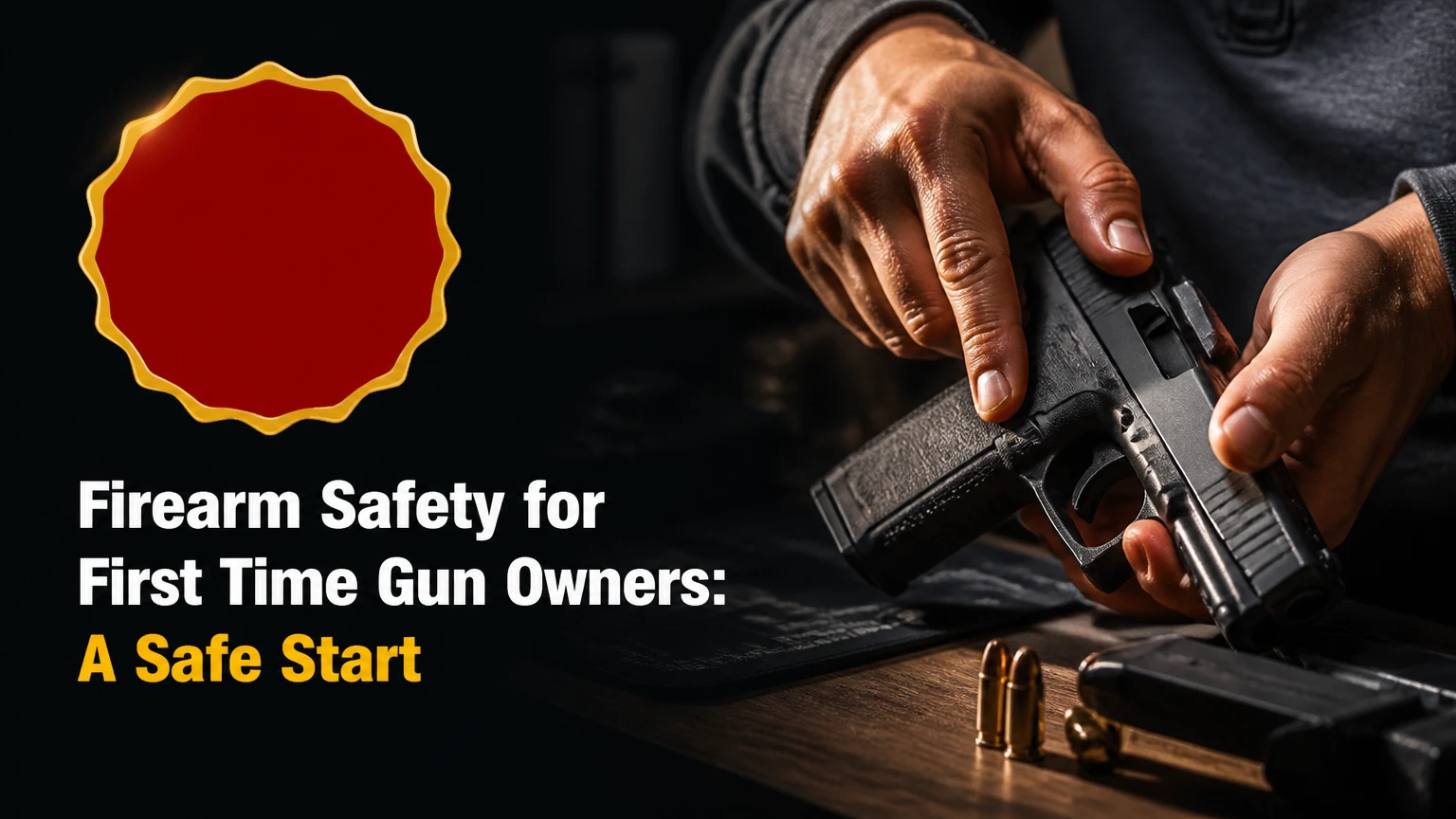
Firearm safety for first time gun owners is a system of behavior, secure storage, training, and mechanical controls that reduces the chance of injury or unauthorized access. The essential starting point is consistent application of the four universal rules, followed by firearm-specific instruction from the owner’s manual and a qualified instructor.
Key facts at a glance
Every firearm must be treated as loaded until the owner personally verifies its condition.
A removed magazine does not prove that a semiautomatic firearm has an empty chamber.
A manual safety can reduce some risks, but it cannot replace muzzle control and trigger-finger discipline.
A firearm in a home should be locked against unauthorized access whenever an authorized user is not directly controlling it.
Hearing and eye protection are required at shooting ranges because one unprotected shot can cause permanent hearing damage.
A weak report, unusual recoil, or failure to fire requires stopping immediately until the firearm is inspected.
What Does Firearm Safety Include?
Firearm safety includes four connected controls: safe handling, correct ammunition, secure storage, and competent training. A safe owner controls where the muzzle points, keeps the trigger untouched until firing is intentional, verifies the target and its surroundings, and prevents unauthorized access when the firearm is unattended.
A firearm’s firing sequence begins when the trigger releases a component in the action. A hammer or striker then impacts the cartridge primer, which ignites the propellant; expanding gas drives the projectile through the barrel. The chamber holds the cartridge, the action supports and cycles the firing mechanism, and the muzzle is the barrel’s forward opening.
Mechanical features such as trigger blocks, firing-pin blocks, grip safeties, and drop-safety systems add resistance to unintended firing. They are not force fields. A safety lever may be disengaged accidentally, a damaged component may fail, and a firearm can still injure someone through negligent muzzle direction even when no shot occurs.
The National Shooting Sports Foundation, or NSSF, summarizes the central standard as: “Always keep the gun pointed in a safe direction.” That rule remains meaningful during loading, unloading, cleaning, transport, and storage.
Why layered safety matters
Safe ownership uses independent barriers. If a person mistakenly touches the trigger, muzzle direction should still protect people; if the muzzle briefly moves, the trigger finger should remain indexed; if both human controls fail, secure storage should prevent unauthorized handling.
This layered approach explains why “accidental discharge” is an incomplete phrase. A mechanical event may be unintentional, but preventable injuries usually involve a chain of unsafe decisions, poor storage, unfamiliarity with the firearm, or ignored warning signs.
What Are the Four Universal Rules?
The four universal firearm safety rules are to treat every firearm as loaded, keep the muzzle pointed in a safe direction, keep the trigger finger outside the trigger guard until ready to fire, and identify the target and what lies beyond it. Apply all four simultaneously, including when a firearm appears unloaded.
Rule 1: Treat every firearm as loaded
Handle an unfamiliar firearm as loaded until you personally verify its condition using the manufacturer’s instructions. Do not rely on another person’s statement, an open action observed from a distance, or a magazine that appears empty.
The rule changes behavior before verification. The owner picks up the firearm with the muzzle controlled, avoids the trigger, and asks for help rather than manipulating an unfamiliar action quickly.
Rule 2: Control the muzzle
Point the muzzle only toward an area that can safely contain a projectile. At a range, that usually means downrange toward the backstop; in a home, there may be no universally safe direction because bullets can penetrate drywall, doors, floors, and ceilings.
A safe direction is not automatically “down.” Floors may conceal people, utilities, or living spaces. The correct direction depends on the building, backstop, nearby people, and the firearm’s potential penetration.
Rule 3: Keep the trigger finger indexed
Keep the trigger finger straight and visibly outside the trigger guard until the sights are on the intended target and the decision to fire has already been made. Resting the finger on the frame or receiver provides a repeatable physical position.
This rule matters during loading, unloading, drawing, holstering, clearing a malfunction, and responding to a dropped firearm. A startled person often contracts the hand, which is why the trigger finger must move before the stressful event occurs.
Rule 4: Know the target and what is beyond it
Identify the target, the area in front of it, and the area behind it before firing. A paper target does not stop a projectile by itself, and a household object, vehicle, or thin wall may not provide adequate containment.
At a range, follow the posted firing direction and use the designated backstop. On private land, confirm the legal shooting area, property boundaries, nearby roads, occupied buildings, livestock, and possible ricochet surfaces.
How Do You Clear a Firearm Safely?
To clear a firearm, control the muzzle, remove the ammunition source, open and lock the action when the design allows it, and confirm the chamber and feed path are empty according to the owner’s manual. Never insert a finger into a chamber to check it; use a visual inspection, chamber flag, or qualified instructor.
The exact sequence varies by firearm. A revolver, semiautomatic pistol, bolt-action rifle, lever-action rifle, and shotgun do not all unload in the same way. The manufacturer’s manual controls when it differs from a general procedure.
Step 1: Establish control
Keep the muzzle in a safe direction, remove your finger from the trigger guard, and place the firearm on a stable surface only if the manual permits that handling position. Tell nearby people that you are clearing the firearm.
Success checkpoint: The muzzle remains controlled and the trigger finger stays indexed.
Common mistake: Turning toward another person while searching for a control.
Step 2: Remove the ammunition source
For a detachable-magazine firearm, remove the magazine completely. For a revolver, open the cylinder and follow the manual’s unloading procedure. For a tube-fed rifle or shotgun, unload the cartridges using the specified action and loading-port controls.
Success checkpoint: No detachable magazine or external ammunition source remains attached.
Common mistake: Assuming magazine removal emptied the chamber.
Step 3: Open and secure the action
Open the slide, bolt, cylinder, or action as directed by the manual. Lock it open if the firearm’s design provides a reliable open position. Do not place a hand near the muzzle while manipulating the action.
Success checkpoint: The action is visibly open, and any ejected cartridge is identified as live ammunition and handled safely.
Common mistake: Closing the action before checking the chamber.
Step 4: Inspect without touching the chamber
Look into the chamber, magazine well, feed area, and ejection port from a safe position. Use a flashlight or chamber flag when appropriate. Do not insert a finger, cleaning rod, or other object into the chamber during a basic safety check.
Success checkpoint: The chamber and feed path are visibly empty, and the action remains open.
Common mistake: Relying on a tactile check that can place a finger near sharp or moving components.
Step 5: Stop when the condition is uncertain
If the action will not open, a cartridge appears damaged, or you cannot identify the firearm’s controls, stop handling it and seek a range safety officer, gunsmith, or certified instructor. Do not force a stuck action or experiment with an unfamiliar mechanism.
| Firearm type | Ammunition source | Primary empty-condition check | Beginner caution |
|---|---|---|---|
| Semiautomatic pistol | Detachable magazine | Open slide, inspect chamber and magazine well | Magazine removal may leave a chambered round |
| Revolver | Individual cylinder chambers | Open cylinder, inspect every chamber | Do not assume one empty chamber means all are empty |
| Bolt-action rifle | Internal or detachable magazine | Open bolt, inspect chamber and magazine area | Keep the muzzle controlled while cycling the bolt |
| Pump-action shotgun | Tubular magazine | Open action, inspect chamber and loading port | Shells may remain in the tube after one is ejected |
| Lever-action rifle | Tubular or internal magazine | Open action, inspect chamber and loading area | Use the manual for model-specific unloading order |
What Does a Mechanical Safety Do?
A mechanical safety blocks or interrupts part of the firing system, but its exact function differs by model and its position does not prove that the firearm is unloaded. Owners should learn the safety, decocker, loaded-chamber indicator, magazine disconnect, and action controls from the manual before handling ammunition.
Some firearms have a manual lever. Others rely on internal drop-safety components, a grip safety, a trigger-blade safety, a decocking lever, or no user-operated safety at all. “Safety on” and “unloaded” describe different conditions.
| Feature | Typical function | What it does not prove | Beginner action |
|---|---|---|---|
| Manual safety lever | Blocks trigger or sear movement on specified models | Chamber is empty | Verify condition using the manual |
| Decocker | Lowers a hammer safely on compatible designs | Firearm cannot fire afterward | Keep muzzle directed safely |
| Loaded-chamber indicator | Shows a cartridge may be present | Indicator is functioning correctly | Inspect according to the manual |
| Trigger-blade safety | Helps prevent some rearward trigger movement | Firearm is drop-proof in every condition | Keep finger outside guard |
| Magazine disconnect | May prevent firing without a magazine | Chamber is empty | Treat chamber as loaded until checked |
Mechanical features also require maintenance. Dirt, wear, damage, incorrect parts, or an unrecognized control position can change how a firearm behaves. A qualified gunsmith should inspect a firearm that has been dropped, modified, exposed to corrosion, or involved in an unusual discharge.
Which Storage Method Fits Your Household?
The best firearm storage method is the one that prevents unauthorized access, matches the household’s access needs, and remains locked consistently. A cable lock may satisfy a basic barrier requirement, while a bolted quick-access safe provides stronger theft resistance and faster authorized access.
Storage is a risk-control decision, not an accessory purchase. Consider children, roommates, guests, visitors, theft risk, fire exposure, accessibility needs, and whether the firearm is stored unloaded.
| Storage option | Typical price | Typical opening time | Best use | Main limitation |
|---|---|---|---|---|
| Trigger or cable lock | $10-$30 | 10-30 seconds | Transport and low-cost access prevention | Weak theft resistance |
| Locking hard case | $25-$100 | 10-60 seconds | Transport and temporary storage | Often portable and easy to steal |
| Mechanical push-button safe | $120-$350 | 2-5 seconds | Dependable quick access without batteries | Limited capacity |
| Electronic or biometric safe | $100-$400 | 2-10 seconds | Quick access with user authentication | Batteries, sensors, and electronics can fail |
| Full-size steel safe | $400-$3,000 or more | 10-60 seconds | Theft and fire protection for multiple firearms | Heavy, expensive, and slower to open |
A lock should not be installed in a way that leaves a loaded firearm able to fire, unless the firearm and lock manufacturer specifically approve that configuration. Read both manuals. A poorly fitted lock can damage the firearm or fail to prevent access.
How should ammunition be stored?
Ammunition should remain in its original labeled packaging or a suitable purpose-built container, away from heat, moisture, chemicals, and unauthorized users. Store ammunition so its caliber and cartridge type remain identifiable, and never combine unidentified cartridges with a firearm.
Separate firearm and ammunition storage can add a useful access barrier, especially in homes with children or visitors. The correct legal arrangement varies by jurisdiction and household circumstances. State and local rules may specify locked containers, transport conditions, or separate storage.
Project ChildSafe uses the concise storage principle: “The safest way to store a firearm is unloaded, locked, and separate from ammunition.” That advice is a baseline, not a substitute for local law or a household-specific emergency plan.
How Should a Beginner Prepare for the Range?
A first range visit should include a safety orientation, eye and hearing protection, the firearm’s manual, compatible ammunition, and enough time to stop when confused. A private introductory lesson typically lasts 60-120 minutes, while a first supervised practice session commonly takes 1-2 hours.
Before arriving, call the range and ask about firearm rentals, ammunition restrictions, target size, lane rules, required identification, holster restrictions, and whether first-time users must receive a briefing. Some ranges prohibit privately supplied ammunition or require factory-loaded cartridges.
| Item | Typical beginner quantity or cost | Purpose | Selection rule |
|---|---|---|---|
| Eye protection | $10-$40 | Protects against fragments and debris | Use impact-rated eyewear |
| Electronic hearing protection | $25-$150 | Reduces impulse noise and preserves communication | Wear it before entering the firing area |
| Paper targets | $1-$5 each | Provides a clear aiming reference | Follow range-approved dimensions |
| Factory ammunition | $20-$60 per 50 handgun rounds | Practice ammunition | Match the exact caliber and cartridge designation |
| Introductory lesson | $75-$200 per hour | Supervised handling instruction | Choose a certified, insured instructor |
| Range lane fee | $15-$40 per visit | Controlled shooting location | Confirm guest and rental policies |
At the range, keep the firearm pointed downrange, leave the action open when not firing if the range requires it, and obey every ceasefire command immediately. During a ceasefire, stop handling firearms, unload only as directed, step away from the bench, and do not approach targets until the range officer gives permission.
What Should First-Time Owners Budget?
A realistic first-time firearm budget is typically $300-$1,500 before recurring ammunition costs, depending on the firearm, secure storage, training, and accessories. The safe, instruction, eye protection, hearing protection, and legal requirements should be budgeted before purchasing the firearm.
Typical costs vary by country, state, firearm type, and range. A low purchase price does not create a low-cost ownership plan if the owner still needs secure storage, professional instruction, transport equipment, and maintenance supplies.
| Ownership expense | Typical one-time cost | Typical recurring cost | Cost-control choice |
|---|---|---|---|
| Basic firearm | $250-$700 | $0 maintenance baseline | Buy only after supervised handling |
| Quick-access safe | $120-$400 | $5-$25 batteries annually if electronic | Choose mechanical access when batteries are a concern |
| Training | $75-$200 per hour | $50-$150 annual refresher | Take a private beginner lesson first |
| Eye and hearing protection | $35-$190 combined | $10-$50 replacement | Do not share poorly fitting protection |
| Cleaning supplies | $20-$80 | $10-$40 annually | Use the manufacturer’s recommended products |
| Range and ammunition | $35-$100 per visit | $35-$150 per practice visit | Confirm caliber and range restrictions |
The least expensive safe choice is not always the least expensive risk. A portable cable lock may prevent casual handling but will not provide the theft resistance of a bolted steel safe.
What Common Mistakes Should New Owners Avoid?
The most common beginner mistakes involve assumptions about firearm condition, rushed manipulation, poor storage, and failure to react to unusual sounds. Each mistake has a simple prevention rule: verify the chamber, slow down, keep the muzzle controlled, and stop when the firearm behaves unexpectedly.
- Removing only the magazine: A chambered cartridge can remain after the magazine is removed. Open the action and inspect the chamber.
- Using the trigger to test a firearm: Never pull the trigger to discover whether a firearm is loaded or functioning. Use the manual and an instructor.
- Holstering with an obstruction: Clothing, drawstrings, or an incompatible holster can enter the trigger guard. Inspect the holster and use a rigid model designed for that firearm.
- Trying to catch a dropped firearm: Move away and let it fall rather than grabbing for it. Afterward, keep people clear and have a qualified person inspect it.
- Using a laser as a toy: A laser does not make muzzle direction safe and should never be pointed at people, vehicles, or aircraft.
- Cleaning without clearing: Cleaning begins only after the firearm is cleared, ammunition is removed from the immediate work area, and the manual is available.
An expert rule of thumb is to pause whenever the handling sequence changes. Distraction, conversation, fatigue, unfamiliar controls, and a new ammunition type are reasons to restart the safety check rather than continue from memory.
What Should You Do During a Malfunction?
During any malfunction, keep the muzzle pointed in a safe direction, keep your finger off the trigger, and wait for qualified instruction if the cause is unclear. A weak report, reduced recoil, smoke, a visible obstruction, or an unexpected sound requires an immediate stop, not another trigger pull.
Squib load
A squib load may produce a soft pop, little recoil, or no normal report because the projectile may not have exited the barrel. Do not fire another cartridge. Keep the firearm pointed safely, notify the range officer, and obtain a professional inspection before any attempt to remove an obstruction.
Using a cleaning rod without knowing the firearm’s design can damage the barrel, push debris deeper, or create another hazard. A gunsmith or range professional should handle an uncertain obstruction.
Click without a normal discharge
A click may indicate ammunition failure, a mechanical problem, or a delayed ignition. Keep the muzzle pointed safely and follow the firearm and range procedures for waiting and unloading. The correct waiting period is not universal, so do not rely on an arbitrary 30-second rule when the manufacturer or range specifies another procedure.
Never look down the barrel, place the firearm near your face, or open the action toward another person. If the cartridge remains in the chamber, ask a range safety officer or instructor to manage it.
How Can You Clean Without Creating a Hazard?
Clean a firearm only after unloading it, removing ammunition from the work area, and confirming the owner’s manual’s disassembly limits. Basic maintenance usually includes removing residue from specified surfaces, applying the manufacturer-approved lubricant sparingly, and checking for corrosion or damage.
Do not disassemble beyond the manual’s field-stripping instructions unless trained. Over-lubrication can attract fouling, migrate into ammunition, or affect operation. Ammunition should not be present on the cleaning bench because a distraction can turn a maintenance session into a loading error.
Cleaning is not a substitute for inspection. A firearm that has been dropped, exposed to water, modified, or involved in a malfunction needs a gunsmith’s evaluation.
How Does Storage Change for Home Defense?
Home-defense storage must balance rapid authorized access with reliable prevention of unauthorized access, and no storage solution removes the need for training, identification, and a lawful response plan. A quick-access safe is generally more appropriate than an unlocked nightstand, while a lock that requires lengthy manipulation may not fit the intended purpose.
A household should decide in advance who may access the firearm, where the safe is mounted, how the access method works in darkness, and what happens if the battery or fingerprint reader fails. Practice access without ammunition under safe supervision, following the safe manufacturer’s instructions.
Home-defense planning also includes emergency contacts, lighting, door security, medical supplies, and knowledge of local self-defense law. A firearm is a poor substitute for an alarm, a locked door, or a clear communication plan.
What changes in a household with children?
Children require locked storage that prevents access even when an adult is nearby or briefly distracted. Store the firearm locked whenever it is not in the authorized user’s hands, and teach children never to touch a firearm, leave the area, and tell an adult.
The National Rifle Association’s Eddie Eagle program uses the sequence “Stop! Don’t Touch. Run Away. Tell a Grown-Up.” Education supports storage, but it does not replace it. Curious children can defeat hidden locations, so concealment alone is not a safety control.
What changes with roommates or guests?
Roommates and guests should not have access unless they are authorized, trained, and legally permitted to possess the firearm. A locked safe should remain locked during parties, cleaning visits, maintenance work, and periods when visitors are present.
Ask a landlord, insurer, and local authority about relevant storage and transport rules. Requirements differ by jurisdiction, and legal advice should come from a qualified local source rather than a general online article.
What Should a New Owner Practice First?
A new owner should practice safe handling with an unloaded firearm under qualified supervision before practicing speed, holstering, or defensive techniques. The first training priorities are identifying controls, applying the four rules, clearing the specific model, loading and unloading under instruction, and responding to range commands.
Dry practice may be useful only when the firearm manufacturer permits it and the owner follows a strict protocol. Remove all ammunition from the room, verify the firearm’s condition repeatedly, choose a safe direction, and stop if another person enters or creates a distraction.
Do not begin with rapid fire, concealed-carry techniques, improvised defensive drills, or modifications. Accuracy and speed have no value if the owner cannot maintain muzzle and trigger control.
FAQ
Should a first-time gun owner keep a firearm loaded?
A first-time gun owner should store a firearm unloaded unless a trained owner has a specific, lawful reason and a storage system designed for that condition. A loaded firearm requires secure access control, model-specific training, and a clear household plan. Local law and manufacturer guidance may impose additional requirements.
Is a gun safe better than a cable lock?
A gun safe generally provides stronger unauthorized-access and theft protection than a cable lock, while a cable lock costs less and travels easily. A cable lock may suit temporary transport or a constrained budget, but a bolted safe is usually the stronger household solution.
How often should a beginner practice?
A beginner benefits from supervised practice every few weeks during the first several months, with short sessions focused on safe handling and consistent operation. A practical starting schedule is one lesson followed by two or three range visits, then an annual refresher and additional training after changing firearms.
Can ammunition be stored in the same safe?
Ammunition can often be stored in the same locked safe, but separate locked storage creates an additional access barrier and may be required by local law or insurance. Keep cartridges labeled, dry, and away from heat, solvents, and damaged ammunition.
What should I do if I am unsure whether a gun is loaded?
If you are unsure whether a firearm is loaded, keep the muzzle pointed safely, keep your finger outside the trigger guard, and ask a qualified instructor, range safety officer, or gunsmith for help. Do not pass it to someone casually or manipulate controls randomly.
Do I need training before buying a firearm?
Training before purchase is strongly advisable because supervised handling can reveal whether the firearm’s controls, size, recoil, and storage requirements suit the owner. Legal purchase requirements vary, but safe ownership requires instruction even where no training certificate is mandatory.
The Bottom Line
Firearm safety for first time gun owners begins with the four universal rules, then becomes a daily system of correct ammunition identification, model-specific training, secure storage, protective equipment, and disciplined responses to malfunctions. Treat every firearm as loaded, control the muzzle, keep the trigger finger indexed, verify the target and backstop, and ask for qualified help whenever the firearm’s condition is uncertain.