Firearm safety at home is the systematic use of safe handling, unloading, physical locks, secured storage, access control, and routine inspection to prevent unauthorized access and unintentional discharge. The safest household plan creates several independent barriers so a child, visitor, thief, or untrained user cannot quickly obtain a functional firearm.
Key Facts at a Glance
A hidden firearm is not securely stored because concealment does not prevent access by children, visitors, or burglars.
A locked container and a separate mechanical lock provide different layers of protection, but the lock must fit the firearm and manufacturer instructions.
Rapid-access storage reduces opening time while increasing the importance of reliable authentication, mounting, lighting, and practice.
Safe storage means controlling the firearm, ammunition, keys, codes, override keys, and biometric enrollment.
Firearm storage laws differ by state, province, territory, and country; official local rules take priority over general advice.
Every household member should know what to do if a firearm is found, stolen, damaged, or suspected to be loaded.
What Does Firearm Safety at Home Mean?
Firearm safety at home means preventing three separate outcomes: unauthorized access, negligent handling, and an unintentional discharge. A complete plan addresses the firearm’s condition, the storage container, ammunition, access credentials, household behavior, and the condition of the room where the firearm is stored.
The National Shooting Sports Foundation’s first safety rule is, “Always keep the gun pointed in a safe direction.” The other widely taught rules are to treat every firearm as loaded, keep the trigger finger outside the trigger guard until ready to fire, and identify the target and what lies beyond it.
These rules remain necessary even when a firearm is locked away. A storage container can fail, a code can be disclosed, or a loaded firearm can be handed to another person. Safety therefore depends on both equipment and repeatable behavior.
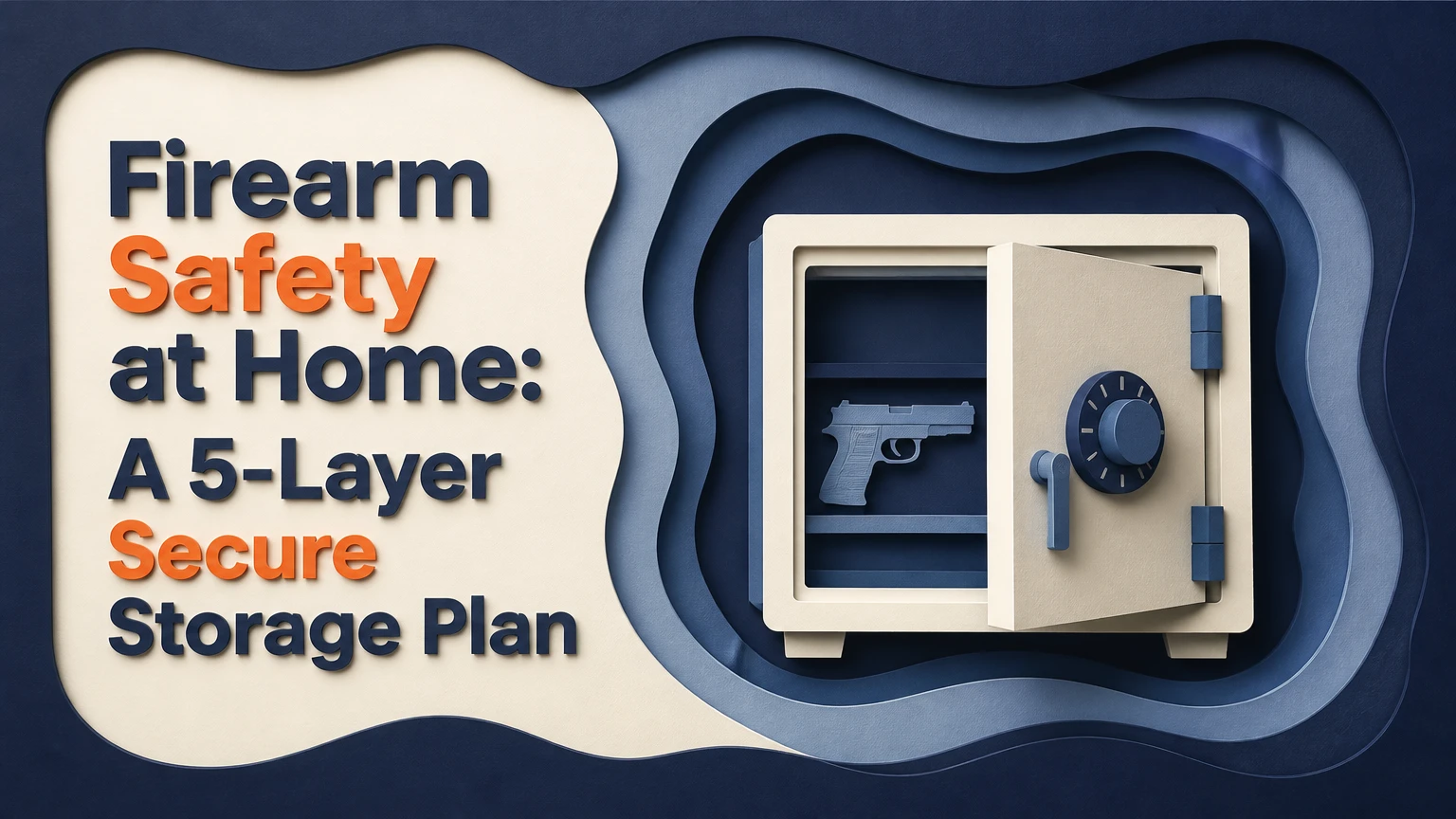
The five protection layers
| Layer | Control | Typical failure prevented | Household example |
|---|---|---|---|
| Handling | Muzzle, trigger, target rules | Negligent discharge | Finger remains indexed on the frame |
| Condition | Unload and verify chamber | Unexpected firing | Magazine removed and chamber checked |
| Mechanical | Cable, chamber, or trigger lock | Immediate operation | Manufacturer-compatible lock installed |
| Physical | Safe, lockbox, or cabinet | Child access and casual theft | Steel container bolted to structure |
| Administrative | Codes, training, inspections | Credential or maintenance failure | Monthly access review and annual battery change |
Johns Hopkins Center for Gun Violence Solutions reported in 2023 that secure firearm storage is associated with lower risks of firearm injury and suicide. The mechanism is straightforward: adding time and physical barriers makes impulsive or unauthorized access less likely, while unloaded storage reduces the chance that a retrieved firearm can be fired immediately.
How Do You Secure a Firearm at Home?
Secure a firearm at home by confirming local law, unloading and clearing it, applying a compatible lock, placing it in a locked and anchored container, and controlling ammunition and access credentials. The basic procedure takes approximately 5-15 minutes per firearm after the correct storage equipment is available, but the strongest factor is consistent access control.
Before you start
| Requirement | Typical specification |
|---|---|
| Time | 5-15 minutes per firearm, plus 20-40 minutes for installation |
| Difficulty | Low for inspection, moderate for anchoring |
| Equipment | Compatible lock, steel container, approved fasteners, flashlight |
| Cost | $20-$2,500 depending on capacity and security level |
| Prerequisites | Owner’s manual, local storage-law check, safe handling knowledge |
| Extra control | Separate locked ammunition container or compartment |
Step 1: Confirm the firearm’s condition
Point the muzzle in a safe direction, keep the trigger finger outside the trigger guard, remove the source of ammunition, and follow the firearm manufacturer’s unloading procedure. For a typical semiautomatic pistol, that may involve removing the magazine, opening the action, and visually and physically checking the chamber, but firearm designs differ.
For revolvers, open the cylinder and inspect every chamber. For rifles and shotguns, follow the manufacturer’s instructions for opening the action and confirming that the chamber and magazine area are empty. Do not rely on a loaded-chamber indicator alone.
You’ll know it worked when: the action is open where the design permits, the chamber is visibly empty, and no ammunition remains attached to or inside the firearm.
Common mistake: assuming that removing a magazine makes a pistol unloaded. A chambered cartridge can remain after magazine removal.
Step 2: Apply a compatible mechanical lock
Use a chamber lock, cable lock, trigger lock, or other device only when the firearm manufacturer says the design is compatible. A cable lock may pass through an action or designated opening on some firearms, but it cannot safely fit every model. Never force a lock through a mechanism or close an action against a lock.
Trigger locks can prevent trigger access, but they do not necessarily prevent a firearm from being picked up, mishandled, or stolen. Many safety organizations caution against installing a trigger lock on a loaded firearm because installation or removal can place pressure near the trigger.
You’ll know it worked when: the lock prevents the action from closing or the trigger from being accessed, without contacting the trigger or damaging the firearm.
Common mistake: treating any free cable lock as universal. Match the device to the firearm, and retain the instructions.
Step 3: Place the firearm inside locked storage
Use a dedicated lockbox, gun safe, or security cabinet that resists the likely threat. For a child-access problem, a locked steel container with a concealed code may be adequate for one handgun. For burglary resistance, a lightweight container needs anchoring, and a larger safe needs structural attachment to reduce removal risk.
Place the storage unit where children and visitors cannot observe the code, locate keys, or reach the override mechanism. A bedside box may improve access speed, but it also requires careful mounting, privacy, lighting, and credential management.
You’ll know it worked when: the container remains closed when pulled, lifted, or shaken normally, and its mounting points cannot be reached without opening or moving the unit.
Common mistake: storing a small lockbox loose inside a drawer. A thief may remove the entire box and open it elsewhere.
Step 4: Secure ammunition and accessories
Store ammunition in a locked container or a separately locked compartment when required by local law or when reducing access is a priority. Keep cartridges dry, away from solvents and excessive heat, and in their original packaging or a container designed for ammunition.
Control magazines, speedloaders, keys, override keys, and written combinations. A locked firearm with an accessible loaded magazine may still create an unacceptable access pathway for a child or unauthorized person.
You’ll know it worked when: an unauthorized person cannot obtain the firearm, ammunition, and access credentials through one obvious route.
Common mistake: hiding the ammunition in the same unlocked drawer as the safe key.
Step 5: Verify the complete system
Close and lock the container, test the lock according to the manufacturer’s instructions, and confirm that the firearm cannot be reached through gaps or openings. Record the battery type, combination-change procedure, and location of the backup key in a secure plan that unauthorized household members cannot access.
Perform a second check after moving furniture, changing a roommate, hosting guests, or modifying the home’s alarm system. Storage is a system, not a one-time purchase.
What Makes a Home Firearm Safe Effective?
An effective home firearm safe combines access control, physical resistance, correct mounting, dependable operation, and a design that fits the firearm without creating handling hazards. A safe that opens quickly but can be carried away may fail against theft, while a highly resistant safe that authorized users cannot open reliably may encourage unsafe storage outside it.
Specifications that deserve attention
| Feature | Practical threshold or question | Why it matters |
|---|---|---|
| Construction | Steel body and door, with no exposed easy pry gap | Slows forced entry |
| Mounting | Pre-drilled anchor points and manufacturer-rated fasteners | Prevents simple removal |
| Lock | Mechanical, electronic, or biometric with documented backup access | Controls authorized entry |
| Interior | Padded, dry, non-abrasive surfaces | Reduces firearm damage |
| Capacity | At least 25% spare room beyond the current collection | Prevents cramped handling |
| Testing | Independent security or burglary rating where available | Gives more useful evidence than marketing labels |
| Fire rating | Published duration and test temperature | Limits, but does not guarantee, fire protection |
“Fireproof” is not an absolute category. Fire ratings often describe the interior temperature and test duration, not guaranteed survival of every firearm, optic, document, or ammunition type. A safe that protects paper at a stated temperature may not protect polymer components, lubricants, or electronic accessories equally well.
Anchor the container to the structure
Anchor a gun safe or lockbox through its designed mounting points into a suitable structural surface. Concrete floors, properly reinforced wood framing, and manufacturer-approved wall structures can provide different levels of resistance. Do not assume that drywall anchors or furniture weight alone will stop removal.
Renters should ask the landlord about permitted anchors, use a security cabinet that can be attached without prohibited modifications, or obtain professional advice about the building structure. A portable container can still reduce child access, but it offers less burglary resistance when an intruder can carry it away.
Which Home Storage Option Fits the Situation?
The best home storage option depends on the number of firearms, required access speed, child and visitor exposure, theft risk, and maintenance tolerance. A bolted rapid-access lockbox generally fits one handgun, while a larger anchored safe better fits multiple firearms and long-term burglary resistance.
| Storage option | Typical market range | Typical opening time | Main strength | Main limitation |
|---|---|---|---|---|
| Steel rapid-access lockbox | $80-$350 | 2-10 seconds | Fast handgun access | Limited capacity and pry resistance |
| Mechanical push-button box | $100-$300 | 5-15 seconds | No battery dependence | Combination practice required |
| Electronic keypad safe | $150-$1,000 | 5-20 seconds | Code access and capacity | Battery or keypad failure |
| Biometric lockbox | $100-$500 | 2-10 seconds | Fingerprint-based entry | Sensor and battery reliability |
| Security cabinet | $150-$600 | 10-30 seconds | Budget long-gun storage | Usually less burglary resistance |
| Heavy-duty gun safe | $500-$3,000 or more | 10-60 seconds | Capacity and structural security | Cost, weight, and slower access |
| Cable or trigger lock | Free-$30 | 15 seconds or longer | Low cost and portability | Does not secure the firearm from removal |
Opening times are typical consumer-use ranges, not guarantees. Stress, darkness, gloves, low batteries, incorrect code entry, fingerprint condition, and unfamiliarity can substantially increase the time.
Biometric and electronic locks
Biometric and electronic locks suit authorized users who need faster access than a dial safe can provide. They require fresh batteries, a reliable backup method, and periodic testing under realistic conditions, including darkness and the user’s normal hand position.
A fingerprint reader should have multiple enrolled prints for each authorized user when the manufacturer permits it. Keep the sensor clean, but do not treat biometric access as infallible. A wet, dirty, injured, or poorly positioned finger can produce a failed read.
Mechanical locks
Mechanical push-button locks and combination dials avoid battery depletion and can perform well in garages, vehicles, or homes where electronic maintenance is often neglected. Their weakness is user memory and speed under stress, particularly when the owner has not practiced opening the container.
Mechanical access also requires privacy. A child who watches a button sequence can learn it, and a written combination can defeat the physical security of the container.
Key locks and cable locks
Key locks work when keys remain controlled and the container resists attack. A key stored in an obvious bedside drawer is an access failure, even if the firearm itself sits inside a steel box.
Cable and trigger locks are useful for transport, temporary disabling, or adding a secondary barrier. They are poor substitutes for a locked container when burglary resistance matters because cutters, leverage, or removal of the entire firearm may defeat them.
How Should Firearm Storage Change for Children and Visitors?
Homes with children, teenagers, babysitters, guests, or visiting relatives should use locked storage every time the firearm is unattended, whether the firearm is loaded or unloaded. The container should block access to the firearm, ammunition, keys, codes, and override methods.
The American Academy of Pediatrics has consistently recommended secure firearm storage, including keeping firearms locked and unloaded with ammunition stored separately. A safety conversation helps, but education cannot replace physical control because children differ in age, judgment, curiosity, and impulse control.
Tell children a simple emergency rule: do not touch the firearm, leave the area, and tell a trusted adult. Avoid presenting the firearm as a forbidden mystery or as a household object that children can inspect without supervision. Older teenagers who receive formal training still need restricted access unless they are authorized under local law and household rules.
For visitors, ask about unfamiliar firearms before hosting overnight guests. If a guest brings a firearm, agree in advance on locked storage, ammunition control, and who retains the key or code. This matters especially in homes with toddlers, visiting children, or people experiencing cognitive impairment.
How Can You Balance Access and Security?
Balance access and security by choosing the fastest storage method that authorized, trained users can open consistently while unauthorized users cannot. Rapid access is a legitimate design objective, but placing an unlocked or weakly secured firearm beside the bed creates a larger risk than a slower, properly locked system.
| Household situation | Preferred control | Access priority | Additional control |
|---|---|---|---|
| Toddler in the home | Anchored locked container | Low | Separate ammunition and concealed credentials |
| Frequent child visitors | Locked storage whenever unattended | Low | Visitor access review before arrival |
| Single trained adult | Rapid-access lockbox | High | Battery checks and backup entry practice |
| Multiple handguns | Larger anchored safe | Medium | Individual compartments or holsters |
| Long-gun collection | Anchored full-height safe | Medium | Interior organization and dehumidifier |
| Roommates or renters | Compact anchored lockbox | Medium | Private code and landlord-approved mounting |
| Mobility limitation | Accessible mounted safe | High | One-handed testing and reachable controls |
A rapid-access container should be mounted where it cannot be casually removed, positioned so the authorized user can operate it without pointing the muzzle at another person, and tested with the actual firearm unloaded. Lighting matters because a code pad or fingerprint reader is harder to use when the user cannot see the controls.
A storage system is not suitable if the owner routinely leaves the firearm outside it because opening the container feels inconvenient. That behavior signals a design mismatch. Improve access speed through placement, practice, and maintenance rather than eliminating the lock.
What Does Secure Storage Cost?
Secure firearm storage typically costs $20-$350 for a lock or single-handgun box, $150-$600 for a security cabinet, and $500-$3,000 or more for a larger heavy-duty safe. Installation may add $50-$300, depending on the structure, location, and whether professional anchoring is needed.
| Setup | Equipment cost | Installation cost | Typical capacity | Suitable use |
|---|---|---|---|---|
| Basic single handgun | $20-$100 | $0-$75 | 1 handgun | Temporary or low-budget control |
| Anchored rapid-access box | $100-$350 | $50-$200 | 1-2 handguns | Faster authorized access |
| Small security cabinet | $150-$600 | $50-$250 | 2-8 long guns | Budget collection storage |
| Mid-size gun safe | $500-$1,500 | $100-$300 | 6-20 firearms | Mixed household collection |
| Large heavy safe | $1,500-$3,000 or more | $150-$500 | 20 or more firearms | Collection and higher theft resistance |
Price does not equal security. A $1,000 safe with thin construction, a poor pry gap, and no anchor may offer less theft resistance than a smaller, properly mounted steel box. Compare construction, lock design, mounting, independent testing, warranty terms, and replacement-key procedures.
How Should Ammunition Be Stored?
Store ammunition in a cool, dry, locked location away from heat sources, solvents, and unauthorized users, following the ammunition manufacturer’s instructions and local fire-code requirements. Separate ammunition from the firearm when local law requires it or when the household needs an additional barrier against rapid unauthorized use.
Avoid unmarked containers that make cartridge identification difficult. Keep ammunition in original boxes or purpose-designed containers, inspect for corrosion or damage, and do not use cartridges with damaged cases, bullets, primers, or signs of chemical exposure.
Do not store ammunition beside gasoline, propane, paint thinner, or other volatile materials. Do not place it directly against a heater, furnace, or attic surface that reaches high temperatures. Humidity control matters in basements and garages, where condensation can damage cartridges and firearm components.
What Legal Checks Belong in the Plan?
Legal firearm storage requirements depend on the governing state, province, territory, municipality, or country, and some rules impose specific duties when children can access the home. Check the current text from the relevant government, police authority, attorney general, or official firearms regulator rather than relying on a retailer’s summary.
Verify these items:
- Whether the law requires a lock, locked container, unloaded condition, separate ammunition, or a combination of controls.
- Whether the rule changes when a minor, prohibited person, or person subject to a protective order lives in or visits the home.
- Whether transport, temporary storage, and vehicle storage have separate requirements.
- Whether local fire codes regulate ammunition quantities or storage locations.
- Whether insurance policies require a specific safe, alarm, documentation, or endorsement.
- Whether a landlord, condominium association, or lease restricts anchoring or firearm storage.
Legal compliance is the minimum standard, not the complete safety standard. A jurisdiction may permit a particular storage method that still leaves a serious child-access or theft vulnerability.
How Do You Test and Maintain Storage Equipment?
Test storage equipment monthly, replace electronic batteries at least annually or according to the manufacturer’s schedule, and inspect anchors, hinges, locks, seals, and interior moisture quarterly. A safe is reliable only when authorized users can open it and unauthorized users cannot.
| Inspection interval | Check | Acceptance condition | Corrective action |
|---|---|---|---|
| Every access | Lock closure and firearm condition | Container relocks fully | Re-secure before leaving |
| Monthly | Code, fingerprint, key, and lighting | Authorized entry works normally | Reprogram or replace battery |
| Quarterly | Anchors, hinges, pry gaps, corrosion | No looseness or structural damage | Tighten or obtain repair |
| Every 6 months | Ammunition and humidity | No corrosion, swelling, or contamination | Isolate damaged items |
| Annually | Full household access review | Credentials remain private | Change codes and remove old users |
If a biometric reader fails, clean the sensor with the manufacturer-approved method, try a registered backup print, and use the mechanical or electronic override. Do not leave the firearm unsecured while troubleshooting.
If an electronic keypad fails, follow the manufacturer’s documented emergency-entry process and replace the batteries with the specified type. Store an override key where children, visitors, and burglars cannot find it, but where the authorized owner can retrieve it during a battery failure.
If a dial or mechanical lock binds, do not apply excessive force. Confirm that the door is fully aligned, check the combination procedure, and contact the manufacturer or a qualified safe technician if the problem persists.
What Are the Emergency Procedures?
After suspected unauthorized access, stop handling the firearm, move people away, and contact local law enforcement or emergency services when immediate danger exists. After theft, fire, flood, or structural damage, preserve the scene, document the loss or damage, and follow applicable reporting and insurance requirements.
| Event | Immediate action | Do not do |
|---|---|---|
| Child finds firearm | Have the child step away and alert an adult | Grab for it while the child is holding it |
| Suspected loaded firearm | Keep muzzle away from people and avoid the trigger | Test it by pulling the trigger |
| Theft | Contact law enforcement and provide identifying records | Delay reporting to search privately |
| Fire exposure | Keep people away and request professional assessment | Assume heat-exposed ammunition is safe |
| Flood or corrosion | Isolate the item and seek qualified inspection | Force the action or fire the firearm |
| Lost key or code | Lock the container and change credentials | Leave the firearm accessible |
Maintain a private record of make, model, serial number, photographs, and purchase documentation where lawful and secure. This information can support a theft report or insurance claim without being posted publicly.
What Changes in an Apartment or Shared Home?
Apartment and shared-home storage requires the same locked-access standard, with extra attention to portability, wall construction, roommates, maintenance staff, and landlord permissions. A lockbox hidden in a bedroom is insufficient if a roommate knows its location or can access the key, code, or override.
Use an anchored container when the lease and building structure permit it. If anchoring is restricted, choose a heavier, purpose-built container and place it where removal is difficult, while recognizing that portability reduces burglary resistance.
Change the code when a roommate moves out, a relationship ends, a repair worker may have observed access, or a key is lost. Domestic-violence risk requires prompt professional advice from local law enforcement, a victim-support organization, or a qualified attorney because protective orders and firearm-possession rules vary substantially.
Common Mistakes and How to Fix Them
Hiding a firearm instead of locking it
Mattresses, closets, drawers, and high shelves provide concealment rather than access control. Replace the hiding place with a locked container that remains secured whenever the firearm is unattended.
Using a container that is too small
A cramped safe can cause muzzle contact, dropped magazines, damaged optics, or careless handling. Select capacity with at least 25% spare room so the firearm can be removed without sweeping another person.
Ignoring backup access
A dead battery or failed fingerprint reader can push an owner toward unsafe improvisation. Test backup entry monthly and keep the override method private, documented, and inaccessible to children.
Leaving the code visible
A code written inside a nightstand, phone case, or wallet can defeat an otherwise strong safe. Memorize the code, use separate credentials for authorized users where possible, and change it after disclosure.
Treating training as a substitute for storage
A trained adult can still make an error when tired, distracted, intoxicated, injured, or under stress. Training improves behavior; a locked container controls access when behavior is impaired.
Forgetting temporary access
Moving a firearm to a suitcase, cleaning bench, vehicle, or guest room creates a new risk point. Use a temporary locked container and return the firearm to primary storage immediately after the task.
FAQ
Should a firearm be stored loaded or unloaded at home?
An unloaded firearm generally reduces the risk of an immediate unintentional discharge, especially in homes with children, visitors, or inexperienced users. Some owners choose a loaded firearm for defensive readiness, but that decision requires training, locked rapid-access storage, strict local-law compliance, and a plan that prevents unauthorized access.
Is a biometric gun safe reliable enough?
A biometric gun safe can be suitable when the owner maintains batteries, registers backup fingerprints, keeps the sensor clean, and verifies access regularly. Biometric readers can fail because of moisture, dirt, injury, poor placement, or electronics, so a documented backup entry method remains necessary.
Should ammunition always be stored separately?
Separate locked ammunition storage is a conservative practice and may be legally required in some jurisdictions. Other laws permit ammunition inside a locked safe with the firearm. Follow local requirements, keep ammunition dry and away from heat or chemicals, and ensure unauthorized users cannot obtain both components.
How often should a gun safe battery be replaced?
Replace the battery at least annually for an electronic or biometric safe, or sooner if the manufacturer specifies a shorter interval or the low-battery indicator appears. Test the safe monthly and replace batteries immediately after any warning, failed opening, or extended storage period.
What is the safest place to keep a firearm at night?
The safest location is a locked, securely mounted container that an authorized, trained adult can open reliably while children, visitors, and intruders cannot. A bedside rapid-access box may fit a defensive-access plan, while a larger anchored safe may better fit multiple firearms or a high-theft-risk home.
What should a child do after finding a firearm?
A child should not touch, move, or inspect the firearm. The child should leave the area, warn other children away, and tell a trusted adult immediately. Adults should provide age-appropriate safety instruction, but physical locked storage remains the primary protection.
The Bottom Line
Firearm safety at home requires more than a hidden location or a single inexpensive lock. Unload and verify the firearm, use a compatible mechanical lock, place it in a locked and anchored container, control ammunition and credentials, inspect the system routinely, and confirm current local law. Choose the fastest storage system that authorized users can operate consistently without sacrificing physical security.