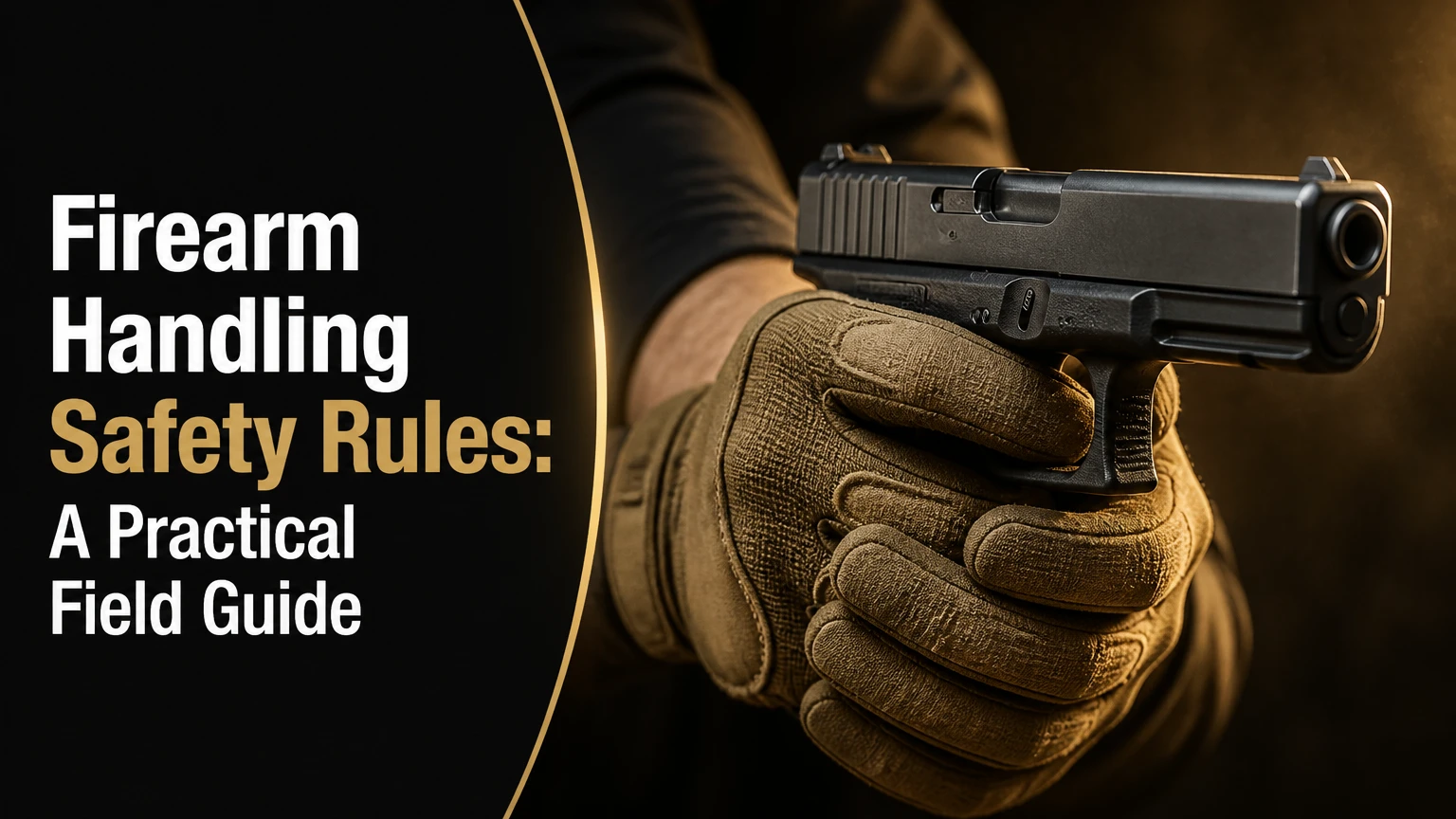
Firearm handling safety rules are layered behaviors that prevent unintended injury during handling, loading, firing, cleaning, transport, and storage. The four fundamental rules are to treat every firearm as loaded, control the muzzle, keep the trigger finger indexed, and identify the target plus its background before firing.
Key Facts
The four firearm safety rules must be followed together; no mechanical safety replaces them.
A firearm is not confirmed clear until its ammunition source is removed, its action is open, and its chamber and feed area are visibly inspected.
A safe direction requires an effective backstop and must account for people, buildings, roads, and penetrable surfaces.
A rigid holster must cover the entire trigger guard before a loaded handgun is carried.
A muffled report or unusually light recoil requires an immediate ceasefire because a projectile may obstruct the barrel.
Storage, transport, and carrying requirements vary by jurisdiction, firearm type, and location.
What Are the Firearm Handling Safety Rules?
The firearm handling safety rules are four overlapping controls: assume the firearm is loaded, keep the muzzle pointed toward a safe direction, keep the trigger finger outside the trigger guard, and confirm the target and everything beyond it. Their purpose is to prevent a handling error from becoming an injury.
The National Shooting Sports Foundation summarizes the first principle as, “Always keep the gun pointed in a safe direction.” That wording matters because a manual safety, unloaded magazine, or open action does not make an unsafe muzzle direction acceptable.
The rules apply during every transition, including picking up a firearm, receiving it from another person, loading, unloading, holstering, moving between shooting positions, cleaning, and placing it into storage. A person who follows only three rules still has an uncontrolled failure path.
Why do the rules overlap?
Overlapping rules create redundancy. A finger inside the trigger guard is dangerous, but a controlled muzzle can prevent injury if the finger moves. A careless muzzle is dangerous, but an indexed finger can prevent a discharge. The system is strongest when both controls remain in place.
Mechanical features add another layer. Drop safeties, firing-pin blocks, transfer bars, manual safeties, and grip safeties can reduce particular risks, but each depends on correct design, maintenance, and operation. Mechanical protection is a backup, not permission to relax human discipline.
The Four Core Rules in Daily Practice
The four fundamental rules describe separate behaviors, but safe handling depends on applying them simultaneously. The following examples translate each rule into observable actions rather than slogans.
1. Treat every firearm as loaded
Handle an unfamiliar or supposedly unloaded firearm as loaded until you personally verify its condition. Do not rely on another person’s statement, a visible empty magazine, or a prior check performed several minutes earlier.
For a handoff, the person receiving the firearm should accept it with the muzzle controlled and then follow the applicable manufacturer’s unloading instructions. A person who cannot identify the firearm’s action, chamber status, or controls should stop and ask a qualified instructor or range officer for help.
“Loaded” is a handling assumption, not a technical description. A firearm with ammunition nearby, a closed action, or an unknown condition deserves the same deliberate behavior as a loaded firearm.
2. Keep the muzzle pointed in a safe direction
Muzzle discipline means keeping the barrel pointed where an unintended shot would cause the least possible harm. At a supervised range, that usually means downrange within the established firing area; elsewhere, the correct direction depends on the structure, terrain, and people present.
A floor, wall, or patch of ground is not automatically safe. Ordinary walls, ceilings, doors, vehicle bodies, and floors may not stop a projectile, and a hard surface can produce dangerous ricochets. The safe direction must include a credible backstop and a clear area around it.
When moving, keep the muzzle within the range’s permitted orientation. Do not swing across another person while turning, setting a firearm down, retrieving equipment, or passing it to someone else.
3. Keep the trigger finger indexed
Keep the trigger finger straight along the frame or receiver, outside the trigger guard, until the sights are aligned on an identified target and the decision to fire has been made. The trigger finger should return to the indexed position as soon as firing stops or the target is no longer confirmed.
This rule addresses startle reactions, trips, slips, sympathetic muscle contraction, and poor grip changes. A person can unintentionally tighten the hand during recoil, surprise, or loss of balance, so trigger-finger placement must remain independent of the other fingers.
The same rule applies when drawing or holstering. A covered trigger guard does not protect against a finger that enters the guard during a rushed presentation or reholstering movement.
4. Identify the target and what lies beyond it
Never fire at a sound, movement, shape, or partially visible object. Confirm the target, the foreground, the background, and the likely path of the projectile before pressing the trigger.
Projectiles can pass through drywall, glass, doors, vehicle panels, vegetation, and some earthen or improvised barriers. A target that appears isolated may have a person, road, building, livestock, or occupied property behind it.
Lighting changes the decision. If glare, darkness, smoke, rain, distance, or an obstructed sight picture prevents positive identification, do not fire. No target is worth guessing.
How Do You Clear and Unload a Firearm?
To clear and unload a firearm, maintain a safe muzzle direction, remove the ammunition source, open the action, inspect the chamber and feed area, and lock the action open when the design permits. The exact controls differ by model, so the owner’s manual and range procedure take priority over a generic sequence.
A platform-neutral clearing sequence
- Control the muzzle. Point it toward the established safe direction before touching any control. Keep the finger outside the trigger guard.
- Remove the ammunition source. Remove the magazine from a detachable-magazine firearm, or unload the internal or tubular magazine according to the manual. Removing the source first reduces the chance of feeding another cartridge.
- Open the action. Retract the slide, bolt, lever, or charging handle fully enough to eject a chambered cartridge. Some actions require repeated cycling; follow the manual.
- Inspect the chamber and feed area. Use adequate light and look directly into the chamber, magazine well, cylinder area, or loading port. Do not place a finger into a chamber or barrel to verify clearance.
- Lock the action open. Engage the slide stop, bolt catch, action lock, or other designed mechanism if available. Keep the firearm oriented safely.
- Account for the ejected cartridge. Locate and secure the cartridge rather than assuming it is inert or out of reach. Keep live ammunition separate from cleaning materials and loose tools.
A visual inspection is essential, but it is not the only control. If lighting is poor, the action cannot remain open, the firearm has an unfamiliar design, or a cartridge is stuck, stop and obtain qualified assistance.
| Handling stage | Required control | Verification checkpoint | Common failure |
|---|---|---|---|
| Pickup | Muzzle controlled, finger indexed | Direction and trigger position are correct | Grabbing the grip with the finger curled |
| Handoff | Action status communicated | Receiver confirms condition personally | Trusting “it is unloaded” |
| Unloading | Ammunition source removed first | Magazine, tube, or cylinder is empty | Opening the action while source remains inserted |
| Clearance | Action open, chamber inspected | Chamber and feed area are visibly empty | Checking only the magazine |
| Storage | Firearm secured, ammunition controlled | Lock engages and access is restricted | Leaving a loaded firearm loose |
How should you hand a firearm to another person?
A firearm should be handed over with the muzzle in a safe direction, the action open when practical, and its condition stated clearly. The receiving person should not rely on the statement alone and should independently verify the firearm’s condition without placing a finger into the trigger guard.
At a range, follow the range officer’s command and local etiquette. During a private handoff, announce “action open” or “loaded,” identify whether a magazine is present, and explain any unusual condition. If the recipient is unfamiliar with the model, keep the firearm under control and request an instructor-led demonstration.
How Do Mechanical Safeties Differ?
Mechanical safeties differ by the part they block and the condition they control. A manual safety may block the trigger, sear, or firing mechanism; a trigger safety prevents movement unless the trigger shoe is correctly pressed; a grip safety depends on hand position; and a decocker lowers the hammer through a designed mechanism.
| Device | Typical function | Main benefit | Important limitation |
|---|---|---|---|
| Manual safety | Blocks trigger, sear, or firing mechanism | Adds a deliberate control step | Can be left engaged or disengaged incorrectly |
| Trigger safety | Prevents trigger movement unless the trigger shoe is pressed correctly | Helps resist some lateral or drop-related trigger movement | Does not stop a cord or clothing from pressing the trigger |
| Grip safety | Blocks firing unless the grip is compressed | Links firing permission to a proper grip | Poor hand placement can prevent operation or create confusion |
| Decocker | Lowers a cocked hammer through a designed mechanism | Returns some systems to a heavier double-action pull | Requires model-specific operating knowledge |
| Transfer bar | Prevents hammer energy from reaching the primer unless the trigger is activated | Reduces certain drop-fire risks | Does not control muzzle direction or target identification |
A safety lever is not a substitute for trigger discipline. Safeties can be misused, damaged, obstructed, improperly reassembled, or misunderstood. Never test a safety by pointing the firearm at a person or by pulling the trigger to “see whether it works.”
Which safety device is best?
No single safety device is universally best because operating systems, training, carry method, and manufacturer design differ. The best choice is a firearm whose controls the user can identify, operate consistently, and verify under supervision without violating the four fundamental rules.
Read the owner’s manual before loading. Learn whether the firearm can fire with the safety engaged, whether the decocker changes trigger mode, and what the manufacturer requires for inspection and maintenance. If a control’s function is uncertain, do not experiment with live ammunition.
What Equipment Supports Safe Handling?
Safe handling equipment reduces predictable environmental and access risks. Core equipment includes properly rated eye protection, hearing protection, a model-compatible holster when carrying, a lock or safe, and storage containers that separate firearms from unauthorized users.
| Equipment | Typical price range | Functional requirement | Poor substitute |
|---|---|---|---|
| Impact-rated eye protection | $10-$80 | Protects against fragments and debris | Ordinary sunglasses |
| Passive or electronic hearing protection | $15-$150 | Reduces hazardous impulse noise | Earbuds not rated for shooting |
| Rigid holster | $30-$150 | Covers the complete trigger guard and retains the firearm | Soft pocket or generic nylon sleeve |
| Cable or chamber lock | $10-$40 | Prevents operation when correctly installed | Decorative lock or loose tie |
| Locking handgun safe | $50-$300 | Restricts unauthorized access while allowing lawful access | Nightstand or mattress storage |
| Locking long-gun cabinet or safe | $150-$2,000+ | Restricts access to rifles and shotguns | Unlocked closet |
Prices are typical United States retail ranges, not legal requirements. Local law may require a particular lock, container, separation method, or transport configuration. A safe that opens quickly but is accessible to children, guests, or unauthorized adults fails its access-control purpose.
What makes a holster safe?
A safe holster is rigid enough to retain its shape, made for the specific firearm model, and designed to cover the entire trigger guard. The holster should retain the firearm during normal movement without requiring the user to press the trigger or insert a finger near it.
Inspect the holster for damaged edges, loose fasteners, foreign objects, and deformation. Before reholstering, remove the finger from the trigger area, visually confirm that clothing and straps are clear, and guide the firearm slowly into the holster. Never force a firearm past an obstruction.
How Should Beginners Build Safe Habits?
Beginners should start with an in-person course taught by a qualified instructor, use inert training aids only under controlled conditions, and postpone live ammunition until they can consistently demonstrate muzzle and trigger control. A typical foundational course takes 8-16 hours, although course length depends on the firearm and jurisdiction.
Dry practice at home has strict prerequisites. Remove all live ammunition from the room, verify the firearm is clear according to the manual, use a safe direction, and follow the manufacturer’s dry-fire guidance because some designs can be damaged by repeated dry firing.
A short, regular practice schedule is more useful than hurried repetition. A typical beginner might use 10-15 minutes, two or three times weekly, with an instructor periodically checking technique. “Muscle memory” is not a guarantee; stress can degrade habits that were never tested under supervision.
What should a first training session include?
A first session should cover firearm identification, ammunition identification, the four rules, action types, loading and unloading demonstrations, safe grip and trigger indexing, range commands, and supervised firing only after the instructor confirms readiness.
| Training component | Typical duration | Competency check | Stop condition |
|---|---|---|---|
| Rules and terminology | 30-60 minutes | Student explains all four rules | Cannot identify muzzle or trigger |
| Unloaded handling | 30-90 minutes | Repeated safe pickup and handoff | Muzzle sweeps another person |
| Loading and unloading | 30-60 minutes | Student follows model-specific sequence | Confuses magazine and chamber |
| Live-fire instruction | 2-6 hours | Safe response to commands and stoppages | Finger enters trigger guard early |
| Follow-up practice | 10-15 minutes, 2-3 times weekly | Consistent indexed finger and muzzle | Fatigue or rushed movements |
An instructor should be able to pause the session without embarrassment or pressure. Competence means safe decisions remain consistent when the student is confused, tired, or surprised.
How Do Home and Concealed-Carry Practices Differ?
Home storage prioritizes preventing unauthorized access, while concealed carry adds retention, trigger protection, clothing management, and reholstering risks. Both require a rigid trigger-covering holster or secure container, but a home firearm should never be left loose on a nightstand or under bedding.
A quick-access safe may be appropriate where lawful, but access speed must be balanced against child access, visitors, theft, and mechanical failure. Test the safe’s opening method with an unloaded firearm and replace batteries or maintain access systems according to the manufacturer’s schedule.
Concealed carriers should inspect the holster and firearm before use, keep objects away from the trigger guard, and avoid reholstering when distracted or hurried. If the firearm is not needed immediately, slow reholstering is safer than a fast presentation.
What changes during transport?
Transport requirements vary substantially by country, state, province, and destination. Before traveling, check the law for the origin, destination, stops, vehicle type, firearm condition, ammunition separation, container, and required permits.
As a conservative handling principle, unload the firearm unless the applicable law and activity require otherwise, secure it in a locked container, keep ammunition controlled, and prevent unauthorized access. Do not leave a firearm visible in an unattended vehicle, even when local law allows vehicle transport.
How Does Cleaning Change the Safety Process?
Cleaning does not make a firearm safe by itself; cleaning begins only after the firearm has been cleared and verified. The person cleaning must remove the ammunition source, open the action, inspect the chamber and feed area, and keep all live ammunition outside the cleaning workspace.
Many maintenance accidents occur because the owner begins disassembly after removing only the magazine. A loaded chamber can remain even when the magazine well is empty, and some firearms can accept a chambered round without a magazine.
Use the manufacturer’s disassembly, lubrication, and reassembly instructions. If a firearm has a damaged part, stuck cartridge, unusual resistance, or suspected mechanical defect, stop using it and consult the manufacturer or a qualified gunsmith.
How should ammunition be checked?
Inspect ammunition before use for the correct caliber or gauge, damaged cases, crushed or missing primers, corrosion, moisture, bullets seated unusually deep or high, and contamination. Do not force a cartridge into a chamber or magazine when it does not fit normally.
Keep ammunition in its original labeled packaging when practical. Mixing cartridges with similar names, such as different loads or cartridges that appear similar, creates a preventable identification error.
What Should You Do After a Misfire, Hangfire, or Squib?
After a misfire, keep the muzzle pointed in a safe direction, keep the finger off the trigger, and follow the firearm and range manufacturer’s procedure before opening the action. After a suspected squib, stop firing immediately and have the barrel inspected for an obstruction before another cartridge is fired.
| Event | Typical sign | Immediate response | Prohibited response |
|---|---|---|---|
| Misfire | Trigger press with no discharge | Maintain safe direction and follow the manual | Immediately opening the action toward people |
| Hangfire | Delayed ignition after trigger press | Keep muzzle controlled for the manufacturer’s stated period | Looking into or pointing the firearm at the cartridge |
| Squib load | Muffled report, weak recoil, little or no projectile impact | Stop firing and obtain a barrel inspection | Firing another round to clear the barrel |
| Case failure | Split case, unusual sound, gas, or cycling problem | Keep muzzle safe and request range-officer help | Continuing to fire through abnormal symptoms |
| Stuck cartridge | Action will not open normally | Keep direction controlled and seek qualified assistance | Applying improvised force near the primer |
Published procedures differ. Some range rules specify a 30-second or 60-second wait for a suspected hangfire, while some manufacturers give different instructions. Follow the firearm manual and range command, and never use a generic countdown as permission to handle a questionable cartridge.
A squib is especially dangerous because a bullet can lodge in the bore while the action appears ready to fire again. A second shot can damage the barrel and send fragments toward the shooter or bystanders.
Which Common Mistakes Defeat the Rules?
The most common failures occur during transitions rather than deliberate firing. Pickup, handoff, loading, holstering, cleaning, and responding to a stoppage all require the same four controls.
- Checking only the magazine. A removed magazine does not prove that the chamber is empty. Correct the error by opening the action and inspecting the chamber and feed area.
- Using the manual safety as a guarantee. A safety lever does not control muzzle direction or target identification. Keep following all four rules.
- Reholstering with a finger near the trigger. Correct the error by indexing the finger, clearing clothing, and moving slowly.
- Relying on a visual assumption in poor light. Improve lighting or obtain assistance. Do not insert a finger into a chamber or barrel.
- Continuing after an abnormal report. Stop firing, maintain direction, and request help before cycling or firing again.
- Handling while impaired or fatigued. Alcohol, recreational drugs, some medications, heat, and sleep deprivation can impair judgment and coordination. Store the firearm and postpone handling.
An experienced range officer watches transitions more closely than a shooter’s first few aimed shots. That is a practical distinction: most unsafe movements appear when attention shifts to conversation, equipment, a malfunction, or another person.
What Are the Range Rules That Add Protection?
Range rules control the environment around the four handling rules. Obey the range officer, keep the firearm pointed downrange, wear eye and hearing protection, keep the action open during ceasefires, and do not handle firearms while anyone is forward of the firing line.
A ceasefire means all handling stops. Remove your hands from the firearm, step away when instructed, and wait for the range officer to declare the line hot. Do not retrieve dropped equipment during a ceasefire unless the officer specifically authorizes it.
Common range commands have precise meanings, but ranges differ in wording. Ask before shooting if a command is unclear. A visitor should read the range’s written rules before unpacking a firearm.
What Is the Bottom Line on Firearm Handling Safety Rules?
Firearm handling safety rules work as a redundant system: assume the firearm is loaded, control the muzzle, index the trigger finger, and identify the target plus its background. Add model-specific training, safe clearing, appropriate storage, protective equipment, and immediate response to abnormal ammunition behavior.
The most reliable practitioner rule is simple: if the firearm’s condition, direction, control, ammunition, or target is uncertain, stop. Ask a qualified instructor, range officer, manufacturer, or gunsmith rather than improvising. The firearm handling safety rules remain effective only when uncertainty triggers a pause.
Frequently Asked Questions
Should the safety be on when handling a firearm?
Use the manual safety according to the firearm’s manual and the activity’s rules, but never treat the safety as the primary protection. Keep the muzzle controlled, the trigger finger indexed, and the target identified regardless of the lever’s position. Some firearms have no manual safety, while others require specific carry or loading procedures.
Can a firearm fire without a magazine?
Some firearms can fire a chambered cartridge without a magazine, while others have magazine disconnect features. The only safe assumption is that removing the magazine does not clear the chamber. Open the action and inspect the chamber according to the model’s manual.
Is a locked case required for firearm transport?
A locked case is required in some jurisdictions and circumstances, but transport law varies by location, firearm type, vehicle, and destination. Check the current rules for every jurisdiction on the route. As a handling standard, prevent unauthorized access and avoid leaving a firearm visible in an unattended vehicle.
How far should ammunition be kept from a cleaning area?
Keep live ammunition outside the cleaning workspace rather than relying on a particular distance. The objective is to prevent a live cartridge from entering the firearm during maintenance. Use a separate container or room, and verify the firearm’s chamber and feed area before disassembly.
Is dry-fire practice safe for every firearm?
Dry-fire practice is not automatically safe for every firearm. Some designs require snap caps or another approved device, and repeated dry firing can damage certain mechanisms. Remove all live ammunition, follow the manufacturer’s instructions, and obtain guidance from a qualified instructor before practicing.
What should a child do if a child finds a firearm?
A child should not touch the firearm, should leave the area, and should immediately tell a responsible adult. Adults must prevent access through lawful locked storage, education, and regular checks. A verbal warning alone cannot replace physical access control.