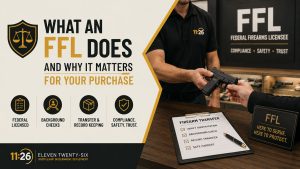
FFL terminology describes the federal licensing system that regulates people and businesses engaged in importing, manufacturing, or dealing in firearms. The Bureau of Alcohol, Tobacco, Firearms and Explosives, or ATF, issues Federal Firearms Licenses under the Gun Control Act, while Form 4473, NICS, bound books, SOT, and C&R describe related compliance processes.
Key Facts at a Glance
- A Federal Firearms License authorizes a defined business activity, not unrestricted possession or every type of firearm transaction.
- The nine principal FFL types cover dealing, pawnbroking, collecting, ammunition manufacturing, firearm manufacturing, importing, and destructive devices.
- A Type 01 FFL generally covers dealing and ordinary gunsmithing, while a Type 07 FFL covers firearm manufacturing and dealing.
- An FFL transfer normally requires the receiving dealer to record the firearm, have the transferee complete ATF Form 4473, and conduct the required background check.
- A Special Occupational Tax, or SOT, is separate from an FFL and applies to qualifying National Firearms Act activities.
- Federal rules are only one layer. State residency, waiting periods, licensing, storage, zoning, and transfer laws can impose additional requirements.
What Does FFL Terminology Explained Mean?
FFL terminology is the vocabulary used to identify a federal firearms license, its authorized activity, and the records or procedures attached to a transaction. “FFL” usually means Federal Firearms License, while “FFL” can also refer informally to the dealer or license holder receiving a firearm for transfer.
The central legal phrase is “engaged in the business.” Federal law defines that phrase in 18 U.S.C. § 921(a)(21) by referring to a person who “devotes time, attention, and labor to dealing in firearms as a regular course of trade or business.” Congress also distinguishes business activity from occasional sales or exchanges from a personal collection, provided the facts do not show a principal objective of livelihood and profit.
The threshold is fact-specific. A person who sells one unwanted firearm from a personal collection is not automatically a dealer, but repeated purchases for resale, advertising inventory, and profit-driven activity can create a licensing obligation. An FFL also does not legalize sales to prohibited persons, evade state law, or permit an owner to ignore firearm-specific restrictions.
FFL, FFL Holder, and FFL Dealer
A license is issued to a person or legal entity at a specified licensed premises. An FFL holder is the licensee, while an FFL dealer commonly means a Type 01 or Type 02 licensee conducting retail, transfer, or pawn activity.
A licensed business may have employees who handle firearms, but the license belongs to the licensee and remains tied to the approved premises and business activity. A dealer’s website, storefront, home office, or transfer counter does not independently become an FFL. The license must be verified through ATF records or a current license copy supplied through lawful business channels.
How Does an FFL Transfer Work?
An interstate retail purchase normally moves from the seller to an FFL in the buyer’s state, where the receiving dealer completes the legal transfer. The buyer generally provides identification, completes Form 4473, undergoes the required NICS check, pays the dealer’s transfer fee, and satisfies any state waiting-period or permit rules before taking possession.
The federal framework comes from 18 U.S.C. § 922(a)(3), § 922(a)(5), and related regulations. A nonlicensee generally cannot receive a firearm directly from an out-of-state nonlicensee, and an interstate dealer-to-consumer transaction is ordinarily completed through an FFL in the consumer’s state of residence.
Online Firearm Transfer Steps
- Confirm legality before ordering. Check the buyer’s state restrictions, age rules, magazine limits, feature bans, permit requirements, and waiting periods.
- Select a receiving FFL. Ask about the transfer fee, accepted shipping methods, identification requirements, storage charges, and policy for delayed or denied checks.
- Place the order using the actual transferee’s information. The intended buyer must be the person acquiring the firearm for personal use, not a stand-in for another person.
- Arrange license verification. The seller and receiving FFL exchange or verify license information through their established business procedures.
- Wait for shipment and intake. The receiving FFL records the acquisition in the Acquisition and Disposition record, commonly called the bound book.
- Complete Form 4473 at pickup. The transferee answers the federal eligibility questions and presents acceptable government identification.
- Complete the background check. The dealer contacts the FBI’s National Instant Criminal Background Check System, or NICS, unless a lawful state alternative or qualifying exception applies.
- Take possession only after approval and local requirements. A transfer fee, state tax, waiting period, permit, or state background check may apply before delivery.
The receiving FFL does not merely hold a package. The dealer is responsible for determining whether the transfer may legally occur under applicable federal and state rules.
What Are Form 4473, NICS, and the Bound Book?
ATF Form 4473 records the transferee’s identity, residence, eligibility answers, and transaction information. NICS is the FBI background-check system that provides a response such as proceed, delayed, or deny. The bound book records a licensee’s acquisitions and dispositions, allowing ATF to trace a firearm’s movement through licensed commerce.
The terms describe different controls. Form 4473 concerns the purchaser’s certification. NICS concerns the eligibility check. The bound book concerns the licensee’s inventory history. A dealer must retain records for the periods required by federal regulation, and the records must be available for lawful ATF inspection or tracing requests.
| Term | Responsible party | Primary purpose | Typical transaction point |
|---|---|---|---|
| Form 4473 | Transferee and FFL | Document identity and eligibility answers | In-person pickup |
| NICS | FFL and FBI | Check disqualifying criminal or legal records | After Form 4473 |
| Bound book | FFL licensee | Record acquisitions and dispositions | When firearms enter or leave inventory |
| FFL copy | Sending and receiving licensees | Verify licensed business status | Before shipment |
| State permit | Buyer, dealer, or state agency | Satisfy local transfer conditions | Before or during pickup |
Which FFL Types Exist?
The ATF recognizes nine principal FFL types, grouped by business function. Type 01 and Type 02 cover ordinary dealing activity, Type 03 covers qualifying collectors, Types 06 and 07 cover manufacturing, Types 08 and 11 cover importing, and Types 09 and 10 cover destructive devices.
Federal license fees are generally charged for a three-year license period. The fee table below reflects the commonly published statutory schedule, but applicants should confirm current amounts on ATF Form 7 and the ATF licensing website before filing.
| FFL type | Authorized activity | Initial fee | Renewal term and fee |
|---|---|---|---|
| Type 01 | Dealer in firearms other than destructive devices; gunsmith | $200 | 3 years, $90 |
| Type 02 | Pawnbroker dealing in firearms other than destructive devices | $200 | 3 years, $90 |
| Type 03 | Collector of curios and relics, noncommercial | $30 | 3 years, $30 |
| Type 06 | Manufacturer of ammunition other than armor-piercing ammunition | $30 | 3 years, $30 |
| Type 07 | Manufacturer of firearms and ammunition other than destructive devices; dealer | $150 | 3 years, $150 |
| Type 08 | Importer of firearms and ammunition other than destructive devices | $150 | 3 years, $150 |
| Type 09 | Dealer in destructive devices | $3,000 | 3 years, $3,000 |
| Type 10 | Manufacturer of destructive devices, ammunition, and armor-piercing ammunition | $3,000 | 3 years, $3,000 |
| Type 11 | Importer of destructive devices, ammunition, and armor-piercing ammunition | $3,000 | 3 years, $3,000 |
What Is a Type 01 FFL?
A Type 01 FFL is the standard federal license for a dealer in ordinary firearms and for a gunsmith whose work does not make the business a firearm manufacturer. Retail stores, transfer dealers, and many home-based dealer businesses use this license, subject to local zoning and state requirements.
A Type 01 dealer may receive firearms, sell qualifying firearms, conduct transfers, and perform many repair services. The license does not authorize manufacturing firearms for sale. A gunsmith who replaces a worn part is not automatically manufacturing, but a business that makes or assembles firearms for distribution must analyze the manufacturing rules.
What Is a Type 03 C&R License?
A Type 03 FFL is a Curio and Relic collector’s license for acquiring, holding, and disposing of qualifying curios and relics as a collector. The license is not a dealer license and cannot lawfully be used as a retail resale operation or inventory-flipping business.
The ATF’s Curios or Relics classification generally includes firearms of special interest to collectors because of age, design, association, or other qualifying characteristics. Age alone does not make every firearm a C&R item. A qualifying firearm may be shipped to the licensed collector under applicable law, but state law and carrier rules still matter.
A Type 03 license does not eliminate all records. The collector must maintain a bound book for qualifying acquisitions and dispositions, and the firearm must remain within the license’s collector purpose.
What Is a Type 07 FFL?
A Type 07 FFL authorizes manufacturing firearms and ammunition other than destructive devices and also permits dealing in firearms. A custom builder, manufacturer, or business that regularly produces completed firearms for sale usually evaluates Type 07 licensing rather than relying on a Type 01 dealer license.
The manufacturing question depends on the activity and commercial purpose, not merely on whether a machine tool is used. Buying a complete firearm and reselling it differs from making a firearm, marking a receiver as required, or assembling components into a firearm for distribution. The ATF’s classification of a particular operation can depend on the facts, so a business should obtain specialized compliance advice before launch.
Which FFL Should a Business Choose?
A transfer-only business generally starts by evaluating Type 01, a commercial collector needs a different analysis, and a builder or producer usually evaluates Type 07. The best license is the narrowest license that fully covers the intended activity, because paying for a broader category does not replace zoning approval, state licensing, recordkeeping, or product-specific compliance.
| Business model | Usually evaluated FFL | Federal fee | Main capability | Main limitation |
|---|---|---|---|---|
| Local transfer dealer | Type 01 | $200 initial | Receive and transfer ordinary firearms | No general firearm manufacturing authority |
| Pawn business | Type 02 | $200 initial | Take firearms in pawn and conduct dealer activity | Pawn and state-law requirements apply |
| Vintage collector | Type 03 | $30 initial | Acquire qualifying C&R firearms as a collector | No commercial dealing purpose |
| Custom firearm producer | Type 07 | $150 initial | Manufacture and deal in ordinary firearms | Manufacturing records and marking duties |
| Ammunition producer | Type 06 | $30 initial | Manufacture qualifying ammunition | Does not authorize firearm manufacturing |
| Import business | Type 08 | $150 initial | Import ordinary firearms and ammunition | Import, customs, and product restrictions |
| NFA dealer | Type 01 plus Class 3 SOT | $200 plus tax | Deal in qualifying NFA firearms | SOT is annual and separate from FFL |
The common practitioner mistake is treating Type 07 as mandatory for every part replacement or hobby assembly. The opposite mistake is more dangerous: assuming a Type 01 covers a commercial operation that manufactures, marks, or distributes completed firearms. The business plan, inventory flow, production activity, and customer relationship should be documented before selecting the license.
How Much Does an FFL Cost?
The federal license fee ranges from $30 to $3,000 for a three-year period, depending on license type. The real startup cost is higher because applicants may also pay for local permits, zoning review, insurance, secure storage, recordkeeping software, state licensing, business formation, and compliance assistance.
| Cost item | Typical amount or term | Who charges it | What changes the amount |
|---|---|---|---|
| Type 01 initial FFL | $200 per 3 years | ATF | License category |
| Type 03 initial FFL | $30 per 3 years | ATF | Collector status |
| Type 07 initial FFL | $150 per 3 years | ATF | Manufacturing scope |
| Type 09, 10, or 11 | $3,000 per 3 years | ATF | Destructive-device activity |
| Local transfer fee | Commonly $20-$75 per firearm | Receiving FFL | Region, service, storage policy |
| NFA transfer service | Commonly $50-$150 or included | Receiving FFL | Dealer and filing workflow |
| SOT | Annual occupational tax | Federal government | Class and business gross receipts |
| Compliance software | Commonly $30-$150 monthly | Software provider | Inventory and e4473 features |
A transfer fee is not a federal tax. It is the dealer’s charge for receiving, recording, storing, processing, and delivering the firearm. Shipping, sales tax, state fees, storage charges, and return shipping can appear separately on the invoice.
How Do You Apply for a Federal Firearms License?
An applicant submits ATF Form 7, pays the applicable fee, provides required identifying materials, establishes a lawful business location, and completes the ATF review process. The ATF states that applications are generally processed within 60 days after receipt of a properly completed application, but local approvals, background issues, requests for information, and application volume can change the actual timeline.
Application Sequence
- Define the business activity. Decide whether the operation deals, manufactures, imports, pawns, collects, or produces ammunition.
- Confirm the premises. Verify zoning, business licensing, lease permissions, home-occupation rules, and any state or municipal firearm requirements.
- Submit Form 7 and the fee. Provide complete ownership, responsible-person, premises, and business information.
- Provide required photographs and fingerprints. The ATF application instructions identify the materials and responsible-person requirements.
- Notify the appropriate local law-enforcement official. The application process includes sending a copy to the chief law-enforcement officer identified by ATF instructions.
- Complete the IOI interview. An Industry Operations Investigator reviews the application, premises, security, recordkeeping, and compliance understanding.
- Await approval and license issuance. A license is issued only after the ATF determines that statutory requirements are met.
Home-based licensing is possible in some locations, but an FFL does not override a city zoning code or a private lease. A local denial can prevent the business from operating even when the federal application is otherwise complete.
What Is an SOT, and Which Class Applies?
An SOT is a Special Occupational Tax registration for certain businesses that handle National Firearms Act firearms, including suppressors, machine guns, short-barreled rifles, short-barreled shotguns, and destructive devices. An SOT does not replace an FFL; the business needs a compatible FFL and then pays the applicable annual occupational tax.
| SOT class | Compatible FFL activity | NFA role | Common pairing |
|---|---|---|---|
| Class 1 | Importing | NFA importer | Type 08 or Type 11 |
| Class 2 | Manufacturing | NFA manufacturer | Type 07 or Type 10 |
| Class 3 | Dealing | NFA dealer | Type 01 or Type 02 |
| No SOT | None | Ordinary Title I activity only | Type 01, 03, or 07 alone |
The SOT tax rate depends on the business category and statutory conditions. Commonly cited rates are $500 annually for qualifying smaller businesses and $1,000 annually for other businesses, but the taxpayer should confirm the current IRS filing instructions and eligibility rules rather than relying on a dealer’s estimate.
A Type 01 FFL alone does not authorize ordinary commercial dealing in suppressors or other NFA items. The FFL and SOT combination also does not permit possession or transfer outside the National Firearms Act, Gun Control Act, state law, and registration requirements.
What Happens When a NICS Check Is Delayed or Denied?
A delayed NICS response means the FBI needs additional time to resolve available records, while a denied response means the transfer cannot proceed unless the result is successfully challenged or another lawful resolution applies. Federal default-release rules do not force a dealer to transfer after a delay, and state law may impose a longer waiting period.
The Brady Act’s federal transfer framework is often summarized around three business days, but the actual outcome depends on the response, state law, dealer policy, and the buyer’s eligibility. A dealer may choose not to release a firearm after the federal waiting period expires if the business policy or state law supports that decision.
A denied buyer can use the FBI NICS appeal process and may request a Voluntary Appeal File review in appropriate circumstances. The firearm cannot be transferred to a spouse, friend, or substitute buyer to bypass the denial. That conduct can create a straw-purchase or prohibited-person problem.
Which Mistakes Create the Most FFL Problems?
The most serious FFL mistakes involve inaccurate records, incorrect transferee identity, unauthorized interstate delivery, and treating a license as broader than its listed activity. A practical compliance system prevents errors before the firearm reaches the counter.
- Using a Type 03 license for resale: A C&R license supports collecting, not a retail flipping business.
- Ignoring the licensed premises: A dealer cannot casually move inventory to an unlicensed location.
- Releasing to the wrong person: The person who answers Form 4473 and passes the required check must be the lawful transferee.
- Treating a delayed response as approval: A delay is not a proceed response.
- Forgetting state rules: State permits, waiting periods, magazine restrictions, and assault-weapon laws may apply even when federal law allows the transaction.
- Recording inventory late or inaccurately: Missing manufacturer, importer, model, caliber, or serial information can undermine traceability.
- Assuming a firearm is C&R because it is old: The firearm must meet the applicable classification, and modifications can affect its status.
- Allowing the FFL to expire: An expired license changes how the business may lawfully receive, sell, and dispose of firearms.
The practitioner rule is to reconcile the physical inventory with the bound book on a scheduled basis, not only before an inspection. A small serial-number discrepancy becomes harder to investigate after multiple transfers, returns, or employee handoffs.
Can You Avoid Getting an FFL?
A private person can generally sell an occasional firearm from a personal collection without obtaining an FFL when the activity does not amount to dealing for livelihood and profit. That exception does not authorize prohibited transfers, interstate shipments to unlicensed residents, sales to people the seller knows or has reason to believe cannot possess firearms, or transactions barred by state law.
Possible lawful alternatives include using a licensed dealer for an individual transfer, limiting activity to genuine personal-collection dispositions, or using a Type 03 license for qualifying collector activity. Each alternative has boundaries. A person cannot create a private-collection label solely to avoid licensing while repeatedly buying firearms for resale.
State law can require a background check or dealer involvement even when federal law does not. The safest decision point is not whether a seller calls the transaction private, but whether the actual conduct, purpose, frequency, advertising, and profit structure show a firearms business.
FAQ
Can an FFL ship a firearm directly to a customer’s home?
An FFL may ship a firearm directly to an unlicensed customer only in situations allowed by federal and state law, and ordinary interstate retail sales generally require delivery to an FFL in the buyer’s state. A licensed collector may receive qualifying C&R firearms under applicable rules, but the C&R license does not cover ordinary modern firearms.
Does an FFL transfer require a background check every time?
Most transfers by a dealer to an unlicensed individual require the transferee to complete Form 4473 and require a NICS check or lawful state alternative. Exceptions can involve specific licensee-to-licensee transactions, state permits recognized under federal law, and other narrow circumstances, so the dealer must identify the legal basis for any exception.
Does a gunsmith need a Type 01 or Type 07 FFL?
A gunsmith commonly evaluates a Type 01 FFL when repairing or servicing firearms without manufacturing them for sale. A Type 07 becomes relevant when the operation manufactures firearms or produces completed firearms for distribution. The distinction depends on the actual work, commercial purpose, marking, and inventory flow, not the business title.
How long does an FFL remain valid?
Most FFLs remain valid for three years, after which the licensee must renew and pay the applicable renewal fee. A licensee should submit renewal materials before expiration because an expired license can interrupt lawful receipt and disposition activity and create complications for inventory already held at the premises.
Can a nonresident use any FFL for an online purchase?
The buyer normally uses an FFL in the buyer’s state of residence, not simply the seller’s preferred dealer. Federal residency rules, state permits, identification requirements, and dealer policies determine whether the transfer can proceed. A buyer should confirm eligibility with the receiving dealer before paying for the firearm.
Is an FFL the same as a gun dealer?
An FFL is a federal license, while a gun dealer is a business or person conducting dealer activity. Many gun dealers hold a Type 01 FFL, but other FFLs cover collectors, pawnbrokers, manufacturers, importers, ammunition makers, and destructive-device businesses. The license type identifies the authorized activity.
The Bottom Line
FFL terminology explained in practical terms is a map of federal firearms roles, records, and transfer controls. A Type 01 generally supports ordinary dealing and gunsmithing, a Type 07 supports manufacturing and dealing, a Type 03 supports qualifying noncommercial collecting, and an SOT adds specific NFA privileges to a compatible FFL. Verify current ATF, IRS, state, and local requirements before acting, because the correct license category does not by itself authorize every firearm, location, purchaser, or transaction.