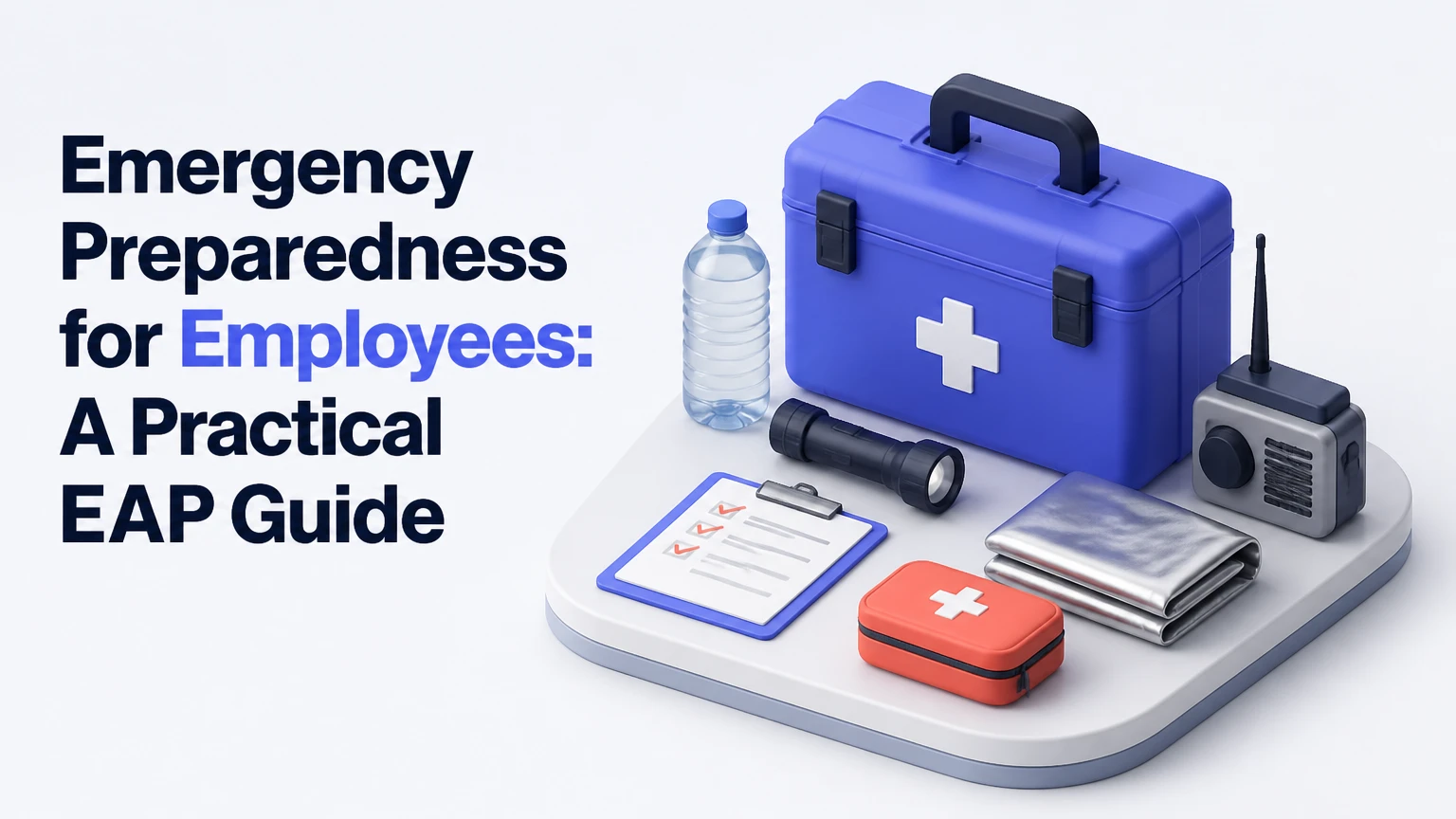
Emergency preparedness for employees is a coordinated workplace system that identifies hazards, assigns response duties, protects people during an incident, and restores operations afterward. An effective system combines a written Emergency Action Plan, trained employees, accessible evacuation or shelter procedures, redundant communication, emergency equipment, and recurring exercises that expose failures before a real crisis.
Key Facts at a Glance
An Emergency Action Plan should name responsible people, alert methods, protective actions, evacuation routes, accountability procedures, and recovery contacts.
OSHA’s emergency action plan standard, 29 CFR 1910.38, identifies core plan elements for covered U.S. workplaces, although local requirements may add duties.
Every critical response role needs a trained alternate because illness, absence, shift work, or the incident itself can remove the primary leader.
A communication plan needs at least one method that works without commercial power, internet access, or mobile service.
Drill quality is measured by observable performance, such as alert reach, exit clearance, headcount completion, and corrective-action closure.
Emergency plans must address employees, contractors, visitors, temporary workers, remote staff, and people who need individualized assistance.
What Is Employee Emergency Preparedness?
Employee emergency preparedness is the capability of a workforce to prevent avoidable harm, respond to a foreseeable incident, and resume essential work under controlled conditions. The capability belongs to the employer and employees together: management provides resources and authority, while workers learn the actions, routes, alerts, and reporting rules that apply to their roles.
The system is broader than a fire evacuation document. It connects hazard controls, business continuity, occupational safety, first aid, crisis communication, security, information technology, facilities management, and employee support. FEMA describes preparedness as “a shared responsibility,” a principle that matters because no single manager can see every hazard or account for every worker during a complex event.
OSHA distinguishes an Emergency Action Plan from a broader business continuity or crisis-management program. An EAP focuses on immediate worker protection, while continuity planning addresses services, suppliers, technology, finances, and recovery priorities. The two plans should connect without becoming one unmanageable binder.
How does the preparedness cycle work?
The workplace preparedness cycle has four linked phases: mitigation and prevention, preparedness, response, and recovery. Each phase produces a tangible control, so a company can test whether planning exists in practice rather than judging readiness from document length.
- Mitigation and prevention: Remove hazards, maintain fire protection, secure chemicals, correct blocked exits, and reduce cyber or utility vulnerabilities.
- Preparedness: Write procedures, assign roles, install alarms, stock supplies, train staff, and coordinate with building management and emergency services.
- Response: Warn people, protect or evacuate them, provide immediate aid, account for personnel, and transfer command information to public responders.
- Recovery: Reopen safely, preserve records, support affected employees, communicate operating changes, and close corrective actions.
A useful rule is to treat every hazard as a chain: trigger, decision, action, communication, accountability, and recovery. If any link has no owner, the procedure is incomplete.
How Do You Build an Employee Emergency Plan?
Build an employee emergency plan in seven controlled steps over approximately 30-90 days for a small or medium office. The success factor is not document volume; it is whether employees can identify the correct action within seconds and whether leaders can verify who remains at risk.
Step 1: Identify hazards and exposed people
Create a site-specific risk register rather than copying generic scenarios. Inspect electrical rooms, kitchens, laboratories, loading bays, roofs, parking areas, stairwells, server rooms, storage areas, and neighboring properties that could affect the workplace.
Record the hazard, trigger, exposed population, existing control, likely consequence, and response decision. A simple score can multiply likelihood from 1-5 by consequence from 1-5. A chemical release near a return-air intake may deserve priority even when it is less likely than a minor fire because the exposure pathway is faster.
Include workforce conditions that change risk:
- Night shifts and lone workers
- Contractors, visitors, and temporary staff
- Employees who do not speak the plan’s primary language
- Hearing, visual, cognitive, or mobility needs
- Severe weather commuting exposure
- Remote employees handling company data or customer services
- Employees who may fear retaliation when reporting hazards
Step 2: Assign command and response roles
Name an incident commander, safety or facilities lead, communications lead, first-aid responders, floor or zone wardens, accountability lead, IT representative, and employee-support contact. Assign at least one alternate to each role, and write the authority boundary for decisions such as evacuation, sheltering, shutdown, closure, and re-entry.
A practical role card fits on one page and includes the role’s first three actions, contact methods, equipment location, escalation point, and handoff rule. The incident commander coordinates; the commander does not personally search every room, treat every casualty, and publish every message.
For high-risk sites, coordinate role definitions with the local fire service, emergency medical services, hazardous-materials team, security provider, and building owner. Public responders take command when they arrive. The workplace team must provide accurate information, not compete for control.
Step 3: Define protective actions
For each scenario, state whether employees should evacuate, shelter in place, lock down, relocate internally, or remain at home. Avoid vague language such as “follow management instructions.” Employees need a visible action and a condition for changing it.
An evacuation procedure should identify all usable exits, prohibited elevators, accessible routes, assembly areas, re-entry authority, visitor handling, and accountability method. A shelter procedure should identify rooms, ventilation controls when appropriate, supplies, duration, and the authority that ends sheltering.
The U.S. Department of Labor’s Job Accommodation Network recommends individualized planning for workers with disabilities. A buddy system can help, but it must be voluntary, rehearsed, and supported by equipment or an accessible route rather than treating a coworker as the person’s sole safety resource.
Step 4: Build redundant communication
Use a primary alert, a secondary alert, and an offline fallback. A typical office might use the fire alarm or public-address system first, SMS or an approved mass-notification platform second, and battery-powered radios, megaphones, printed rosters, or runners during an outage.
Every message should answer four questions: What happened? Where? What must employees do now? When will the next update arrive? Keep instructions specific and avoid unverified casualty details.
Example evacuation message:
Fire alarm reported on Floor 3. Leave by the nearest stairwell, do not use elevators, and report to the south parking assembly point. Supervisors must bring printed rosters. Do not re-enter until fire officials authorize it. Next update in 10 minutes.
Store emergency contacts in a printed, password-protected or access-controlled format. Digital systems can fail, but printed information can also become outdated or expose personal data. Assign an owner and review date to both versions.
Step 5: Equip the workplace
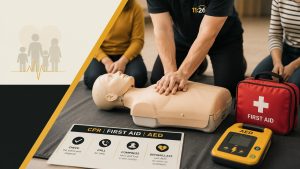
Equipment must match the hazard assessment, occupancy, distance from emergency services, and legal requirements. A basic office commonly needs first-aid kits, AED access where appropriate, flashlights, spare batteries, high-visibility vests, barrier tape, emergency contact cards, drinking water, basic sanitation supplies, and battery or hand-crank communication equipment.
Do not improvise specialist equipment. Chemical facilities may require detection, containment, respiratory protection, eyewash stations, decontamination equipment, and trained responders; those controls require competent occupational safety and HazMat review.
| Control or supply | Typical planning quantity | Inspection or replacement point |
|---|---|---|
| First-aid kits | 1 per floor or work zone | Monthly inventory; expiry check quarterly |
| Flashlights and spare batteries | 1 kit per 20-30 occupants | Monthly function test; batteries per manufacturer |
| Drinking water | 1 gallon per person per day where sheltering is planned | Review every 6-12 months |
| Printed rosters and contacts | 1 sealed set per warden plus control room | Reprint after staffing or phone changes |
| High-visibility vests | 1 per warden and incident lead | Inspect after every drill |
| AED | Site-specific placement, usually near high-occupancy areas | Self-test daily or weekly, per model |
| Emergency radios or megaphone | 1 per response zone or control point | Monthly battery and signal test |
The AI Overview’s three-to-five-year refresh suggestion is too broad for every supply. Water, medications, batteries, sterile dressings, and chemical products have different shelf lives. Follow each manufacturer’s date and inspect more often than the replacement interval.
Step 6: Train employees and run drills
Train new employees during onboarding and refresh the material after plan changes, major incidents, relocations, or role changes. Minimum employee knowledge should include alarm recognition, nearest and alternate exits, assembly location, shelter or lockdown action, emergency reporting, visitor guidance, and the rule against re-entry.
Drills should test one decision or capability at a time. An announced evacuation may test route capacity; a communications exercise may test reach and message clarity; a tabletop exercise may test leadership decisions without moving people through a building.
Track measurable results:
- Time from trigger to first alert
- Percentage of employees receiving the message
- Time to clear each zone
- Number of blocked, confusing, or inaccessible routes
- Time to complete accountability
- Unresolved names or last-known locations
- Corrective actions closed by their due dates
The U.S. Fire Administration recommends regular fire drills, but no universal drill frequency fits every jurisdiction or hazard. Follow the stricter applicable law, insurer condition, building rule, or fire authority direction. As a practical baseline, many offices schedule fire evacuation exercises at least twice yearly and tabletop exercises quarterly.
Step 7: Review, document, and improve
Complete an after-action review within 48-72 hours of a drill or incident. Record what happened, what should have happened, the risk created, the owner, the due date, and the evidence required for closure.
Review the plan at least annually and immediately after a move, renovation, acquisition, serious incident, major staffing change, new process, new chemical, utility change, or regulatory update. Version-control the document so employees can identify the current plan rather than relying on multiple copies with conflicting instructions.
Which Workplace Emergencies Need Separate Procedures?
Different emergencies require different protective actions, so one generic evacuation instruction is unsafe. Fire, earthquake, violence, hazardous-material release, medical events, severe weather, cyber incidents, and utility failures need scenario-specific triggers and decisions.
| Emergency type | Immediate employee action | Leader decision | Recovery checkpoint |
|---|---|---|---|
| Fire or smoke | Activate alarm, evacuate by stairs, close doors if safe | Confirm evacuation and responder handoff | Fire authority clears re-entry |
| Earthquake | Drop, cover, and hold on; evacuate after shaking if directed | Check hazards and structural concerns | Qualified inspection before occupancy |
| Tornado or severe wind | Move to designated interior shelter away from glass | Monitor official warnings and building condition | Inspect roof, utilities, and access |
| Chemical spill | Isolate area, move upwind if outdoors, report substance | Evacuate or shelter; control HVAC only with competent advice | Decontamination and air-safety clearance |
| Active violence | Run if safe, hide and secure if escape is unsafe, fight only as last resort | Notify law enforcement and protect information | Trauma support and controlled reopening |
| Medical emergency | Call local emergency number, send AED and trained responder | Preserve access for EMS and document handoff | Incident review and equipment replacement |
| Power or IT outage | Stop unsafe work, use backup communications, protect equipment | Decide closure, remote work, or controlled shutdown | Restore systems and validate data |
| Infectious disease event | Follow health guidance, isolate when directed, use ventilation controls | Apply absence, cleaning, and continuity measures | Monitor return-to-work criteria |
Fire extinguishers are not a universal employee response tool. The RACE sequence, commonly taught as Rescue, Alarm, Confine, Extinguish or Evacuate, should only lead to extinguisher use when the fire is small, the employee is trained, the correct extinguisher is available, and escape remains clear.
For an active threat, the U.S. Department of Homeland Security’s widely used guidance is Run, Hide, Fight. Training must avoid implying that employees should confront an attacker; hiding, locking or barricading doors, silencing devices, and following law-enforcement instructions are often safer choices.
What Must Every Employee Know?
Every employee should know the first action for each likely emergency, the nearest and alternate safe route, the assembly or shelter location, the alert channels, the reporting number, and the person responsible for accountability. Employees should also know that they must not delay evacuation to collect belongings or re-enter for someone who may already be accounted for.
Use a one-page employee safety card containing:
- Local emergency number and site address
- Alarm meanings and notification channels
- Nearest and alternate exits
- Assembly and shelter locations
- First-aid kit and AED locations
- Instructions for visitors and contractors
- Severe weather, violence, and hazardous-material actions
- Accessibility or individualized-assistance contact
- After-hours and remote-work reporting procedures
Employees should report blocked exits, missing supplies, false alarms, unsafe behavior, and changes in personal assistance needs through a protected reporting channel. Confidential health information belongs with authorized personnel, not on a public evacuation map.
How Do You Plan for Disabilities, Visitors, and Remote Employees?
Inclusive emergency preparedness requires different ways to receive warnings, move safely, communicate, and confirm status. A plan that works for an able-bodied daytime employee may fail for a deaf worker on a night shift, a visitor unfamiliar with the building, or a remote employee whose address is unknown to the organization.
For accessibility, assess alarms with visual and audible signals, accessible routes, refuge areas where permitted by local code, evacuation chairs if trained staff use them, accessible transportation, and personal emergency plans. Never assign assistance without consent and a backup arrangement.
Visitors need sign-in data, host responsibilities, reception procedures, and a method for accounting when the reception desk is evacuated. Contractors may understand site hazards better than employees, so include contractor induction and supervisor confirmation.
Remote and hybrid programs should define:
- Which emergency number applies to the worker’s location
- Whether employees report safety status to a manager or platform
- How the company supports severe weather, domestic violence, or power loss
- Which systems remain available during an office closure
- How remote staff protect company information during cyber incidents
- How managers verify wellbeing without collecting unnecessary location data
A remote-work policy is not a substitute for local household preparedness. The employer should provide role-specific guidance and continuity support, while employees remain responsible for following local emergency instructions.
Which Communication Tools Work During Outages?
No single notification technology works in every emergency. A mass-notification platform improves speed and delivery tracking, while SMS can fail during congestion, email requires connectivity and attention, and radios require charging, coverage, and user training.
| Communication method | Typical reach or dependency | Strength | Limitation and fallback |
|---|---|---|---|
| Public-address system | Building power and audibility | Fast for occupants onsite | Use megaphone or wardens if power fails |
| SMS alert platform | Cellular network and current numbers | Delivery tracking and broad reach | Keep voice calls and printed rosters |
| Email or collaboration app | Internet and device access | Detailed instructions and records | Use SMS, radio, or phone tree |
| Two-way radio | Charged units and channel discipline | Works without internet | Test range and assign channels |
| Megaphone or runners | Physical access | Operates without network service | Use zone maps and protective equipment |
| Printed roster | Manual control | Works during cyber or power loss | Secure personal data and update monthly |
A mass-notification app is a poor replacement for a fire alarm, a trained warden, or public emergency instructions. Technology improves coordination; it does not remove the need for physical controls and human judgment.
How Much Does Preparedness Cost?
A small low-risk office typically spends about $200-$600 for an initial basic setup, excluding major building systems, specialized training, and regulatory upgrades. A professional consultant commonly costs $1,000-$5,000 or more, while mass-notification software often falls near $2-$8 per user annually in typical market estimates, with vendor and regional variation.
| Workplace profile | Initial planning range | Recurring annual range | Main cost drivers |
|---|---|---|---|
| Small office, fewer than 50 workers | $200-$2,000 | $150-$1,000 | Supplies, training, signage, first aid |
| Multi-floor office, 50-500 workers | $2,000-$15,000 | $2,000-$20,000 | Notification, drills, wardens, access systems |
| Warehouse or manufacturing site | $10,000-$100,000+ | $5,000-$50,000+ | Detection, PPE, specialist training, audits |
| Laboratory or chemical facility | $15,000-$150,000+ | $10,000-$75,000+ | Monitoring, containment, medical and HazMat controls |
These are planning ranges, not quotations. Local labor rates, building ownership, fire-code requirements, hazard classification, insurance conditions, and existing equipment can change the budget substantially.
A useful purchasing order is risk controls first, communication redundancy second, training third, and software fourth. A subscription cannot compensate for a locked exit, missing extinguisher inspection, or untrained night-shift team.
Should You Write the Plan Internally?
Internal planning works for a small, low-risk workplace when a responsible owner can inspect the site, understand local requirements, consult employees, and maintain the plan. Professional support becomes more valuable for manufacturing, laboratories, healthcare, high-rise buildings, large headcounts, multiple sites, regulated operations, or incidents involving hazardous substances.
| Planning approach | Typical cost | Best fit | Main limitation |
|---|---|---|---|
| Internal template | $0-$2,000 | Small low-risk office | May miss technical or legal hazards |
| Safety consultant | $1,000-$5,000+ | Complex or regulated site | Requires internal ownership afterward |
| Notification platform | $2-$8 per user/year typical | Distributed or large workforce | Depends on current data and networks |
| Integrated EHS program | $10,000-$100,000+ | High-risk multi-site operation | Requires governance and specialist staffing |
The strongest model is often hybrid: internal leaders provide operational knowledge, while a qualified safety professional validates hazards, legal alignment, training, and emergency-service coordination. A consultant cannot maintain a plan that employees never practice.
Common Preparedness Mistakes and Fixes
The most damaging emergency-planning mistakes are operational, not grammatical. Organizations often write a long plan, fail to assign authority, omit vulnerable workers, or measure attendance instead of response performance.
Paper-plan syndrome
Failure: The EAP exists in a shared drive or binder, but employees cannot name the assembly point.
Fix: Convert core actions into a one-page card, onboarding module, wall map, and short scenario exercise.
Single-leader dependency
Failure: One facilities manager knows the routes, contacts, and shutdown procedures.
Fix: Train alternates across shifts and store role cards in controlled offline locations.
Incomplete accountability
Failure: Supervisors count people present but have no visitor, contractor, remote, or last-known-location process.
Fix: Use a current roster, reception log, department owners, and a rule for reporting unknown status without sending untrained people back inside.
Overly realistic drills
Failure: Unannounced alarms, simulated injuries, or blocked exits create panic or introduce hazards.
Fix: Define exercise boundaries, notify essential partners, prohibit simulated physical danger, and use tabletop methods for high-consequence decisions.
False certainty about re-entry
Failure: A manager allows return because smoke has cleared or power has returned.
Fix: Name the authorized clearance source, such as the fire service, building engineer, utility, public health authority, or qualified inspector.
Accessibility as an afterthought
Failure: A buddy is named once, but no route, equipment, backup, or consent process exists.
Fix: Develop an individualized plan confidentially, test it with the employee, and revise it when schedules or work areas change.
What Is the 90-Day Implementation Schedule?
A practical 90-day implementation schedule produces a usable first version quickly, then validates it through exercises. The schedule should prioritize life safety controls that can be corrected immediately instead of waiting for a polished policy document.
| Period | Deliverable | Acceptance test | Owner |
|---|---|---|---|
| Days 1-15 | Hazard register and workforce profile | All zones, shifts, visitors, and high-risk tasks listed | Safety or facilities lead |
| Days 16-30 | Draft EAP and role cards | Every core role has an alternate and decision authority | Incident commander |
| Days 31-45 | Maps, contacts, supplies, and alerts | Exit maps, rosters, equipment, and channels verified onsite | Facilities and IT |
| Days 46-60 | Employee briefing and accessibility review | Workers can state their first action and assembly location | HR and wardens |
| Days 61-75 | Evacuation or shelter drill | Alert, clearance, accountability, and accessibility results recorded | Emergency team |
| Days 76-90 | Corrective-action closure and final approval | High-risk findings have owners, dates, and evidence | Senior management |
Do not wait 90 days to correct an immediate danger. Remove blocked exits, repair alarms, secure unstable storage, and report serious hazards as soon as they are identified.
The Bottom Line
Emergency preparedness for employees is effective when people, procedures, equipment, communication, and recovery decisions work together under pressure. Start with a site-specific hazard register, create a concise EAP with alternate role owners, provide accessible and redundant alerts, train every shift, and use drills to close measurable gaps rather than to produce attendance records.
The best plan is the one employees can execute without searching for a binder. Review it after every meaningful workplace change, incident, or exercise, and obtain competent local advice when the building, hazard, or legal environment exceeds internal expertise.
FAQ
What is the difference between an EAP and a business continuity plan?
An EAP directs immediate life-safety actions, including evacuation, sheltering, alarms, accountability, and emergency contacts. A business continuity plan protects essential services over hours or days through alternate sites, technology recovery, staffing, suppliers, financial controls, and customer communication. Organizations should link the documents but keep their purposes distinct.
How often should employees receive emergency training?
Employees should receive basic emergency instruction during onboarding and whenever the plan, workplace, role, or hazard changes. Many organizations refresh core training annually and run scenario exercises during the year. The legally required frequency depends on the jurisdiction, industry, fire authority, insurer, and specific hazards.
Should workplaces use shelter in place or evacuation?
The correct action depends on the hazard, location, building design, and official instructions. Fire usually requires evacuation, while certain external airborne releases or severe weather may require sheltering. The EAP should define the trigger, destination, ventilation decision, communication method, and authority for changing actions.
How should a company communicate during a cyberattack?
A company should shift to preapproved offline procedures, including printed contacts, verified phone numbers, radios, in-person runners, and manual accountability. Employees should not use compromised systems for sensitive instructions. IT and security leaders must define trusted channels before an incident and explain how employees report suspicious messages.
What should happen after an employee is injured during an emergency?
Call the local emergency number, provide first aid only within the responder’s training, send the AED when appropriate, preserve EMS access, and document the handoff. After immediate care, the employer should follow applicable incident reporting, workers’ compensation, privacy, investigation, and employee-support procedures without delaying medical treatment.
How can a small business prepare without a large budget?
A small business can begin with a hazard walk-through, one-page employee instructions, printed contacts, clear exit maps, basic first-aid supplies, trained alternates, and short evacuation or shelter drills. Spending should first address blocked exits, missing alarms, unsafe storage, and communication gaps before purchasing specialized software.