CPR vs first aid training is a comparison between a focused cardiac-emergency skill and a broader system for managing illness and injury. CPR training prepares responders for cardiac arrest, while first aid training addresses bleeding, burns, choking, fractures, allergic reactions, and other urgent conditions before professional care arrives.
Key Facts at a Glance
CPR training focuses on cardiac arrest, chest compressions, rescue breaths, and AED use.
First aid training covers immediate care for injuries, sudden illness, and environmental emergencies.
CPR does not replace first aid, and first aid does not provide complete cardiac-arrest training.
A combined CPR/AED and first aid course usually takes 4-6 hours and costs approximately $70-$120 in the United States.
Healthcare workers generally need provider-specific BLS certification rather than a general public CPR card.
Online-only courses may teach knowledge, but many employers require an in-person skills assessment.
What Is the Difference Between CPR and First Aid Training?
CPR training is a specialized course for responding to cardiac arrest, whereas first aid training is a broader course for stabilizing people with injuries or sudden medical problems. CPR prioritizes circulation and oxygen delivery; first aid prioritizes scene safety, rapid assessment, emergency activation, and prevention of further harm.
The difference is easiest to understand through the event being managed. A person who collapses, does not respond, and is not breathing normally may need CPR and an automated external defibrillator. A person with a deep cut, sprained ankle, thermal burn, asthma attack, or suspected concussion may need first aid without CPR.
The courses overlap because first aid responders must recognize life-threatening conditions, call emergency services, and protect the airway. Many providers therefore package CPR, AED, and first aid together, but the certificate may list separate modules and separate completion requirements.
| Attribute | CPR training | First aid training | Combined course |
|---|---|---|---|
| Primary emergency | Cardiac arrest | Injury or sudden illness | Cardiac arrest plus injury and illness |
| Main intervention | Compressions, ventilation, AED | Assessment, bleeding control, recovery support | Both skill sets |
| Typical public course | 2-3 hours | 2-3 hours | 4-6 hours |
| Typical US price | $40-$75 | $40-$60 | $70-$120 |
| Core equipment | Mannequin, AED trainer, barrier device | Bandages, gauze, splint materials | All listed equipment |
| Common audience | Parents, coaches, staff | Workers, caregivers, travelers | Most households and workplaces |
What Does CPR Training Cover?
CPR training teaches recognition of cardiac arrest, high-quality chest compressions, rescue breathing, AED operation, and age-specific modifications for adults, children, and infants. Adult lay-responder courses commonly teach a compression rate of 100-120 per minute and a depth of at least 2 inches, or 5 centimeters, while avoiding excessive depth beyond approximately 2.4 inches, or 6 centimeters.
The response begins with scene safety and a responsiveness check. A rescuer should shout for help, direct someone to call the local emergency number and retrieve an AED, and assess whether the person is breathing normally. Agonal gasps are not normal breathing and should not delay resuscitation.
For a trained adult rescuer, conventional CPR generally uses 30 compressions followed by 2 breaths. A willing untrained bystander may provide hands-only CPR for a suddenly collapsed adult by calling emergency services and pushing hard and fast in the center of the chest. The American Heart Association uses the instruction “push hard and fast” in its public CPR messaging.
Adult CPR specifications
| CPR element | Typical adult target | Training consequence |
|---|---|---|
| Compression rate | 100-120 per minute | Rhythm must remain fast but controlled |
| Compression depth | At least 2 inches, 5 cm | Shallow compressions reduce blood flow |
| Maximum practical depth | About 2.4 inches, 6 cm | Excessive depth increases injury risk |
| Compression-to-breath ratio | 30:2 | Used by one or two trained rescuers |
| Breath duration | About 1 second each | Visible chest rise, not forceful inflation |
| AED timing | As soon as available | Follow the device prompts and pause only for analysis or shock |
A pulse check is difficult for untrained responders and can delay compressions. Current public-facing guidance generally emphasizes responsiveness and abnormal breathing, while healthcare-provider courses teach a pulse assessment within 10 seconds. Training providers may present slightly different sequences because they follow AHA, American Red Cross, Resuscitation Council UK, or another national protocol.
CPR is not treatment for a heart attack. A heart attack occurs when blood flow to heart muscle is blocked; cardiac arrest occurs when the heart stops pumping effectively. A heart attack can cause cardiac arrest, but a conscious person with chest pain usually needs emergency medical evaluation, not chest compressions.
What Does First Aid Training Cover?
First aid training teaches responders to identify immediate threats, activate emergency help, give basic care, and monitor the person until advanced medical assistance arrives. Standard courses commonly include severe bleeding, shock, choking, burns, wounds, sprains, fractures, allergic reactions, seizures, heat illness, hypothermia, poisoning, and sudden breathing problems.
The first-aid process is broader than a single procedure. The responder checks scene hazards, obtains consent when possible, uses gloves or another barrier, assesses responsiveness and breathing, calls emergency services for serious conditions, and gathers relevant information such as symptoms, allergies, medications, medical history, recent food or drink, and the event that caused the problem.
The familiar Three Ps summarize the purpose of first aid: preserve life, prevent the condition from worsening, and promote recovery. Those goals do not authorize diagnosis, invasive treatment, medication administration, or transportation beyond the responder’s training.
| First-aid situation | Immediate trained response | Escalation indicator |
|---|---|---|
| Severe external bleeding | Direct pressure, wound packing or tourniquet when trained | Spurting blood, persistent heavy bleeding, pale or weak person |
| Thermal burn | Cool running water, remove constricting items, loose sterile covering | Face, airway, hands, genitals, major area, or deep burn |
| Conscious choking | Encourage coughing if effective; use age-appropriate back blows and thrusts | Inability to speak, cough, or breathe; unresponsiveness |
| Suspected fracture | Keep the area still, control bleeding, avoid unnecessary movement | Open fracture, deformity, loss of circulation, spinal concern |
| Anaphylaxis | Help the person use their prescribed epinephrine auto-injector | Breathing difficulty, throat swelling, faintness, worsening symptoms |
| Heat illness | Move to a cooler area and begin active cooling | Confusion, collapse, seizure, or inability to drink |
First-aid courses vary considerably. A two-hour workplace class may cover only core emergencies, while an advanced occupational course adds patient assessment, oxygen administration, epinephrine protocols, or specialized equipment. The course outline matters more than the word “first aid” on the title.
Are CPR and First Aid Taught Together?
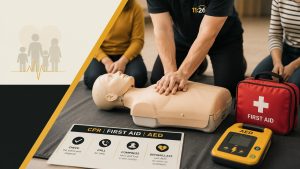
CPR and first aid are frequently taught together because workplaces, childcare settings, schools, and community organizations need both emergency capabilities. A combined course usually contains a CPR/AED module and a first-aid module, followed by practical demonstrations or a skills check for each area.
Combining the subjects saves registration time and often costs less than booking two separate classes. The trade-off is cognitive load: a participant may practice adult compressions, infant choking, bleeding control, burns, seizures, and allergic reactions in one long session, then remember only the most recently rehearsed details without periodic refreshers.
A combined certificate is appropriate when an employer asks for “CPR and first aid,” but the exact provider and course level must still match the requirement. A general Heartsaver course may not satisfy a hospital’s BLS requirement, and an online certificate may not satisfy a childcare regulator’s in-person rule.
What does each certification level mean?
| Course level | Intended learner | Typical content | Common acceptance boundary |
|---|---|---|---|
| Lay responder CPR/AED | Public, office staff, coaches | Adult CPR, AED, sometimes child and infant skills | Community and many workplace roles |
| Heartsaver CPR/AED | Non-healthcare employees with job duty | CPR, AED, optional first aid | Employer-specific acceptance |
| Standard first aid | Workers, caregivers, public | Injury and illness response | Workplace or community use |
| BLS Healthcare Provider | Nurses, EMTs, clinicians, students | High-quality CPR, team response, ventilation | Healthcare education and employment |
| ACLS | Advanced healthcare professionals | Cardiac rhythms, medications, advanced airway | Clinical roles requiring ACLS |
| PALS | Pediatric healthcare professionals | Pediatric resuscitation and advanced algorithms | Pediatric clinical roles |
| Wilderness First Aid | Remote workers and outdoor users | Evacuation, prolonged care, improvised treatment | Remote settings, not usually hospital employment |
BLS is not simply “more CPR.” BLS adds healthcare-team dynamics, two-rescuer coordination, bag-mask ventilation, pulse checks, and role-specific resuscitation decisions. ACLS and PALS build on BLS and require professional clinical knowledge, so a lay CPR card cannot substitute for them.
How Much Do CPR and First Aid Courses Cost and Take?
Typical US pricing is $40-$75 for standalone CPR/AED, $40-$60 for standalone first aid, $70-$120 for a combined course, and $60-$90 for BLS. Most public certifications require 2-3 hours for one subject, 4-6 hours for a combined course, and approximately 3-5 hours for initial BLS, although local providers, testing rules, and course depth change the total.
| Training option | Typical duration | Typical US price | Skills assessment | Common renewal interval |
|---|---|---|---|---|
| CPR/AED only | 2-3 hours | $40-$75 | Usually required | 2 years |
| First aid only | 2-3 hours | $40-$60 | Provider-dependent | 2 years |
| CPR plus first aid | 4-6 hours | $70-$120 | CPR and first aid checks | 2 years |
| BLS initial course | 3-5 hours | $60-$90 | Required by major providers | 2 years |
| Wilderness First Aid | 16-24 hours | $180-$350 | Scenario-based | 2-3 years |
| Pediatric CPR and first aid | 4-6 hours | $75-$150 | Age-specific skills | 2 years |
The two-year period is a common provider policy, not a universal guarantee of competence. The American Heart Association, American Red Cross, and many workplace programs recommend renewal at two-year intervals, while employers or regulators may impose shorter deadlines or annual refreshers.
Ask whether the fee includes the digital card, manuals, practice equipment, travel charge, retest, and employer documentation. An unusually low price may represent an online knowledge course without an instructor-led skills demonstration.
Does Online CPR or First Aid Training Count?
Online-only training may count for personal education, but it does not automatically satisfy an employer, licensing board, school, or regulator. Many organizations accept blended learning only when online instruction is followed by an in-person skills session with a qualified instructor and equipment.
| Delivery method | Theory format | Hands-on practice | Typical acceptance |
|---|---|---|---|
| Classroom | Instructor-led | Mannequin and AED trainer | Widely accepted |
| Blended CPR | Online modules | In-person skills check | Accepted when provider is approved |
| Online-only CPR | Video or quiz | None or self-practice | Often rejected for job compliance |
| Mobile group class | Instructor at workplace | On-site equipment | Practical for teams |
| Virtual first aid | Online modules | Usually absent | Useful for awareness, limited certification value |
CPR is a physical skill. A video cannot verify compression depth, release, hand position, ventilation, or AED behavior under pressure. First aid also benefits from practice, particularly tourniquet application, bandaging, recovery position, choking response, and pediatric assessment.
Before booking, obtain the requirement in writing. Confirm the named organization, course title, delivery method, expiration date, card format, and whether the instructor’s credential must come from AHA, Red Cross, Health and Safety Institute, St John Ambulance, or a local authority.
Which Training Should You Choose?
The right choice depends primarily on the emergency risk, the job requirement, and the age or environment of the people you may assist. Choose CPR/AED alone when cardiac-response certification is the stated requirement; choose first aid alone for a narrow injury-management role; choose the combined course when no rule excludes it and you want broad household or workplace readiness.
| User situation | Best starting course | Add-on | Reason |
|---|---|---|---|
| Office employee | CPR/AED plus first aid | AED orientation | Covers collapse, bleeding, falls, and burns |
| New parent or nanny | Pediatric CPR plus first aid | Infant choking practice | Children need age-specific procedures |
| Healthcare student | BLS Healthcare Provider | First aid if required | Clinical placements commonly specify BLS |
| Construction worker | Workplace first aid plus CPR/AED | Bloodborne pathogens | Injury exposure is higher than office exposure |
| Hiker or remote guide | Wilderness First Aid | CPR/AED | Evacuation may take hours rather than minutes |
| Swim coach or lifeguard | CPR/AED plus first aid | Water-rescue credential | Drowning response needs rescue-breath competence |
| Household member | Combined adult and pediatric course | AED familiarization | One course covers the widest home scenarios |
Should parents take CPR or first aid?
Parents, grandparents, and babysitters should usually choose pediatric CPR, AED, and first aid together. The course should include infant and child compressions, choking relief, drowning response, fever-related concerns, allergic reactions, burns, bleeding, and when to activate emergency services.
Adult-only CPR does not provide enough practice for small bodies. Infant compressions use different hand techniques, and child choking response changes with body size and responsiveness. Parents should also ask whether the instructor uses infant mannequins rather than discussing pediatric adaptations verbally.
What should workplaces require?
Most workplaces benefit from a combined CPR/AED and first aid course, but the correct level depends on the hazard assessment and applicable jurisdiction. An office may need designated responders and AED users, whereas construction, manufacturing, laboratories, schools, and childcare settings may require broader first-aid content or a specified number of trained employees.
OSHA requirements in the United States vary by workplace conditions and access to medical care; OSHA does not make every worker universally subject to one identical CPR certificate. The employer’s written safety plan and local regulation control.
What should healthcare workers take?
Healthcare workers and students should take the exact BLS course named by their employer or school, often from the American Heart Association or American Red Cross. A lay-responder CPR card normally lacks the healthcare-provider assessment, team-response practice, and ventilation skills required for clinical placement.
Do not buy ACLS or PALS merely because the course title sounds more advanced. Those courses require BLS-level competence and apply to professionals who manage advanced clinical resuscitation.
What should outdoor users take?
Outdoor users should choose Wilderness First Aid when evacuation or definitive care may be delayed beyond one hour, then add CPR/AED training if the wilderness course does not include current resuscitation certification. Wilderness courses emphasize patient assessment, improvised splints, hypothermia, heat illness, evacuation decisions, and prolonged wound care.
Standard first aid assumes relatively fast access to emergency services. It is not designed to manage an injured climber overnight or make a multi-hour evacuation safe.
Can CPR Replace First Aid Training?
CPR cannot replace first aid training because CPR addresses one narrow emergency, cardiac arrest, while first aid addresses dozens of conditions that do not require chest compressions. A person trained only in CPR may know how to respond to collapse but lack the skills to control severe bleeding, cool a burn, support a fracture, or recognize anaphylaxis.
First aid cannot replace CPR training either. First aid students may learn to recognize cardiac arrest, but a general first-aid module may provide little hands-on compression practice or no AED assessment. Course titles are not interchangeable.
The combined course is the most efficient substitute for taking both subjects separately, provided the course includes current CPR/AED skills verification and the certificate matches the organization requesting it.
What Are the Most Common Training Mistakes?
The most common mistake is selecting a certificate by title instead of comparing its required skills, provider, delivery method, and expiration date. A second mistake is treating certification as permanent competence, because compression quality, infant choking response, and tourniquet confidence decline without rehearsal.
Mistake 1: Choosing online-only for a hands-on job
Problem: The participant completes a quiz but cannot demonstrate compressions or AED use.
Correction: Select classroom or blended instruction with an in-person skills check and verify employer acceptance before payment.
Mistake 2: Confusing a heart attack with cardiac arrest
Problem: The rescuer assumes every chest-pain patient needs CPR.
Correction: A conscious, normally breathing person with suspected heart attack needs emergency activation and monitoring; CPR begins when the person becomes unresponsive and is not breathing normally.
Mistake 3: Delaying CPR for a pulse check
Problem: An untrained rescuer spends too long searching for a carotid pulse.
Correction: Follow the course protocol, but prioritize responsiveness, abnormal breathing, emergency activation, and immediate compressions when cardiac arrest is apparent.
Mistake 4: Using a tourniquet loosely
Problem: A partially tightened tourniquet can fail to stop arterial bleeding.
Correction: Apply it 2-3 inches above the wound, never over a joint, tighten until severe bleeding stops, and record the application time when possible.
Mistake 5: Applying ice, butter, or ointment to a serious burn
Problem: These substances can damage tissue or complicate later treatment.
Correction: Cool a thermal burn with clean, cool running water, commonly for at least 20 minutes under modern first-aid guidance, then cover it loosely and seek medical care for severe burns.
Mistake 6: Forgetting personal safety
Problem: The rescuer becomes a second casualty through traffic, electricity, fire, blood exposure, or water hazards.
Correction: Make the scene safe, use barriers, and wait for trained responders when entering the scene would create unreasonable risk.
A practical rule is simple: training should reduce hesitation, not encourage improvisation beyond your scope. Certification does not authorize invasive procedures, diagnosis, or treatment that the course never taught.
How Long Does Certification Last?
Most CPR, AED, first aid, and BLS cards remain valid for two years, but the expiration rule comes from the issuing organization, employer, regulator, or licensing body. Wilderness and pediatric programs may use different renewal periods, and some employers require annual skills refreshers even when the card remains current.
Schedule renewal before the card expires. Some organizations accept a renewal course only during a short window, while others require an initial course after expiration. A renewal class may also be shorter or cheaper, but that distinction is provider-specific.
Monthly practice improves retention more reliably than rereading a certificate. A household can rehearse emergency calling, AED location, recovery position, bleeding-kit contents, and compression technique with a feedback-enabled mannequin when available.
What Should You Verify Before Enrolling?
Confirm six details before paying for CPR or first aid training:
- Required credential: Ask for the exact course name and issuing organization.
- Hands-on requirement: Confirm the number of in-person practice and assessment hours.
- Age coverage: Check for adult, child, and infant content when relevant.
- Equipment practice: Verify access to a CPR mannequin, AED trainer, gloves, and barrier devices.
- Certificate evidence: Ask how the card is delivered and when it expires.
- Instructor qualification: Confirm the instructor’s current authorization and class size.
Class size affects practice time. A class with 30 participants and one mannequin offers less individual feedback than a class with 8 participants and multiple stations, even when both advertise the same syllabus.
FAQ
Is first aid harder than CPR?
First aid is usually broader, while CPR is more physically repetitive and time-sensitive. First aid requires recognition across multiple conditions, whereas CPR requires reliable compression mechanics, rescue-breath decisions, and AED operation. Difficulty depends on the learner’s role, age groups, physical ability, and prior exposure to emergencies.
Does first aid include AED training?
Standalone first aid may not include AED operation. CPR/AED courses generally include AED trainer practice, and combined CPR, AED, and first aid courses include both modules. Read the syllabus because “first aid certification” alone does not guarantee AED instruction or assessment.
Is BLS the same as CPR?
BLS includes CPR but covers more than basic public CPR. BLS training adds healthcare-provider assessment, two-rescuer coordination, ventilation with a bag-mask device, pulse checks, and team communication. Hospitals, clinics, and nursing programs commonly require BLS rather than a general lay-responder CPR card.
Can I take CPR and first aid separately?
You can take CPR and first aid separately when the issuing organizations and expiration dates meet the requirement. Separate classes may suit someone who already holds a valid certificate, needs only one renewal, or has limited scheduling flexibility. A combined course is usually more efficient for first-time learners.
What equipment should a home first-aid kit contain?
A practical home kit should include at least 20 adhesive bandages, 4 sterile gauze pads, 2 roller bandages, 2 pairs of gloves, medical tape, antiseptic wipes, a digital thermometer, scissors, tweezers, and a tourniquet if a trained adult knows how to use it. Add child-sized supplies for households with children.
How often should CPR skills be practiced?
Practice CPR skills every six months when possible, with formal certification renewal commonly required every two years. Short mannequin sessions can reinforce hand position, rate, depth, recoil, AED sequencing, and rescue-breath technique more effectively than passive video review.
The Bottom Line
CPR vs first aid training is not an either-or choice for most households and workplaces. CPR training addresses cardiac arrest with compressions, rescue breaths, and AED use; first aid training addresses injuries and sudden illnesses; and a combined course provides the broadest practical coverage when the certificate meets the employer or regulator’s rules.
Choose CPR/AED alone for a specific cardiac-response requirement, first aid alone for a defined injury-management role, BLS for healthcare work, pediatric CPR and first aid for childcare, and Wilderness First Aid for remote settings. Verify hands-on assessment, provider acceptance, age coverage, cost, and renewal date before enrolling.