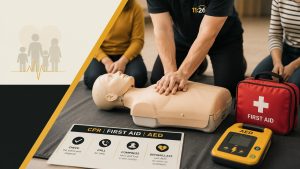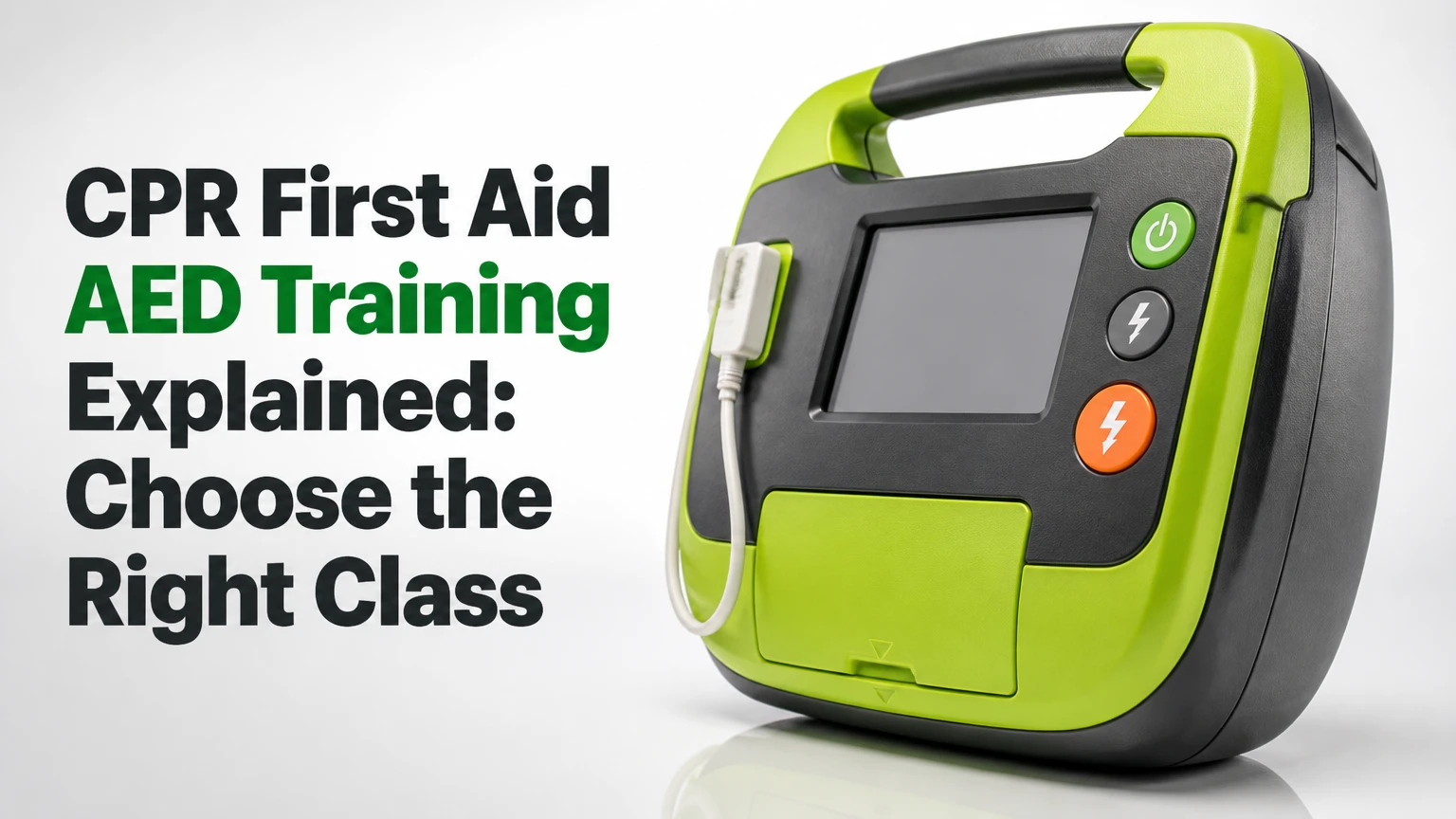
CPR first aid AED training explained means learning three connected emergency skills: cardiopulmonary resuscitation keeps blood moving during cardiac arrest, an automated external defibrillator analyzes rhythm and may deliver a shock, and first aid stabilizes injuries or sudden illness until emergency medical services arrive. Together, the skills address both cardiac and non-cardiac emergencies.
Key facts at a glance
Adult CPR uses chest compressions at 100-120 per minute and about 5-6 cm, or 2 inches, deep.
An AED delivers a shock only when its analysis identifies a rhythm that may respond to defibrillation.
Hands-only CPR is appropriate for many sudden adult collapses, but full courses also teach rescue breathing and choking response.
A complete workplace course usually combines CPR, AED operation, and first aid rather than teaching cardiac arrest alone.
Most major U.S. CPR and first aid credentials require renewal every two years, although the employer or regulator sets the acceptance rule.
Online education can explain procedures, but many employers require an in-person skills demonstration on a manikin.
What Does CPR First Aid AED Training Explained Mean?
CPR first aid AED training explained is a coordinated course rather than one medical procedure. CPR addresses absent or ineffective circulation, AED use addresses certain electrical rhythms, and first aid addresses immediate care for bleeding, burns, choking, illness, and injury. The sequence matters because a person may need more than one intervention.
Cardiac arrest is an electrical and mechanical failure in which the heart stops pumping blood effectively. A heart attack is a blocked blood supply to heart muscle, and it can cause cardiac arrest, but the two terms are not interchangeable. A conscious person with chest pressure may need urgent medical assessment, while an unresponsive person with abnormal breathing needs an immediate cardiac-arrest response.
The American Heart Association describes high-quality adult CPR with the instruction to “push hard and fast in the center of the chest.” That short phrase captures the central performance requirement, but training adds body position, recoil, ventilation decisions, AED coordination, and practice under pressure.
What Is CPR?
CPR combines repeated chest compressions with rescue breaths when appropriate. Compressions temporarily move blood to the brain and heart; breaths add oxygen, which becomes especially important when arrest follows drowning, respiratory failure, or a pediatric emergency.
CPR does not restart every stopped heart. Its purpose is to preserve circulation while another responder retrieves an AED and emergency clinicians arrive.
What Is an AED?
An AED is a computerized defibrillator designed for lay rescuers and trained responders. Adhesive pads detect the victim’s electrical rhythm, and the device gives spoken or visual instructions. The AED will not intentionally shock a rhythm that does not meet its programmed criteria.
An AED cannot replace CPR. The best sequence is immediate recognition, early emergency activation, continuous compressions, rapid pad application, and immediate resumption of CPR after analysis or shock.
What Is First Aid?
First aid is immediate care for illness or injury before definitive treatment. A first aid course commonly covers severe bleeding, burns, choking, fractures, sprains, shock, stroke symptoms, seizures, allergic reactions, poisoning, heat illness, hypothermia, and sudden medical problems.
First aid is not a substitute for diagnosis. A responder controls immediate threats, avoids making the condition worse, monitors the person, and transfers information to EMS.
What Should You Do During a Cardiac Emergency?
For an unresponsive adult who is not breathing normally or is only gasping, make the scene safe, activate emergency services, send for an AED, and begin CPR immediately. A trained rescuer may use 30 compressions followed by two breaths, while an unwilling or unable rescuer should provide continuous hands-only CPR.
Step 1: Check Safety and Responsiveness
Look for traffic, electricity, fire, violence, unstable structures, or water hazards before approaching. Tap the shoulders and shout, “Are you okay?” Do not spend more than about 10 seconds trying to establish responsiveness and normal breathing.
Agonal gasps are not normal breathing. Occasional snorting, irregular gasping, or slow struggling breaths should trigger the cardiac-arrest response when the person is unresponsive.
Step 2: Call EMS and Send for the AED
Call the local emergency number, place the phone on speaker, and identify the exact location. Point to a specific bystander and say, “Bring the AED,” because a general request often leaves everyone waiting.
The dispatcher may provide CPR instructions. Follow those instructions when they differ from memory, especially when local protocols or the victim’s age are uncertain.
Step 3: Give High-Quality Compressions
Kneel beside the victim on a firm surface. Place the heel of one hand in the center of the chest, place the other hand over it, straighten the elbows, and position the shoulders above the hands.
Push at 100-120 compressions per minute, allowing the chest to return fully after each compression. For an average adult, compress approximately 5-6 cm, or at least 2 inches without exceeding about 6 cm, or 2.4 inches. Avoid leaning between compressions because incomplete recoil reduces filling between pumps.
Step 4: Add Rescue Breaths When Trained and Willing
Use a 30:2 cycle when a trained responder can provide breaths safely with a barrier device. Open the airway with a head-tilt and chin-lift unless a suspected spinal injury changes the trained protocol, seal the mouth, pinch the nose, and give two breaths of about one second each.
Each breath should produce visible chest rise. Excessive force or volume can inflate the stomach, cause regurgitation, and interrupt compressions.
Step 5: Apply the AED as Soon as It Arrives
Expose the chest, turn on the AED, and follow its voice prompts. Attach pads to clean, dry bare skin in the illustrated positions, then stop touching the victim while the device analyzes.
If the AED advises a shock, loudly state “Clear,” verify that nobody is touching the victim, and press the shock button when instructed. Resume compressions immediately afterward. If the AED advises no shock, restart CPR without delaying for further interpretation.
Emergency response checkpoints
| Situation | Immediate action | Key time or quantity |
|---|---|---|
| Unresponsive adult, abnormal breathing | Call EMS, retrieve AED, start CPR | Breathing check under 10 seconds |
| Adult hands-only CPR | Continuous chest compressions | 100-120 per minute |
| Adult conventional CPR | 30 compressions, 2 breaths | About 2-minute cycles |
| AED rhythm analysis | Stop contact and movement | Resume CPR immediately after prompt |
| Rescuer fatigue | Change compressors with minimal pause | About every 2 minutes |
How Does CPR and AED Training Work?
CPR and AED classes combine explanation, demonstration, physical practice, and skills assessment. The student learns recognition and decision-making first, then repeats compressions, breaths, choking response, and AED operation until the sequence becomes reliable under time pressure.
A meaningful class uses an adult manikin, and pediatric courses add child and infant manikins. Skills practice exposes errors that videos cannot reliably detect, including shallow depth, incorrect hand position, slow rate, incomplete recoil, poor mask seal, and long pauses.
What Are the Correct CPR Numbers?
The principal adult CPR numbers are 100-120 compressions per minute, approximately 5-6 cm depth, 30 compressions to two breaths, and no unnecessary pauses longer than 10 seconds. These are training targets, not a reason to delay action while searching for perfect measurement.
| CPR element | Adult | Child | Infant |
|---|---|---|---|
| Compression rate | 100-120/min | 100-120/min | 100-120/min |
| Compression depth | 5-6 cm | About 5 cm, one-third chest depth | About 4 cm, one-third chest depth |
| Two-rescuer ratio | 30:2 | 15:2 | 15:2 |
| One-rescuer ratio | 30:2 | 30:2 | 30:2 |
| Hand technique | Two hands | One or two hands | Two fingers or two-thumb method |
Child and infant protocols vary by provider and guideline edition, so a current course should control the exact technique. Pediatric arrest often begins with a breathing problem, which makes rescue breathing more important than it is in many witnessed adult collapses.
When Is Hands-Only CPR Appropriate?
Hands-only CPR is a reasonable public response for a suddenly collapsed, unresponsive adult when the rescuer is untrained, unwilling to give breaths, or lacks a barrier. Continuous compressions are better than waiting for a trained person or refusing to help.
Conventional CPR with breaths is preferred for children, infants, drowning, overdose, respiratory arrest, and prolonged collapse when the responder is trained. A pocket mask or bag-mask device can reduce direct mouth contact, but unfamiliar equipment should not create a delay.
What Does First Aid Training Include?
First aid training teaches a structured primary assessment, control of immediate threats, and escalation to EMS. Students usually practice direct pressure for bleeding, recovery position decisions, choking response, burn care, seizure protection, and recognition of time-sensitive illness.
A workplace course may also include tourniquet awareness, epinephrine auto-injector assistance, naloxone education, splinting, chemical exposure, heat stroke, and incident documentation. Exact content depends on the provider, industry, jurisdiction, and course length.
Which Course Do You Need?
Most nonclinical employees need a CPR/AED and first aid course with an in-person skills demonstration, while healthcare professionals usually need Basic Life Support. Childcare workers, teachers, and coaches should choose a pediatric-inclusive course because infant and child emergencies require different manikins, assessment skills, and ventilation practice.
| Student or job | Recommended course | Required practical content | Typical duration |
|---|---|---|---|
| General public or office employee | Adult CPR/AED plus first aid | Adult manikin, AED, bleeding, choking | 4-7 hours |
| Teacher, coach, or childcare worker | Pediatric CPR/AED plus first aid | Adult, child, infant manikins | 5-8 hours |
| Construction or industrial worker | Comprehensive workplace first aid | CPR, AED, bleeding, burns, trauma | 5-8 hours |
| Nurse, EMT, dentist, or physician | BLS for healthcare providers | Two-rescuer CPR, ventilation, team response | 3-5 hours |
| Family member or babysitter | Community CPR/AED with pediatric content | Infant and child CPR, choking | 2-5 hours |
Course names are not standardized across all countries. “Level A,” “Level C,” “Heartsaver,” “Emergency First Aid,” and “BLS” can represent different curricula, so compare the issuing organization, victim ages, practical assessment, and employer acceptance rather than the label alone.
Is BLS the Same as CPR Certification?
BLS is broader and more demanding than a basic community CPR card. BLS courses train healthcare providers in two-rescuer coordination, bag-valve-mask ventilation, pulse and breathing assessment within the provider’s role, team communication, and high-quality resuscitation cycles.
A BLS card may not satisfy a workplace that specifically requests first aid. Conversely, a general first aid course may not satisfy a hospital that requires current BLS from a named provider.
Which Training Format Is Legitimate?
Instructor-led classroom training provides the strongest immediate feedback, blended learning offers flexibility with a practical session, and online-only training provides theory without dependable hands-on verification. Legitimacy depends on the employer or regulator’s acceptance criteria, not merely on a downloadable certificate.
| Format | Theory time | Skills practice | Typical U.S. price | Main limitation |
|---|---|---|---|---|
| Classroom | 4-8 hours | Full instructor-led practice | $70-$160 | Fixed schedule |
| Blended | 2-4 hours online | 1-2 hours in person | $60-$140 | Separate skills appointment |
| Online only | 1-3 hours | None or self-practice | $15-$50 | Often rejected for compliance |
| BLS classroom | 3-5 hours | Adult and team manikins | $60-$150 | Healthcare focus |
The Occupational Safety and Health Administration does not create one universal online CPR approval label for every employer. Employers, state agencies, licensing boards, and accrediting bodies may require different providers or hands-on evaluations. Confirm acceptance before paying.
Classroom Versus Blended Versus Online
Classroom training is preferable when a student needs correction with compression depth, ventilation, or pediatric technique. Blended learning works well for experienced staff who can complete online theory and attend a scheduled practical session without treating the online portion as the entire credential.
Online-only education is useful for awareness, preparation, and reviewing concepts. It is a poor choice when an employer, childcare license, healthcare facility, or contract requires demonstrated physical skills.
How Much Does CPR First Aid AED Training Cost?
Typical U.S. pricing is $15-$50 for online-only education, $60-$140 for blended CPR/AED and first aid, $70-$160 for classroom courses, and $60-$150 for BLS. Final cost changes with location, provider, travel, course materials, group size, replacement cards, and required pediatric modules.
| Training choice | Typical price | Student time | Common validity |
|---|---|---|---|
| Online CPR/AED awareness | $15-$50 | 1-3 hours | Provider-dependent |
| Adult classroom CPR/AED | $50-$100 | 3-5 hours | Usually 2 years |
| CPR/AED plus first aid | $70-$160 | 4-8 hours | Usually 2 years |
| Blended CPR/AED plus first aid | $60-$140 | 3-6 hours total | Usually 2 years |
| Healthcare BLS | $60-$150 | 3-5 hours | Usually 2 years |
Renewal every two years is common for AHA and American Red Cross programs, but a two-year card does not guarantee acceptance after a workplace policy changes. Some employers require annual refreshers, and some licensing rules impose separate first aid renewal dates.
What Mistakes Reduce CPR Quality?
The most damaging CPR mistakes are delayed compressions, shallow depth, incomplete recoil, excessive ventilation, and long pauses. These failures reduce blood flow or oxygen delivery even when the rescuer understands the general procedure.
- Starting with a prolonged assessment: Limit the responsiveness and breathing check to about 10 seconds.
- Compressing too slowly: Use a metronome near 100-120 beats per minute.
- Leaning on the chest: Lift pressure completely after each compression.
- Pausing to reposition repeatedly: Maintain a stable hand position and switch compressors efficiently.
- Over-ventilating: Give only enough air to produce visible chest rise.
- Waiting for the AED before compressing: Begin CPR while another person retrieves the device.
A practitioner rule is to assign roles aloud: compressor, caller, AED runner, and airway rescuer. Role clarity reduces duplicated tasks and makes a two-minute compressor change faster.
What If the AED Will Not Analyze?
An AED commonly fails to analyze because someone is touching the victim, the pads have poor contact, the chest is wet, or the pad connector is not fully inserted. Keep CPR going while correcting the problem, unless the device specifically requires a brief pause for analysis.
AED special situations
| Problem | Corrective action | Important restriction |
|---|---|---|
| Wet or sweaty chest | Dry the chest quickly | Do not apply pads to standing water |
| Dense chest hair | Shave only the pad locations if needed | Do not delay lifesaving care |
| Pacemaker or implanted defibrillator | Place pad beside the lump | Do not place directly over the device |
| Medication patch | Remove with gloved hand and wipe area | Avoid touching medication with bare skin |
| Oxygen near chest | Move oxygen source away during shock | Follow device and EMS instructions |
| Pregnant victim | Use standard AED pads | Maternal resuscitation takes priority |
Do not place an AED pad directly over a visible implanted device. A one-inch separation is a practical minimum when pad placement allows it. Follow the pad diagram because front-and-back placement may be necessary for a small chest or unusual anatomy.
The AED should not be used while the victim is in a puddle or being transported. A wet chest can be dried quickly, but a responder must never create an electrical hazard by kneeling in water.
Which Course Fits Your Situation?
Office employees generally need adult CPR/AED and first aid with hands-on verification, while childcare providers need pediatric-inclusive practice and healthcare workers need current BLS. High-risk workplaces should choose a comprehensive course that covers trauma hazards in addition to cardiac arrest.
For office staff and remote workers
Choose a blended or classroom adult CPR/AED plus first aid course if the employer requires a card. Online-only training may be adequate for personal knowledge but often fails a workplace skills requirement.
For teachers, coaches, and childcare providers
Choose pediatric CPR, AED, and first aid with adult, child, and infant manikin practice. Confirm that the course covers choking, rescue breathing, allergic reactions, seizures, and field or classroom emergencies.
For construction and industrial teams
Choose classroom training with bleeding control, burns, crush injuries, fractures, heat illness, and emergency communication. A cardiac-only class leaves a serious gap when the dominant hazards involve machinery, falls, vehicles, or tools.
For clinicians and first responders
Choose BLS from the organization accepted by the employer or licensing body. Verify the course includes two-rescuer scenarios, bag-mask ventilation, team dynamics, and a monitored skills assessment.
What Should You Verify Before Enrolling?
Before enrollment, verify the issuing organization, card type, expiration date, age groups, practical assessment, instructor credentials, and employer acceptance. A low price is not a saving if the certificate must be retaken before a shift, placement, license application, or contract begins.
Use this checklist:
- Ask the employer or regulator for the exact course name.
- Confirm whether adult-only or pediatric content is required.
- Check whether first aid is separate from CPR/AED.
- Confirm an instructor-led skills session and manikin assessment.
- Verify the card format and renewal interval.
- Ask whether the course is recognized by the American Heart Association, American Red Cross, National Safety Council, or another specifically accepted provider.
- Check cancellation, travel, and replacement-card fees.
- Keep the certificate and renewal reminder in the workplace record system.
A provider should clearly identify curriculum, instructor qualifications, assessment method, and issuing organization. Claims such as “OSHA approved” deserve scrutiny because OSHA generally describes workplace training expectations, while employers and recognized training organizations determine how credentials are issued and accepted.
Frequently Asked Questions
Does CPR certification include first aid?
CPR certification does not automatically include first aid. A CPR/AED card usually covers resuscitation and defibrillator use, while a combined CPR, AED, and first aid course adds injury and illness response. Read the certificate title and course outline before assuming both requirements are satisfied.
Can an AED shock someone with a pulse?
An AED analyzes electrical rhythm and is programmed to advise a shock only for rhythms it identifies as shockable. A rescuer should follow the device prompts, avoid touching the victim during analysis, and continue CPR when the AED says no shock is advised.
What happens if CPR breaks a rib?
Rib injury can occur during effective chest compressions, especially in older adults, but fear of injury should not stop resuscitation. Continue compressions at the correct position and depth, because untreated cardiac arrest is immediately life-threatening and emergency clinicians can manage injuries afterward.
Does CPR training expire?
Most widely issued U.S. CPR, AED, first aid, and BLS cards are valid for about two years, but expiration rules depend on the provider, employer, and regulator. Check the printed card and schedule renewal before the credential lapses, particularly for healthcare, childcare, and licensed work.
Should a lone rescuer leave an adult to find an AED?
A lone rescuer should activate EMS and begin CPR; whether the rescuer leaves depends on the location, phone access, and local protocol. If an AED is nearby and can be retrieved quickly, obtain it, but do not make a long search delay compressions.
Is online-only CPR training enough for a job?
Online-only CPR training is enough only when the employer or regulator explicitly accepts an online credential. Many workplaces require an in-person skills demonstration because compression depth, rate, recoil, ventilation, and AED handling cannot be reliably verified through a screen.
The Bottom Line
CPR first aid AED training explained is best understood as one emergency-response system with three roles: CPR maintains circulation, an AED addresses certain cardiac rhythms, and first aid stabilizes non-cardiac injury or illness. Choose the course by job requirement, victim age, practical assessment, issuing organization, and employer acceptance rather than by price alone. Begin with scene safety, call EMS early, start appropriate CPR, and apply the AED as soon as it arrives.