CPR certification requirements usually include full course participation, a hands-on demonstration of CPR and AED skills, and a provider-specific knowledge assessment. Requirements vary by organization, course level, employer, state rule, and occupation. A valid card normally identifies the issuing organization, course completed, completion date, expiration date, and credential holder.
Key Facts
Most major CPR credentials are valid for approximately two years, but the expiration date printed on the card controls.
A certification course normally requires an in-person skills evaluation, even when the knowledge portion is completed online.
Healthcare workers generally need Basic Life Support, or BLS, rather than a public Heartsaver CPR course.
OSHA does not issue CPR cards or approve individual training companies; employers must evaluate whether training meets the applicable workplace standard.
Hands-only CPR courses teach useful emergency action but usually do not satisfy jobs requiring a formal CPR/AED credential.
Course acceptance depends on the employer, licensing board, state agency, and training organization, not only on the words printed on the card.
What CPR Certification Means
CPR certification is documented completion of an approved cardiopulmonary resuscitation course. The credential shows that a learner received instruction and demonstrated specified knowledge and physical skills, but it is not a medical license, professional license, or guarantee of future competence.
Card terminology varies. The American Heart Association issues course completion cards for programs such as Heartsaver CPR AED and BLS Provider. The American Red Cross issues certificates or digital credentials for its CPR and first aid programs. Training centers may provide cards under an established organization’s curriculum, while independent online vendors may issue certificates that an employer refuses.
A certification card should contain the learner’s legal or registered name, course title, training organization, instructor or training center information, completion date, expiration date, and a verification method. A missing card number, generic certificate, or unsupported claim of “national accreditation” warrants verification before payment.
Is CPR Certification Legally Required?
CPR certification is not universally required by federal law for every adult, but specific jobs, licenses, facilities, schools, and contracts can require it. Federal workplace rules may require trained first-aid or CPR personnel in particular settings, while state laws and professional boards establish additional requirements.
OSHA is often misunderstood in this area. OSHA publishes workplace requirements and interpretations, but OSHA does not run a universal CPR certification program or place every private provider on a single approval list. For example, an employer may need reasonable access to first-aid personnel under 29 CFR 1910.151, while the exact course accepted by a hospital, school district, or fitness chain can be set by that organization.
Ask the receiving organization before enrolling. Written acceptance is more reliable than a provider’s sales page.
What Requirements Must You Meet?
Formal CPR certification generally requires course participation, successful skills testing, and completion of a written or electronic knowledge assessment. The exact passing score, retest policy, attendance rule, and card format depend on the issuing organization and course edition.
Most learners must:
- Attend or complete every required lesson and video module.
- Demonstrate high-quality compressions on an adult manikin.
- Demonstrate rescue breathing when the selected course includes ventilations.
- Use an automated external defibrillator, or AED, in the required sequence.
- Complete a written or online knowledge evaluation.
- Correct failed performance during a permitted remediation or retest.
- Provide accurate identification and contact details for credential records.
AHA and Red Cross classes may use different instructional systems and evaluation forms. One provider may allow an instructor to remediate a failed skill immediately; another may require a second appointment. A typical written passing threshold is approximately 75%-84%, but the course provider’s published policy controls.
What Happens During the Skills Assessment?
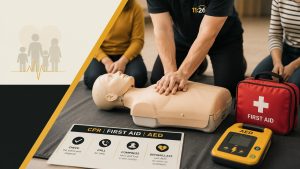
The skills assessment measures whether a learner can recognize cardiac arrest, activate emergency response, perform effective CPR, and operate an AED according to the course standard. Instructors commonly assess hand position, compression rate, depth, recoil, interruptions, ventilation technique, and responsiveness to AED prompts.
For an adult scenario, the widely taught target is 100-120 compressions per minute, with a depth of at least 2 inches and full chest recoil. The Red Cross summarizes the compression action as: “Push hard and fast in the center of the chest.” The phrase is simple, but passing depends on controlled depth and limited pauses rather than speed alone.
Most skills stations also test scene safety, responsiveness, breathing assessment, emergency activation, and continuation of care until help arrives. A learner who performs technically strong compressions but never calls emergency services can fail the scenario because CPR is a response sequence, not an isolated exercise.
What Does CPR Training Teach?
CPR training teaches recognition of cardiac arrest, chest compressions, rescue breaths, AED use, choking response, and age-specific modifications. A formal course also teaches when to stop, how to reduce interruptions, and how to coordinate with another rescuer.
For an unresponsive adult who is not breathing normally, a trained rescuer checks safety, assesses responsiveness and breathing for no more than 10 seconds, activates emergency services, begins compressions, and applies an AED as soon as one becomes available. Current American Heart Association guidance emphasizes early recognition, immediate CPR, rapid defibrillation, and professional post-arrest care.
For a single rescuer, the common adult CPR pattern is 30 compressions followed by 2 breaths when rescue breathing is used. Hands-only CPR is appropriate for many untrained bystanders responding to a suddenly collapsed adult, but formal occupational courses may require ventilation skills.
How Do Child and Infant Requirements Differ?
Child and infant CPR courses modify hand position, compression depth, rescue breathing, and choking procedures for smaller bodies. The course should explicitly identify the age groups covered because adult-only training does not automatically demonstrate pediatric competence.
| Learner or victim | Typical compression depth | Typical hand technique | Common course distinction |
|---|---|---|---|
| Adult | At least 2 inches, avoiding excessive depth | Two hands on the sternum | Standard adult CPR and AED sequence |
| Child | About 2 inches | One or two hands based on rescuer size | Pediatric assessment and age-appropriate force |
| Infant | About 1.5 inches | Two fingers for one rescuer, two-thumb technique for two rescuers | Infant breathing, choking, and two-rescuer CPR |
| Healthcare provider team | Adult, child, and infant targets | Two-rescuer coordination and BVM use | Pulse checks, ventilation equipment, and team roles |
The exact teaching language can change with guideline updates and provider course materials. Use the manikin age and course manual as the final reference during training.
Which Course Type Do You Need?
The correct course depends on the duties attached to the credential, not on the shortest course or lowest price. General workplace staff often need Heartsaver CPR/AED, childcare workers may need pediatric coverage, and healthcare professionals usually need BLS Provider training.
| Course | Typical audience | Skills included | Common acceptance context |
|---|---|---|---|
| Hands-Only CPR | General public, community groups | Adult compressions, emergency activation | Personal preparedness, usually not a job credential |
| Heartsaver CPR/AED | Office staff, teachers, coaches, workers | Adult CPR, AED, often child and infant modules | Workplace and community roles |
| Pediatric CPR/AED | Parents, babysitters, childcare staff | Infant and child CPR, AED, choking | Childcare employers and family care |
| BLS Provider | Nurses, physicians, EMTs, dental staff | CPR, AED, ventilations, team dynamics | Hospitals, clinics, healthcare education |
| ACLS or PALS | Advanced clinical teams | Cardiac or pediatric resuscitation algorithms | Usually added after BLS, not a replacement |
Does BLS Include CPR?
BLS includes CPR, but BLS is broader than a basic public CPR course. BLS training covers high-quality adult, child, and infant CPR, AED operation, rescue breathing, ventilation equipment, recognition of respiratory arrest, and team-based resuscitation.
A nurse applying for hospital privileges may need an AHA BLS Provider card or a Red Cross equivalent specifically named by the institution. ACLS generally assumes foundational BLS competence and does not always replace a separately required BLS card. PALS focuses on pediatric advanced life support and likewise may be held alongside BLS.
Read the job posting precisely. “CPR required” can mean Heartsaver for one employer and BLS for another.
Which Training Format Is Accepted?
In-person and blended courses with a documented hands-on evaluation are the safest choices for employment compliance. Online-only courses can teach knowledge, but many employers, schools, healthcare institutions, and regulators reject them because a browser test cannot verify physical performance.
| Format | Typical learner time | Typical price | Skills verification | Main limitation |
|---|---|---|---|---|
| Classroom | 3.5-6 hours | $45-$100 | Instructor observes manikin performance | Fixed schedule and travel |
| Blended | 2-3 hours online plus 1-2 hours onsite | $60-$130 | In-person appointment | Requires separate online and practical completion |
| Online-only | 1-2 hours | $15-$40 | Usually none or remote simulation | Often rejected for regulated employment |
| Private group class | 3-6 hours onsite | $500-$1,500 per group | Instructor observes each learner | Minimum enrollment or travel fee |
A course can be legitimate yet still unsuitable for a particular job. Before purchasing, send the employer the exact course name, provider, delivery format, and sample card. Ask whether a practical test must occur in person and whether the provider must be AHA, Red Cross, or another named organization.
How Can You Verify a Provider?
Verify the provider through the issuing organization’s course directory, instructor credentials, card verification system, and physical skills policy. A credible training center should identify the course owner, instructor, learning format, retest terms, and credential expiration rules before registration.
Be cautious when a website promises a card in minutes, says every employer accepts its certificate, or uses “OSHA certified” without explaining the actual course and workplace standard. OSHA does not create a universal consumer CPR card. The employer or regulator remains the acceptance authority.
How Much Does CPR Certification Cost?
Typical individual CPR certification costs $45-$130 when the course includes an instructor-led class or blended learning. Online-only certificates may cost $15-$40, while group classes, travel, replacement cards, and late renewals can increase the total.
| Expense | Typical range | When it applies | Check before payment |
|---|---|---|---|
| Classroom CPR/AED | $45-$100 | Individual public or workplace course | Textbook, card, and AED included |
| Blended CPR/AED | $60-$130 | Online theory plus practical test | Separate skills appointment fee |
| BLS Provider | $70-$150 | Healthcare worker course | Renewal and retest pricing |
| Replacement card | $5-$30 | Lost or damaged credential | Digital retrieval availability |
| Group training | $500-$1,500 | Employer-hosted class | Travel, minimum seats, equipment |
Prices vary by city, instructor travel, class size, and course organization. A low price is not evidence of a fraudulent course, but a low price combined with no skills evaluation is a compliance risk.
How Long Is a CPR Card Valid?
Most major CPR and BLS completion cards remain valid for two years, but the printed expiration date and receiving organization’s rule determine whether the credential is current. Some employers require renewal before expiration, while others allow a short grace period or require uninterrupted certification.
Do not assume a renewal course extends an expired card. A provider may classify the learner as renewal-eligible only while the prior credential remains current, and an employer may require a full initial course after a lapse. Schedule training four to eight weeks before expiration when a job, clinical placement, or license depends on continuous coverage.
| Situation | Likely administrative result | Best action |
|---|---|---|
| Card expires in 1-8 weeks | Renewal course may be available | Confirm renewal eligibility |
| Card expired recently | Provider policy determines course type | Ask whether a full course is required |
| Card expired several months | Full course commonly required | Book an accepted initial course |
| Card is lost but current | Replacement may be available | Contact issuing training center |
| Employer rejects card | Credential mismatch or format issue | Obtain written course requirements |
Can You Renew CPR Certification Early?
You can often renew CPR certification before the expiration date, but the new expiration date depends on the issuing organization and course policy. Some systems preserve the original renewal cycle, while others issue a new two-year period from the completion date.
Early renewal is practical before a job transition, travel assignment, school semester, or license application. Keep both the old and new records until the employer confirms that the replacement card has been entered into its compliance system.
How Do You Pass the CPR Skills Test?
Pass the CPR skills test by prioritizing uninterrupted, technically controlled compressions, clear emergency activation, correct AED handling, and calm scenario communication. Practice on a firm surface before class, and ask the instructor to identify measurable errors rather than relying on general confidence.
Use this performance sequence:
- Check safety and responsiveness. Tap the shoulders, speak loudly, and assess breathing for no more than 10 seconds.
- Activate help. Direct a specific person to call emergency services and retrieve an AED.
- Position correctly. Place hands on the center of the adult chest, lock the elbows, and align shoulders over hands.
- Compress consistently. Maintain 100-120 compressions per minute, reach at least 2 inches for an adult, and allow complete recoil.
- Ventilate correctly. Give two breaths of approximately one second each when the course requires rescue breathing.
- Use the AED promptly. Expose the chest, attach pads to bare skin, follow voice prompts, and keep everyone clear during analysis and shock.
- Resume CPR immediately. Restart compressions after the shock or “no shock advised” message.
A common expert rule is to protect compression quality before attempting perfect breaths. Poorly sealed breaths can be corrected, but long pauses lower circulation immediately. Another practical rule is to verbalize the next action, because instructors grade coordination as well as hand placement.
What If You Fail the Written or Practical Test?
A failed CPR test usually leads to immediate remediation, a retest, or a required repeat appointment rather than permanent disqualification. Ask the training center which elements failed, whether the retest is included, and whether the original completion date remains valid after remediation.
| Failure point | Typical cause | Corrective action |
|---|---|---|
| Shallow compressions | Bent elbows or weak body position | Stack shoulders over hands and use torso weight |
| Incomplete recoil | Leaning between compressions | Lift pressure without removing hand position |
| Wrong rate | Starting too fast under stress | Use a metronome or instructor cadence |
| Long pauses | Slow breaths or AED handling | Prepare equipment and limit interruptions |
| Poor ventilation | Inadequate seal or head position | Reposition airway and confirm chest rise |
| Written-test errors | Confusing age-specific rules | Review the provider’s current course manual |
Do not practice solely on a soft bed. A manikin on a firm floor better reproduces the resistance and body mechanics assessed in class.
Which Course Should You Choose?
Choose the course named by the receiving employer or licensing body. If no organization specifies a provider, select an AHA or Red Cross classroom or blended course with adult, child, infant, and AED coverage when your duties involve the public.
Healthcare Professionals
Choose BLS Provider training for nurses, physicians, EMTs, dental professionals, medical assistants, and clinical students. Select ACLS or PALS only when the job separately requires advanced adult or pediatric resuscitation.
Teachers, Coaches, and Office Workers
Choose Heartsaver CPR/AED or an equivalent workplace course with the age groups relevant to your students or clients. A school district may require first aid plus CPR/AED, so a CPR-only card may be incomplete.
Childcare Workers and Babysitters
Choose pediatric CPR/AED with infant and child choking response. Add adult CPR if the role includes facility staff, parents, or other adults who may need emergency assistance.
Fitness Staff and Lifeguards
Choose the employer’s specified CPR/AED and first aid combination, often with adult, child, and infant skills. Aquatic employers may require lifeguarding credentials from a designated organization in addition to CPR.
Parents and the General Public
Choose a community course such as Family and Friends CPR when the goal is preparedness rather than employment documentation. These sessions may omit a formal written test and completion card, so they should not be represented as occupational certification.
Is Online-Only CPR Certification Valid?
Online-only CPR certification is valid only when the receiving organization explicitly accepts it. Online instruction can communicate concepts and test recall, but it generally cannot verify compression depth, chest recoil, ventilation technique, AED pad placement, or hands-on teamwork.
The limitation is practical, not merely administrative. A learner may score 100% on a quiz while compressing at the wrong depth or stopping repeatedly during a manikin scenario. For regulated jobs, choose an in-person or blended course with an instructor-observed skills test and a verifiable card.
Is CPR Certification Transferable Between States?
CPR cards are often accepted across state lines when the course organization, course level, and skills format match the employer’s requirements. Transferability is not automatic because states, licensing boards, school districts, and healthcare employers can impose separate standards.
Before relocating, compare the original card’s issuing organization, course title, expiration date, and practical component with the new employer’s checklist. A current AHA BLS card may satisfy one hospital while another requires a specific renewal class or electronic verification record.
Accessibility and Physical Participation
A learner should discuss accommodation needs with the training provider before class, because CPR certification requires physical skill demonstration even when a disability affects kneeling, compressive force, transfers, hearing, vision, or rescue breathing.
The provider may offer an adjusted floor position, assistive equipment, additional practice time, or an alternative method permitted by the course organization. Accommodation cannot erase a job’s essential physical duties, but it can make instruction and assessment more accessible. Request the written policy early, particularly for group classes with fixed manikin stations.
The Bottom Line
CPR certification requirements usually combine participation, an instructor-observed skills assessment, and a knowledge test, with the exact standard determined by the provider and receiving organization. Choose BLS for most healthcare roles, Heartsaver CPR/AED for many workplace roles, pediatric coverage for childcare, and a blended or classroom course whenever hands-on acceptance matters.
Before enrollment, confirm five facts: the required course title, approved issuing organization, age groups covered, in-person skills requirement, and card expiration rule. That checklist prevents the most expensive mistake, completing a course that teaches useful skills but does not satisfy the job.
Frequently Asked Questions
Does CPR certification include first aid?
CPR certification does not automatically include first aid. A CPR/AED course focuses on cardiac arrest, rescue breathing, and defibrillation, while first aid covers bleeding, shock, burns, fractures, allergic reactions, and other injuries. If a job posting says “first aid and CPR,” enroll in a combined course and verify both subjects appear on the card.
Do you need a high school diploma for CPR certification?
Most CPR courses do not require a high school diploma, college degree, or healthcare license. Learners generally need enough language comprehension to follow instructions and enough physical ability to demonstrate the required skills. Age policies vary, so parents should confirm whether a minor can receive a formal card rather than only attend a community awareness session.
Can you get CPR certified without giving rescue breaths?
You can learn hands-only CPR without giving rescue breaths, but a formal occupational credential may require ventilations. Heartsaver, BLS, pediatric, childcare, and lifeguarding courses commonly assess rescue breathing. Ask the employer before choosing a compression-only class, because hands-only training often does not satisfy a full CPR/AED requirement.
Does a CPR card prove someone can perform CPR today?
A CPR card proves that a learner completed a specified course at a past date; it does not measure performance every day until expiration. Skills decay without practice, and a card cannot replace emergency dispatch instructions or current training. Short refresher practice, manikin drills, and prompt renewal improve readiness between formal courses.
What should you bring to CPR class?
Bring government-issued identification if the provider requests it, your current card for renewal, required online completion records, comfortable clothing, and any approved accessibility equipment. Avoid clothing that restricts kneeling or chest access. Confirm whether the training center supplies a mask, barrier device, textbook, and completion card, because included materials vary by provider.