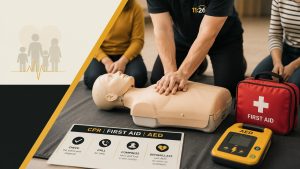
CPR and AED basics are the immediate actions used when sudden cardiac arrest makes a person unresponsive and normally breathing stops. Cardiopulmonary resuscitation provides temporary blood flow through chest compressions, while an automated external defibrillator analyzes the heart rhythm and delivers a shock when a shockable rhythm is present.
Key Facts at a Glance
- Sudden cardiac arrest is an electrical and pumping emergency, whereas a heart attack is a blocked-blood-flow problem that can cause cardiac arrest.
- Adult CPR uses 100-120 chest compressions per minute, with a depth of at least 2 inches and no more than 2.4 inches.
- An AED analyzes the rhythm and shocks only when its software identifies a rhythm for which defibrillation is appropriate.
- Hands-only CPR is appropriate for many untrained bystanders responding to a suddenly collapsed adult, but breaths matter more in drowning, overdose, children, and infants.
- CPR should continue until emergency medical services take over, the person shows clear signs of life, the scene becomes unsafe, or the rescuer cannot continue.
- AED pads require bare, dry skin and must not be placed directly over a medication patch or implanted cardiac device.
What Are CPR and AED Basics?
CPR and AED basics combine manual circulation with early defibrillation. CPR does not restart most arrested hearts by itself; chest compressions move a limited amount of oxygenated blood to the brain and heart while rescuers obtain an AED and emergency professionals arrive.
Sudden cardiac arrest differs from a heart attack. A heart attack blocks blood flow to heart muscle, and a person may remain conscious and breathe. Cardiac arrest causes collapse, unresponsiveness, absent normal breathing, and loss of effective circulation. A heart attack can lead to cardiac arrest, but the terms are not interchangeable.
The American Heart Association describes cardiac arrest as a condition in which “the heart stops beating unexpectedly,” and its public guidance emphasizes immediate CPR and AED use. The response is time-sensitive because untreated cardiac arrest rapidly damages the brain and other organs.
How Do CPR and AEDs Work Together?
CPR creates temporary circulation; an AED treats certain electrical rhythms. Ventricular fibrillation and pulseless ventricular tachycardia produce ineffective or absent pumping despite electrical activity, so a defibrillation shock can interrupt the rhythm and give the heart’s normal electrical system an opportunity to resume organized activity.
An AED does not diagnose the person’s overall medical condition. It analyzes the electrical signal through adhesive electrode pads and announces whether a shock is advised. An AED generally will not shock asystole, commonly called a flatline, because asystole lacks the electrical pattern that defibrillation can interrupt.
CPR remains necessary before and after analysis. A shock does not guarantee a pulse, and every pause in compressions reduces blood flow. Follow the device’s prompts, keep everyone clear during analysis and shock, then resume compressions immediately when instructed.
How Do You Start CPR on an Unresponsive Person?
Start by confirming scene safety, checking responsiveness, activating emergency services, and assessing normal breathing for no more than 10 seconds. If an adult is unresponsive and not breathing normally or is only gasping, assume cardiac arrest, begin chest compressions, and get an AED without delaying for a prolonged pulse check.
Step 1: Check the Scene and Responsiveness
Look for traffic, fire, exposed electricity, unsafe water, toxic fumes, or violence before approaching. Tap the person’s shoulders and shout, “Are you okay?” Do not move the person unless danger requires relocation.
If the person responds, leave the person in the safest position, assess the problem, and call emergency services for serious symptoms. If there is no response, shout for help and direct tasks to specific people rather than asking generally.
Step 2: Call Emergency Services and Get an AED
Point to one bystander and say, “Call emergency services and return with an AED.” Point to another person to control the entrance or guide responders. Specific assignments prevent the common failure in which everyone assumes someone else called.
When alone with an adult, call emergency services on speakerphone and begin CPR. Retrieve an AED only if it is immediately accessible and doing so will not create a long interruption or leave the person unattended for an unreasonable distance. The dispatcher can provide instructions.
Step 3: Assess Normal Breathing
Watch the chest, listen, and feel for normal breathing for up to 10 seconds. Occasional gasps, irregular snorts, or “agonal” breaths are not normal breathing and should be treated as cardiac arrest in an unresponsive person.
Do not spend time searching for a pulse unless you are trained to do so. For lay rescuers, responsiveness and normal breathing provide the practical trigger for action. Begin compressions when those signs indicate arrest.
Step 4: Begin Adult Chest Compressions
Place the heel of one hand in the center of the chest on the lower half of the breastbone, place the other hand over it, and keep the fingers off the ribs. Position the shoulders directly above the hands, lock the elbows, and press vertically.
| Adult CPR measure | Target value | Practical checkpoint |
|---|---|---|
| Compression rate | 100-120 per minute | Use a steady rhythm similar to “Stayin’ Alive” |
| Compression depth | At least 2 inches, maximum 2.4 inches | Press approximately 5-6 centimeters |
| Recoil | Full recoil after every compression | Do not lean on the chest |
| Breathing pause | Less than 10 seconds when possible | Prepare breaths before stopping |
| Compression cycle | 30 compressions | Count aloud to coordinate rescuers |
Press hard enough to reach the target depth, allow complete recoil, and minimize pauses. If two rescuers are present, change the compressor about every two minutes, or sooner if fatigue causes shallow compressions. A tired rescuer often continues compressions but loses depth and rhythm.
When Is Hands-Only CPR Appropriate?
Hands-only CPR is the preferred practical option for an untrained bystander responding to a suddenly collapsed adult, especially when the collapse was witnessed and no breathing-related cause is apparent. Push continuously in the center of the chest and follow the emergency dispatcher’s instructions until an AED or responders arrive.
Conventional CPR uses 30 compressions followed by two breaths. A trained rescuer who is willing and able to provide breaths should use it for children, infants, drowning, choking-related arrest, suspected opioid overdose, and prolonged collapse because oxygen depletion is more likely in those situations.
Rescue breaths should last about one second and produce visible chest rise. Avoid repeated or forceful ventilation because excess air can enter the stomach, causing gastric inflation, vomiting, and possible airway obstruction. A pocket mask or bag-mask device improves hygiene and technique when available, but lack of a barrier should not delay compressions.
| Situation | Preferred bystander approach | Reason |
|---|---|---|
| Suddenly collapsed adult | Hands-only CPR if untrained | Early circulation is faster to start |
| Adult drowning | Conventional CPR, 30:2 if trained | Hypoxia is a primary cause |
| Child or infant arrest | Conventional CPR if trained | Respiratory causes are common |
| Suspected opioid overdose | CPR with breaths if trained, plus naloxone if available | Respiratory depression may precede arrest |
| Rescuer unwilling to give breaths | Continuous compressions | Some CPR is better than waiting |
How Do You Use an AED?
Use an AED as soon as it arrives by turning it on, exposing the chest, attaching the pads exactly as shown, and obeying every voice or screen instruction. Stop touching the person during analysis and shock, then restart CPR immediately when the AED tells you to resume.
- Turn on the AED. Open the lid or press the power button. Many devices begin spoken instructions automatically.
- Expose and dry the chest. Remove clothing from the torso and wipe away standing water or heavy sweat. Move the person out of water before pad placement.
- Attach the pads. Place one pad on the upper right chest and the other on the lower left side below the armpit, following the printed diagrams. Use bare skin.
- Allow rhythm analysis. Say, “Everyone clear,” and ensure nobody touches the person, bed, stretcher, or conductive surface.
- Deliver the shock if advised. For a semi-automated AED, press the flashing shock button only after confirming everyone is clear. A fully automated AED delivers the shock after its warning sequence.
- Resume CPR. Begin compressions immediately after the shock or after a no-shock message, following the device’s timing.
An AED is designed for public use, so do not wait for a perfect technical setup. Correct placement matters, but rapid application matters too. The device will not deliver a shock when its analysis does not identify a shockable rhythm.
What If the Chest Is Wet, Hairy, or Has a Medical Device?
Dry heavy moisture quickly, shave only excessive hair preventing pad adhesion, and never delay CPR while attempting cosmetic preparation. If pads will not stick, press firmly or use a spare set if available; follow the AED’s “check pads” instruction.
Do not place a pad directly over a transdermal medication patch. Remove the patch with a gloved hand, wipe away medication, and then apply the pad to bare skin. Avoid placing a pad directly over a visible implanted pacemaker or defibrillator lump; move the pad several centimeters away while preserving the front-and-side chest geometry.
Metal jewelry does not normally require removal unless it lies under a pad. Never place an AED pad over a nipple, thick clothing, or a substantial metal object.
How Does CPR Change for Children and Infants?
Child and infant CPR uses the same priorities as adult CPR, but compression depth, hand technique, and the likelihood of a breathing-related cause differ. Use two fingers or the two-thumb encircling technique for an infant, one or two hands for a child, and a 30:2 compression-to-breath ratio for a single rescuer.
| Patient | Age guideline | Compression depth | Hand technique | Single-rescuer ratio |
|---|---|---|---|---|
| Infant | Younger than 1 year | About 1.5 inches, 4 centimeters | Two fingers or two thumbs | 30:2 |
| Child | About 1 year to puberty | About 2 inches, 5 centimeters | One or two hands | 30:2 |
| Adult | Puberty and older | At least 2 inches, no more than 2.4 inches | Two hands | 30:2 |
| Child or infant, two rescuers | Before puberty | One-third chest depth | Two-thumb encircling technique for infants | 15:2 |
For a child or infant, use breaths when trained, particularly after drowning, choking, respiratory illness, or a prolonged unobserved event. If you are alone and did not witness the collapse, provide about two minutes of CPR before leaving to call emergency services and retrieve an AED when no phone is available.
Use pediatric AED pads or the device’s child setting for children when available. Do not use pediatric pads on an adult. If pediatric equipment is unavailable, an AED with adult pads may still be used on a child or infant, provided the pads do not touch each other and the device’s instructions are followed.
Which CPR Method Should You Choose?
The correct CPR method depends primarily on the patient’s age, the likely cause of arrest, rescuer training, and whether breaths can be delivered safely. Hands-only CPR is simpler for an adult sudden collapse, while conventional CPR has greater value when oxygen loss caused or contributed to the arrest.
| Method | Best scenario | Main benefit | Main limitation |
|---|---|---|---|
| Hands-only CPR | Untrained adult bystander | Starts compressions immediately | Does not add oxygen |
| Conventional 30:2 CPR | Trained rescuer, child, infant, drowning | Adds ventilation and circulation | Requires coordination and barrier technique |
| Semi-automated AED | Public-access response team | Rescuer controls shock timing | Requires button press after clear warning |
| Fully automated AED | Untrained or highly stressed rescuer | Device delivers advised shock | Absolute compliance with clear prompts is required |
No method eliminates the need for emergency services. CPR buys time; it does not replace definitive treatment, airway management, advanced life support, or hospital care.
What Does CPR and AED Readiness Cost?
Typical United States public-access AED purchase prices range from approximately $1,200 to $2,500, excluding cabinets, signage, replacement supplies, and installation. CPR and AED certification commonly costs about $40-$100 per participant, while replacement pads often cost $60-$150 and batteries about $150-$400.
| Readiness item | Typical cost or interval | What to verify |
|---|---|---|
| Public-access AED | $1,200-$2,500 | Adult capability, warranty, self-test indicator |
| Adult electrode pads | $60-$150 per set | Expiration date and sealed packaging |
| AED battery | $150-$400 | Standby life and replacement date |
| CPR/AED course | $40-$100 per person | Skills practice and recognized provider |
| Pad replacement | Typically every 2-5 years | Manufacturer expiration date |
| Battery replacement | Typically every 4-5 years | Device-specific standby rating |
| Certification renewal | Commonly every 2 years | Employer or regulator requirements |
These are typical planning ranges, not universal prices. Pediatric pads, cellular-connected monitoring, wall cabinets, insurance, shipping, and local compliance requirements can increase the total program budget.
An AED program also needs ownership. Assign a person to inspect the status light, pad seal, battery date, cabinet access, and signage at least monthly, with a documented quarterly audit. Certification renewal does not replace equipment inspection.
How Should Homes, Offices, and Schools Prepare?
A useful AED program places a working device where a trained or untrained person can reach it quickly, ideally within a few minutes of likely collapse locations. Preparation includes emergency calling, visible signage, monthly checks, local registration where required, and realistic practice drills.
Homes with a person at elevated cardiac risk should identify the nearest public AED, teach household members adult CPR, and keep emergency addresses visible. A home AED can be expensive and cannot replace medical evaluation, but rapid access may matter when public equipment is distant.
Offices should place AEDs near elevators, reception areas, gyms, cafeterias, or other high-occupancy locations rather than inside a locked manager’s office. Schools need pediatric training, age-appropriate pads or settings, access during sports activities, and a plan for after-hours events.
Expert practice rule: measure retrieval time during a drill instead of judging placement by distance alone. Locked doors, elevators, security desks, and missing signage can add more delay than the map suggests.
What Errors Reduce CPR or AED Effectiveness?
The most damaging CPR errors are delayed compressions, shallow depth, incomplete recoil, long pauses, and excessive ventilation. The most damaging AED errors are waiting for permission, placing pads over clothing or medication patches, touching the patient during analysis, and failing to resume CPR after the device’s prompt.
- Shallow compressions: Reposition the shoulders over the hands and use the AED’s feedback if available. Rotate rescuers when fatigue reduces depth.
- Leaning between compressions: Lift the hands slightly without losing position. Full recoil allows the heart to refill.
- Long pauses: Pre-position the AED pads and limit rhythm checks, breaths, and rescuer changes to the shortest practical interval.
- Vomiting: Turn the person briefly onto the side, clear visible material, return supine, and restart compressions. Do not perform blind finger sweeps.
- Pads will not adhere: Dry the chest, remove excess hair only where needed, and replace damaged or expired pads.
- Rescuer fear of shocking: Remember that the AED decides whether a shock is advised. The rescuer’s job is to attach pads, announce clearance, and follow the prompt.
A counterintuitive safety point matters: an AED does not know whether a person is “medically dead,” and it cannot correct every cardiac arrest. It identifies electrical patterns suitable for its programmed shock algorithm. A no-shock message still requires CPR and emergency response.
What Are the Limits of CPR and AEDs?
CPR and AEDs cannot guarantee survival, repair the underlying cause, or replace professional treatment. CPR may cause bruising or broken ribs, especially when compressions are deep enough to produce effective circulation, but fear of injury should not delay treatment for an unresponsive person without normal breathing.
CPR also cannot reliably determine whether collapse resulted from overdose, drowning, trauma, hypothermia, pulmonary embolism, or a primary rhythm disorder. Those causes require additional treatment, such as naloxone, oxygenation, warming, bleeding control, or hospital intervention.
Follow local emergency-dispatch instructions and applicable Good Samaritan protections. Legal protection varies by jurisdiction, and training organizations such as the American Heart Association, American Red Cross, and European Resuscitation Council publish guidance that may differ in small operational details.
Frequently Asked Questions
Can CPR restart a stopped heart?
CPR usually does not restart a stopped heart by itself. Chest compressions maintain limited circulation while an AED evaluates the rhythm and emergency clinicians provide defibrillation, medications, ventilation, and treatment for the cause. CPR remains worthwhile because it preserves some oxygen delivery during the interval before those interventions occur.
Can you use an AED on someone who has a pulse?
Do not use an AED on a responsive person or someone clearly breathing normally with signs of circulation. If an unresponsive person is not breathing normally, follow emergency-dispatch instructions and apply the AED. The device analyzes the rhythm and will not advise a shock for rhythms outside its shockable criteria.
Can an AED be used on a pregnant person?
An AED can be used on a pregnant person in cardiac arrest. Apply the pads to the bare chest in the standard positions, avoid delaying defibrillation, and begin CPR. Pregnancy does not make a needed shock unsafe; emergency clinicians will provide additional maternal and fetal care after resuscitation begins.
Is CPR dangerous if the person is having a heart attack?
CPR is not indicated for a conscious person who is breathing normally, even if the person may be having a heart attack. If a suspected heart-attack patient becomes unresponsive and stops breathing normally, call emergency services, begin CPR, and use an AED. Chest compressions can injure ribs, but delay is more dangerous.
How long should you perform CPR?
Continue CPR until emergency professionals take over, the person shows clear signs of life, the scene becomes dangerous, an AED instructs a brief pause, or physical exhaustion makes continuation impossible. Do not stop merely because several cycles have passed or because the AED says no shock is advised.
Does CPR certification make someone qualified for every emergency?
CPR/AED certification teaches a defined basic-response skill set, usually with renewal commonly required every two years. Certification does not qualify a person to perform advanced airway management, administer every medication, interpret all rhythms, or replace emergency medical training. Refresh skills through practice because compression quality and confidence decline without rehearsal.
The Bottom Line
CPR and AED basics reduce the time between sudden cardiac arrest and effective treatment. Check safety, confirm unresponsiveness, call emergency services, identify abnormal breathing, start 100-120 adult compressions per minute, apply an AED promptly, follow its prompts, and resume CPR after analysis or shock. For children, infants, drowning, and overdose, add rescue breaths when trained.