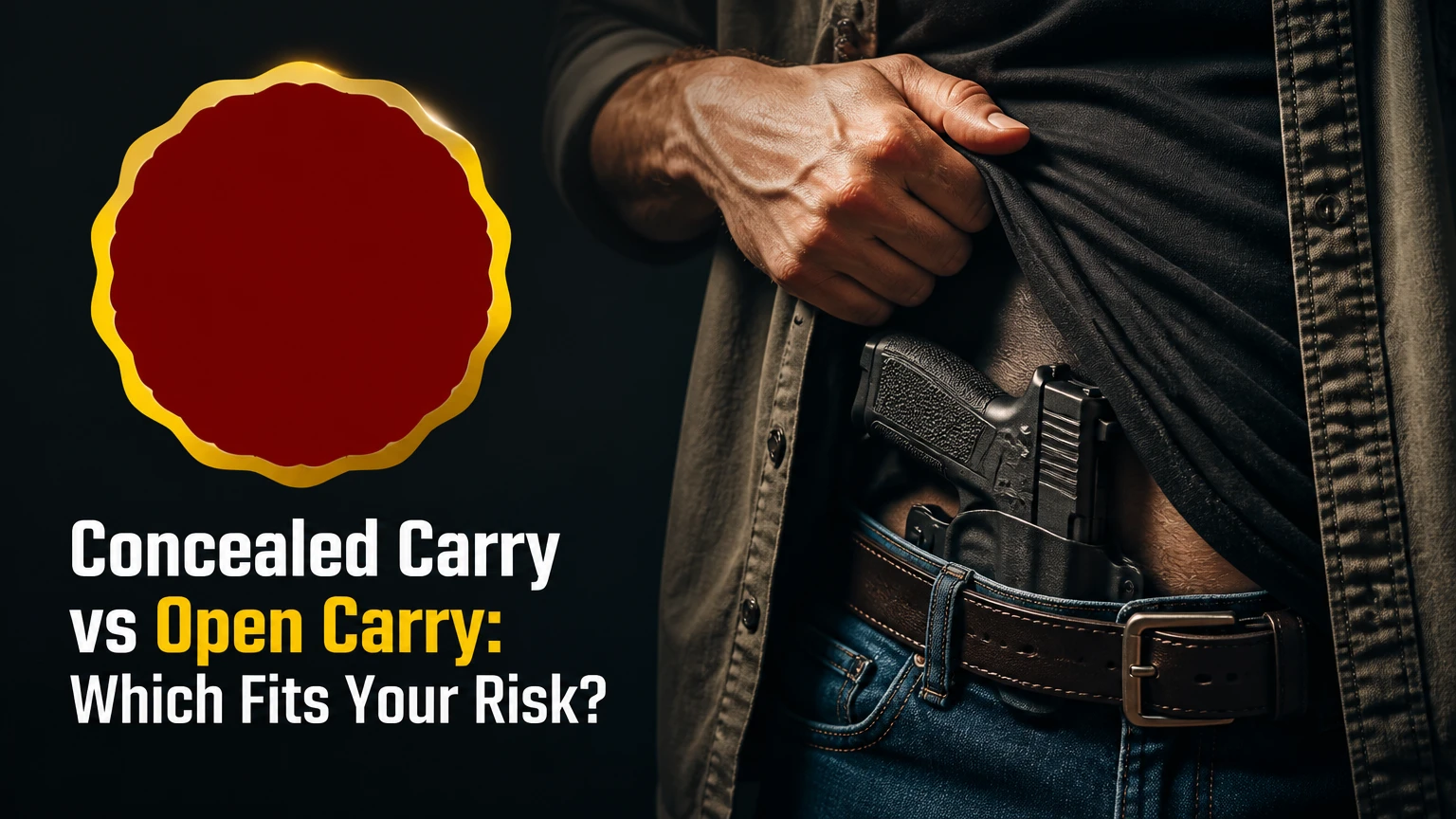
Concealed carry hides a firearm from ordinary observation, while open carry keeps the firearm visible in public. Concealed carry generally prioritizes privacy and reduces public attention; open carry can simplify access and clothing but increases visibility, retention, and legal-management concerns. The better choice depends on jurisdiction, training, environment, clothing, and personal risk tolerance.
Key Facts at a Glance
Concealed carry and open carry are separate legal classifications in many jurisdictions, but some laws regulate both under one license.
Open carry is not automatically legal without a permit, and permitless carry does not eliminate prohibited-place or private-property rules.
Concealed carry requires reliable concealment, a secure holster, a suitable belt, and clothing that remains lawful during ordinary movement.
Open carry requires a holster that fully covers the trigger guard and provides retention appropriate to the environment.
No carry method compensates for inadequate firearms training, unsafe storage, or failure to verify current local law.
A consistent, lawful method that a trained person can maintain is usually more useful than a theoretically superior method abandoned for discomfort.
What Do Concealed Carry and Open Carry Mean?
Concealed carry means carrying a firearm in public while keeping it hidden from ordinary observation. Open carry means carrying a firearm where a casual observer can identify it as a firearm without moving clothing or equipment.
The legal definition varies by jurisdiction. Some states define concealment by whether the weapon is hidden from common observation, while others regulate partial exposure, vehicle placement, or specific holster positions. A jacket that covers an outside-the-waistband holster may be treated as concealed carry in one jurisdiction and unlawful concealment in another.
“Printing” describes a visible outline or shape under clothing. Printing is not automatically the same as legally exposing a firearm, although certain jurisdictions treat accidental exposure or partial concealment differently. The carrier must check statutory language and current administrative guidance rather than relying on advice from a retailer, social-media post, or a neighboring state.
Is open carry the same as constitutional carry?
Open carry and constitutional carry describe different legal questions. Open carry describes visibility; constitutional carry describes whether a permit is required for a qualifying person to carry, usually subject to age, location, and eligibility restrictions.
A permitless-carry state may allow concealed carry, open carry, or both. It may also impose separate rules for schools, courthouses, government buildings, public demonstrations, alcohol-serving premises, vehicles, or private businesses. “Lawful gun owner” is not a complete legal test because prohibited-person rules and location restrictions still apply.
The Supreme Court stated in District of Columbia v. Heller (2008), “Like most rights, the right secured by the Second Amendment is not unlimited.” That decision did not create a nationwide permission to carry in every location or manner.
Concealed Carry vs Open Carry: The Core Trade-Offs
Concealed carry is usually the stronger default for people who prioritize discretion, while open carry is more practical for people who prioritize easy access, reduced clothing constraints, or specific outdoor conditions. Neither method has a universal tactical advantage because visibility changes how other people identify, interpret, and respond to the carrier.
| Decision criterion | Concealed carry | Open carry |
|---|---|---|
| Public visibility | Firearm hidden under clothing or equipment | Firearm visible to casual observers |
| Typical holster position | IWB, AIWB, belly band, or concealment chassis | OWB, duty-style, chest, or drop-leg holster |
| Clothing burden | Requires coverage, sizing, and movement testing | Requires a visible holster and secure belt system |
| Retention concern | Lower exposure to a grab, but access must remain controlled | Higher exposure to unauthorized contact or takeaway |
| Social attention | Usually low when concealment remains intact | Frequently higher because observers can see the firearm |
| Legal exposure | Concealment, printing, permit, and prohibited-place rules | Open-carry, brandishing, sensitive-place, and private-property rules |
| Typical equipment cost | $60-$150 holster, $50-$150 belt, clothing variable | $70-$250 retention holster, $60-$180 belt, clothing variable |
| Best fit | Discreet daily carry in populated settings | Appropriate outdoor or occupational settings where lawful |
The table shows why the decision is not simply “speed versus surprise.” Comfort, retention, legal classification, social context, and the carrier’s ability to remain consistent all affect the outcome.
Which Method Is Safer in Public?
Neither concealed carry nor open carry is categorically safer in every setting. Concealed carry reduces visibility and may reduce unwanted attention, while open carry makes the firearm accessible without clearing a covering garment but exposes it to observation, contact, and interpretation by others.
The most important safety variables are trigger-guard protection, consistent holster use, muzzle discipline, secure storage, and training. A firearm should remain in a purpose-built holster that covers the trigger guard and retains the firearm during normal bending, sitting, walking, and vehicle entry.
Open carry creates a specific retention problem. A visible firearm can attract unwanted contact, and a passive-friction holster may not provide enough resistance in a crowded environment. Concealed carry creates different risks, including negligent handling during dressing, unsafe storage around children, and careless adjustment in public.
A reasonable practitioner rule is simple: if the carrier cannot maintain control of the firearm during a normal day, the chosen system is not ready for daily use. Carrying less often with better training is safer than carrying continuously without a tested setup.
Does open carry deter crime?
Open carry may discourage some opportunistic misconduct, but a universal deterrence effect has not been established. Visibility can also attract attention, cause bystanders to call law enforcement, or identify the carrier during a confrontation.
The causal question is difficult to measure because open-carry laws differ in training requirements, population, enforcement, and location. A visible firearm can communicate lawful preparedness to one observer and perceived threat to another. That uncertainty makes deterrence a context-dependent consideration, not a guaranteed benefit.
Which Method Is Easier to Carry Comfortably?
Open carry is often physically easier because an OWB holster does not place the firearm inside the waistband, but concealed carry can be comfortable with the correct firearm dimensions, belt, holster geometry, and clothing. Comfort depends more on the complete system than on visibility alone.
| Carry system | Typical location | Clothing requirement | Common strength | Common limitation |
|---|---|---|---|---|
| AIWB | Front waistband, approximately 12-1 o’clock | Untucked shirt or cover garment | Compact footprint and consistent access | Sensitive to body shape, sitting, and vehicle posture |
| Strong-side IWB | Approximately 3-5 o’clock | Untucked shirt, sweater, or jacket | Familiar positioning and concealment | Can press into the hip or lower back |
| OWB pancake | Hip outside waistband | Jacket, overshirt, or visible carry | Comfortable weight distribution | Usually requires deliberate concealment or open visibility |
| OWB retention | Hip or duty position | Uniform, jacket, or open-carry clothing | Added resistance to unauthorized removal | More bulk and greater public visibility |
| Chest or shoulder system | Torso or shoulder area | Outer layer or outdoor clothing | Useful with packs, vehicles, or outdoor clothing | Vehicle and jurisdiction rules can complicate use |
AIWB is not inherently exclusive to concealed carry. A person could expose an AIWB holster, although that arrangement is uncommon and may create different legal and retention concerns. OWB is not inherently open carry either, because a long coat can conceal it where local law recognizes that concealment.
How do clothing and body movement affect concealment?
Concealment should be evaluated during movement, not only while standing still. A carrier should test sitting, reaching, bending, entering a vehicle, removing a jacket, and carrying ordinary objects before relying on the setup in public.
A rigid belt can reduce sagging and grip rotation, but excessive stiffness may reduce comfort. A longer shirt may conceal the grip while a shorter shirt exposes it during reaching. Heavy fabric can hide outlines but may slow access and become impractical in hot weather.
The carrier should not repeatedly touch or adjust the firearm in public. Frequent checking can reveal the presence of a firearm and may create unsafe handling. If the firearm shifts, the solution is usually a better holster, belt, garment, or position tested at home, not repeated manipulation in public.
How Do Firearm Size and Holster Choice Affect the Decision?
Compact firearms commonly provide a compromise between concealability, grip size, and ammunition capacity, while full-size firearms are easier to handle but harder to conceal. Micro-compacts reduce bulk but may require more practice because their shorter grips and lighter frames can be less forgiving.
| Firearm profile | Typical barrel length | Typical capacity range | Concealment tendency | Practical trade-off |
|---|---|---|---|---|
| Full-size pistol | 4.5-5.5 inches | 15-20 rounds | Difficult under light clothing | Larger grip and sight radius, greater bulk |
| Compact pistol | 3.8-4.3 inches | 10-17 rounds | Moderate with IWB | Balanced size, weight, and control |
| Subcompact pistol | 3.0-3.7 inches | 6-13 rounds | Easier under clothing | Smaller grip and reduced control surface |
| Micro-compact pistol | 2.8-3.2 inches | 10-17 rounds | High concealability | Short sight radius and small controls |
| Revolver, small frame | 1.8-3 inches | 5-6 rounds | High with pocket or IWB systems | Simple manual controls, limited capacity |
Examples such as the Glock 17, Glock 19, Glock 43X, SIG Sauer P365, and Springfield Hellcat illustrate size categories, but model names do not determine suitability. Fit, reliability, safe operation, and the carrier’s ability to train with that specific firearm matter more than capacity claims alone.
A holster must match the exact firearm model and accessories. It should cover the trigger guard, remain attached during the draw, and prevent the firearm from falling out during normal activity. “Universal” fabric holsters deserve particular scrutiny because loose fit and trigger access can create avoidable hazards.
Are Level II and Level III retention labels universal?
Retention-level labels are not perfectly standardized across manufacturers. In general, Level I refers to friction or one primary retention mechanism, Level II adds a second active mechanism, and Level III adds another active safeguard, but product-specific designs and definitions differ.
Open carry in crowded or physically active environments generally warrants active retention selected for the firearm and use case. A carrier should learn how the release works and confirm that normal movement does not activate it. More retention can slow access, so the system requires deliberate, supervised practice rather than assumptions based on a label.
Which Method Is Legal?
The legal answer depends on the state, local government, prohibited location, firearm type, carrier eligibility, vehicle, and private-property rules. A concealed-carry permit does not automatically authorize open carry, and permission to open carry does not automatically authorize concealed carry.
| Legal framework | Permit question | Typical limitation | Verification source |
|---|---|---|---|
| Permitless carry | A permit may not be required for eligible adults | Age, location, vehicle, and prohibited-person rules remain | State police or attorney general website |
| Shall-issue licensing | Permit is generally issued after statutory requirements | Training, fingerprints, fees, and background review may apply | State licensing agency |
| May-issue or discretionary system | Agency discretion may affect issuance | Good-cause or suitability standards may apply in some systems | State statute and licensing agency |
| Recognition or reciprocity | Another state’s permit may be recognized | Recognition can exclude residents or change by location | Official reciprocity page |
| Local restriction system | State permission may not settle every question | Municipal rules, posted premises, or local zones may apply | State preemption rules and municipality |
Before carrying, verify five separate issues: whether the person may possess the firearm, whether the chosen carry mode is lawful, whether a permit is required, whether the destination is prohibited, and whether the route or vehicle creates additional restrictions.
Use official state statutes, the state police or public-safety agency, attorney general guidance, and posted premises rules. Laws change, and online summaries can omit exceptions. For a high-consequence question, a licensed attorney in the relevant jurisdiction is more reliable than a general-purpose national chart.
What places commonly restrict carry?
Commonly restricted locations include schools, courthouses, secured government buildings, airport sterile areas, correctional facilities, and certain election or public-event sites. The exact list and exceptions vary substantially.
Private businesses may prohibit firearms through signs, direct notice, employment policies, or state-specific statutory procedures. A carrier who remains legally armed in a public place may still violate a property rule and be required to leave. Refusing to leave can create a separate offense.
Alcohol rules also vary. Some jurisdictions restrict possession while consuming alcohol, while others regulate the premises or degree of intoxication. A person should not combine carrying with alcohol use or impaired judgment.
How Much Does Lawful Carry Typically Cost?
A new lawful carry setup commonly costs $250-$700 before the firearm itself, depending on licensing, training, holster quality, belt, safe storage, and practice ammunition. Permitless carry can remove an application fee but does not remove the cost of education, equipment, or ongoing practice.
| Expense | Typical range | When paid | Main variable |
|---|---|---|---|
| Safety or carry course | $75-$250 | Before or during licensing | State curriculum and live-fire requirement |
| Application and fingerprints | $40-$150 or more | Application submission | State agency and fingerprint vendor |
| Concealed holster | $50-$150 | Equipment purchase | Material, model fit, and adjustment |
| Open-carry retention holster | $70-$250 | Equipment purchase | Active retention and duty construction |
| Purpose-built belt | $50-$180 | Equipment purchase | Rigidity, width, and buckle design |
| Practice ammunition | $25-$50 per 50 rounds | Range sessions | Caliber, brand, and market price |
| Lockbox or safe | $30-$500 | Before household access | Capacity, mounting, and access method |
The recurring cost matters more than the initial purchase. A carrier may need several practice sessions each year, replacement batteries for lights or optics, holster maintenance, and updated training after moving or changing equipment.
Which Method Fits Different Situations?
Concealed carry usually fits populated daily environments when lawful discretion, reduced attention, and compatibility with ordinary clothing matter most. Open carry can fit rural property, outdoor work, or occupational settings when visibility is accepted, the law permits it, and the holster provides adequate retention.
| User situation | Usually more suitable | Reason | Condition that can reverse the choice |
|---|---|---|---|
| Urban commuter | Concealed carry | Lower visibility on public transit and in shops | Employer, transit, or local law may prohibit either method |
| Rural property owner | Open or concealed carry | Clothing and distance may make visibility less disruptive | Visitors, posted property, livestock, or vehicle rules |
| Day hiker | Either, often concealed | Packs and crowded trailheads favor discretion | Wildlife concerns, heat, pack interference, and local law |
| Uniformed security worker | Open carry | Duty equipment can support retention and visible identification | Employer policy and licensing requirements |
| Retail or office employee | Concealed only if lawful | Workplace privacy and policy often control | Employer may prohibit firearms entirely |
| New license holder | Neither until trained | Familiarity and safe handling come first | Structured training and supervised practice |
Open carry is not automatically preferable in the backcountry. A backpack hip belt can interfere with an OWB holster, while thick clothing can complicate access and retention. Wildlife risk also differs by region and species, and a firearm does not replace food storage, distance, noise, or local wildlife guidance.
Concealed carry is not automatically preferable in an office. A workplace policy, locked-storage requirement, or state sensitive-place rule may prohibit possession regardless of whether the firearm is hidden.
What are alternatives to concealed and open carry?
Alternatives include leaving the firearm secured at home, transporting it according to local law, carrying non-firearm safety equipment, or choosing a different lawful security plan for the activity. A person who cannot carry safely, lawfully, or consistently should not carry merely to maintain a routine.
For some activities, a phone, flashlight, medical kit, personal alarm, communication plan, and avoidance strategy provide more practical value than a firearm. The correct alternative depends on the threat, environment, legal rules, and the person’s training.
What Common Mistakes Create the Most Risk?
The most common carry failures involve legal assumptions, poor equipment fit, unsafe handling, and inconsistent practice. Correcting those failures begins with stopping the unsafe behavior, securing the firearm, checking the governing rule, and obtaining qualified instruction.
- Treating permitless carry as unrestricted carry.
Permitless status does not erase prohibited places, age limits, vehicle rules, or private-property restrictions. Verify each destination before carrying. - Using a holster that does not fully cover the trigger guard.
Replace the holster with a model designed for the exact firearm and accessories. A loose universal pouch is not an acceptable substitute. - Relying on passive retention for exposed carry in active environments.
Choose active retention appropriate to the setting, then train with the manufacturer’s release method under qualified supervision. - Testing concealment only in front of a mirror.
Walk, sit, bend, reach, enter a vehicle, and wear the clothing used in daily life. A setup that fails during movement needs adjustment before public use. - Handling the firearm in public to correct printing.
Move to a lawful private location before adjusting equipment. Repeated touching can alarm others and can create negligent-handling risk. - Carrying a new firearm without function and proficiency practice.
Complete formal safety training and practice with the same firearm, holster, and ammunition configuration used for carry.
What should a carrier do during a law-enforcement encounter?
Keep hands visible, follow lawful instructions, avoid sudden movements, and do not reach toward the firearm or permit without clear direction. Notification duties differ by jurisdiction, and a carrier should know whether disclosure is required, permitted, or prohibited during a specific encounter.
The safest response depends on the officer’s instructions and local law. Carry documentation should be accessible without reaching across the firearm. If the encounter involves a legal dispute, comply with immediate safety instructions and seek legal advice afterward rather than arguing roadside.
How Should Someone Decide Between the Two?
Choose concealed carry when privacy, reduced public attention, workplace compatibility, and lower exposure to unauthorized contact outweigh the clothing burden. Choose open carry only when the jurisdiction clearly permits it, the setting accepts visible carry, and the carrier has a secure retention system and a reason to accept the added visibility.
The urban daily carrier
A discreet concealed system is usually the more practical option for an urban resident who moves through shops, transit areas, offices, and crowded sidewalks. The carrier must still check workplace, transit, municipal, and sensitive-place restrictions.
The outdoor worker
Open carry may be more workable for a rancher, trail worker, or rural property owner whose clothing and environment make concealment difficult. The decision changes when the person enters a posted business, vehicle, public event, or jurisdiction with different rules.
The new permit holder
A new permit holder should delay routine carry until completing safety instruction, validating the holster, and practicing with the actual equipment. Concealed and open carry both demand judgment that a permit card alone does not demonstrate.
The physically active employee
A worker who bends, climbs, or wears a tucked-in uniform needs a system that remains secure through those movements. If no lawful setup remains concealed and stable, the correct answer may be not carrying at work rather than improvising with a loose bag or unsafe holster.
FAQ
Can a concealed firearm become open carry accidentally?
Yes, accidental exposure can create legal consequences in jurisdictions that regulate concealment or partial exposure. Clothing movement, reaching, and vehicle entry can reveal the firearm. Test the setup through ordinary movements, and verify how the relevant jurisdiction defines exposure, printing, and unlawful carry.
Is concealed carry faster than open carry?
Open carry removes the need to clear a covering garment, but speed depends on holster design, body position, clothing, training, and the situation. Concealed carry may require an additional garment-clearing movement. Neither method should be judged by speed alone because legal compliance and safe control come first.
Can a person open carry in a vehicle?
Vehicle carry rules vary by jurisdiction and may treat a visible holstered firearm, a loaded firearm, and a firearm inside a locked container differently. A state may also distinguish between a permit holder and a person carrying under a permitless law. Check the official vehicle-transport rule before driving.
Does a concealed-carry permit authorize open carry?
Not always. Some jurisdictions issue a license that covers both methods, while others distinguish concealed and open carry or impose different restrictions. The permit’s wording, state statute, reciprocity rules, and destination restrictions determine the answer.
Is a belly band safer than an IWB holster?
A belly band can work when it securely retains the exact firearm and fully protects the trigger guard, but many elastic products provide less structure than a purpose-built IWB holster. The safer choice is the system that remains secure, covers the trigger, and permits consistent handling during movement.
Should someone carry a firearm for wildlife protection?
A firearm should not be treated as a substitute for wildlife-specific preparation. Local wildlife agencies commonly emphasize distance, food storage, group behavior, and species-specific responses. Carrying may be lawful in some areas, but the person must verify regulations and obtain training appropriate to the environment.
The Bottom Line
Concealed carry vs open carry is a decision about visibility, legality, retention, comfort, training, and environment rather than a universal contest with one winner. Concealed carry is usually the more discreet daily option; open carry can suit lawful outdoor or occupational settings. Verify current local rules, use a properly fitted holster, train with the complete system, and choose the method that can be maintained safely and consistently.