Concealed carry training course topics usually include firearm safety, handgun operation, storage, concealed-carry equipment, self-defense law, situational awareness, live-fire practice, and a state-required qualification. The exact syllabus, minimum hours, legal instruction, and shooting standard depend on the issuing state, course provider, and permit type.
Key Facts at a Glance
- A state-approved permit course is different from advanced defensive handgun training.
- Typical permit classes run 4-16 hours and cost approximately $75-$250, while advanced courses commonly cost $250-$600 or more.
- Reciprocity is not automatic; the carrying state controls its own prohibited places, transport rules, and use-of-force laws.
- Live-fire qualification proves performance against a stated standard, not complete readiness for every defensive situation.
- A safe course covers storage, handling, loading, unloading, holster use, and decision-making before introducing speed.
- Online instruction may explain law and theory, but it cannot replace supervised handling and live-fire practice where a state requires them.
What Do Concealed Carry Training Course Topics Include?
The standard syllabus combines four domains: safe gun handling, legal responsibility, practical carry, and demonstrated shooting competence. A reputable concealed carry course also explains avoidance, secure storage, emergency planning, and the consequences of displaying or using a firearm.
Most classes begin with administrative requirements and a safety briefing. Classroom instruction then addresses state law and justifiable force, followed by handgun fundamentals, dry practice, supervised range work, and a written or practical assessment. Some providers compress the material into one day, while others divide classroom and range sessions.
A permit course is usually an entry requirement. It is not automatically a complete defensive program. Students who have never operated a handgun may need a separate fundamentals lesson before class, and experienced range shooters may still need instruction in concealment, legal judgment, and post-incident conduct.
What Should a Complete Syllabus Cover?
| Topic area | Specific subjects | Typical evidence of completion |
|---|---|---|
| Safety and handling | Muzzle direction, trigger discipline, loading, unloading, chamber checks | Instructor observation and safety briefing acknowledgment |
| Firearm knowledge | Pistol or revolver parts, ammunition, sights, controls, cleaning | Written quiz or verbal identification |
| Legal responsibility | Defensive force, prohibited locations, transport, notification rules | State-law exam or classroom assessment |
| Carry practice | Holster fit, concealment, garment clearance, safe reholstering | Dry-practice demonstration |
| Range qualification | Grip, sight alignment, trigger press, controlled fire, reloads | State or provider score on a defined target |
| After-incident conduct | Calling emergency services, medical priorities, lawful cooperation | Scenario discussion or written response |
How Does a Typical CCW Course Work?
A typical course follows a sequence from eligibility screening to classroom instruction, supervised handling, range qualification, and documentation. Students should expect the instructor to verify identity, explain range rules, inspect equipment, and establish a procedure for stopping unsafe conduct.
Before registration, confirm that the instructor and course are recognized by the permit-issuing authority. Ask whether the course includes live fire, whether ammunition is included, which firearm types are accepted, and whether a failed qualification requires a retest fee.
The range segment should begin with an unloaded firearm demonstration and clear commands. Dry practice should occur only when the instructor has established a safe condition, the ammunition is physically separated, and local range rules permit the activity.
What Happens Before the Range Session?
Students commonly complete a safety orientation, legal lecture, equipment check, and basic handling exercise before firing. A useful instructor explains the four universal rules, identifies the loaded and unloaded conditions, and gives students a repeatable chamber-verification process.
Typical enrollment requirements include government identification, course payment, eye and ear protection, ammunition, and a permitted handgun. Requirements vary by state and provider. Some jurisdictions require fingerprints, a background-check application, or a separate application fee that the class price does not include.
What Is Tested During Live Fire?
Live-fire testing normally measures safe manipulation and accuracy at specified distances, from specified positions, with a specified number of rounds. State standards vary substantially, so a student should obtain the current official qualification description rather than rely on a provider’s summary.
Common exercises include loading and unloading, slow fire, controlled pairs, shooting at several distances, and a timed string. A qualification may use a silhouette target, bullseye target, or another state-approved design. The instructor should explain the scoring area before the first scored string.
Which Firearm Skills Belong in the Course?
Core firearm skills include establishing a safe grip, aligning the sights, pressing the trigger without disturbing the handgun, managing recoil, and returning the firearm to a safe condition. A course should teach these skills at controlled speed, because rushing before building consistency creates unsafe habits.
Students should learn the controls of their specific firearm. A semi-automatic pistol may require instruction on the magazine release, slide stop, chamber status, manual safety, and loaded-chamber indicator. A revolver requires different loading, unloading, cylinder, and trigger-management procedures.
Cleaning and inspection also belong in basic education. The student should understand how to identify the ammunition type, recognize obvious damage, confirm that the firearm is unloaded, and follow the manufacturer’s manual. Ammunition compatibility is a manufacturer and caliber question, not an instructor guess.
How Are Malfunctions Addressed?
Malfunction instruction explains how to recognize a stoppage, keep the muzzle pointed safely, keep the trigger finger indexed, and follow the instructor’s approved clearing procedure. “Type 1,” “Type 2,” and “Type 3” labels are common training terms, but their definitions differ among schools.
| Common label | Typical condition | Training emphasis |
|---|---|---|
| Type 1 | Failure to fire or click with no discharge | Maintain muzzle control and follow the instructor’s immediate-action procedure |
| Type 2 | Failure to eject with an obstruction visible | Keep the firearm pointed safely and clear only under supervision |
| Type 3 | Serious feed or extraction stoppage | Stop, stabilize the firearm, and use the school’s detailed clearance method |
| Unknown condition | Uncertain chamber or mechanical status | Treat the firearm as loaded and request instructor assistance |
A responsible class does not turn malfunction drills into a speed contest. New students should first learn to stop safely and communicate the problem. If a firearm repeatedly malfunctions, the student should stop using it and have the firearm and ammunition examined by a qualified gunsmith or instructor.
What Self-Defense Law Is Taught?
Self-defense law instruction covers when force may be legally justified, the difference between threat levels, retreat rules where applicable, defense of others, defense of property, and prohibited conduct. The legal test depends on jurisdiction, facts, and current statutes, so generic phrases cannot replace state-specific instruction.
Many instructors discuss ability, opportunity, and jeopardy as a decision-making framework. The framework can help students analyze whether a person has the capability and apparent opportunity to cause an imminent unlawful threat. It is not a universal statutory formula, and it does not authorize force merely because someone is suspicious, insulting, or trespassing.
Castle Doctrine and Stand Your Ground laws also require careful treatment. These doctrines may affect a retreat obligation or create legal presumptions in defined circumstances, but neither doctrine grants blanket immunity for every shooting. State statutes, case law, location, and the defender’s conduct remain relevant.
Which Legal Boundaries Matter Most?
| Legal issue | Why the issue matters | Student action |
|---|---|---|
| Prohibited locations | Schools, courthouses, secure government buildings, and posted premises may have separate restrictions | Check current state and local rules before carrying |
| Federal property | Federal facilities and federal buildings can impose restrictions that differ from state law | Review federal rules and signs before entry |
| Private property | An owner may prohibit firearms or require departure | Follow posted policy and leave when lawfully directed |
| Alcohol and drugs | Impairment can create criminal and civil exposure | Do not carry or handle a firearm while impaired |
| Transport | Loaded, locked, or separated transport rules vary by jurisdiction | Verify the destination and route requirements |
| Notification | Some states specify when a carrier must disclose possession | Learn the exact trigger, timing, and wording |
| Force against property | Deadly force generally cannot be used solely to protect unattended property | Treat human safety and property protection as separate legal questions |
Students should use official state resources for current requirements. The Bureau of Alcohol, Tobacco, Firearms and Explosives, state police agencies, attorney general offices, and permit authorities may provide useful primary information, but no national source replaces the law of the location where the carrier is present.
What Does a Course Teach About Concealed Carry Equipment?
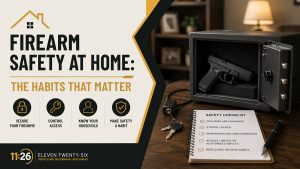
Equipment instruction covers a secure holster, belt support, concealment garment, spare ammunition storage where appropriate, eye and ear protection, and safe storage at home. The equipment must retain the firearm, cover the trigger guard, and permit a controlled draw and reholstering process.
| Carry method | Typical position or configuration | Main trade-off |
|---|---|---|
| IWB | Inside waistband, commonly hip or appendix position | Better concealment, with greater demands on fit and clothing |
| OWB | Outside waistband under a covering garment | Easier access and comfort, with greater printing risk |
| AIWB | Inside waistband near the appendix area | Strong concealment, requiring careful holster design and handling |
| Pocket holster | A dedicated holster inside a suitable pocket | Convenient for small handguns, with slower access and strict pocket-use limits |
| Off-body bag | Dedicated compartment in a purse or pack | Flexible clothing options, but the firearm can be separated from the carrier |
A holster should not collapse into the trigger guard, allow the firearm to shift freely, or require the student to place a finger near the trigger during the draw. A soft nylon pouch may look inexpensive, but poor retention and trigger protection can make it unsuitable for a loaded handgun.
How Should Students Test Concealment?
Students should test the unloaded firearm, holster, belt, and clothing together before carrying. They should walk, sit, bend, enter a vehicle, reach overhead, and check whether the grip or outline becomes visible during normal movement.
Printing is a concealment problem, not automatically a safety violation. However, printing can invite attention, reveal the carrier’s habits, or cause repeated adjustments that move the firearm. A practical instructor evaluates concealment during ordinary activity rather than only while standing still.
How Long and How Much Do Courses Take?
Typical state-approved permit classes last 4-16 hours and cost approximately $75-$150, while multistate-oriented programs often cost $120-$250 and advanced one- or two-day training commonly costs $250-$600 or more. These are typical market ranges, not universal prices, and application fees, ammunition, fingerprints, and range fees may be separate.
| Course format | Typical duration | Typical tuition | Primary purpose |
|---|---|---|---|
| State-mandated permit class | 4-16 hours | $75-$150 | Satisfy a state training requirement |
| Multistate permit seminar | 4-8 hours | $120-$250 | Explain selected reciprocity and application options |
| Beginner handgun fundamentals | 2-4 hours | $75-$175 | Build safe operation before permit instruction |
| Defensive handgun course | 1-2 days | $250-$600+ | Add movement, decision-making, and structured drills |
| Private coaching | 1-3 hours | $75-$200 per hour | Correct individual handling or accuracy problems |
Course length alone does not measure quality. A 16-hour class may devote most of its time to legal material and provide little range practice, while a shorter approved course may efficiently meet the legal standard but leave defensive skill gaps.
Does an Online Course Replace Range Training?
An online course can explain statutes, terminology, safety principles, and application steps, but it cannot reliably assess muzzle control, trigger-finger position, grip, or reholstering. Whether online instruction satisfies a permit requirement is determined by the issuing jurisdiction.
Hybrid courses can work well when classroom law is completed online and a qualified instructor conducts an in-person safety and shooting session. Students should obtain written confirmation from the permit authority or review the current official rule before paying for an online certificate.
How Should Beginners, Travelers, and Home Defenders Choose?
Beginners should prioritize supervised handgun fundamentals and a state-approved permit course. Frequent travelers should prioritize current reciprocity research and location-specific restrictions. Home defenders should seek a broader program that covers secure storage, family planning, communication, and lawful decision-making inside the home.
| Student profile | First training choice | Common mistake |
|---|---|---|
| New handgun owner | 2-4-hour fundamentals lesson plus approved permit class | Buying a carry handgun before learning safe operation |
| Experienced target shooter | Approved permit class plus concealment practice | Assuming accuracy on a square range equals defensive readiness |
| Frequent traveler | State-specific legal instruction and reciprocity research | Treating one permit as valid everywhere |
| Home-defense student | Storage, access control, identification, and emergency planning | Carrying the home-defense setup into public without testing it |
| Revolver owner | Instructor experienced with revolver operation and qualification rules | Assuming pistol drills transfer without modification |
A concealed carry permit is a legal authorization where issued, not a guarantee that a particular firearm, holster, or action is appropriate. Students should choose equipment after receiving instruction and testing an unloaded setup under normal clothing.
What Happens After a Defensive Firearm Incident?
After a defensive firearm incident, the immediate priorities are safety, emergency medical assistance, and contacting emergency services. The carrier should follow lawful instructions, identify themselves as the reporting party, avoid handling evidence unnecessarily, and request legal counsel before providing a detailed recorded statement.
Exact procedures vary, and instructors should not promise that one script protects every carrier. A course can explain general priorities, but a licensed attorney is the proper source for jurisdiction-specific advice about statements, searches, civil claims, and contact with investigators.
Students should also understand that the legal process may continue after criminal investigators leave. A defensive incident can involve witnesses, surveillance footage, medical records, property damage, civil litigation, and licensing review. Training should prepare students for responsibility, not present a defensive shooting as a simple pass-fail event.
How Can You Audit a Course Before Enrolling?
A quality audit should verify instructor authorization, state approval, live-fire requirements, class size, equipment rules, and the precise qualification standard. The provider should answer these questions in writing and identify costs beyond tuition.
Use this checklist before registration:
- Confirm the issuing authority recognizes the instructor or course.
- Ask whether the class includes live fire and how many rounds students need.
- Request the current written qualification standard and retest policy.
- Confirm whether pistol and revolver students follow the same or different procedures.
- Ask how the class handles unsafe conduct, medical needs, weather, and firearm stoppages.
- Check whether tuition includes targets, range fees, ammunition, and certification paperwork.
- Verify the instructor’s experience with beginners rather than relying on tactical branding.
- Determine whether legal material is state-specific and updated for current rules.
An oversized class can reduce individualized feedback. A very small class may cost more, but it often gives the instructor more time to correct grip, trigger control, and safe reholstering.
What Are Common Training Failures?
The most common failures are treating qualification as mastery, arriving with untested equipment, confusing reciprocity with universal permission, and practicing speed before safe handling. Each failure has a practical correction.
| Failure mode | Likely consequence | Correction |
|---|---|---|
| New firearm brought directly to class | Unfamiliar controls and avoidable stoppages | Take a fundamentals lesson and practice under supervision |
| Flimsy or poorly fitted holster | Trigger exposure, shifting, or unsafe reholstering | Use a rigid, trigger-covering holster designed for the firearm |
| Unlubricated or neglected firearm | Reliability problems during qualification | Follow the manufacturer’s maintenance guidance before class |
| Clothing never tested | Printing, garment interference, or entanglement | Practice unloaded movements while seated and standing |
| Reciprocity assumed | Unlawful carry across state lines | Check the destination’s official rules before travel |
| Speed prioritized over control | Sweeping, finger contact, or rushed reholstering | Reduce speed until every movement remains deliberate |
One practitioner rule is especially useful: reholstering should be slower than drawing. Most students gain little from forcing a fast return to the holster, while a rushed reholstering movement can create an avoidable negligent-discharge risk.
Another rule concerns equipment. A carry setup is a system, not a single product. A reliable handgun can still be difficult to carry safely if the belt, holster, clothing, seating position, and storage plan do not work together.
A final limitation deserves emphasis. A permit class is usually poor preparation for complex force-on-force judgment, low-light identification, physical contact, vehicle problems, or communication under stress. Those subjects require additional training, suitable facilities, and instructors who can manage safety during realistic exercises.
Frequently Asked Questions
Can I Take a CCW Class With a Revolver?
Many approved courses accept revolvers, but the qualification procedure and equipment rules vary by state and instructor. Contact the provider before enrollment, identify the revolver model and caliber, and ask whether the class teaches revolver-specific loading, unloading, cylinder management, and malfunction procedures.
How Many Rounds Are Needed for a Concealed Carry Class?
A typical class may require approximately 50-100 rounds for instruction and qualification, but the official number depends on the state and provider. Bring only the ammunition type approved for the firearm, and confirm whether the instructor requires additional rounds for practice or a retest.
Do I Need a Permit to Practice Concealed Carry Skills?
A person does not need a permit to practice safe handling with an unloaded firearm in an appropriate location, but carrying a loaded firearm in public is governed by state and local law. Training should occur at a lawful range or private location with a safe backstop and applicable property rules.
Are Concealed Carry Classes the Same as Defensive Pistol Classes?
Concealed carry classes and defensive pistol classes have different purposes. A permit course usually satisfies a legal education and qualification requirement, while a defensive pistol class may add decision-making, movement, low-light work, communication, and structured stress exercises.
When Should a Carrier Retake Training?
A carrier should consider refresher training after changing firearm platforms, adopting a new holster, experiencing a long practice gap, moving to another state, or discovering a safety or accuracy problem. Legal updates also justify reviewing current state rules, especially before interstate travel.
The Bottom Line
Concealed carry training course topics should cover safe handling, firearm operation, storage, carry equipment, state-specific law, defensive-force limits, live-fire qualification, and post-incident responsibilities. The right course depends on the student’s experience, firearm, state, and purpose.
A state-approved permit class can satisfy a legal prerequisite, but it may not develop complete defensive competence. Beginners should add fundamentals training, travelers should verify every destination’s rules, and experienced carriers should seek advanced instruction only after demonstrating consistent safety and control. Use the syllabus, instructor credentials, qualification standard, and total cost to compare courses before enrolling.