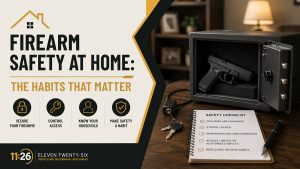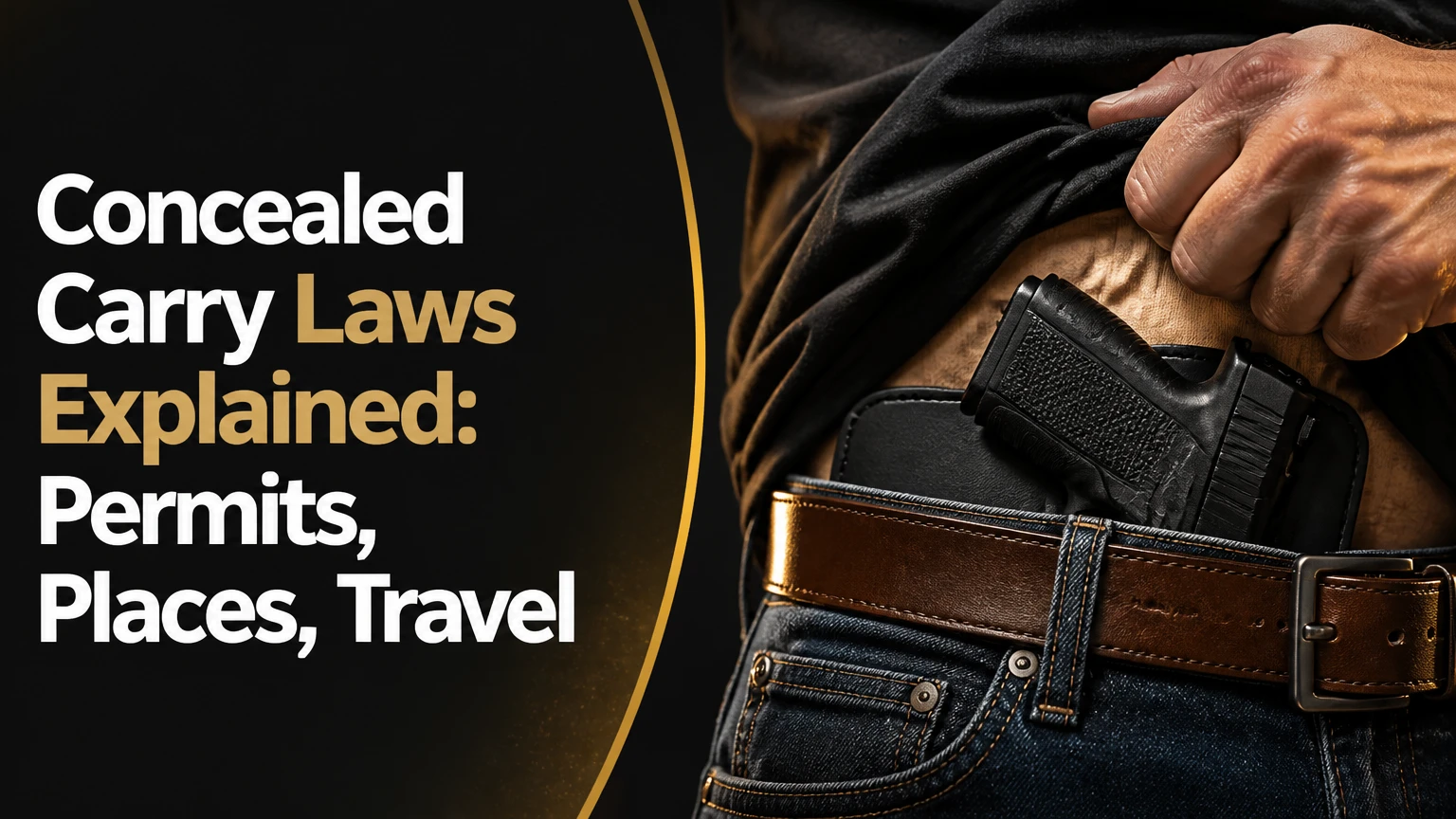
Concealed carry laws explained in practical terms: federal law determines who generally may possess firearms, while each state controls public carry, licensing, prohibited locations, and recognition of out-of-state permits. Since NYSRPA v. Bruen in 2022, states cannot require subjective “good cause,” but they may impose objective licensing rules and location restrictions.
Key Facts at a Glance
- A concealed carry permit authorizes concealed public carry only within the issuing state’s laws and the laws of states that recognize it.
- Permitless carry does not eliminate age limits, prohibited-person rules, restricted locations, private-property rules, or safe-storage duties.
- NYSRPA v. Bruen rejected discretionary “proper cause” requirements, not all permits or all location restrictions.
- Reciprocity is state-specific; a home-state permit, a nonresident permit, and permitless carry can produce different travel outcomes.
- A complete carry setup typically costs $400-$1,200 when firearm, holster, belt, training, ammunition, and fees are included.
- A rigid holster that fully covers the trigger guard is a safety requirement, regardless of whether a state requires a particular holster.
What Do Concealed Carry Laws Regulate?
Concealed carry laws regulate the public possession of a handgun or other weapon when ordinary observers cannot readily see it. Legal analysis usually separates four questions: whether the person may possess the firearm, whether the person may carry it in public, whether concealment requires a permit, and whether the specific location permits firearms.
“Concealed” does not mean invisible under every circumstance. A firearm may remain legally concealed when clothing briefly shifts, but a state may separately prohibit intentional display, brandishing, threatening conduct, or carrying in a way that alarms others. The statutory wording matters more than informal labels such as “printing.”
Federal law supplies the baseline. The Bureau of Alcohol, Tobacco, Firearms and Explosives explains federal prohibitions involving categories such as certain felony convictions, qualifying domestic-violence convictions, unlawful controlled-substance use, fugitive status, and some restraining orders. State law may add disqualifiers, impose waiting periods, or regulate public carry more strictly.
A permit is not a national license. The issuing state cannot authorize conduct that violates another state’s law, and an out-of-state permit does not automatically override a business’s private-property policy.
What Did NYSRPA v. Bruen Change?
NYSRPA v. Bruen held that New York’s discretionary “proper cause” requirement for a public-carry license violated the Second and Fourteenth Amendments. The Supreme Court’s opinion stated that the Second Amendment protects carrying handguns publicly for self-defense, but the decision did not require every state to allow unlicensed carry or prohibit objective licensing systems.
The legal test changed. Courts must examine whether a modern firearm restriction is consistent with the nation’s historical tradition of firearm regulation, rather than balancing the restriction against an interest in public safety under the approach used by many lower courts before Bruen.
Justice Thomas wrote that “the Second Amendment guarantees an individual right to possess and carry weapons in case of confrontation.” That quotation describes the constitutional right recognized by the Court, not a promise that every public place is open to firearms.
After Bruen, states such as New York, California, and Hawaii retained licensing systems but revised eligibility standards and expanded sensitive-location rules. Those revisions have generated continuing litigation. A court ruling affecting one provision does not automatically invalidate every rule in that state.
How Do Permit Systems Work?
Four labels describe the main state frameworks, although actual statutes often combine features from more than one category.
| Framework | Basic rule | Training and age pattern | Permit value |
|---|---|---|---|
| Permitless carry | Eligible adults may carry without a carry permit | Often 18 or 21, with state-specific training rules | May improve reciprocity and simplify travel |
| Shall-issue | Agency must issue after objective requirements are met | Background check, application, fee, and often training | Creates documented authority where required |
| Discretionary or historical may-issue | Agency once evaluated subjective need or good cause | Standards varied by county or official | Pure subjective denial is generally vulnerable after Bruen |
| Reciprocity | One state recognizes another state’s permit | Depends on the receiving state’s statute or agreement | Recognition varies by permit type and resident status |
Is Permitless Carry the Same in Every State?
Permitless carry is not a single national rule. Common differences include minimum age, whether the person must be a resident, whether a permit is still needed inside vehicles, whether schools and alcohol-serving premises are restricted, and whether carrying while intoxicated is a separate offense.
As of 2026, commonly cited state counts place permitless-carry jurisdictions at approximately 29, but totals vary when constitutional provisions, effective dates, restricted age groups, and special permit requirements are counted differently. A person should verify the current statute through the state police, attorney general, or legislative website rather than rely on a national map.
Permitless carry also does not mean “carry without a background check.” A state may omit a carry-permit application while federal and state law still regulate firearm purchases and prohibit possession by disqualified people. A permit can remain useful for reciprocity, streamlined purchase procedures, recognition of legal protection, or access to locations where permit holders receive different treatment.
What Is the Difference Between Shall-Issue and May-Issue?
A shall-issue state uses objective criteria, such as age, residency, training, fingerprints, and a background check, while a may-issue system historically allowed an official to deny an otherwise qualified applicant for lack of special need. After Bruen, pure subjective “good cause” licensing requirements are constitutionally suspect.
Modern statutes may still give licensing agencies time to investigate identity, criminal history, mental-health records, or incomplete applications. That administrative investigation is different from discretionary power to deny a qualified applicant because the official does not accept the applicant’s reason for carrying.
How Do You Apply for a Concealed Carry Permit?
A typical application takes five steps: confirm eligibility, complete required training, submit the application and fingerprints, pass state and federal checks, and receive or challenge the agency’s decision. Processing commonly takes 30-120 days, while fees and training requirements vary sharply by state and county.
Step 1: Check Eligibility
Review the state’s age, residency, citizenship, criminal-history, domestic-violence, substance-use, and mental-health rules before paying for a class. A conviction that is not a federal prohibition may still disqualify an applicant under state law.
Do not assume an expungement, pardon, deferred judgment, sealed record, or restored civil right has the same effect in every jurisdiction. Written advice from a firearms attorney is appropriate when the record includes a felony, domestic-violence allegation, protective order, involuntary commitment, or pending charge.
Step 2: Complete Approved Training
State-approved courses commonly range from 4-16 hours and may include firearm safety, storage, use-of-force law, live fire, and a qualification test. Online-only courses may be insufficient even when they advertise national recognition.
Training is legally separate from competence. A permit class can satisfy a statute without teaching enough repetition for safe handling under stress. A responsible owner should add supervised practice, malfunction procedures, safe holstering, judgment exercises, and periodic refresher training.
Step 3: Submit Documents and Fingerprints
Applications commonly require government identification, proof of residency, a training certificate, passport-style photographs, fingerprints, and a fee. The issuing office may be a state police agency, county sheriff, municipal police department, or online state portal.
Answer every question accurately. A false statement can create a new criminal problem even when the original record would not have disqualified the applicant.
Step 4: Complete Background Checks
The agency may query the FBI’s National Instant Criminal Background Check System, state criminal-history databases, protection-order records, and mental-health records authorized for release under applicable law. A delayed check is not necessarily a denial.
Applicants should preserve the receipt, tracking number, training certificate, and agency correspondence. Those records help identify whether a delay results from missing fingerprints, an incomplete record, or a statutory investigation period.
Step 5: Review the Permit and Renewal Date
Check the name, photograph, expiration date, resident status, and any restrictions when the permit arrives. Permit validity commonly lasts 2-5 years, although some states issue longer permits or offer optional extended terms.
A permit does not replace continuing legal research. Renewal deadlines, address changes, duty-to-inform rules, and reciprocity lists can change while the physical card remains valid.
What Does a Permit and Carry Setup Cost?
A typical permit application costs $40-$200, mandatory training costs $50-$300, and fingerprinting costs $10-$100. A complete entry-level setup often costs $400-$1,200 after adding a reliable handgun, rigid holster, belt, ammunition, secure storage, and practice.
| Expense | Lower typical range | Higher typical range | Main cost driver |
|---|---|---|---|
| Application fee | $40 | $200 | State and local agency |
| Fingerprinting | $10 | $100 | Vendor and processing method |
| Required training | $50 | $300 | Course length and live fire |
| Handgun | $300 | $800 | Manufacturer, size, optics |
| Rigid holster | $40 | $180 | Material, retention, carry position |
| Ammunition and practice | $75 | $250 | Defensive and range ammunition |
| Lockbox or safe | $40 | $400 | Portable versus anchored storage |
A California-style local process may exceed $400 before firearm and storage costs, while a permitless Texas resident may spend nothing on a carry license but still benefit from optional training and a permit for interstate recognition. Those examples are cost illustrations, not current quotations for every county or applicant.
The least visible cost is continuing practice. A new owner who fires 100-200 rounds during initial familiarization and repeats a structured session every few months may spend more on ammunition than on the permit over several years.
Where Is Concealed Carry Prohibited?
Concealed carry is commonly restricted in schools, courthouses, police facilities, secured airport areas, federal buildings, and posted private businesses, but the exact list depends on the controlling jurisdiction. A permit rarely overrides a prohibited-location statute.
| Location | Common controlling authority | Typical legal issue |
|---|---|---|
| K-12 school | State statute and federal Gun-Free School Zones Act | Exceptions may depend on permit, distance, and school activity |
| Federal courthouse | Federal law and court rules | Firearms are generally prohibited in federal court facilities |
| Post office | 18 U.S.C. § 930 and USPS regulation | Public postal property rules differ from ordinary private property |
| Airport checkpoint | Federal aviation and airport rules | TSA security areas prohibit firearms; checked transport follows TSA rules |
| State courthouse | State statute and judicial order | Screening, lockers, and total bans vary |
| Private business | State trespass and firearm signage law | Notice method and penalties differ by state |
| Bar or restaurant | State alcohol and firearms statute | Some states use alcohol percentage, revenue, or possession rules |
| Polling place | State election law | Restrictions may apply only during voting or within a defined distance |
Federal law is especially important at federal facilities. The U.S. Postal Service’s rule generally prohibits firearms on postal property, and TSA requires unloaded firearms to be locked in checked baggage, declared to the airline, and never placed in carry-on baggage.
Private-property rules deserve separate attention. In one state, a sign may have to meet a specified size or wording requirement; in another, an owner’s oral instruction may be enough to create trespass liability. Leaving after notice usually matters even when the initial entry was not itself a firearms offense.
Are Schools, Bars, and Government Buildings Always Off Limits?
No universal answer exists. State statutes can create exceptions for permit holders, private vehicles, school-approved individuals, security personnel, or unloaded firearms in locked containers, while another state can prohibit the same conduct without exception.
Alcohol creates two separate questions: whether the location is restricted and whether the carrier is impaired. A person may violate an intoxication statute, negligent-storage rule, or use-of-force principle even where the premises itself is not categorically off limits.
How Does Reciprocity Work?
Reciprocity means that a receiving state recognizes an out-of-state concealed-carry permit under specified conditions. Recognition may depend on permit type, permit holder age, residency, vehicle status, weapon type, notification duties, and whether the visitor obeys the receiving state’s location rules.
| Reciprocity category | Example outcome | Verification needed |
|---|---|---|
| Broad recognition | State honors many resident permits | Confirm age and permit validity |
| Conditional recognition | State recognizes permits from states meeting defined standards | Compare training, age, and background rules |
| Resident-only recognition | Nonresident permits may not qualify | Check issuing-state residency |
| No general recognition | Visitor cannot rely on an out-of-state permit | Review state application or transport rules |
| Permitless visitor carry | State permits some nonresidents to carry without a permit | Confirm age, prohibited-person, and location rules |
A Florida or Utah nonresident permit can expand recognition in some states, but it does not grant nationwide authority. A receiving state may recognize a Utah resident permit while rejecting a Utah nonresident permit, or may impose a higher minimum age than the issuing state.
Use the receiving state’s official statute or law-enforcement guidance first. Private reciprocity maps are useful research tools, but they can lag legislative amendments, attorney-general opinions, injunctions, and emergency orders.
What Should You Do Before Crossing a State Line?
Before interstate travel, identify every jurisdiction where the firearm will be carried, stored, or transported, then verify permit recognition, prohibited locations, vehicle rules, magazine restrictions, ammunition limits, and notification requirements. Recheck the rules immediately before departure because reciprocity can change during litigation or legislative sessions.
A practical travel file should contain:
- The current permit and a government photo ID.
- Official links or saved copies of each state’s relevant statutes.
- A route map identifying schools, courthouses, federal facilities, and airport handling points.
- A locked container, separate ammunition storage where required, and a vehicle plan.
- A written decision not to carry if any rule remains unclear.
The federal Firearm Owners’ Protection Act includes a safe-passage provision for transporting an otherwise lawful firearm between places where possession is lawful. That provision is not a universal immunity from arrest, and courts have differed over how it interacts with stops, unnecessary interruptions, local transport rules, and readily accessible firearms.
The safest travel strategy is conservative. Transport unloaded and locked when the law permits, avoid unnecessary stops with the firearm accessible, and never carry into a state whose rules you have not verified.
How Should a Person Carry Safely?
A safe concealed-carry method keeps the firearm secured, keeps the trigger covered, preserves control of the weapon, and allows the carrier to reholster without placing fingers or objects near the trigger. Carry position should follow the person’s body shape, clothing, vehicle use, training, and ability to maintain muzzle discipline.
| Carry method | Typical concealment | Main advantage | Main limitation |
|---|---|---|---|
| IWB, 3-5 o’clock | Shirt or jacket | Stable waist control and broad comfort range | Belt and clothing must support the weight |
| AIWB, front position | Untucked shirt or overshirt | Strong concealment and consistent access | Requires careful holstering and sitting adjustment |
| OWB under cover garment | Jacket or long shirt | Comfortable draw and less waistband pressure | Greater exposure risk when clothing shifts |
| Dedicated off-body bag | Purse, sling, or compartment | Works with clothing that cannot support a belt | Bag theft, access delay, and poor control |
| Pocket holster | Pocket-sized handgun | Simple for limited clothing situations | Must prevent trigger contact and holster movement |
A holster should be rigid enough to retain its shape, cover the entire trigger guard, prevent the firearm from moving inside the holster, and remain attached during the draw. A loose pocket gun or soft pouch that allows trigger access creates a negligent-discharge risk regardless of the owner’s experience.
Off-body carry is not inherently unlawful, but it requires continuous possession or secure control. A purse left on a restaurant chair, a backpack placed in an unattended vehicle, or a bag accessible to a child creates both safety and possible storage-law problems.
What If the Gun Prints or Briefly Shows?
A brief outline through clothing is not automatically brandishing. Legal consequences depend on the state’s definition of concealed carry, intentional display, threatening conduct, public alarm, and whether the carrier knowingly exposed the firearm.
Correct the equipment or clothing problem rather than repeatedly adjusting the gun in public. A concealment wing, a stronger belt, a different shirt cut, or a smaller firearm may reduce printing, but no accessory compensates for poor holster retention or unsafe handling.
What Are the Most Common Legal Mistakes?
The most common concealed-carry violations result from assuming that a valid permit answers every legal question. It does not. The permit addresses authorization under particular conditions, while location, vehicle, alcohol, private-property, storage, and interstate rules remain separate.
Mistake 1: Treating a Reciprocity Map as the Law
Maps can become outdated after statutory amendments or court orders. Confirm the receiving state’s official source and save the date of your research.
Mistake 2: Entering a Restricted Building
Many carriers check state reciprocity but forget that federal buildings, courtrooms, postal property, and secured airport zones have separate rules. Leave the firearm secured before approaching screening.
Mistake 3: Confusing Printing With a License to Display
Printing may be harmless in one jurisdiction and evidence of intentional exposure in another. Do not touch, lift, or reposition clothing around the firearm in a crowd.
Mistake 4: Carrying Without a Complete Trigger Cover
A trigger must remain protected during carry, loading, unloading, storage, and movement. A quality firearm with an unsuitable holster is an unsafe system.
Mistake 5: Assuming Permitless Carry Removes Training Duties
A statute may remove mandatory training while leaving the carrier exposed to negligence, unsafe-storage, or use-of-force consequences. Voluntary training remains a practical legal-risk reduction.
Mistake 6: Forgetting Duty-to-Inform Rules
Some states require a person carrying a firearm to disclose that fact during a law-enforcement encounter. Others do not, and some require disclosure only when asked. Learn the exact rule before carrying, rather than improvising during a traffic stop.
How Does Concealed Carry Compare With Other Options?
Concealed carry is the most legally complex common carry choice because the person must satisfy possession, public-carry, concealment, location, and travel rules simultaneously. Open carry may reduce concealment questions but can create different location, public-display, and business-policy issues.
| Option | Access pattern | Legal burden | Suitable limitation |
|---|---|---|---|
| Concealed handgun | Clothing-covered access | Permit, location, printing, reciprocity rules | Requires consistent clothing and holster |
| Open handgun | Visible access | Open-display and sensitive-place rules | May attract attention or violate local law |
| Locked transport | Inaccessible during travel | Vehicle, container, and route rules | Not a ready-access carry method |
| No firearm | No firearm-related carry violations | No permit or equipment burden | Does not provide armed protection |
| Professional security | Trained, regulated carry | Employer, licensing, and jurisdiction rules | Not available for ordinary personal carry |
There is no legal advantage in choosing a larger firearm that cannot remain concealed or controlled. Conversely, a small handgun can be harder to operate safely because reduced grip area and shorter sight radius demand more deliberate practice.
What Are the Important Limits of This Guidance?
A national explanation cannot determine whether a particular person may carry in a particular place. State statutes, municipal rules, tribal jurisdiction, federal property rules, court orders, permit conditions, and facts about the carrier can change the outcome.
This guide is educational, not individualized legal advice. A qualified attorney should review any situation involving a criminal record, domestic-violence history, mental-health commitment, protective order, immigration status, juvenile record, pending charge, or planned travel through multiple restrictive jurisdictions.
Legal status also does not answer the use-of-force question. Defensive-force law generally turns on imminence, necessity, proportionality, reasonable belief, and state-specific doctrine. Carrying a firearm does not create permission to display or use it merely because another person is rude, trespassing, insulting, or recording.
Frequently Asked Questions
Can a nonresident carry in a permitless-carry state?
Often, but not always. Some permitless-carry statutes apply to nonresidents who meet the state’s age and eligibility rules, while others impose residency or permit conditions. A visitor must also follow location, vehicle, prohibited-person, and private-property rules. Confirm the statute for the specific state before carrying across its border.
Does a concealed carry permit allow open carry?
Not automatically. Some states issue one permit for both methods, some regulate open and concealed carry separately, and some allow open carry without a permit but require a license for concealment. A permit holder should check the issuing state and every destination state rather than infer one authorization from another.
Can a person carry a loaded firearm in a vehicle?
Vehicle rules vary by state and by whether the person has a recognized permit. Some jurisdictions allow loaded concealed carry in a vehicle, some restrict access or placement, and others require unloaded transport in a locked container. Federal safe-passage rules do not erase local vehicle regulations or prohibited-person restrictions.
Is a concealed carry permit required to buy a handgun?
Usually no. Purchase eligibility and public-carry authorization are separate legal questions. Federal and state purchase laws may require a dealer background check, waiting period, permit, or additional documentation, while a carry permit may be issued by a different agency under different standards.
Can a person carry on private property?
The answer depends on the owner’s policy and state notice law. Some states require a prescribed sign or direct notice before criminal penalties apply, while others allow an owner to prohibit firearms through oral instruction or general trespass rules. A carrier should leave immediately when the owner or authorized employee gives notice.
How often should concealed-carry training be renewed?
The legal requirement may be only once, at renewal, or not at all in a permitless state. A practical baseline is a supervised skills session at least twice yearly, with dry-practice habits conducted only after the firearm is unloaded and the practice area is isolated. Formal defensive-law instruction should be refreshed when laws change.
The Bottom Line
Concealed carry laws explained accurately require more than a list of permitless states. The controlling questions are whether the person may possess the firearm, whether the state requires a permit, whether the destination recognizes that permit, whether the location is restricted, and whether the carrier complies with storage, notification, vehicle, and use-of-force rules.
NYSRPA v. Bruen removed subjective “good cause” barriers, but it did not create a nationwide carry permit or eliminate state regulation. Verify current official sources before carrying, use a rigid trigger-covering holster, obtain training even when optional, and treat every state line and restricted building as a separate legal research task.